| Author |
 Replies: 11 / Views: 2,830 Replies: 11 / Views: 2,830 |
|
|
Valued Member
United States
321 Posts |
I am an American collector getting into UK coins, specifically Maundy Money. I mean, what's not cool about collecting coins with mintages in the several thousands and directly associated with the ruler of Great Britain? Why be another collector of Morgan dollars or whatever when you can collect something different, something fairly unknown to most US collectors? There are so many coins in the Maundy series that date back centuries and searching for specific years and denominations can actually be a hard task, because of how few pieces are out there. It just defines the "challenge of the hunt", because there are literally hundreds, maybe even over a thousand coins to obtain for a "complete" set, with four new ones coming out every year. I just ordered my first Maundy piece in the mail yesterday, an 1839 fourpence. I will post pictures when I get it in hand in a few weeks, but it is a nice problem-free Fine and it cost $14 US or about £10.75 UK. Is anyone else on this forum into this area of collecting? Edited by Omegaraptor
08/07/2017 5:54 pm
|
|
|
|
Bedrock of the Community
United Kingdom
18946 Posts |
Hi Omegaraptor
I like Maundy coins. I've got a few complete sets: George IV, Victoria Young Head, Victoria Veiled Head and Edward VII, plus various singles. I agree - they're very historic coins with a great story behind them!
|
|
Valued Member
Canada
68 Posts |
I'm collecting circulation silver pennies, so up to 1800. From 1797, my penny collection turns to copper then bronze. However, a mid1800's Victoria has crept into the collection, don't know how....
Are they still considered 'maundy' money if they were circulation coins?
|
|
Pillar of the Community
United Kingdom
2624 Posts |
Well I don't have many...just two sets, and no good photo's to hand. One set is from Victoria and the other from Elizabeth as part of a millennium set of all silver coins. 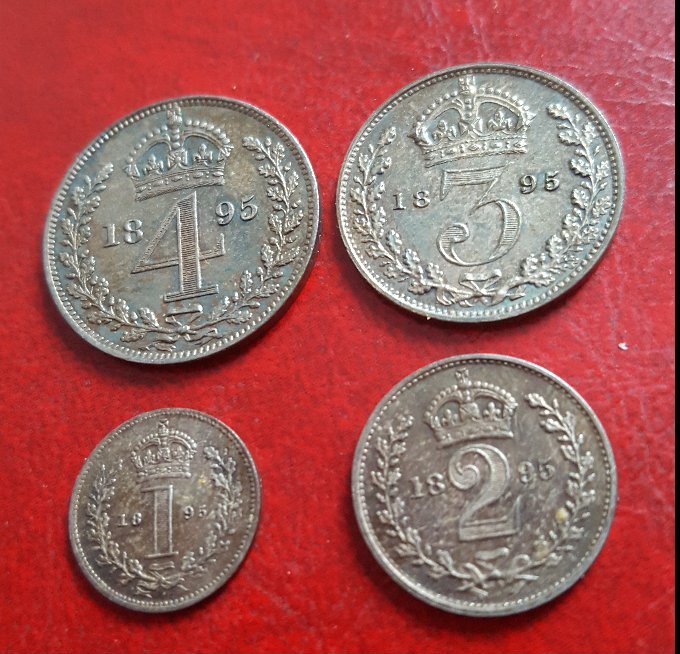 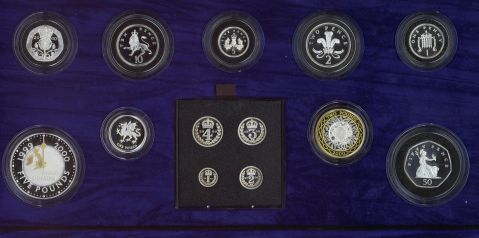 |
|
Valued Member
 United States
321 Posts |
Quote:
Are they still considered 'maundy' money if they were circulation coins? Yup! That silver penny was likely handed out at the Maundy ceremony. Any penny or fourpence with the Maundy design is a Maundy coin. Twopences and threepences are a bit more complicated, but I can explain them if you want me to. |
|
Valued Member
Canada
68 Posts |
Omegaraptor, I'd love to read your explanation. I've read that the penny was issued only as maundy as early as 1759 or as late as 1800. But these were online sources (not wiki...). I wonder which is correct?
|
|
Pillar of the Community
United Kingdom
2624 Posts |
Maundy sets are distributed to as many old men and women as the monarch has years... so o the monarchs 40th birthday 40men and 40 women get a set (10 pence per set)this happens on Maundy Thursday (the day before good Friday)
The earliest set I have listed is 1763. Though 1670 was the first time a set of coins sharing the same date appears and the ceremony where the monarch washes the feet of the poor started in 1400's. Charles II gave money out in 1662 but they started with circulation coinage...before then it was gifts.
The three pence shared its design with circulation coinage, the others were not seen... they are still officially legal tender but never see circulation.
Edited by DavidUK
08/08/2017 08:22 am
|
|
Pillar of the Community
Russian Federation
5186 Posts |
Quote:
Any penny or fourpence with the Maundy design is a Maundy coin. I wonder if that makes my 1699 fourpence a Maundy coin as well... |
|
Bedrock of the Community
Australia
21792 Posts |
I have 23 pieces of small English / British silver, which includes 1 1/2 pence (penny ha'pennies), and Britannia groats. Some of the earlier coins are:- Charles 1 silver penny (no date, but 1670 or before), 1679 two pence and four pence, 1687 threepence, 1689 threepence, 1703 penny, 1800 two pence, 1827 four pence. Most of these are holed, condition VG to Fine, which can be quite common for the earlier dates, because they were used for jewelry much like earlier American Half Dimes and silver Three Cents. (I have a few of these as well, most of which are also holed). All but one of the the later dates are Victorian or Edwardian, with only one Elizabeth 11 threepence, in mint state. There is some doubt that all of the earlier dates of Maundy Money actually were purely Maundy Money, because most of the earlier dated coins turn up with lots of wear, indicating that the poor to whom they were issued, actually used them as money, and then continued to circulate. Modern Maundy money is strictly NCLT. I also had a complete type set of English / British shillings, Charles 1 to Elizabeth 11, (Fine to Unc), but I gave that set to my son. (Only missing Dorien & Magens, and Northumberland). ---------------------------------------------------------------------------------------------------------------------------------------------------------------------------------------- Trout1105 is actively collecting Maundy sets and has all dates of Edward V11 except two, but is finding it very difficult to find the 1908 and 1909 four coin sets. |
|
Valued Member
United States
321 Posts |
Quote:
Omegaraptor, I'd love to read your explanation. I've read that the penny was issued only as maundy as early as 1759 or as late as 1800. But these were online sources (not wiki...). I wonder which is correct? Okay, here's the explanation. About the pennies and fourpence, before 1822, regular coins were used for the ceremony. As such, all pennies, twopence, threepence, and fourpence from this time are sometimes referred to as "Maundy", and often collected as such, even though they almost always aren't. Twopence: Most twopence with the Maundy design post-1822 are Maundy. However, there are three dates in specific to look out for: 1838, 1843, and 1848. Circulation twopences were minted with the Maundy design in these dates: about 1045000 of the 1838, about 903000 of the 1843, and about 261000 of the 1848. If you see one of these three dates marked as "Maundy", be wary. Threepence: This is by far the toughest one to crack, as all threepences made before 1926 actually use the Maundy design! Don't buy a threepence before 1926 that is marked as Maundy unless you are absolutely sure it is (i.e. in a set). |
|
Valued Member
Canada
68 Posts |
Thanks for that Omegaraptor, although I'm confused a little about the 'Maundy design' - weren't they all the same after Charles II's interlinked C's?
My only complete set is 1763. The coins exhibit different degrees of wear and patina, which suggests to me that they were assembled from circulation coins rather than an uncirculated "maundy set"; does that sound right? I hope so, it makes the coins more interesting to me!
|
|
Pillar of the Community
United Kingdom
1324 Posts |
Some notes on the maundy coins... Quote:
Beginning in 1699 the monarch did not attend the service, sending an official in his place. In 1931 Princess Marie Louise was at Royal Maundy, and afterwards suggested that her cousin, King George V, make the distributions the following year, which he did, beginning a new royal custom. https://en.wikipedia.org/wiki/Royal_MaundyAlso, it is only from 1909 that the coins were restricted to the maundy service itself, prior to this you could order sets from the banks.... |
| |
Replies: 11 / Views: 2,830 |
|










 Posted 08/07/2017 7:06 pm


