| Author |
 Replies: 860 / Views: 49,701 Replies: 860 / Views: 49,701 |
|
|
|
Moderator
 United States
194606 Posts |
Quote:
In line with several other members of the classic era of US commemorative coins, the 1936 Bridgeport, Connecticut Half Dollar combines historical realism and allegorical symbolism... Excellent example!  |
|
Bedrock of the Community
United States
78271 Posts |
Nice example. Errers and Varietys.
|
|
Moderator
United States
105295 Posts |
nice one commems |
|
CCF Master Historian of USA Commemoratives
United States
12497 Posts |
The 1936 Albany Charter 250th Anniversary Half Dollar is another "mixed" example from the classic era of United States ("US") commemorative coins. The coin's obverse presents a Beaver - an allegorical representation of the City of Albany, New York - gnawing on a maple tree branch symbolic of the vast number of maple trees in New York (the Sugar Maple has been the official State Tree since 1956) and the tree's important multi-faceted role in the State's early development. The reverse depicts a romanticized view of an historical event - Governor Thomas Dongan (left) shaking hands with Peter Schuyler after he presented the city's charter to him (the Charter is the rolled-up document being held by Schuyler). Allegorically, a small pine tree with its branches and pine cones clearly evident is presented behind Dongan. The lumber industry was of primary importance to Albany in its early history - along with beaver pelts - with many pine trees being felled to make the lumber needed to build a growing community. 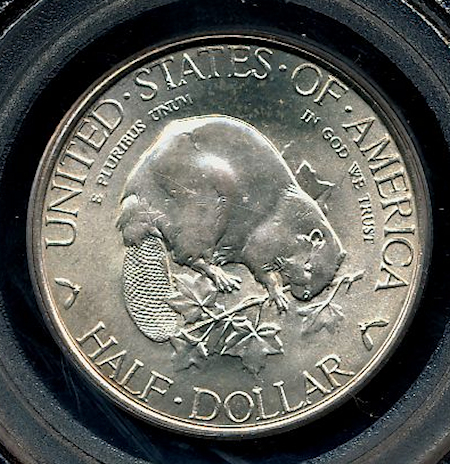 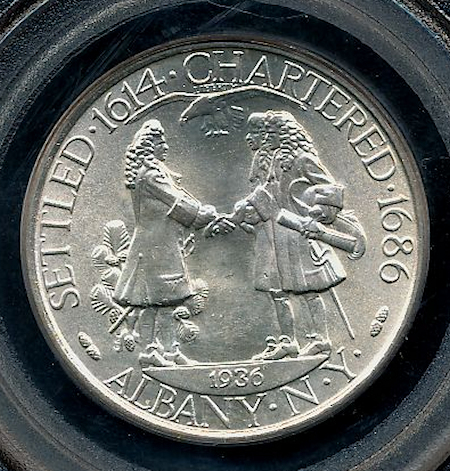 Collecting history one coin or medal at a time! (c) commems. All rights reserved.
|
|
Bedrock of the Community
United States
78271 Posts |
Very nice! Errers and Varietys.
|
|
Moderator
United States
105295 Posts |
very nice addition. |
|
CCF Master Historian of USA Commemoratives
United States
12497 Posts |
Next, a look at the 1936 Elgin, Illinois Centennial Half Dollar: The Elgin half dollar is a coin that uses its obverse and reverse design elements as allegorical symbolism representing the pioneer spirit inherent in those who made their way to the American West. The obverse depicts the left-facing portrait of a represntative pioneer meant to symbolize all pioneers, while the reverse presents a pioneer family as depicted in the Pioneer Memorial statue (the statue that was commissioned for the Elgin Centennial; but faced funding issues and was not dedicated in Elgin until 2001). The coin and statue were designed/sculkpted by Trygve Rovelstad. 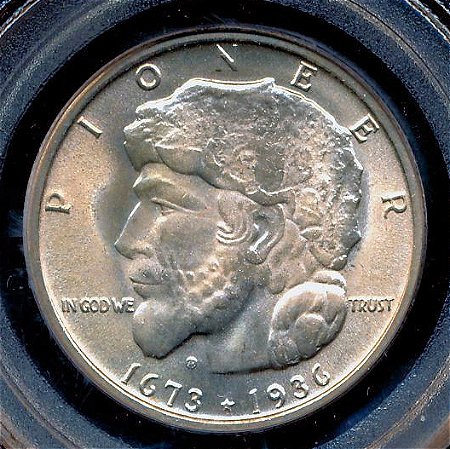 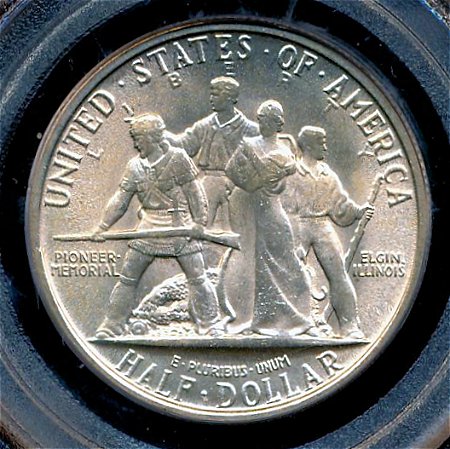 Collecting history one coin or medal at a time! (c) commems. All rights reserved.
|
|
Bedrock of the Community
United States
78271 Posts |
Nice addition. Errers and Varietys.
|
|
Moderator
United States
105295 Posts |
another fine looking coin!
|
|
Moderator
United States
194606 Posts |
Nice examples and explanations, commems! |
|
CCF Master Historian of USA Commemoratives
United States
12497 Posts |
Next up, the 1936 San Francisco-Oakland Bay Bridge Opening Half Dollar: The Bay Bridge half dollar makes use of allegory on each of its sides. On the obverse, a grizzly bear is used to symbolize California, while the reverse depicts the new bridge and represents the engineering prowess (circa 1936) involved in its design and construction - it is meant to represent more than just the bridge itself. 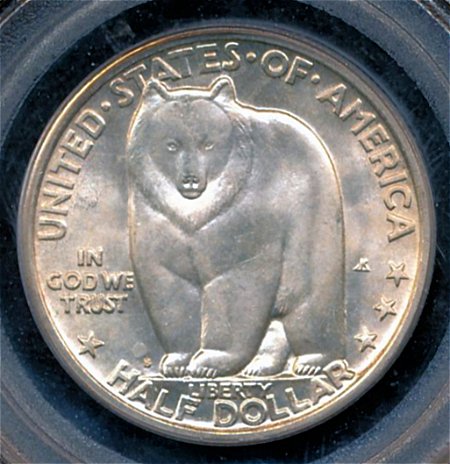 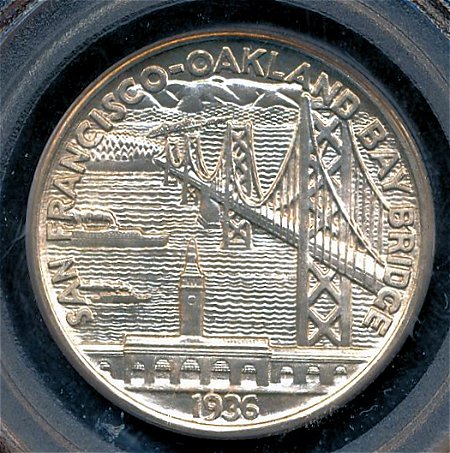 Collecting history one coin or medal at a time! (c) commems. All rights reserved.
|
|
Bedrock of the Community
United States
78271 Posts |
Nice one, commems! Errers and Varietys.
|
|
Moderator
United States
194606 Posts |
Quote:
Next up, the 1936 San Francisco-Oakland Bay Bridge Opening Half Dollar: Fantastic! |
|
Moderator
United States
105295 Posts |
excellent commemorative half - looking close, you can see Treasure Island, and the continuation of the bridge on the 'Oakland' side of the Bay.
|
|
CCF Master Historian of USA Commemoratives
United States
12497 Posts |
And now, the 1936 Columbia, South Carolina Sesquicentennial Half Dollar: Allegorical elements are found on each side of the Columbia, SC half dollar. On the obverse, the allegorical figure of Lady Justice is found; she is based on the Greek goddess Dike and/or the Roman goddess Justitia - each a personification of human justice. On the coin, Lady Justice, is depicted holding a balance scale in her upraised left hand while holding a sword, pointed down, in her right hand. The pans of the scale are level, indicating fair and equitable treatment for all under the law. The sword is symbolic of the enforcability of the law; it is a double-sided sword which indicates that it will defend and protect either party in a dispute. It is also shown positioned below the scales, which is meant to indicate that the law is enforced after the evidence is weighed and not before. The coin's reverse design is dominated by a Palmetto tree, which is being used to symbolize South Carolina. The Palmetto tree, and its strength, is a popular symbol of South Carolina - historically and currently. The Palmetto tree is the State Tree of South Carolina - officially referred to as a Sabal Palm tree, At the base of the tree is seen a broken branch from an oak tree. This is meant to symbolize how the South Carolina fort on Sullivan's island (built using Palmetto tree wood) protected Charleston against the British and outlasted the onslaught of the British ships which were constructed from the wood of oak trees. 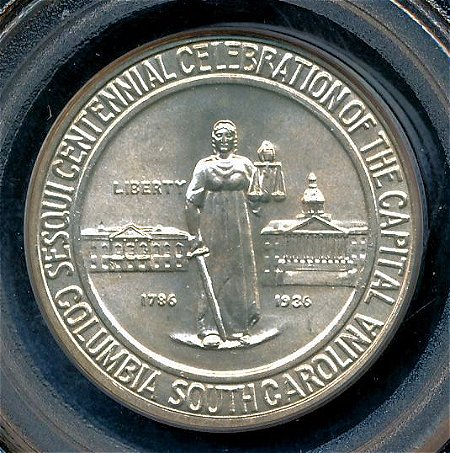 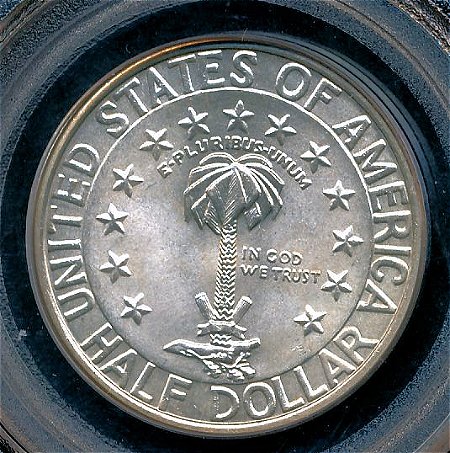 Collecting history one coin or medal at a time! (c) commems. All rights reserved.
|
| |
Replies: 860 / Views: 49,701 |






 First Page
 Previous Page


 Posted 10/31/2025 11:51 am





