| Author |
 Replies: 38 / Views: 10,391 Replies: 38 / Views: 10,391 |
|
|
|
Pillar of the Community
Canada
1046 Posts |
|
|
Pillar of the Community
United States
840 Posts |
The coinsandcanada site is a good introductionary site to introduce one to the vast realm of Cananian coins.
The thread mentioned above documents some six die-cracks of the 1854 1/2 penny series, but this is merely the tip of the iceberg.
And the site does not reference any specific Dr. Courteau variety for the die-cracks.
Below is my cut and paste of my shortcut which contains a somewhat more extensive listing.
The listing below is not complete as this listing contains only the die-cracks of this series of which I am privy to.
From this listing I can quickly narrow my search and then compare the die-cracks to my known ensamples.
Dr. Courteau's initial work on the St. George series is vague concerning die-cracks. For ensample, on the 1850 1/2 penny series, Dr. Courteau mentions some 37 varieties having a die-crack to the "F" in HALF, but provides scant or no data concerning the track or placement of the specific die-crack. Also, Dr. Courteau often uses the phrase "several die-cracks, especially..." and proceeds to identify only one or two of the die-cracks (some ensamples have upwards to a dozen).
For now, one can use my short-cut and then utilize Dr. Courteau's narrative to further identify the variety....
Or be patient. Given time, this information will be readily available.
Cut and paste:
1854 ONE HALF PENNY
Die-Cracks Obverse
Numeral 1 120, 127, 138, 143.
Numeral 8 131, 154.
Numerals 854 131.
Numeral 4 125, 150 (x2).
Numeral 5 113, 146.
Thru Date 116, 141, 141-1.
B in BANK 114, 117, 122, 130, 141.
Betwixt B/A in BANK 137.
BA in BANK 131.
A in BANK 125, 131, 142 (x2), 156, 157.
N in BANK 119, 124, 148, 150.
K in BANK 112, 118, 120, 121, 122, 127, 130, 139, 140, 141, 150, 158.
thru BANK 117, 126.
O in OF 125, 146.
Betwixt O and F 131.
F in OF 114, 124, 146, 147.
Thru F UPPER CANADA 122, 131.
Betwixt F in OF and you 121.
To Mantle 113, 116, 122, 130, 132, 138, 147, 148, 151, 152.
Man's right Hand 147, 151.
U in UPPER 113, 118, 123, 143, 147, 148.
1st P in UPPER 112, 120, 121, 125, 128, 140.
1st P to Helmet 126, 140.
2nd P in UPPER 119, 122, 124, 142, 153.
Betwixt PE in UPPER 132.
R in UPPER 120, 137, 151.
PER C in UPPER CANADA 132.
PER CANADA 143.
UPPER CANADA 137.
From Horse to C 128.
C in CANADA 131.
1st A in CANADA 138.
N in CANADA 119, 120, 122, 128, 133, 139, 142, 143, 148, 150.
2nd A in CANADA 114, 118, 149, 150.
D in CANADA 129, 139, 146.
3rd A in CANADA 119, 122, 124, 126, 127, 137 (x2), 138, 147, 148, 151, 156.
CANAD in CANADA 120.
Thru Ankles of Horse 126, 140.
Right ground 116, 120, 123, 128, 130, 140, 153.
Left ground 116, 124, 126, 129, 137.
Left Rosette 120, 139, 147, 148, 151.
Right Rosette 141, 143.
Foreleg of Horse 139.
Man's Head 147.
Tail of Horse 147.
Hoofs of Horse 148, 149.
Die-Cracks Reverse
B in BANK 126, 140.
BAN in BANK 129, 140.
A in BANK 117, 119, 147, 148.
N in BANK 151, 152.
NK in BANK 126.
Crown 128, 129, 147, 148, 151, 152.
Shield 140, 147, 148.
Betwixt Rosette & T 121.
Betwixt T/O in TOKEN 144, 144-1, 145, 145-1, 146.
OK in TOKEN 146.
K in TOKEN 116.
N in TOKEN 140.
ON in ONE 126.
H in HALF 152.
ALF in HALF 126.
L in HALF 119, 129, 131, 132.
F in HALF 152.
P in PENNY 143.
2nd N in PENNY 137.
Y in PENNY 137, 143, 147, 148.
betwixt Y and Rosette 152.
Cornucopiae 117, 119, 126, 127, 128, 129, 139, 140, 142, 147.
Anchor 140, 152.
Left Rosette 142, 143.
To Pineapple 151, 152.
Obverse Die-Clash 111, 114, 119, 121, 123, 125, 129-1, 130, 130-1, 135, 137, 145-2, 156, 158-1.
Reverse Die-Clash 111, 114, 116, 119, 120, 124, 125, 126, 127, 128, 130, 130-1, 131, 132, 137, 141, 141-1, 142, 143, 145-2, 147.
I am confident that this listing is not complete as I am sure there are others that I am presently unware of.
But I am confident of the variety of those listed above.
Enjoy
doug
Edited by colonialtokens
12/26/2017 09:41 am
|
|
Pillar of the Community
Canada
2786 Posts |
Since the thread has morphed & discussion is now on die cracks, I thought that I would add that the 1857 series also includes a number of examples showing similar die failures. I've posted this one before, 1857 1/2p, I don't know how many more strikes were left in this die after my example was struck, but my guess would be 'not many' 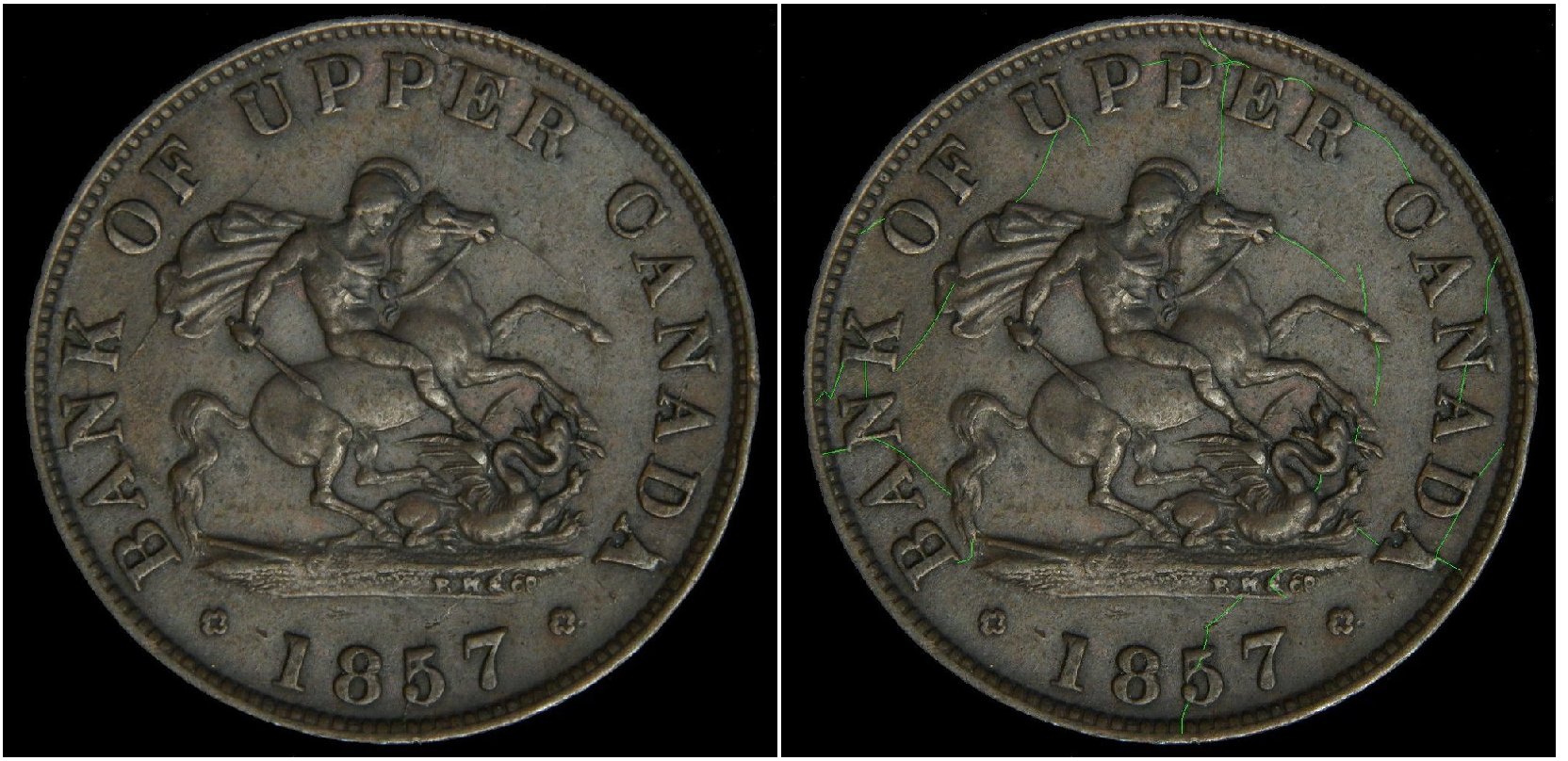 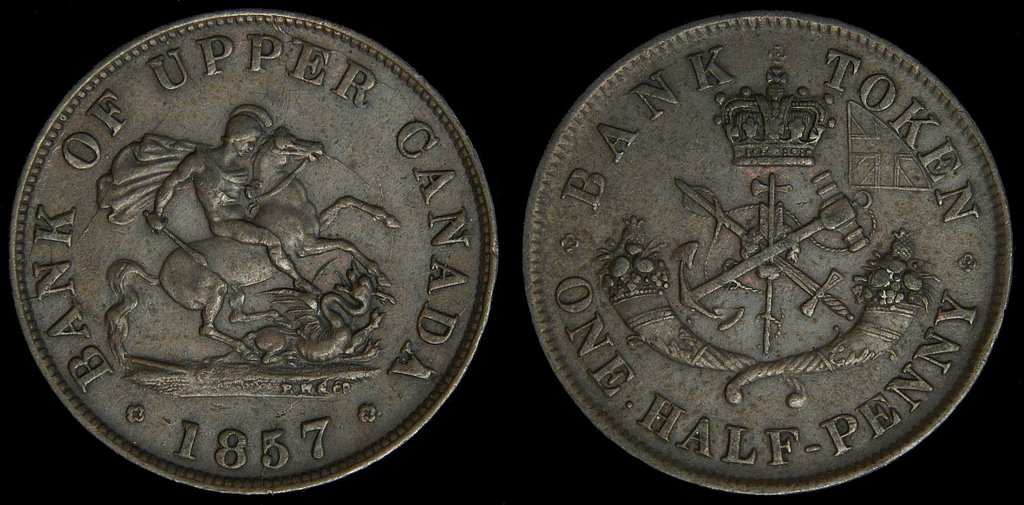 |
|
Pillar of the Community
United States
840 Posts |
Wade
Dr. Courteau identified some 48 different varieties of this series (159-207 inclusive). Several more have since been discovered.
Your token is Dr. Courteau variety 159. I suspect your token is an XF-45, perhaps an AU 50.
This is from a terminal state of the die having a dozen or so Die-Cracks.
My cut and paste concerning variety 159:
159 R-4 The terminal of the Anchor rope ends with One Dot.
Varieties 159, 159-1, 160, 161, 162, 163, and 164 are the only varieties of this group having One Dot.
Obverse characteristics:
The numeral 7 is relatively close to and higher than the numeral 5.
The 7 is on-line with the centre of the 4th Denticle to the immediate right of the numeral 5.
An imaginary line across the Face of the vertical of the Serif of the numeral 7 is on-line with the left ends of the Serifs of the left Upright of the initial H in the abbreviation below the ground.
An imaginary line across the top of the numeral 7 is on-line with the vertex of the left and upper Lobes of the right Rosette.
The Man's left Foot is missing, or is weakly struck.
Some specimens shew two short lines emanating from the Belly of the Horse, representing the remnants of the Man's Heel and upper outline of the Foot.
The left Bridle Rein is thin.
The left Rein is thin, runs close to the upper Rein and merges at the midpoint of the upper.
Minor re-touching of the dies also appears concerning the line below the Man's right Arm. All specimens encountered have a line not extending to the Man's Back, below the Man's right Arm. On some, the line appears slightly forked, and on others, the line appears to blossom into three blunt tines.
The right-side of the right Leg of the K in BANK is double-cut.
Two faint horizontal lines are below the left Wing of the Dragon.
Note - This feature may not be readily discernable on lower grade specimens.
From perfect and broken dies.
A Die-Crack is to the numeral 5.
This crooked diagonal Die-Crack is from the right-section of the Denticle betwixt the numerals 8 and 5 in 1857, extending through the ball of the same 5 and exiting the top of the same 5 slightly to the right of the midpoint, continuing upward into the field and bending rightward and continuing diagonally through the ground, the initial H and the Ampersand, exiting to the left Forearm of the Dragon.
A Die-Crack is to the N in BANK.
This double forked Die-Crack is from betwixt the Denticles above the left Upright of the N in BANK, extending through the left-side of the Serif of the same Upright, and extending along the left-side of the left Upright of the same letter. Halfway down the left-side of the left Upright of the N, the Die-Crack forks.
The upper branch turns 90° and extends through the mid-section of the same N to the mid-section of the left-side of the left Upright of the K in the same word.
The lower branch turns diagonally through the right Stand of the A in the same word, and extends through the lower section of the Tail of the Horse. Upon exiting the same Tail, the Die-Crack forks again, one branch extending to the Log above the ground, the other branch extending through the left section of the left-side of the ground, exiting to the centre of the Denticle betwixt the B in the same word and the left Rosette.
A Die-Crack is to the K in BANK.
This Die-Crack is from betwixt the Denticles above the right Upright of the N in BANK, extending to the upper left corner of the Serif of the Upright of the K in the same word, and extending through the Serif of the same Upright, exiting into the field, and curving upward to the 2nd Denticle to the right-side of the same letter.
Note - This Die-Crack was not mentioned by Doctor Courteau.
A Die-Crack is to the you in UPPER.
This Die-Crack is from atop the left section of the Denticle above the right Upright of the you in UPPER, extending through the same Upright, exiting the lower right side of the same Upright, extending into the field towards the bottom of the Man's Helmet, however nearing the rear of the Man's Helmet, the Die-Crack turns abruptly rightward to the juncture of the rear of the Crest and the rear of the Man's Helmet, and continues through the Man's Head, exiting the Man's Brow, and continues through the Eyes of the Horse, and exits the bottom of the upper Lip of the same Horse, and extends into the field, terminating on-line with the left Foreleg of the same Horse.
Note - Of this One Dot grouping, varieties 159, 160, and 162 have a Die-Crack through the you in UPPER. Especial care must be taken to distinguish betwixt the three. They are not identical. Each of the Die-Cracks are situated differently.
A Die-Crack is to the Mantle.
This long relatively straight Die-Crack is from the bottom of the left-side of the you in UPPER, extending to the Mantle immediately to the right of the 2nd Mantle Fold, and continuing through the upper section of the Mantle, exiting the lower corner of the 4th Mantle Fold, and exiting into the field below the left Upright of the K in BANK.
Note - This Die-Crack was not mentioned by Doctor Courteau.
A Die-Crack is to the letters ER in UPPER and CA in CANADA.
This long crooked jagged Die-Crack is from the left-side of the Denticle above the centre of the 2nd P in UPPER, extending through the upper sections of the E and R in the same word, and continuing through the C and A in CANADA.
Note - This Die-Crack was not mentioned by Doctor Courteau.
A Die-Crack is to the NA in CANADA.
This diagonal Die-Crack is from the centre of the Denticle above the 1st A in CANADA, extending through the upper section of the left Upright of the N in the same word, exiting the mid-section of the right Upright of the same letter, and exiting to the left-side of the left Leg of the 2nd A in the same word.
Note - This Die-Crack was not mentioned by Doctor Courteau.
A Die-Crack is to the 3rd A in CANADA.
This Die-Crack is from betwixt the Denticles above the 3rd A in CANADA. This Die-Crack is rather strange. The section of the Die-Crack above the A is "J" shaped. The main section of the Die-Crack passes through the centre of the same A, and extends through the right Leg of the same A, exiting the Stand of the same Leg, and extending through the bottom of the Claws of the left Paw of the Dragon, and through the right Forearm and Neck of the Dragon.
Note - Early states of the Die-Crack appear as two short protruding lines emanating from the upper left Leg of the A. These lines later turned into both branches of the "J." Later states of this Die-Crack have the centre of the A blocked.
Note - This Die-Crack was not mentioned by Doctor Courteau.
A Die-Crack is to the left Ankle of the Horse.
This rather long bending Die-Crack is from the bottom of the right Leg of the R in UPPER, extending downward into the field. Midway into the field the Die-Crack turns 90° and extends downward through the Ankle of the left Foreleg of the Horse, exiting the rear of the Hoof of the same leg, and extending through the Hoof of the right Foreleg of the Horse, and through the left Ear, Throat, Chest, and Rib Cage of the Dragon, and exiting through the ground to the initial H.
Note - This Die-Crack may be a fork of the Die-Crack to the numeral 5 (previously discussed).
Note - This Die-Crack was not mentioned by Doctor Courteau.
Reverse characteristics: Basically the same as variety 160.
The outline of the Union Jack is Perfect.
Only the upper section of the St. Andrew's Cross frame shews below the E in TOKEN.
The Anchor Rope ends with a single Dot.
The right-side of the Stand of the Leg of the K in BANK is double-cut.
The right-side of the lower section of the same Leg is also double-cut.
The inner ornamental Balls are not connected to the Cornucopias. The lower ornamental Balls are very weakly connected.
The Battle Axe has a hole.
Three non-distinct squiggly globs are for the Anchor Rope Dots betwixt the Feather and Anchor Shaft.
Many Dots within the lower sections of the Anchor Rope are weak or missing.
The Dot to the left of the lower ornamental Ball of the right Cornucopia is present, but not strongly struck.
The 1st quadrant of the Anchor Ring is very weakly struck and is sometimes missing.
The Anchor brace running across the top of the left-side Anchor Arm is heavy, but terminates midway to the Fluke.
From broken dies.
A Die-Crack connects the bottoms of ONE.
Self-explanatory.
A Die-Crack connects the tops of the NK in BANK.
This Die-Crack is from betwixt the Denticles betwixt the A and N in BANK, extending through the Serifs of the N and K of the same word.
Note - This Die-Crack was not mentioned by Doctor Courteau.
A Die-Crack is across the top of the N in TOKEN.
This Die-Crack is across the top of the N in TOKEN extending into the field.
Note - This Die-Crack was not mentioned by Doctor Courteau.
Thus:
159 Perfect obverse - A Die-Crack is to ONE.
Die-Cracks as above, plus a Die-Crack is across the N in TOKEN.
Die-Cracks as above, plus a Die-Crack is to the NK in BANK (reverse).
Die-Cracks as above, plus a Die-Crack is through the N in BANK (obverse).
159A Die-Cracks as above, plus a Die-Crack is to the K in BANK (obverse).
Die-Cracks as above, plus a Die-Crack is to the you in UPPER.
Die-Cracks as above, plus a Die-Crack is to the Mantle.
159B Die-Cracks as above, plus a Die-Crack is to the numeral 5.
Die-Cracks as above, plus a Die-Crack is to the NA in CANADA.
Die-Cracks as above, plus a Die-Crack is to the left Ankle of the Horse.
Die-Cracks as above, plus a Die-Crack is to the 3rd A in CANADA.
Die-Cracks as above, plus a Die-Crack is to the letters ER in UPPER and CA in CANADA.
Other minor Die-Cracks are evident.
Note - Many Die-Cracks were not mentioned by Doctor Courteau.
Note - Doctor Courteau mentions 'with several Die-Cracks, especially,' and identifies three. The question remains, which of the above were included in Doctor Courteau's 'several.'
This is the Die-Crack progression.
Enjoy
doug
Edited by colonialtokens
12/26/2017 2:55 pm
|
|
Pillar of the Community
United States
1101 Posts |
That's a nice 1857 token Wade! I love the extensive die cracks on that one.
Doug, your list of die cracks on the 1854 1/2 penny tokens is a great resource. Thanks!
|
|
Valued Member
Canada
222 Posts |
I've just released last week an 88-page book (With a very small number of copies) featuring Courteau's work on this series of tokens, but with a few small changes to the content.
Terminated the use of multiple abbreviations. I also tried to reduce the number of comings and goings in the book with references like "Same as #xxx", as well as adding dozens of illustrations, and a few other things.
However, after reading Colonialtokens publications on this subject, I am intimidated compared to all the work you have undertaken to get this lot of information.
Congratulations to you. I can only imagine how much time it must have taken to you.
Note: I have been working since few years now on a book that will also deal with this series of tokens. However, the content will concern only very little the identification of dies, but rather on this series in the broad sense, with history, gradation, statistics, counterstamp, catalogue of value, proof struck, etc..
However, I should still have at least one to two years before I have completed this book. This is a reason why in the meantime I had decided to take up Courteau's monograph, because I noticed that many people had difficulty with this book.
I'm sorry if my English isn't perfect... I'm learning a little more every day.
Edited by ainsivalavie
04/25/2018 03:36 am
|
|
Pillar of the Community
 Canada
5662 Posts |
It sounds to me that these two people (Doug & Ainsivalavie) need to get together on a joint venture and compilation. Doug has been up here to Toronto at least once for Torex or the Expo .... don't know if he's coming to the RCNA annual. |
|
Pillar of the Community
United States
840 Posts |
Compare the two photos the two different tokens concerning the extension to the numeral 4 (where the extended line crosses the H and the ampersand in the abbreviation) clearly shews the placement of the 4's differ, each being from a different die.
doug
|
| |
Replies: 38 / Views: 10,391 |
To participate in the forum you must log in or register.
Disclaimer: While a tremendous amount of effort goes into ensuring the accuracy of the information contained in this site, Coin Community assumes no liability for errors. Copyright 2005 - 2026 Coin Community Family- all rights reserved worldwide. Use of any images or content on this website without prior written permission of Coin Community or the original lender is strictly prohibited.
Contact Us | Advertise Here | Privacy Policy / Terms of Use
|
| Coin Community Forum |
© 2005 - 2026 Coin Community Forums |
| It took 0.38 seconds to rattle this change. |
 |
|





 First Page
 Previous Page


 Posted 12/26/2017 09:41 am


