| Author |
 Replies: 61 / Views: 7,737 Replies: 61 / Views: 7,737 |
|
|
|
Bedrock of the Community
13014 Posts |
Quote:
It's a branch mint specimen. It graded SP65. This. I was going to make a thread on it then kinda wondered if I should let the cat out of the bag and then decided to let it run a bit. But yes its a SP 65 first Specimen for a 1878-S to be graded |
|
Rest in Peace
10197 Posts |
Well, as ya all know, ain't no fan of toned coins, this one needs a dip IMHO. I have to agree tho with smalldawg, looks over-engraved, especially on the eagle's wings, maybe that's the new die? 7-tail feathers? So what is it? Live or Memorex?
|
|
Pillar of the Community
United States
1789 Posts |
Quote:
This. I was going to make a thread on it then kinda wondered if I should let the cat out of the bag and then decided to let it run a bit.
I was considering that as well, but I knew someone else would do it before me. |
|
Bedrock of the Community
13014 Posts |
To put it nicely people that think this coin is fake or wonder about, it is self reflection time on whether or not you guys should be trying to influence opinions about Morgans
|
|
Bedrock of the Community
United States
12057 Posts |
If it graded 65 it's the most undergraded Morgan I have ever seen.
Member ANA - EAC - TNA - SSDC - CCT #890 "Most of the things worth doing in the world had been declared impossible before they were done." -- Louis D. Brandeis |
|
Bedrock of the Community
13014 Posts |
|
|
Pillar of the Community
United States
4846 Posts |
I think this picture is in the absolute best light possible, I'm willing to bet that the toning doenst look nearly as good in most other lighting other than the optimal direction.
Even so, it still seems undergraded
|
|
Bedrock of the Community
United States
12003 Posts |
Quote:
10 sets of dies were shipped to San Fran in 1878. Of those, 8 sets were reported as being unusable due to pitting and other problems. Are you saying that the San Francisco Mint produced 9,774,000 Morgan dollars in 1878 using just 2 sets of dies?  From PCGS: Quote:Life of Morgan dollar DiesOver the life of the Morgan dollar series from 1878 through 1904 (not including 1921) 1,198 pairs of dies were produced for Philadelphia Mint coinage, 222 pairs for Carson City Mint production, 1,231 for New Orleans, and 898 for San Francisco. Dividing these numbers into the total coinage of Morgan dollars from those mints yields a figure of 217,679 coins per die pair from the Philadelphia Mint, 62,441 from Carson City, 151,208 from New Orleans, and 121,930 for San Francisco. It hardly seems possible to produce 9.8 million Morgan dollars from 2 sets of dies. It also seems impossible to produce the 78s mintage using 10 sets of dies, as all 10 sets would likely yield about 2.2 million strike impressions. Also it would take a really long time to mint 9.8 million coins running just 2 presses, even if running 24/7/365 nonstop. Edited by numismatic student
08/06/2018 11:25 pm
|
|
Bedrock of the Community
United States
12003 Posts |
Looks like I may have found it. The Mint's year for annual reporting purposes ended on June 30. Thus: Quote:During FY 1878 which ended June 30, 1878, the San Francisco Mint produced 2,552,000 standard silver dollars. The Philadelphia Mint Engraving department shipped 192 dies (i.e., 96 pairs) to the San Francisco Mint. [Annual Report 1878, pp.4, 29.] https://www.NGCcoin.com/boards/topi...-coins-made/ That was only for the first half of the year. An additional 7.22 million morgans dated 1878 would be minted at the San Francisco Mint that year. Not sure how many more die pairs would be used. Looks like minting of Morgans did not begin in SanFrancisco until May 15, 1878. Some additional 1878s mintage records on that page: Quote:
1. The first documents production was April 17, 1878. The die life list coverers the period from May 15 through June 30, 1878. [Letter DM 7/13/1878.] Thus, this die list might be part of the break-in period, or standard production, or represent use of dies from new hubs. The list and date range was sent to the DM at his request. This is the end of FY 1878.
2. As near the beginning of standard silver dollar production for the San Francisco Mint, these first weeks were likely a break-in or production adjustment period. It was commonplace to begin work on a small scale and then increase output as the interactions of various manufacturing steps were modified and coordinated for greatest efficiency.
3. The stated manufacturing goals for the San Francisco Mint were 100,000 good silver dollars per day or 2.5 million per month. [Letter to DM 3/15/1878, p.2.] The die life list shows that the actual number of pieces struck during the first six-weeks was 1,080,000 or about 30,000 per day. (Assuming 90% good coins during this break-in period, actual usable dollar coins would have been approximately 27,000 pieces.)
4. The San Francisco Mint Superintendent, Dodge, stated that he would need one additional furnace for melting in order to meet the 100,000/day goal and he expected this to be in place within the next month. [Letter to DM 3/15/1878, p.1.] No documents have been located that confirm completion of the furnace until August 1878 when the Coiner, Cicott, complains of not being able to anneal silver strip in the most efficient manner. [Letter to DM 8/12/1878, pp.1-2 and Letter to Superintendent 8/12/1878, pp.1-7.]
5. The average daily silver dollar production is less than one-half the daily capacity (90 coins per minute) of a standard large toggle-press of the era. During initial test production it would be a reasonable manufacturing procedure to limit variables to one large press and carefully annealed planchets.
6. If #5 is correct, then dies were probably used in sequential order and paired more-or-less as shown by the number of strikes for each die. (Existing variety and die marriage lists should be examined carefully and reevaluated, at least on a trial basis, in light of the die life list.
7. Once all production systems were operational and the new furnace working properly, productivity and output should have increased. However, with only 9,774,000 good coins made during 1878, it appears the 100,000 per day goal was rarely achieved.
8. Daily deliveries of silver dollars have not been located, but there is the possibility they exist within RG50 (Treasurer of the U.S.), entry 151, vol. 1-12, "Daily statement of the coinage and movements of Standard Silver Dollars, Dec 5, 1878 to June 30, 1891" even though the first San Francisco Mint dollar production was outside the date range of the NARA entry. |
|
Rest in Peace
10197 Posts |
So who by chance owns this one, private collection as Eliasberg or what? Gotta be a bundle!
|
|
Bedrock of the Community
13014 Posts |
NS thak you for that in a nicer way I would have. Why some keep trying to post now when they should be showing humility is beyond me
|
|
Bedrock of the Community
United States
12003 Posts |
Paralyse (Adam) has forgotten more about Morgan dollars than I know. Not gonna knock him for being helpful as he has always done, as long as I have been here. I've learned a lot from him an continue to do so. I make mistakes all the time and often learn more from being wrong than from being right. I'm not going to knock anyone for trying to be helpful.  btw, here is the Eliasberg specimen considered to be the first 1878s Morgan dollar minted. If you are wondering who John Roberts is, he is ANACS' Director of Attribution Services. The cataloguer for the Bowers Merena sale listed this coin as Proof 63, but a TPG has never called it that. It is generally considered a specimen strike, but who knows. These categories seem to be jumbled.  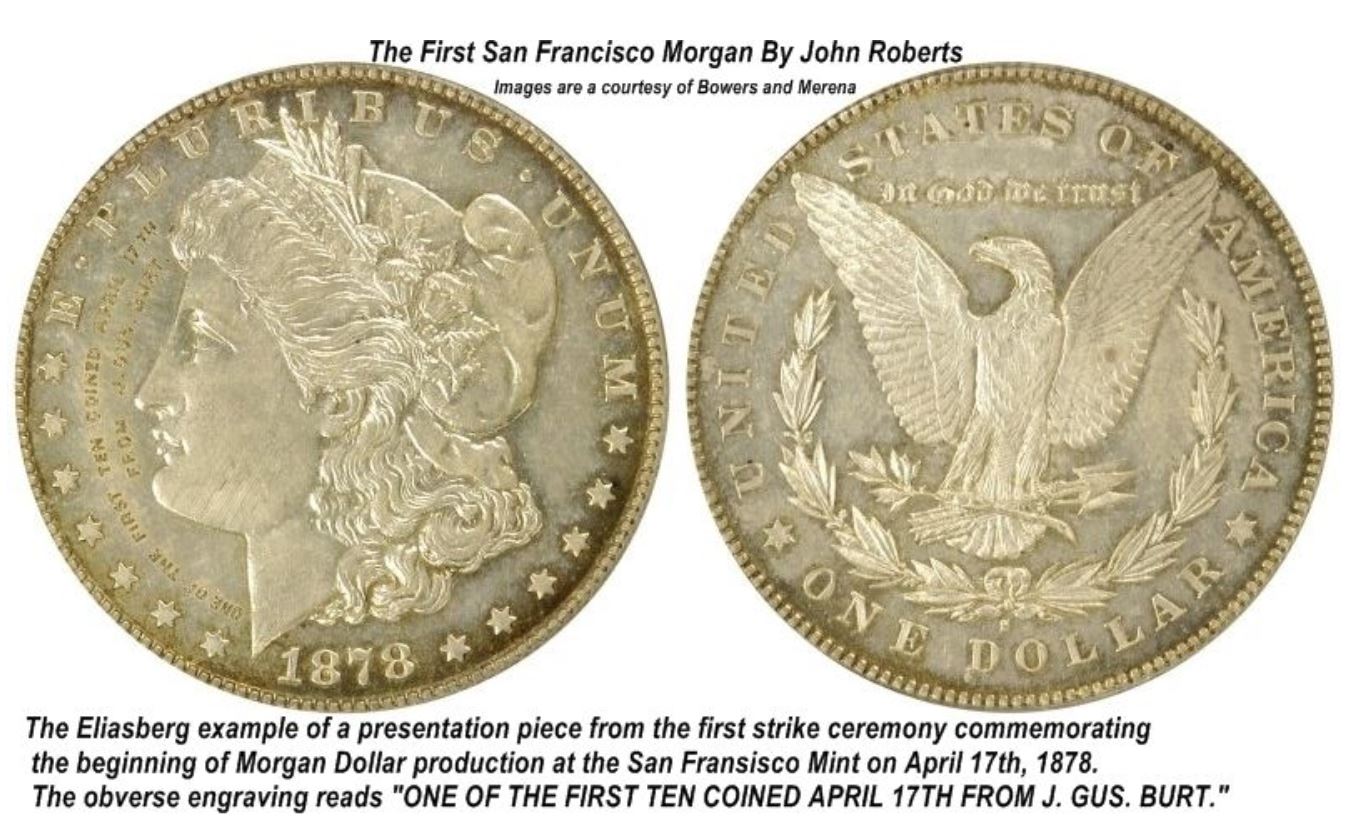 Edited by numismatic student
08/07/2018 12:27 am
|
|
Bedrock of the Community
United States
12057 Posts |
The INITIAL startup of minting at San Fran was done with 10 dies shipped from Philadelphia in April of 1878. At "least" the first 10 coins were engraved. It is known that those first 10 coins, as well as some others, were given very special treatment -- the planchets were polished and smoothed, the dies were polished and compounded to mirror finishes, and each coin was struck at least twice, or possibly as many as four or five times. These first runs of coins were intended as gifts for the mint master, engraver/die sinker, a few for the Mint cabinet, and also handed out to dignitaries and VIPs that were in attendance. Leroy Van Allen owned two of the Philly presentation strikes, both later slabbed by ANACS, a 62DMPL and 64DMPL. Of those 10 initial pairs of dies, 8 were deemed "unsatisfactory" -- it was reported that they contained pitting, cracking, and other signs of improper preparation and handling. They may or may not have been used anyway later in the run. Carson City received its dies from Philadelphia as well. This is one reason why a few issues of 1878-P, 1878-S and 1878-CC all have the same 7 feather "long nock" parallel arrow feather reverse, aka Van Allen's "B1" reverse. Coins struck in Philadelphia prior to April of 1878 used the A and B1/A (aka 8TF and 8/7TF) long nock reverse. The first die used in Philadelphia in March of 1878 was the VAM 9 variety. A (since debunked) claim was made that the first set of dies failed after a little more than 300 coins were struck; this is known to be false because the number of attributed VAM 9's exceeds 300 by quite a bit. The first two die pairs used at San Fran were those now called VAM 60 and VAM 26 -- both "long nock" reverses of 1878. Mass production of Morgans started in earnest in May 1878 in San Fran. Mintage: 2.2m (CC) from 20 known unique die pairs, B1 reverses (7 TF long nock/parallel feathers), theoretical avg 110.6k coins per die pair Mintage: 9.77m (San Fran) from 105 known unique die pairs, of which only 9 were B1 reverses (7 TF long nock/parallel feathers) and the remainder were short nock B2's. This is more die pairs than acknowledged by the Mint's records (by exactly 9, coincidentally the number of B1 reverse die pairs known to have been used...); theoretical avg. 93.1k coins per day (using LVA numbers) or 101.8k coins per day (using Mint numbers.) Those averages were rarely, if ever, achieved on a daily basis. Edit: I should mention that some of the B2-type (parallel arrow feather, short nock) reverse dies were kept in use through 1879, creating the scarce "Reverse of 1878" varieties of 1879-S Morgans. At least two of the 1878 B1/A Philly reverse dies - aka the 8/7 tailfeather varieties -- were also used at CC in 1880, with reused 1879 obverse dies, creating the oddball and very scarce 1880/79-CC 8/7TF VAM's 4 and 7. The B1 reverse of '78 was later used, in a somewhat modified and re-engraved form, to hub the reverse of the issues of 1921, found with either 16 or 17 berries. Member ANA - EAC - TNA - SSDC - CCT #890 "Most of the things worth doing in the world had been declared impossible before they were done." -- Louis D. Brandeis Edited by paralyse
08/07/2018 03:02 am
|
|
Rest in Peace
United States
10625 Posts |
I'm glad to see I'm not the only one that enjoys the history of the Morgan dollar. Great posts guys!  I too didn't let the cat out of the bag just to see what others would think about this rare piece of history. I'm glad I did.  |
|
Pillar of the Community
 United States
5725 Posts |
Thanks for the fascinating history, Paralyse and NS!
|
| |
Replies: 61 / Views: 7,737 |





 First Page


 Posted 08/06/2018 10:42 pm


