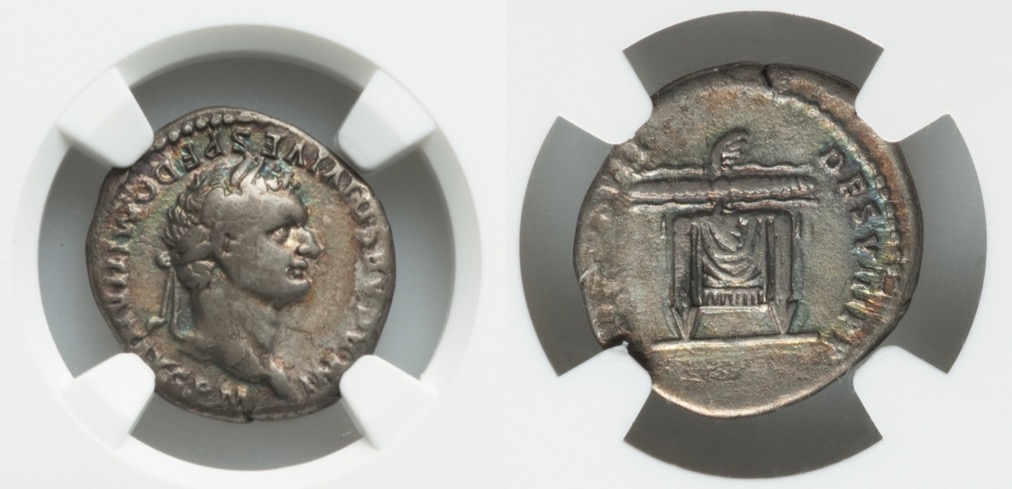
I am very happy to have won this in a Heritage auction a few days ago. The reason I wanted it was for the rare obverse legend IMP CAES DIVI VESP F DOMITIAN AVG P M. On the denarii of Vespasian this legend only appears on 9 types. Of the 9, 2 are R3 (only one example known) and 7 are R2 (very few examples known). All 9 examples were struck in Domitian's first year as Augustus 81 CE between September 13 and December 31. There were 4 groups of precious metal coinage issued in 81 CE. Of the 9 types 1 was part of group 2, 1 in group 3, and 7 in group 4. The groups are separated by reverse legends. The chronology of these groups is not clear. That is part of what makes studying these early denarii of Domitian so interesting. Is there a reason why this obverse legend is so prevalent in group 4 yet so scarce in groups 2 and 3, and non existent in group 1? All I know is that much more study of these first year denarii is necessary.
The legend is also interesting for another reason. It pays homage to Vespasian. While Titus issued many DIVVS Vespasian issues Domitian did not. the reverse is interesting in that like so many of the first year denarii, it carries on the pulvinar types from the reign of Titus.
I really like the young portrait on this coin and it had another selling point. It was part of the Morris collection. I like coins with an interesting history or provenance.
Domitian, as Augustus (AD 81-96). AR denarius Rome
13 September-31 December AD 81
(18mm, 3.02 gm, 6h).
NGC Choice Fine 4/5 - 4/5.
Obv: IMP CAES DIVI VESP F DOMITIAN AVG P M, laureate head of Domitian right Rev: TR P COS VII-DES VIII P P, pulvinar of Jupiter and Juno, draped, surmounted by thunderbolt.
RIC II 72 (R2), BMC--, RSC--, Cohen--
2019 August 18 Ancient Coin Selections from the Morris Collection, Part II Monthly Online Auction #271933Lot # 35169







 Posted 08/22/2019 2:51 pm





