For this edition of Quick Bits, we'll take an "inside" look at the introduction and initial sales of the 1936-S Oregon Trail half dollar...
In 1936, half dollars were struck for the Oregon Trail Memorial Association at the Philadelphia Mint and at the San Francisco Branch Mint; 10,000 at Philadelphia, 5,000 at San Francisco. The San Francisco issues were struck and available for sale ahead of the Philadelphia coins.
The Scott Stamp & Coin Company, the official distributor of the Association's coins in 1936, began advertising the 1936-S pieces via its in-house coin publication -
The Coin Collector's Journal - in March 1936 at a price of $1.60 each plus postage. In the April issue of the
CCJ, Scott announced that "the entire issue was oversubscribed" within ten days, but that they would be doing their best to fill all orders for one or two coins at the original price. They also stated that due to "the work involved in sorting the thousands of orders the mailing will be somewhat delayed." It appears that they were above board with their efforts.
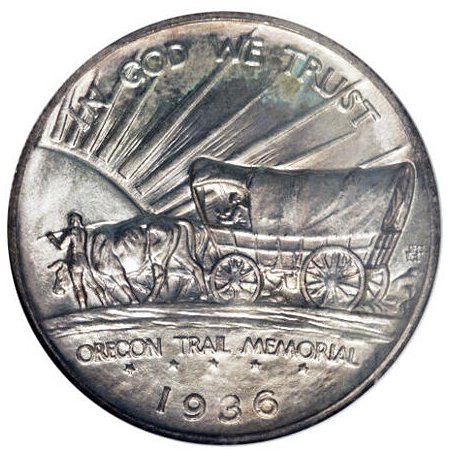
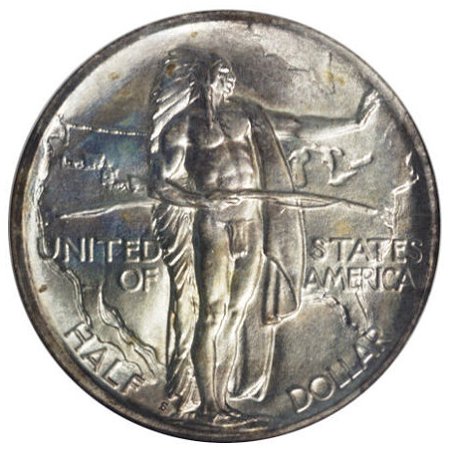 Images courtesy of Heritage Auctions, http://www.ha.com. The "S" mint mark is near the rim to the right of "Half" on the reverse.
The April issue also included a notice that Scott would pay $2.25 per coin (plus return postage) for as many of the coins as it could buy to fill the orders from "a great many collectors we are unable to supply." No sale price was listed for the coin in the magazine, with Scott stating "Until our stock is replenished we cannot quote prices on this issue."
Apparently, not enough collectors were enticed by the $2.25 per coin offer, as the May issue of the
CCJ included an updated notice that increased the buy back offer to $3.50 per coin plus return postage.
By the time of the June issue, Scott's inventory was replenished enough for them to list a selling price of $6.00 per coin, along with a new buying price of $4.00. These prices held until September, when the "Buy" price was raised to $5.00 and the "Sell" to $8.50. In the November magazine, the prices jumped again, this time to $6.50 and $10.00, respectively; these prices held into 1937.
The Philadelphia Mint Oregon Trail half dollars became available beginning in late June/early July 1936. This helped the situation slightly, but speculators continued to drive prices for the "scarce" S-mint coins.
So, during the first nine months of availability, the selling price of the 1936-S coin went from $1.60 to $10.00 each. The $8.40 jump represents a price increase of 525%! The 1936-(P) coins also increased in price after being release mid-year, going from $1.60 each at issue to $5.00 each by the end of the year (a 212.5% increase), but the increase paled in comparison to the rise seen for the S-mint coins.
Today, market prices across the various collector grades (AU to MS-66) for the 1936-S are generally only slightly higher than the 1936-(P); they are no where near the price doubling seen in late 1936 and early 1937. Today, the Oregon Trail Memorial coins are mostly purchased by collectors for their personal sets vs. the speculators that were driving prices in the mid-1930s. Oh, what a difference 85 years makes!
PS: The 2020 equivalent of $10 in 1936 is approximately $187. This is about the price of a nice MS-63 example in today's market (you'd likely get a few dollars change from your purchase). So, when inflation is taken into account, the market price for the BU coins delivered by Scott in 1936-37 is essentially the same as today. Interesting!) 




 Posted 09/18/2020 11:40 am





