| Author |
 Replies: 9 / Views: 1,417 Replies: 9 / Views: 1,417 |
|
|
Pillar of the Community
United States
522 Posts |
I am on the hunt for a 37 D 3-legged Buffalo nickel. I'm wondering if you have any tips. This is what I am considering: Because of price point, I'm looking at a VF 20 example, slabbed. I will review other diagnostics, including the deterioration of back leg. I know there are others but can remember off the top of my head. Will look, though. Surfaces: problem free without hairlines. I've noticed many of these even in slabs have obviously been cleaned. And, as always, buy the coin not the slab. Does anyone have any other guidance? Thanks |
|
|
|
Pillar of the Community
United States
5825 Posts |
Quote:
... VF 20 example, slabbed. I suggest only NGC or PCGS slabs. |
|
Bedrock of the Community
United States
10284 Posts |
I would try to get one in a higher grade and save up for it. You are already putting out several hundred dollars for a three legger and a grade jump or two doesn't really make a huge difference in price. I have a VF35 straight ANACS graded one. I can wish it were XF45 to AU50 but it would probably be easier to sell than a VG8 or F12. Before putting out $500 to $1000 on a coin, you are doing the right thing. You posted here.  You might be better off getting one already in a PCGS NGC or ANACS holder with a straight grade. Buy one that you like that appeals to you and of course, not what the holder says it is. There is a lot of posts about diagnostics for this coin here on CCF and elsewhere on the internet. My favorite clue is the E PLURIBUS UNUM is clearly NOT near the Buffalo back on a genuine three legger 1937 D and a fake one it looks like it is almost touching. Another is the raised "spray" of dots under the belly going toward the ground on a genuine. But has it been cleaned? Is it corroded? Be careful. |
|
Pillar of the Community
 United States
522 Posts |
I am by no means an expert, but I do collect this series. I have a complete set except for varieties, including the 37 D 3-leg. Surfaces are important to me, so I am on the look out there. I'm basing my pricing on Numismedia, which shows a big jump from 20 to 40. To me there's a big difference between $500 and $1,000.
To be honest, I'm hesitant to go really high as this particular coin has shown a significant decrease in price over the past ten years- at least according to Numismedia price charts. This is interesting because one of the ideas I always read around here is that a collector should buy the key dates as these always increase in value.
|
|
Bedrock of the Community
United States
10284 Posts |
The range of $500 to $1000 I mentioned is a price you might expect to pay for a circulated 3 legged 1937D Buffalo. I looked at Numismedia too before I posted. It is only a $117 dollar difference between a VF20 and XF40 example. Is it better to save a $117 or so and settle for the lesser grade? That's up to you. It's all ballpark figures anyway, you may have to pay more or less. It's just a guide, but you might want to have your 3 legger blend in nicely with your 1930's issues grade wise. I'm sure they are the better condition coins in your set. Oh and I have to add. Perhaps prices are falling in recent years for this issue. It can be looked at different ways but I try to remember to buy when prices are falling and sell when they are rising. 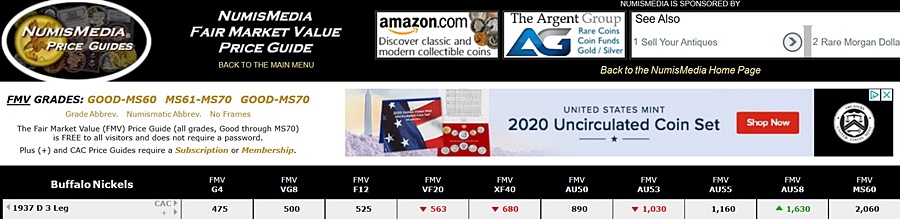 Edited by TNG
01/13/2021 12:01 pm
|
|
Pillar of the Community
United States
522 Posts |
I appreciate the general collector strategy, but I guess I should clarify that the real point of this post was asking for tips on this specific coin. For example, perhaps horns are not generally pronounced or strike is somewhat 'mushy'. Or, maybe there are features of the braid that one should look for as desirable. For instance, a dealer at the last coin show I was at (so long ago!), suggested I look for hair separation above the knot when shopping for an uncirculated 1921. I'm not sure exactly, but are there elements of the strike or wear patterns to look for? As I'm writing this, I wonder if there are degrees of the missing leg, meaning that on certain coins the leg is totally absent while on others it may be partially visible. I seem to notice this on the back leg. Anyway, just anything to be on the look out for. Thanks
|
|
Bedrock of the Community
United States
20753 Posts |
I think your being a bit on the particular side. As to one of those Nickels I'd just be happy with one that is slabbed so you know it's real. Way to many normal coins have been tampered with to make those.
|
|
Valued Member
United States
189 Posts |
There are a couple websites that do a good job of breaking down all the 3-leg diagnostics, but here's my understanding (I really want to buy one as well!) * EPU on back does not touch the back of the bison * Weakness in one of the rear legs, looks more lightly struck * Back of the Indian's neck towards the top looks 'moth eaten' or pitted * Rev front leg is missing * Area underneath the Bisons belly has this swoop of dots PCGS has a great image https://www.PCGS.com/coinfacts/coin...-3-legs/3982There are PLENTY of non-slabbed fake ones on ebay. When I see one I give the seller a hard time. I think some instances are just ignorance, but most clearly know they are selling a fake. Personally I would take the other users advice, buy a slabbed example, with this coin it's an investment. Good luck |
|
Pillar of the Community
 United States
5711 Posts |
Since you are planning to buy a slabbed example, authenticity shouldn't be an issue. But personally, I would get familiar with the diagnostics listed above and find an attractive example that shows all those pick up points clearly. Sometimes some of the diagnostics are not as obvious.
|
|
Pillar of the Community
United States
4429 Posts |
IMHO, it's best to go with a SHARP, full horn VF. I don't believe the price spread is that much greater, and revisiting the piece over time will be much more rewarding, methinks.
|
| |
Replies: 9 / Views: 1,417 |
|










 Posted 01/13/2021 09:48 am


