| Author |
 Replies: 86 / Views: 9,343 Replies: 86 / Views: 9,343 |
|
|
|
Pillar of the Community
United States
4963 Posts |
Quote:
That these were "faulty struck planchets that were reused to make the penny in order to save steel." If the planchets had protrusions, they would be flattened by the dies and couldn't possibly be raised above the design unless there were depressions in the dies. I agree that we're just beating a dead horse here. We clearly haven't changed your mind and you haven't changed ours. Send one to ANACS and hope for a "details" grade. I'll be interested to hear what comes of it. |
|
Bedrock of the Community
United States
19573 Posts |
Yes, please send some examples to third party grading/attribution services. Let us know what the outcomes are. Thanks.
|
|
Valued Member
 United States
163 Posts |
I do respect your opinions and as I said, I am no expert on error coins. I also realize this is a dead post. But I do know what a replated coin is. I just pulled these from my collection and had to share. The top penny on all pics is our cleaned pennies. The bottom 2 on all pics are obviously re-plated. And as I said before....these started as normal blackend pennies as shown in prior photos posted. I would be amazed if someone could replate a steel penny , reproduce Zinc oxidation and grime from 1943, and pass off a replated coin as an original. Either way, your efforts are appreciated and I'm trying to get them looked at by Verdae Auction here in SC and also Greenville Coins as I type. 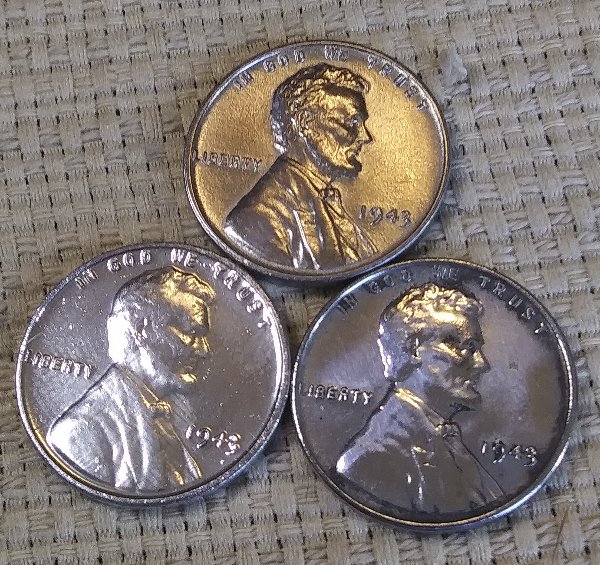 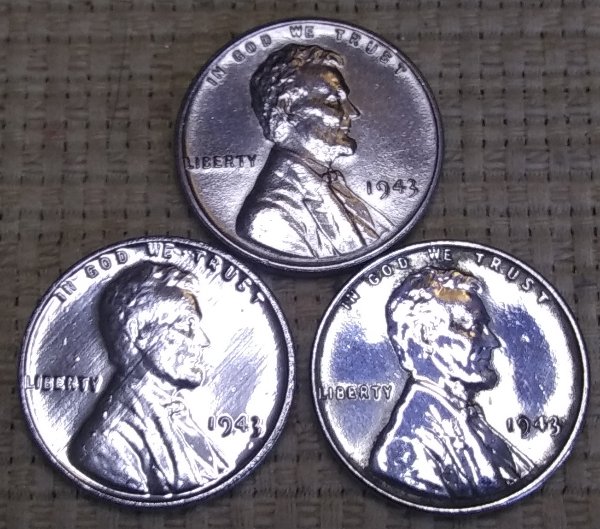 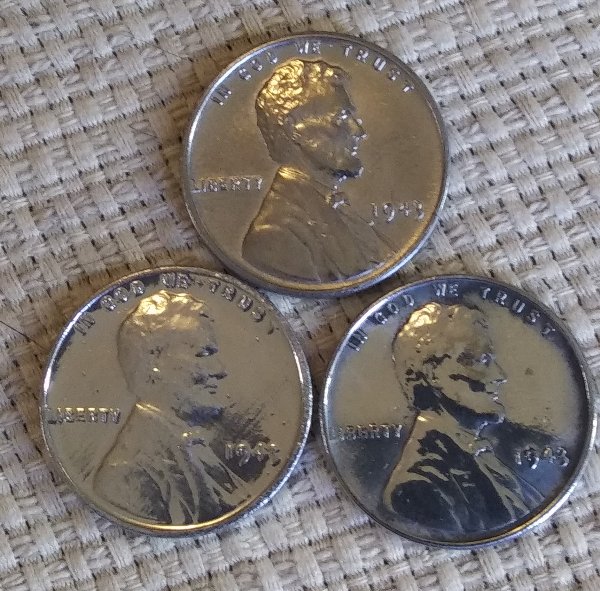 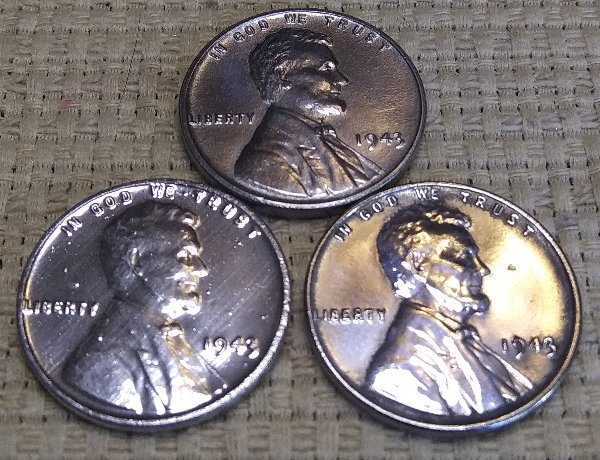 |
|
Valued Member
United States
163 Posts |
Good day all. I finally got alittle more news about these crazy pennies. Lol I sent all photos and more that was requested to a Auction House here in SC. They are not rare but seldomely seen outside of a collection given they are 1943 Steel`s. Their best guess was "struck through". "Most likely a staple was present during strike. The cascading deterioration of the foreign matter is the result of the staple losing its form and basically getting smashed to bits as it vibrated around the planchet." The fact I have so many they beleive is just an example of "bottom of the barrel filling". The seller had these errors seperated from a much larger batch, but "snuck them in" to fullfill my last order of 1,000. I still do not know what their worth as they would need to investigste them in person. And even so, they informed me they could not set a grade or value becuase they were cleaned. Again, many thanks to all that have tried to assist with these curious pennies.  |
|
Pillar of the Community
586 Posts |
I didnt read past the first page of comments but I recently bought 3 rolls of steel pennies for diet cheap cause most were in pretty bad shape. I soaked them in lemon juice just to clean them up and be able to actually see the coin. I wasnt planning on selling them or anything. They were to the point you couldnt really see any definition of either side so why not. Anyways, most of them came out looking awesome but even though it was just the steel now, they didnt have this kind of shine to them. These def look replated and if so then maybe theses are blisters in the zinc from something on the steel? I've never seen this before either. Also, if someone mentioned this possibility already, sorry.
Edited by Waynoah83
02/16/2021 11:46 pm
|
|
Valued Member
United States
163 Posts |
Yes,your right. More is done than just lemon juice to get these pennies that shiny. And as many have ask us on ebay and Etsy how we do it....we have had to decline. I can say full heartedly that its not a magic trick, its not done with abrasive polishers, and is done under cold water as stated earlier on in this post. If anything, these pennies only get exposed to the heat of reguliar hot tap water coming from anyones home. And you have a point. But if exposed to a heat source that could do that kind of damage, I would think it would be more a weld which would be way more evident? Thanks!  |
|
Pillar of the Community
United States
4963 Posts |
Raised -> not struck through. I stand by that position.
|
|
Pillar of the Community
586 Posts |
It could be tap water. You should use distilled. doesn't necessarily have to be a heat source. Especially if being done at home. And yeah, def not a weld. I happen to be a welder. This is actually the shirt I am wearing right now so I can tell you that is def out of the question. No matter what kind of welder is being used.  |
|
Valued Member
United States
163 Posts |
Quote:
Raised -> not struck through. I stand by that position. Numisma, that still is a great point I am considering. |
|
Pillar of the Community
586 Posts |
I went back and read the last couple posts before mine and def not a strike through. It would be incused as opposed to raised which it obviously is. So the staple theory doesn't work at all. Even if it someone damaged the die they would all be the same area or if it miraculously did damage to the die you would see progression with all the previous damage on the coin along with the damage caused by the staple breaking up after each continuous strike. Its def not what happened in my opinion. The fact they are raised alone proves it's not a strike through. I actually do have a steel that has some raised lines on it that seem too fat to be gouges. It looks more like die damage. Who knows. Maybe it's a steel cent form of improper alloy mix. Steel is iron and carbon mainly. It was the 1940s and we were in a war. Maybe there were some irregularities in the steel. There are all diff types, grades, and purities of metals and alloys. We only started fine tuning them to precision with advancement of computer technology. Back then it was kind of eyeballing it.
|
|
Valued Member
United States
163 Posts |
Waynoah83, that post was enlightening. Thank you for bringing that information to the table! It definitely opened my eyes to other possibilities. And I should like to point out, these are not in Wexler or any other source I could find in the past 2 weeks. So maybe they are not an official nor unofficial strike error. Edited by sccollector
02/17/2021 12:28 am
|
|
Bedrock of the Community
United States
10635 Posts |
Quote:
We clean them in our shop to make them look the way they do. They are first soaked in lemon juice and salt. After that they get another process and a final high sheen polish. I am arriving to this conversation late, and I have to say I am sad that so many of these special cents have gone through your hands only to be ruined. Searching for an answer to your "bumps', I noticed you quoted an expert on error coins without giving a name, why I wonder? Petespockets55 had an excellent idea: Quote:
I'm going to make a suggestion that will be much less costly than sending to any service. Sacrifice one of the coins by seeing if the raised area will come off by scraping with a knife or dental pick. Look to see what is under the surface. I too, believe that something about the process you use left these raised areas on the coins (if they aren't Chinese) Being Chinese certainly would explain things. Why don't you "sacrifice," (a biopsy of sorts), just one of your bumpy cents to see what's inside? That might tell us a lot. Don't forget to photograph this procedure for us. Kloccwork419 summed up my feelings on this matter best by saying: Quote:Well good luck. These are plated damaged coins. There are thousands of "reputable sellers" on ebay that sell damaged, cleaned, whizzed, polished, replated junk and still have 100% feedback. doesn't make them reputable. There are just many more buyers that dont know any better. All the areas you think is errors, is damage. As commented above, if these were raw steel, it would be rusting as your taking the pictures. You can see on the reverse of the coin above on the right that it was replated over corrosion. These are not errors They are ALL damaged. They are ALL ruined.  |
|
Pillar of the Community
586 Posts |
Like I posted earlier, I believe these are plated Penny's with some kind of flaw in the plating. The only thing I have to disagree with that I've seen posted multiple times before is of the naked steel pennies that have had the zinc removed rusting immediately. Depending conditions, that's not necessarily the case. I live in Florida so 98% of the year our A/C is running and kept at around 75 or under. A/Cs are basically giant dehumidifiers as well. I have a little table I use for my coin hobby and I've had one sitting out for the last 4 months atleast and it still is free of rust. That being said, I also have quite a few that have rusted almost over night in the past. Just depends. This doesn't really add to what the issue is with these coins that much unless they are caused by a little moisture under the plating that causes rust which maybe explains what I think could be blisters. But you need oxygen to cause rust so maybe it's not the case either. I just wanted to share my experience with steels I have stripped.
Edited by Waynoah83
02/17/2021 02:34 am
|
|
Valued Member
United States
163 Posts |
I hope this pic will end this redric of re-plating. Out of the two coins....which looks replated and which looks natural. Which one looks like its got errors on it. Maybe the past picks I posted with my bright l.e.d. light gave the impression that they were replates? If you cannot tell the obvious difference between their condition, then this entire post is mute. And as I looked closer at this error, I see easily that the coin inprint, back side of head, came down on the bump and smashed it down. The metal bump had to be there before the strike. So as previously mentioned, I agree these are not "struck through" error Coins. 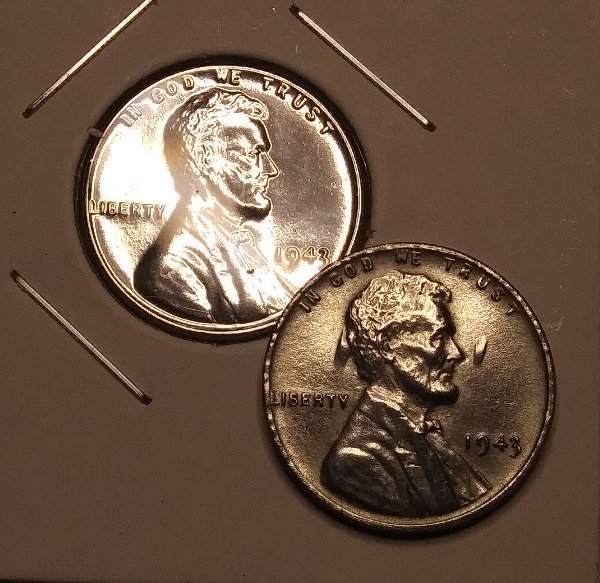 Edited by sccollector
02/17/2021 05:39 am
|
|
Pillar of the Community
586 Posts |
I see what you're saying now. Those pics you can tell that one wasnt replated just by the pitting on the service. They all have that look when they are stopped. Well I guess my previous replies were a waste. I agree now that it had to be the die that was damaged or something to do with the planchet itself. I'm just not sure about the staple idea at all still. Why would there even be a staple in the first place and with all your examples being different, that would kind of dispel the damaged die theory I think cause they wouldve been burning through dies left or else you would see a lot more examples of these I would think. The mystery continues.
|
| |
Replies: 86 / Views: 9,343 |





 First Page
 Previous Page


 Posted 02/09/2021 09:25 am





