To commemorate the 1883 centennial of the city of Charleston, SC, the US Mint was asked to strike a medal. It was a request from the private sector, vs. the US Congress. Per the Coinage Act of 1873, the US Mint was approved to strike such medals as long as they were of "national character" vs. just a personal memento/souvenir. One of the reasons this stipulation was put in place was so that the Mint did not become a direct competitor to the many private die sinkers / medal makers that were in business. The important role that Charleston,SC had played in US history to that point enabled the Mint to view its centennial as an event of national character and thus eligible for it to strike the commemorative piece.
Charleston can trace its routes back to 1663 when King Charles II granted land charters in the present-day Carolinas to his friends, the eight Lords Proprietors. In 1670, the Lords arranged for settlers from Bermuda and Barbados to travel to what would become South Carolina and establish Charles Town on Albermarle Point in the Ashley River. The Albermarle Point settlement was ultimately unsuccessful and faded away within a few years, but a settlement at nearby Oyster Point, initiated in 1672, survived and grew. The name "Charles Town" was officially adopted by the Oyster Point settlement in 1680.
Records of the time indicate that the name "Charles Town" was contracted to "Charlestown" about 1719. Approximately six decades later, in 1783, Charlestown formally changed its name to Charleston (and incorporated under the new name). It is this event that is commemorated by the medal. I would consider the small name change to be more of a minor footnote in the city's history, but such was not the case for the medal's sponsor who obviously viewed it as a major event.
The obverse depicts a seated
Lady Liberty holding a pole/staff topped with a Phrygian cap (aka Liberty cap) in her right hand while her left is held up and is pointing to something beyond the sight lines of the viewer (the future?). The background depicts Charleston harbor. Below the figure of
Liberty is seen "CAROLOPOLIS CONDITA A.D. 1670." which translates to "Established in the year of our Lord, 1670."
Encircling the central scene, in Latin, is the inscription "AEDES MORES JURAQUE CURAT / CIVITATIS REGIMINE DONATA A.D. 1783." "AEDES MORES JURAQUE CURAT" translates to English as "She guards her buildings, customs, and laws" and "CIVITATIS REGIMINE DONATA A.D. 1783." translates as "Given to the city government in 1783." which refers to the city's 1783 incorporation.
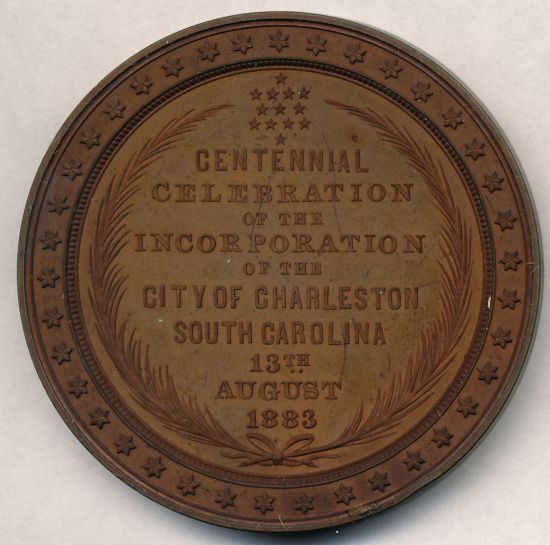
The medal's reverse is dominated by its commemorative inscription which is enclosed within a wreath that appears to be made from palmetto tree fronds. Around the rim are found 38 stars, one for each current (in 1883) state of the Union. A constellation of 13 stars, representing the original 13 colonies/states is seen above the inscription at the 12 o'clock position.
The bronze medal is the work of
Charles Barber.
1883 Charleston, SC Centennial Medal - US Mint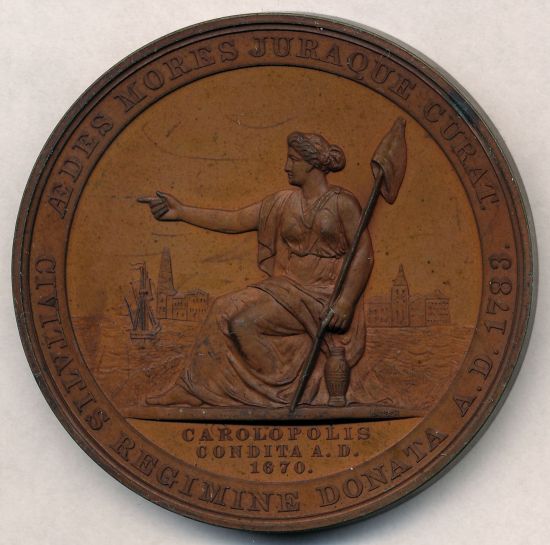







 Posted 06/03/2021 11:55 am





