Quote:
Beautiful and historical. It makes me want one. Although I suspect it wouldn't come cheap...
Thank you, @JohnConduitt.
About pricing, John II stipulated in his decree:
Quote:
a franc d'or ... of which there should go two on an English Noble
Looking around a bit, I think you will still get two of these francs for the price of one noble

Quote:
within one year it inspired the engravers in many adjacent states to copy it
Thanks, @tdziemia. It apparently made an impression already back then. It
is a catchy design.
My last coin for the 1360s, and for the 1300s actually ... time to bring out the BIG popcorn bowl!
 France 1365-80, franc "à pied," Charles V.
 1.000 gold, 3.71 g, 28 mm. Duplessy 360A, Lafaurie 371.
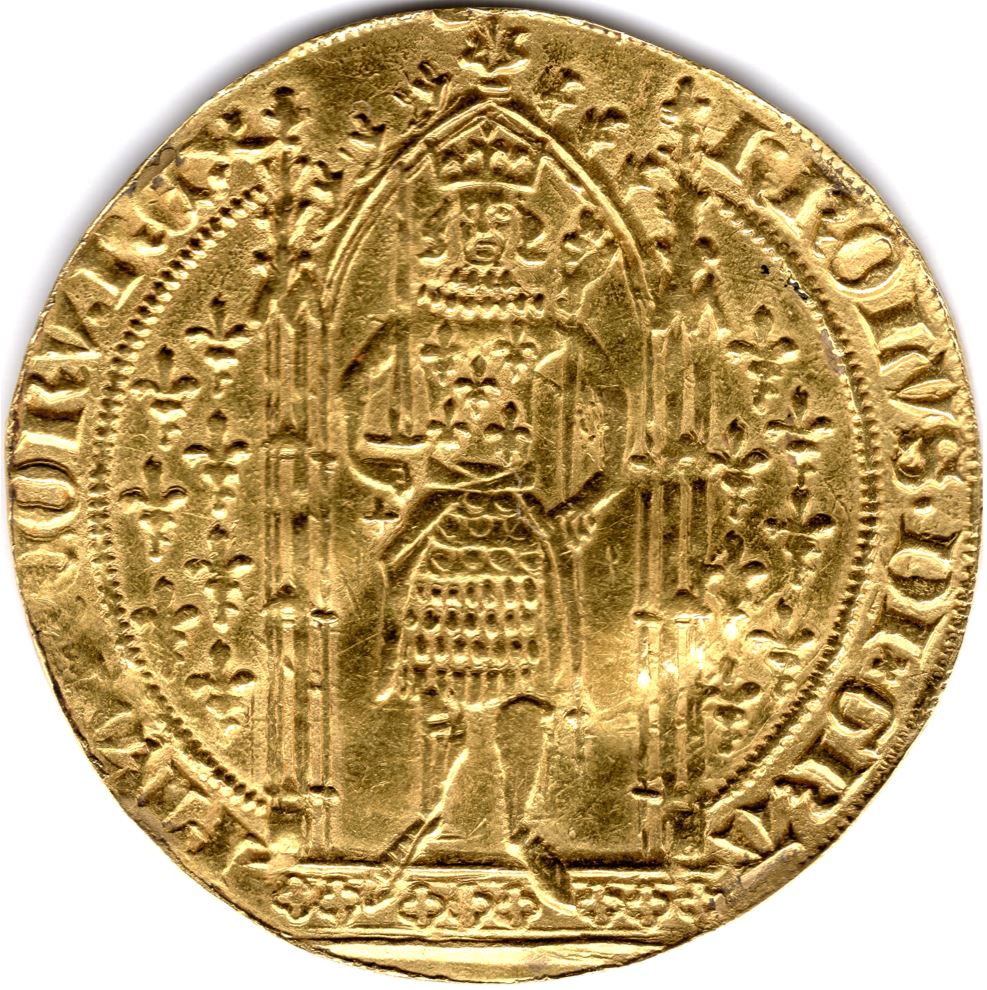
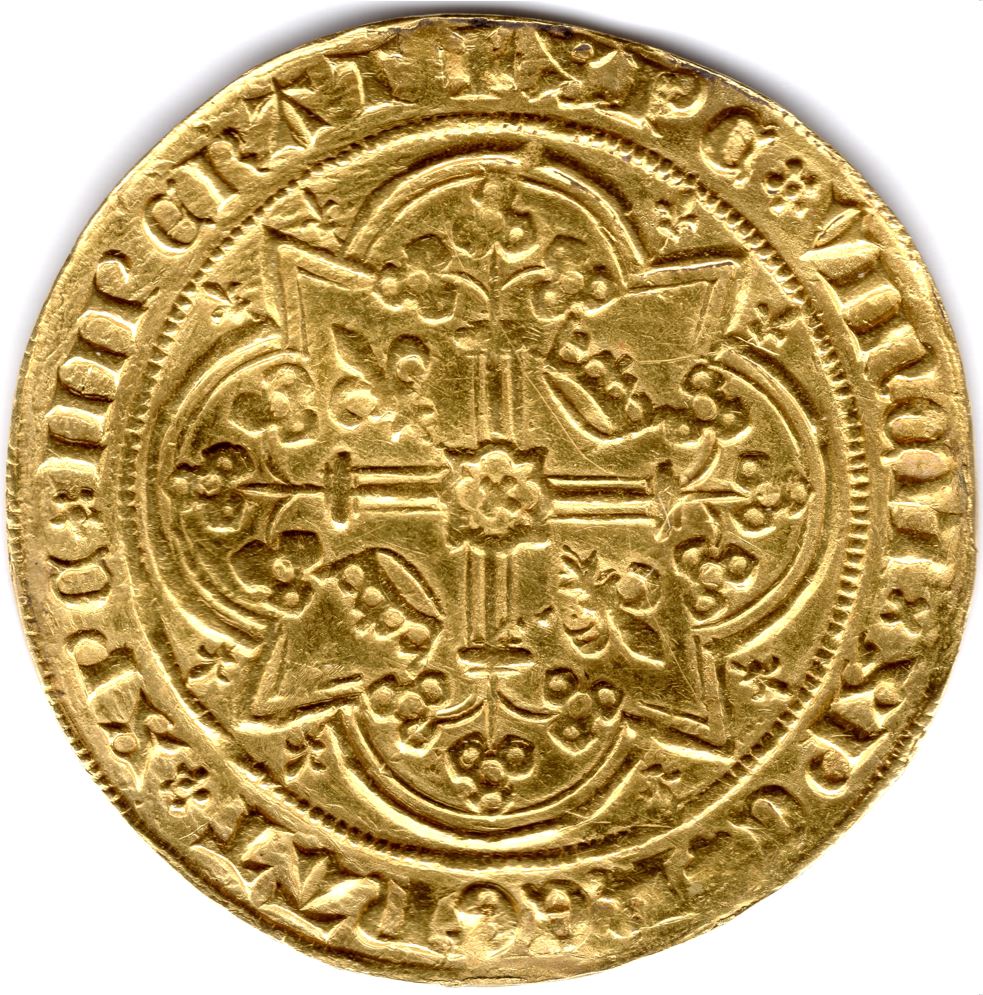
Obv: The king holding sword and the
Hand of Justice, standing under a Gothic arch.
Inscription: KaROLVS DeI GRAcia FRANCORVm REX (Charles by Grace of God King of the Franks).
Rev: Floriated cross in a quadrilobe with crowns and fleurs-de-lys.
Inscription: XPC VINCIT XPC REGNAT XPC IMPERAT (Christ conquers, Christ reigns, Christ commands).
John II's son and successor on the French throne, Charles V, continued to mint the
franc à cheval for a short while, but soon changed to a new design. The
franc à pied - "franc afoot" - was a direct continuation of the first franc, with same fineness and
almost the same weight. The change of design could be to mark that this was no longer ransom money, the message being that things were back to normal. (Not that the war with the English was really over, the Hundred Years War only in its 3rd decade ... but the peace treaty that had led to John II's release in 1360 was still in effect and hostilities would not break out again until 1369.)
What is shown is Charles V's coronation, with some important attributes: He wears the crown of Charlemagne; holds the sword "Joyeuse," which also belonged to Charlemagne; the
Hand of Justice (French:
Main de Justice), a royal scepter that symbolises the king's ultimate jurisdiction. One should probably make note of that under his tunic with fleurs-de-lys, the king wears his armor. On contemporary depictions of the coronation ceremony, he does not. A message to the users of his money about his readiness for war, no doubt.
Note: Charlemagne's sword "Joyeuse" was last used at the coronations of the French kings during the Restauration in the 1800s. Today it can be seen at the Louvre Museum. The
Hand of Justice scepter was used by the French kings since maybe the 12th century (its origins are a bit obscure; on the original scepter the hand was believed to be made of unicorn horn). The one used by Charles V disappeared in the late 1500s, together with Charlemagne's crown, during one of the insurrections that kept the French kings busy through the centuries.






 First Page
 Previous Page



 Posted 12/21/2021 12:36 pm