It might seem a bit odd to post about a pair of commemorative coins issued on behalf of the Philippines within the US Commemoratiive Coin forum area, but bear with me for a minute and you'll understand (hopefully) my reasoning.
The Philippine Islands were a US Territory from 1898 (post Spanish-American War) until 1935 and then a US Commonwealth from 1935 to 1946. From 1903 through 1945, mints of the United States struck coins for the Philippines. All of the US-PI coins included the inscription "UNITED STATES OF AMERICA" on their obverse (the side most collectors consider the reverse) along with either the Territorial or Commonwealth Seal.
The Philippines became a fully-independent nation on July 4, 1946. The first coins it struck as a new nation were the 1947 General Douglas MacArthur commemorative Peso and 50 Centavos coins. MacArthur was honored for his role in helping to liberate the Philippines from Japanese occupation during World War II. The coins were struck at the San Francisco Mint and were designed by
Laura Gardin Fraser. The coins' connections to the US are multiple - US General commemorated, struck by a US Mint and designed by a US artist who had previously designed multiple US commemorative coins.
(Side Note: In addition to my focus on US commemorative coins, I also collect the US coinage struck for the Philippines. I extend my set to include these first releases by the newly-independent Philippines Republic due to their strong US history tie-in.)The reverse of the One Peso coin features a right-facing profile portrait of MacArthur. The 50 Centavos coins also presents a right-facing portrait of MacArthur, but he is presented turned slightly forward. The obverse design on both coins is the Coat-of-Arms of the Philippines.
1947-S Philippines General Douglas MacArthur Peso and 50 Centavos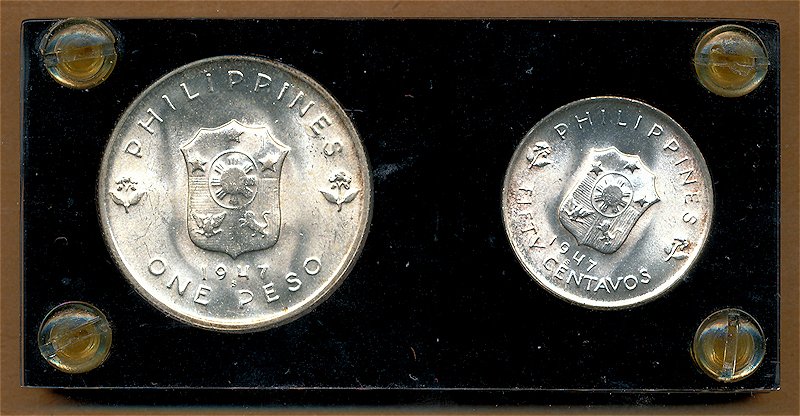
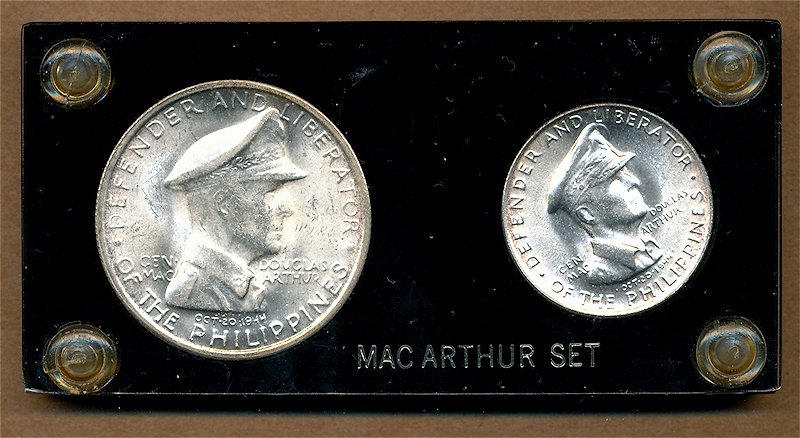
One of the most oft-heard criticisms of the two coins is their shallow relief and lack of design detail.
Laura Gardin Fraser worked on the designs for the coins through much of 1947. It was relatively late in the year before they were finalized and it was not until December 1947 that the SF Mint struck the coins. I've presented images of the plaster models LGF prepared for the coins in talks I've given about the US-PI series and can state unequivocally that her models feature much more detail and depth vs. the coins that were produced. It appears certain that the relief of the models was decreased during the process that reduced the models and created the dies.
Fraser's Plaster Models for the 1947 MacArthur Peso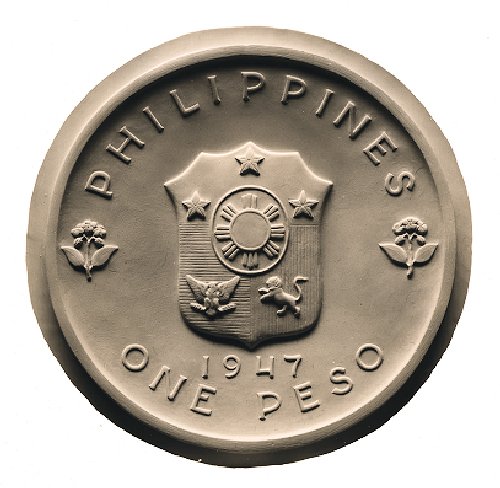
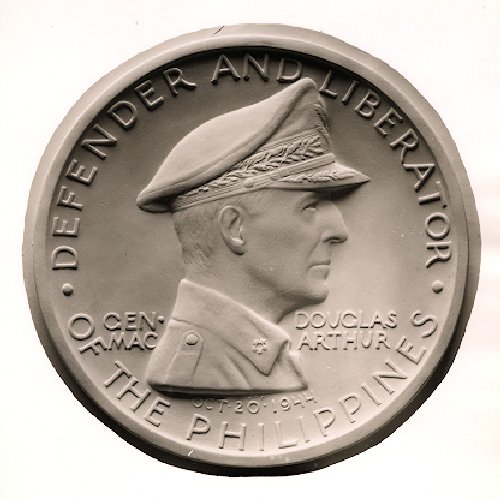
December 1947 was a busy month for the SF Mint. It struck 9.8 million
Roosevelt dimes during the month (28% of its total 1947 output of dimes) along with 1.4 million
Washington quarters (nearly 26% of the branch's 1947 total for the coin). It also struck roughly 100,000 Booker T. Washington commemorative half dollars in December.
My belief is that this high demand for circulating coinage volume caused the SF Mint to make compromises regarding the MacArthur commemorative coins. I believe it was decided to reduce the striking pressure used to produce the coins to extend die life, minimize handling time and complete the Philippines' order as quickly as possible.
Coupled with the low-relief dies, the weak striking pressure used during production created coins that do not live up to their potential. (At least IMO.) LGF can't be blamed for the final product, however, as she created well-executed, attractive designs that would have made excellent coins had time allowed for more proper handling of the Philippine Republic's first coins.
I've picked up multiple of these coins over the years, from graded gem mint state versions, to attractive, choice uncirculated two-piece sets. Shown here is one of the two-piece sets in my collection; its in a Capital Platics holder.
If you enjoyed reading about these coins, you might also find this previous US-PI commemorative coinage post of mine of interest:
-
1935 US-PI Commonwealth Commemorative Coins






 Posted 08/19/2021 3:19 pm





