| Author |
 Replies: 33 / Views: 3,616 Replies: 33 / Views: 3,616 |
|
|
|
Bedrock of the Community
United States
11969 Posts |
Having said that I'll guess on the VF35/XF40 fence from what I can see. Nice even wear and great eye appeal. Could be a weakly struck higher grade coin I suppose.
|
|
Pillar of the Community
 United States
4680 Posts |
Here is the full reverse shot. Even in MS the tip of the horn is barely visible. Thoughts with full reverse? 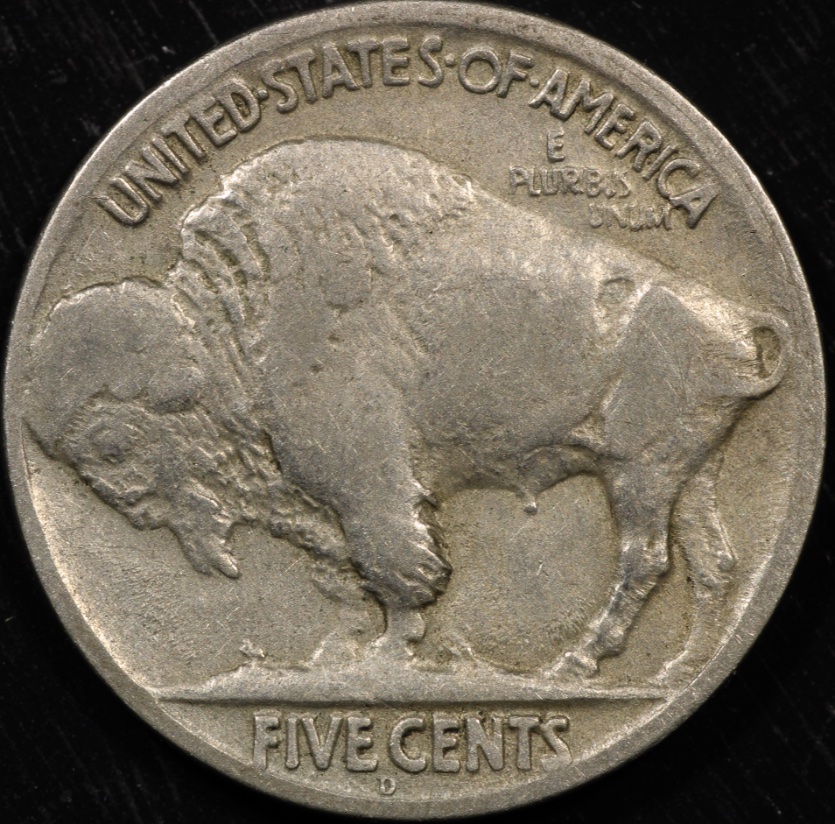 |
|
Bedrock of the Community
United States
11969 Posts |
I guess the same. Not like this is a Fine coin or anything like that.
|
|
Pillar of the Community
United States
3745 Posts |
Now that the bald-headed buffalo has been revealed, here's a bit of history on this variety. The reverse die is LMDS. It originally was paired with a different obverse die. (In the early Buff years, dies, especially at the branch mints, were replaced individually.) The original die pairing resulted in heavy die clashing, in all the usual areas: second feather/buffalo's head, chin/EPU, "LI" of LIBERTY/right rear leg, hairline/ground level, neck/buffalo's back, etc. The press operator grabbed a wire brush and attacked the clashing with gusto. It obliterated the buff's head, but left deep parallel gouges in the buff's hindquarters. Ironically, the second feather clash is still weakly visible between the buff's head and the "U" of UNITED. Several examples exist with the deeply gouged hindquarters. The press operator evidently fixed that problem by further abrading the reverse die, this time obliterating the tail and most of the fur on the rear of the buff, along with a good part of the right rear leg. Speculation here, but the clashed obverse die may have failed or was too worn to leave in place. The present EDS obverse die was then paired with the tremendously abraded reverse die, producing FS-901. That's why there is no evidence of clashing or abrading on the obverse. In short:  The grade refers to the state of preservation of the coin. The coin needs to be graded in comparison to what it looked like when it left the mint, not in comparison to what other coins of the same date looked like when they left the mint. Our Canadian friends have an easy time with this one. Canadian coins are graded exclusively on the obverse. That's what needs to be done with heavily abraded Buffs. FS-901 generally is found in AG/G/VG, and very rarely above EF. This is a spectacular example of this variety. Re-grade entirely by the obverse, and see what you think. The result will surprise. |
|
Pillar of the Community
United States
1694 Posts |
AU/55 I see quite a bit of detail and luster still . Not good at grading these though.
|
|
Bedrock of the Community
United States
11969 Posts |
fortcollins, I think that what you said about the grading of the coin based on how the Mint produced a coin with jacked dies makes sense. But I also feel that an ordinary buyer will be discerning about coins that display a nice full or fuller horn and one that is obliterated like the one in this interesting variety. As a result, the everyday buyer will be concerned very little with why the horn is obliterated and heavily discount the value of a coin like this. A more distinct horn will bring a heavy premium. We see that with the 24s and 26s.
This coin is a different story for knowledgeable specialists like Ty2020b and fortcollins because you can appreciate the lengths the Mint went to, during the run of this difficult to produce coin, to get them out the door in decent shape with the limited resources that the Mint staff had. But for most Buffalo collectors, a coin like this, despite the higher grade than indicated by the horn, is an easy pass onto something more visually attractive with better details.
Coveting a missing leg on a buffalo is part of greater American lore. I don't know if you can say the same for the hornless buffalo.
|
|
Pillar of the Community
United States
3745 Posts |
Fewer than 200 of these have been slabbed. Maybe 20-24 are slabbed above EF. They existed under the radar for a very long time, and were treated as low-grade circulated Buffs. I believe they still exist in quantity, though in lower grades. The key is to look for wildly mismatched obverse/reverse dies, with mid-grade obverse and low grade appearing reverses, then check mm position, right rear leg appearance, and the markers. Even in AG/G/VG, these are worth $50-ish. This is a very tough variety in higher grades. It's well worth the cherry pick hunt. It's an undervalued variety, and there is a window of opportunity right now to snag one below market. The higher grade coins escalate in price rapidly. I had the privilege of handling a stunning MS-65 a few years ago. It was slabbed by a second-tier company, and unattributed. Everyone involved knew exactly what we were looking at, and the negotiations were plenty fun. One of my longtime clients has it now. EDIT: For the record, the one I handled is the condition census coin, only it isn't in the census because it was unattributed in a second-tier slab. It's nicer than the PCGS or NGC census coins. It's the only top grade coin I've ever handled. That's why I'm passionate about this critter. In fairness, when I negotiated its purchase, I needled the selling dealer that it was overpriced for just an "UFF" since it wasn't a whole buffalo.  On this coin, IMHO it is at least AU-55, with a shot at AU-58. Great coin! Edited by fortcollins
10/01/2021 6:04 pm
|
|
Bedrock of the Community
United States
94367 Posts |
With deference to my ignorance on the fine points of grading branch mint Buffs, I'll stick with 45.
|
|
Bedrock of the Community
United States
11969 Posts |
I will defer to your greater knowledge on this subject fc. Just curious, how many people would you estimate are out there interested in paying a large premium for this variety? I guess you only need 2 with deep pockets, but is it a dozen people or hundreds of people, perhaps more?
|
|
Pillar of the Community
United States
3745 Posts |
@numismatic student, There are a couple hundred collectors who would snap up an AG/G/VG example in the $50-$75 range, and maybe a few dozen who would go $200-$250 for a mid-grade. It regularly sells for four figures above EF, and let's just say the one I handled was really deep into that range.
Cherry pickers can still snag the AG/G/VG coins for $5-$10 raw and the mid-grade coins for under $50 raw, so it's a decent flip. There aren't many buyers for the higher grades, but there are very few known coins in those grades. It only takes one . . .
|
|
Bedrock of the Community
United States
11969 Posts |
Thanks for the wealth of knowledge you share with us all the time.  |
|
Pillar of the Community
United States
3745 Posts |
Ha! I hardly have a wealth of knowledge. My wife reminds me regularly that I'm the king of useless trivia.
Don't forget to search slabbed coins for unattributed FS-901s. Even in a second or third tier slab, I'd leave it in the slab. Variety Slabbing Service and others are now doing Cherrypicker Guide varieties, and their stickers are respected. That avoids the risk of dropping a grade on crossover or submission to one of the big two.
|
|
Pillar of the Community
United States
3008 Posts |
Well, after reading everything here, I still hold to my VF-35 grade estimation, and I have been known to buy better date, higher grade teens and twenties mintmarked buffs for less than 5 bucks. Haha  now I have to look at my complete Buffalo nickel set and see if any need upgrading. Thanks as always to fort collins... Edited by mrwhatisit
10/01/2021 6:59 pm
|
|
Pillar of the Community
United States
4680 Posts |
Quote:
The grade refers to the state of preservation of the coin. The coin needs to be graded in comparison to what it looked like when it left the mint, not in comparison to what other coins of the same date looked like when they left the mint Exactly! That was my main goal with this "exercise" if you will, even if we don't have a "definitive" (no such thing) grade. Understanding the series, Buffalo or not, and the many factors that can be involved (strike, die state, etc.) Thank you to fortcollins as always for your much appreciated input and expertise! |
|
Bedrock of the Community
United States
11969 Posts |
Quote:
The grade refers to the state of preservation of the coin. The coin needs to be graded in comparison to what it looked like when it left the mint, not in comparison to what other coins of the same date looked like when they left the mint Quote:
Exactly! That was my main goal with this "exercise" if you will, even if we don't have a "definitive" (no such thing) grade. Understanding the series, Buffalo or not, and the many factors that can be involved (strike, die state, etc.)
Thank you to fortcollins as always for your much appreciated input and expertise! Although you can make up rules for how you grade coins any way you want, so can PCGS and I think PCGS has different ideas, at least for uncirculated coins. PCGS says that for uncirculated coins, the grade depends on eye appeal and the quality of the strike. In their view, two coins with the same state of preservation, if one is beautiful in their eyes and one is ugly again in their eyes, they will receive different grades if they are uncirculated. Furthermore, strike, whether it is an accident of circumstance or the result of die wear, polishing, brushing, mishandling, cracking or outright breaks, will influence uncirculated grades. You may not agree with PCGS, but PCGS will also not agree with you. Everyone has an opinion, and perhaps this is not the most widely held one. |
| |
Replies: 33 / Views: 3,616 |







 First Page


 Posted 10/01/2021 3:53 pm





