In the United States, publicly-supported, laboratory-based research and analysis directed toward investigation of agricultural issues/problems began in 1875 when the Connecticut Board of Agriculture was successful in getting an allocation of public funds to finance a laboratory under its control. This was the birth of Agricultural Experiment Stations (AES) in the US.
In 1877, Agricultural Experiment Stations were created in California and North Carolina. The NC facility was opened at The University of North Carolina - Chapel Hill campus; its original name was Agricultural Experiment and Fertilizer Control Station. The facility was the first of its kind in the southern US.
In 1887, Congress passed the Hatch Act whose purpose was to provide funding for the creation of an "agricultural experiment station" in each state within the agricultural department of the land-grant colleges it had funded previously via the Morrill Act of 1862. The stations were "to aid in acquiring and diffusing among the people of the United States useful and practical information on subjects connected with agriculture, and to promote scientific investigation and experiment respecting the principles and applications of agricultural science." (Hatch Act of 1877)
On March 7, 1887, the NC Assembly created the North Carolina College of Agriculture and Mechanic Arts (the forerunner of today's North Carolina State University). It also designated that the new school would receive the land-grant funds of the Morrill Act (funds that previously had gone to UNC-CH) as well as the Hatch Act funds.
Over the years, the AES system across the US has been a leader in agricultural research and has helped enhance agricultural production across the nation via the introduction of new technologies, products, methods and practice improvements.
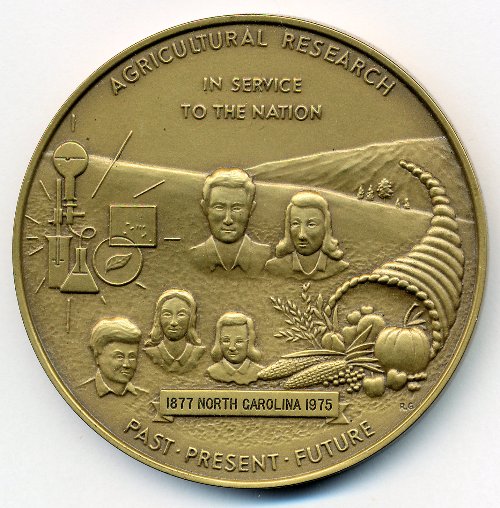
In 1975, the centennial of the first AES in Connecticut was celebrated with a bronze commemorative medal. The medals are 63 millimeters in diameter and were struck by the Medallic Art Company of New York. The obverse of the piece features a map of the US along with research instruments and agricultural products along with a commemorative inscription at the rim. The design on the reverse follows a similar theme with generic portraits of researchers and laboratory equipment overlaid on an open field with a cornucopia overflowing with farm products at the right.
A nice touch on the medal is the inclusion of a blank ribbon on the reverse that could be engraved with the name of each state along with the dual dates of its first AES and the centennial year. Shown is the North Carolina medal with its station-specific identification inscription.
Agricultural Experiment Station Centennial Medal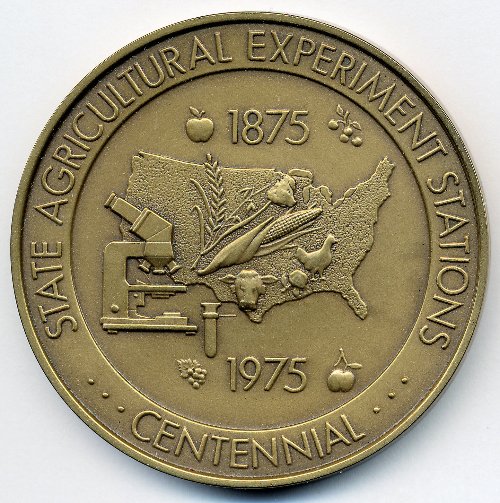
For other of my posts about commemorative coins and medals, check out:
Commems Collection.







 Posted 11/08/2021 11:44 am





