| Author |
 Replies: 227 / Views: 25,718 Replies: 227 / Views: 25,718 |
|
Pillar of the Community
Canada
2655 Posts |
I posted this comment on another forum.... Quote:
I like small Commonwealth island QEII notes & find these to be large variations in terms of pricing, availability & expense. The most to least expensive of the bunch:
Bermuda (not sure why but these are ballistic with no end in sight)
Jamaica (make sense as they were short lived)
Falklands (small # issued)
Trinidad (like Jamaica)
British Honduras (like Trinidad)
Bahamas (pre-decimal & high decimal denoms can be pricey)
& Belize (these are a bargain compared to the above)
British territories:
Isle of Man
Guernsey (older versions only)
Hong Kong ($1 are fairly common & inexpensive)
Gibraltar (some uncommon dates but pretty inexpensive)
Jersey (inexpensive compared to Cyprus & Malta)
Others:
Seychelles (super popular thus expensive- forget the catalogues)
Ceylon (scarce to tough in higher grades & expensive)
Fiji (predecimal & early decimal moderate- later issues cheap)
Cyprus & Malta (almost cheap compared to the above)
Solomon Islands (Cheap) I later realized that I omitted the African colonies & was just scratching the surface. In fact, I had listed the countries I had known to be collected about half a year ago on my NC site. https://sites.google.com/view/notap...world-motifs Starting in Canada, this $20 Large Seal, which features Elizabeth well before her uncle abdicated & anybody knew she would become queen. It had only 200,000 printed which is actually less then the more popular French version: 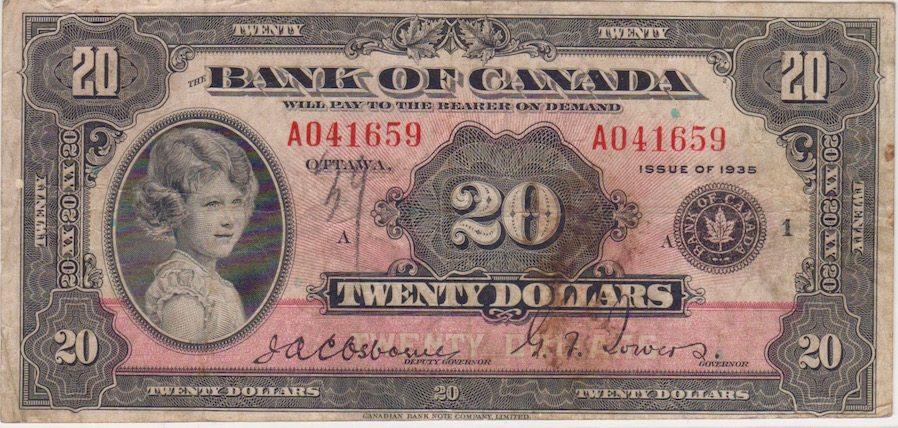 At such low numbers, it can be a tough note to come by & is often found in low grade (like the example above). I believe that there are many nations out there that only printed her image briefly as colonies. Let me know what you have found tough to source. Such a pursuit provides a wide range of nations to collect & I would enjoy seeing other collectors (apolitical) opinions on which countries & denominations have been elusive. |
|
|
|
Moderator
 United States
198004 Posts |
Very interesting!   |
|
Pillar of the Community
 Canada
2655 Posts |
Quote:
Very interesting! -Thanks @jbuck. Great to see one CCF member interested!  I didn't start out with the intention of collecting strictly QEII notes. I just noticed, half-way-through, although I was collecting notes from various parts of the world, many were QEII. And, only recently, I have realized they're quite a challenge for many colonies, some nations, high denominations & a few early series. While the queen first appears on the BOC $20 (BC-9/10 & P-46ab/47) her next appearance is in 1947 on Malta's 10/- & £1 (P-23ab/P-24) well before she's crowned: http://www.banknote.ws/COLLECTION/c.../MLT0023.htm ...but I won't start with Malta, as it would be much simpler to take an A-Z regional approach. The Commonwealth of Australia first designs their $1.00 (P-37a) in 1966 with her image: 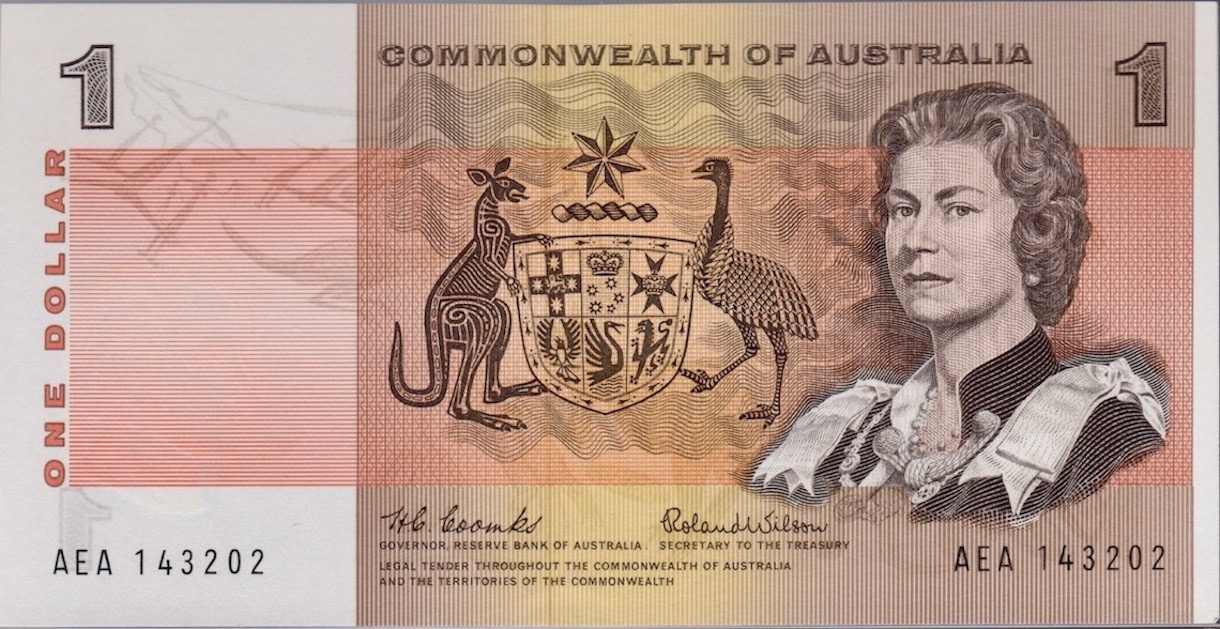 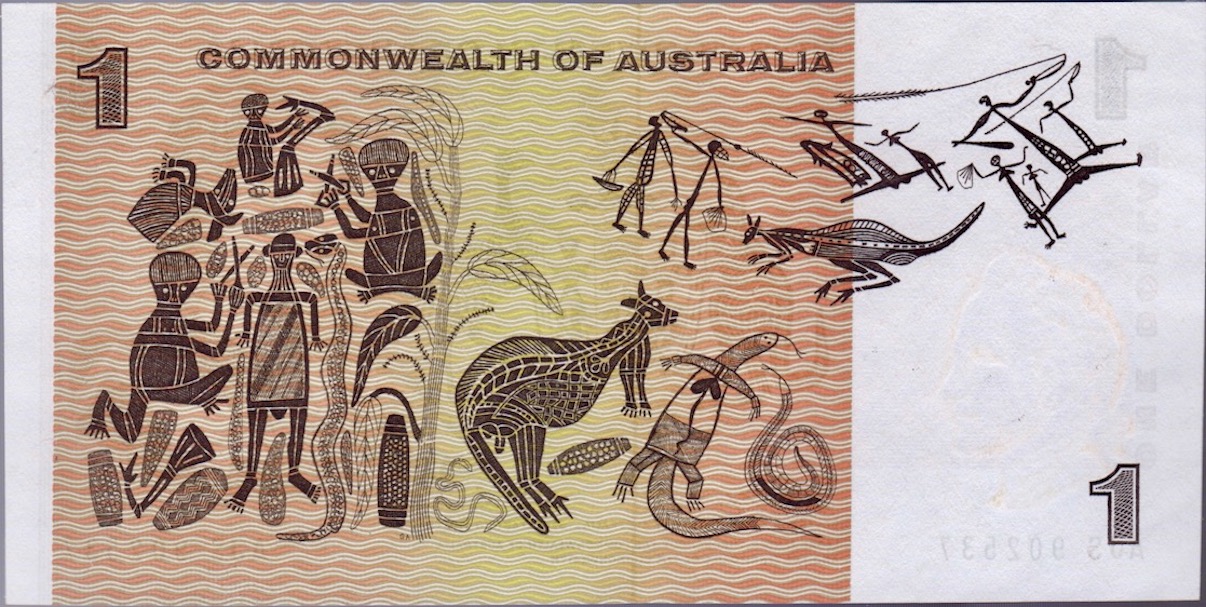 This "Coombs-Wilson" signature combo is not too hard to get since several prefixes were issued before changing to the very tough "Coombs-Randall" (P-37b) version. While this 1968 signature version was tough, (P-37a) also had an asterisk replacement version (P-37ar) which I believe remains the most elusive note to acquire. I remember looking at a few P-37ar replacements from this series about 15-20 years ago and they were listed for thousands (raw) in UNC. I was pretty shocked but just figured world currency would have to wait another decade as these were way out of reach. If there are any CCF members out there who would care to comment (or add additional info to this or subsequent tough notes from Australia with QEII image), it would be great to see. Edited by walk2dwater
12/15/2021 10:10 am
|
|
Moderator
United States
198004 Posts |
I think it is an excellent theme idea. A nice, multi-national series to build and I will enjoying seeing it presented here. I do hope others will join in.  |
|
New Member
Germany
28 Posts |
I do not collect QEII notes cause they are generally too expensive for my small budget.  Though I can't avoid them complete as I collect some countries belonging to her Majesty. Would be glad to hear from you again with the other QEII countries  |
|
Pillar of the Community
Canada
2655 Posts |
When it comes to Australia, it generally is pre-decimal notes that are dear & the series which keeps climbing in FMV (Fair Market Value) due to demand. A 10 Schilling (P-25a), featuring QEII father (George VI) is a good example: 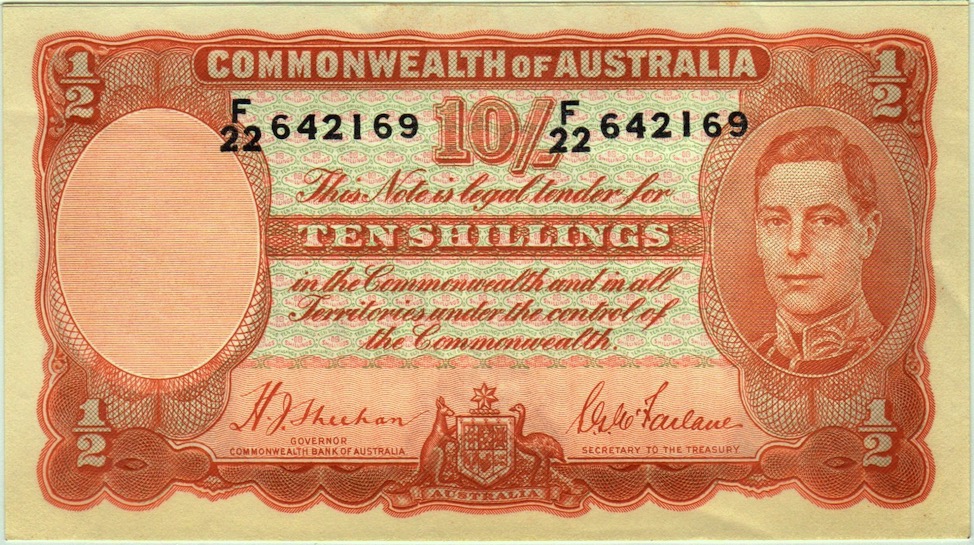 Quote:
I do not collect QEII notes cause they are generally too expensive for my small budget. ...
Would be glad to hear from you again with the other QEII countries I hear you @Dispargum. When I first started putting aside VG to VF CDN banknotes 4 decades ago, I often dipped into my collection as I just could not afford to keep a $5 or $10! [I hate to think what I had to throw back into the wild] I lived in 2 countries & have travelled about 40 but rarely put anything aside from my travels as well. Two things I have learned over the years was that any note is typically just that: any old note & condition is paramount. Most notes we come across in circulation are uncollectible. You have to learn where to source banknotes (ie: don't always continually revert to the easiest/same source) & learn to grade. Once you know what to look for, it becomes a lot easier & you'll develop an instinct for what's a good pick up. For example, I bought P-37a for $20 which was about 3X what I paid for P-42d 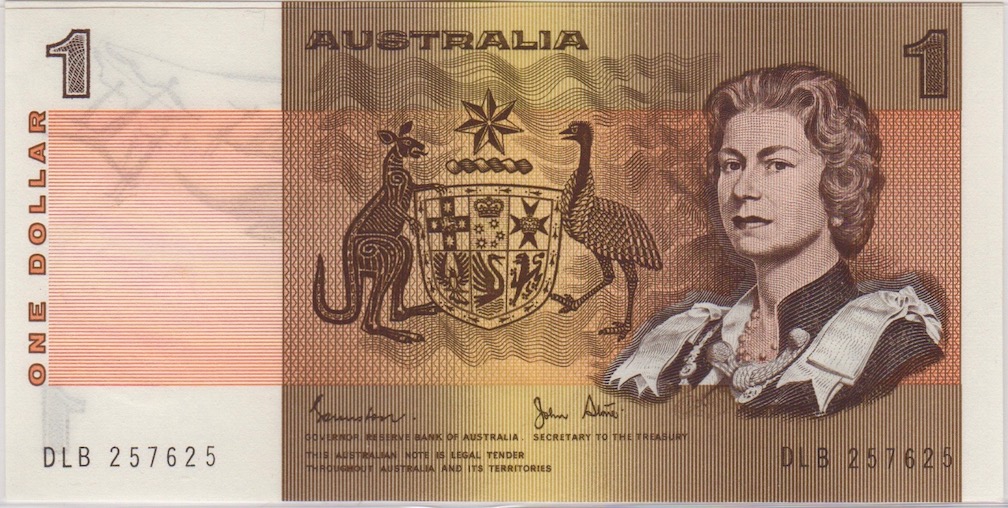 but this later "Australia" version (especially 42-d) is very common & I have seen it many times listed for the same price or less (when sold True Auction style) over the past 3 years. The lesson? Just be patient & never stop searching for different sources (don't get too reliant on a one stop BIN shopping spree). Since Australia produced the first all polymer banknote (the $10) & 4 years later (1992) released: 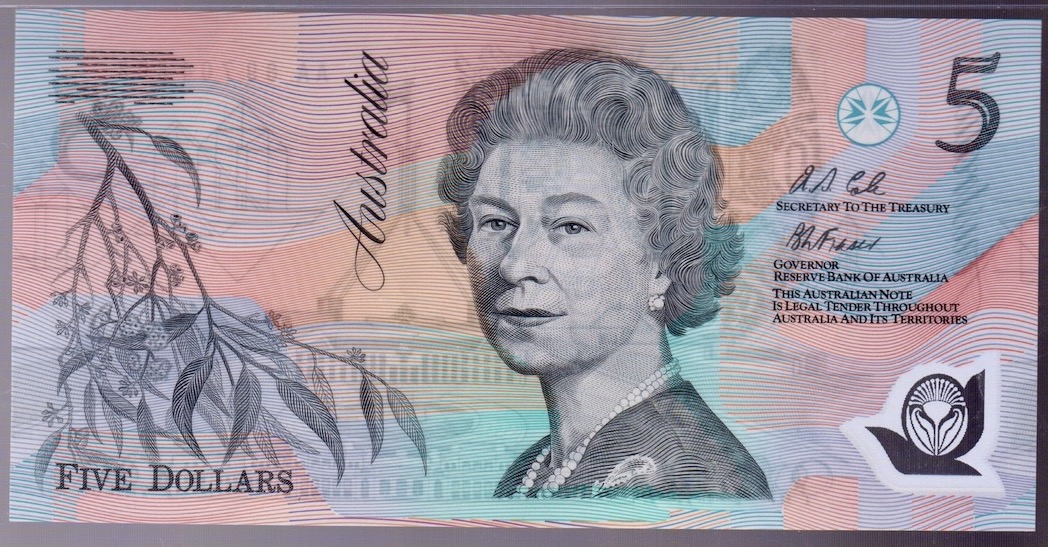 you may find the first (or last) prefix or a signature change-over at a bargain price. That is what I encourage all collectors to do (get educated), be patient & develop an eye (some online knowledge) about what exactly they're after. A few good tips to keep in mind also are: avoid common notes & hyped up listings research what you want avoid listings that don't show the note many world sellers maybe coin collectors & won't notice radar # &/0r low # This last point I discovered right off the bat & "cherry picked" a few. Notice the trends. When I first started getting into world currency I noticed how inexpensive Fiji notes were & realized that they were becoming popular/pricey. So I hunted down a few at fairly reasonable prices & I know I can sell those for a small profit now. Tomorrow, I will move onto "Bahamas." |
|
Moderator
United States
198004 Posts |
Nice examples! |
|
Pillar of the Community
Canada
2655 Posts |
Quote:
Nice examples! -Thanks @jbuck. I think its important to keep in mind that the easy notes are just as important as the tough ones, especially if your goal is to collect OFEC (one from every country) or by region, QEII, etc. BAHAMASIf you're looking for tough QEII notes than you should consider collecting pre-decimal or P-13a-c. These are from the same classical designs that were used with the 1936 King George VI notes (P-9 to P-12). However the reverse of the QEII design is not 2-tone, nore quite as colourful & dramatic. Plus the printers add blue to the £5 (P-16) as its likely that P-12 was getting confused with P-11 (similar front colour schemes). Below is P-13-b with QEII facing left on a 4 shilling note & I have P-13d which I consider pretty easy to compared to the first three signature combinations (don't let the SCWPM BV fool you): 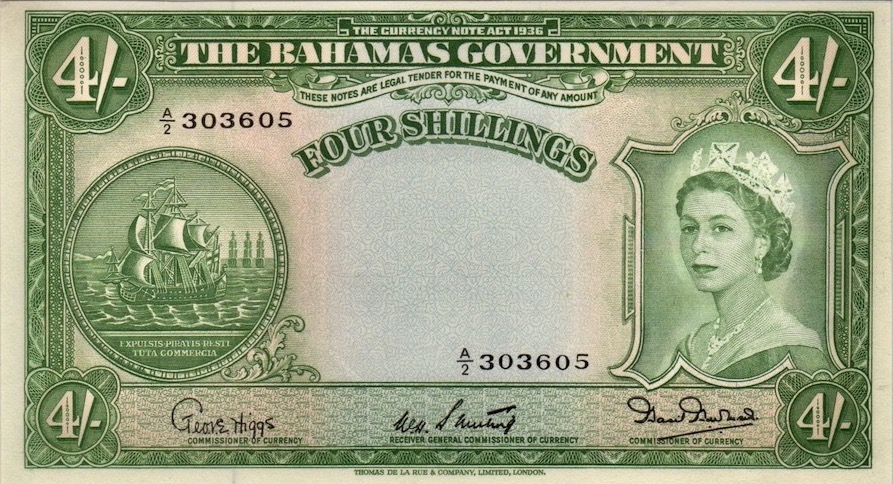 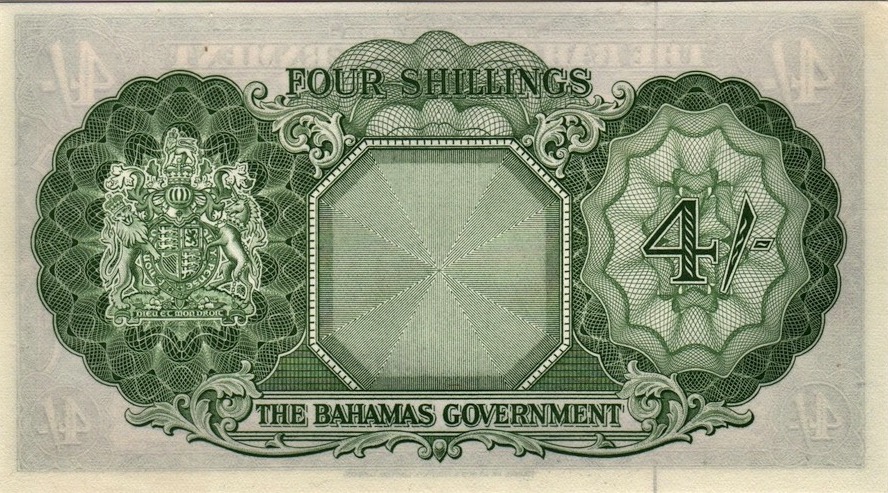 If you want a little more challenging note move up to the red 10 Shilling: http://www.banknote.ws/COLLECTION/c.../BAH0014.htmAll 4 versions of the black-yellow One Pound are scarce in "Q" & high grades. I've seen very few up for auction: http://www.banknote.ws/COLLECTION/c.../BAH0015.htmand the very scarce blue Five Pound: http://www.banknote.ws/COLLECTION/c.../BAH0016.htmis super tough (& expensive) in higher grades. The 1965 "The Bahamas Government" decimal series was covered by @commems when he shared his lovely collection. QEII faces right & the notes bring in the local floral & fauna motifs that Bahamas becomes famous for. The only thing I would add is to keep your eye out for the "Smiley Butler" 3 signature variation as its much more uncommon than the 2 signature one: http://goccf.com/t/409411and I am in still on the look out for the green $5.00 (P-20): http://www.banknote.ws/COLLECTION/c.../BAH0020.htmthough the $10 (P-22) is tough & the $20, $50 & $100 are simply scarce. $5 & higher 1968 "The Bahamas Monetary Authority" are probably just as tough as the 1965 series but I believe the first series is slightly more popular. "The Central Bank of Bahamas" (released in 1974) is the most accessible series of the older QEII portrait but again the higher denominations are the bigger challenge. I remember being so excited to add this P-38a $10 (from 1974) to my collection: 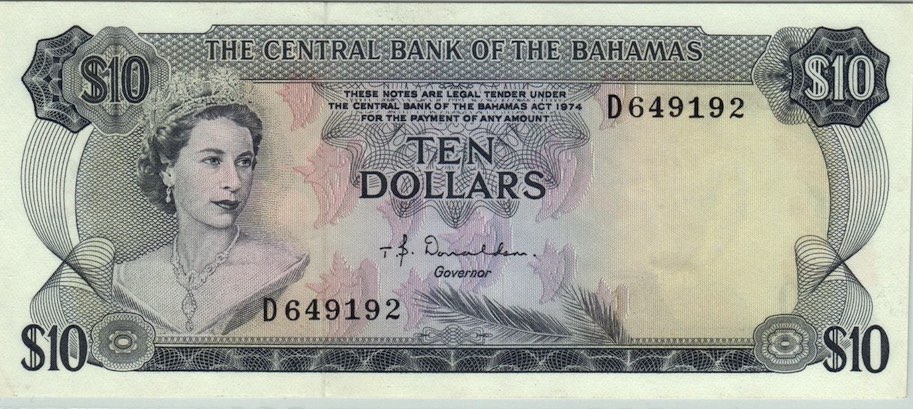 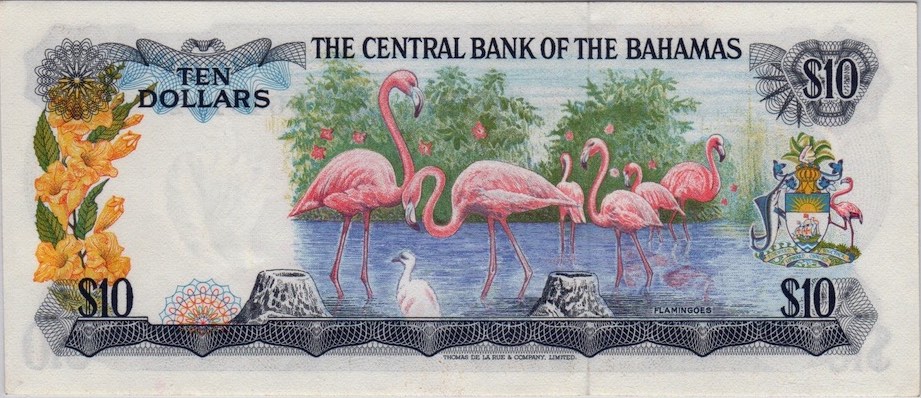 1986 1986 was the next design change bringing in even more local sights & national values. It features QEII with big hair looking straight on like seen on the East Caribbean (2nd Caymans & 2nd Falklands QEII) & many other Commonwealth nations from the same 1980's - 1990's era. Once again, the $5 (P-45): 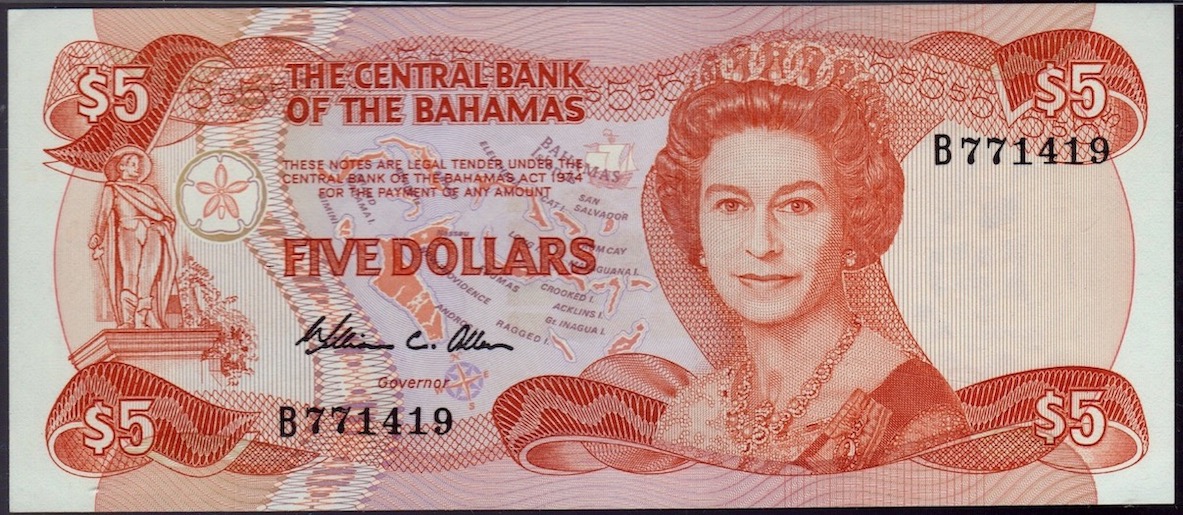 the TEN (P-46), TWENTY (P-47), FIFTY(P-48) & $100 (P-49) can all be challenging in high grades. They can be very pricey. P-44 ($3) is very common & can be had for about $10-$15 USD in Gem Unc. Remember this series has 2 HORIZONTAL serial numbers & many sellers mix it up for the later (1992-1995) Series. Of this later series, the FIVE (P-52) drops QEII for Cecil Wallace-Whitfield & the TWENTY (P-53A) substitutes her majesty for Sir Milos Butler. The back of this note has the old design (ships appearing horizontally) & is much scarcer than P-54 (ships appearing vertically). http://www.banknote.ws/COLLECTION/c...AH0053A2.htmOnce Bahamas introduce some of their own former prime ministers and add vertical serial numbering the notes become a little less dear & easier to obtain in higher UNC grades. Edited by walk2dwater
12/17/2021 2:50 pm
|
|
New Member
Germany
28 Posts |
Fascinating reading. I was so impressed, that I have bought the Australia P37a you have mentioned earlier.  |
|
Pillar of the Community
Canada
2655 Posts |
Quote:
I was so impressed, that I have bought the Australia P37a you have mentioned earlier. -That's awesome @Dispargum! Before we move onto Belize, I would like to stay on "Bahamas" one more day in case any collector would like to add some observations. Most of what I have written is common knowledge & (unfortunately) many sellers prefer flipping (increase the price) with a high BIN (Buy it Now) price of the exact notes I've been reviewing. However, there are still enough True Auction style Listings ( TAsL) where one can find these higher denoms/tougher notes at a lower Fair Market Value ( FMV) since this is always fluid. For example, I have been on the look out for the 1965 3 signature variety (Smiley Butler) P-18b for a couple of years now. Most of them that I do find are listed as such but every 5-10 listings I see, will have one which is not hyped up or BIN. But what usually happens is I will see another nation on my wish list that's TPG (&/or higher denom) and I will pull the trigger on this one, letting the 3 signature slide for another day. When I first noticed P-52 $5 was rarely listed & saw that P-53A (unmodified $20) was listed for twice SCWPM BV, I hesitated. Later these notes kept creeping up in BIN & they plus other higher denoms are getting to be very tough to find for an affordable price on ebay right now. The thing is ebay isn't the only show in town & there are often opportunities to buy these elsewhere. We just need to keep our eyes peeled & actively look around (always keeping in mind condition). Be patient (don't just snap up EF-AU because you've gotta have it- unless you just know its a decent/fair price as you've been watching a long time). And lastly, be very wary (or just stay steer clear) of the QEII notes released in cardboard holders ("Banknotes of All Nations" & such collector's editions). These will often be faded on the display sides (light damage) & would be considered "mounted." Most of these are not UNC (maybe AU) & buyers should not be paying the current prices most sellers are asking IMO. Edited by walk2dwater
12/18/2021 09:40 am
|
|
Moderator
United States
198004 Posts |
Quote:
I remember being so excited to add this P-38a $10 (from 1974) to my collection: Love the flamingos! My mother loves and collects them, so the note reminds me of her. |
|
Pillar of the Community
Canada
2655 Posts |
Quote:
Love the flamingos! My mother loves and collects them, so the note reminds me of her. -Likewise BELIZE:http://www.banknote.ws/COLLECTION/c...m#GOVERNMENTBritish Honduras gained its independence in June 1973 renaming itself Belize. Many collectors go for the earlier colonial version but the first issue (which, other than the name at the top, appears the same) can be tough for the first 2 signatures & higher denominations). " Government of Belize" P-33 to P-37 are dated according to a-1974; b-1975 & c-1976. The $5 only two versions (1975/1976) & it, the $10 & $20 are fairly tough to acquire. I have yet to own one myself but will be trying to remedy that gap in 2022. Next in 1980, a new issue by the " Monetary Authority of Belize" drops the $2.00 & features a very attractive revamped design with fish on the front & their legislative building on the reverse. The One & Five (P-38/P-39) can be easily attained but the Ten, Twenty & One Hundred (P-40-P-42) can be tough. https://en.numista.com/catalogue/note276384.htmlhttps://en.numista.com/catalogue/note276387.htmlhttps://en.numista.com/catalogue/note277143.htmlThe 1983 "Central Bank of Belize" launches 3 denominations in July of that year. Besides the ONE DOLLAR (P-43), the TEN (P-44) & TWENTY (P-45) will be tough ones again. The coat of arms for this series is modified only 4 months later (November 1st 1983) for the ONE DOLLAR (P-46) so be sure to check the dates of your notes. P-47 ($5.00) to P-48 ($10) were released later (1987 & 1989) with P-49 ($20) having a successive (1986/1987) release. The top 3 denominations have always been quite tough to attain in higher grades. The last large format series from 1990-1994 have been my personal favourite for the exotic birds/animals they place on the reverse designs. They're also a little less expensive than Bahamas or other Commonwealth nations. Here is P-52a which can be easily found & purchased for a reasonable price: 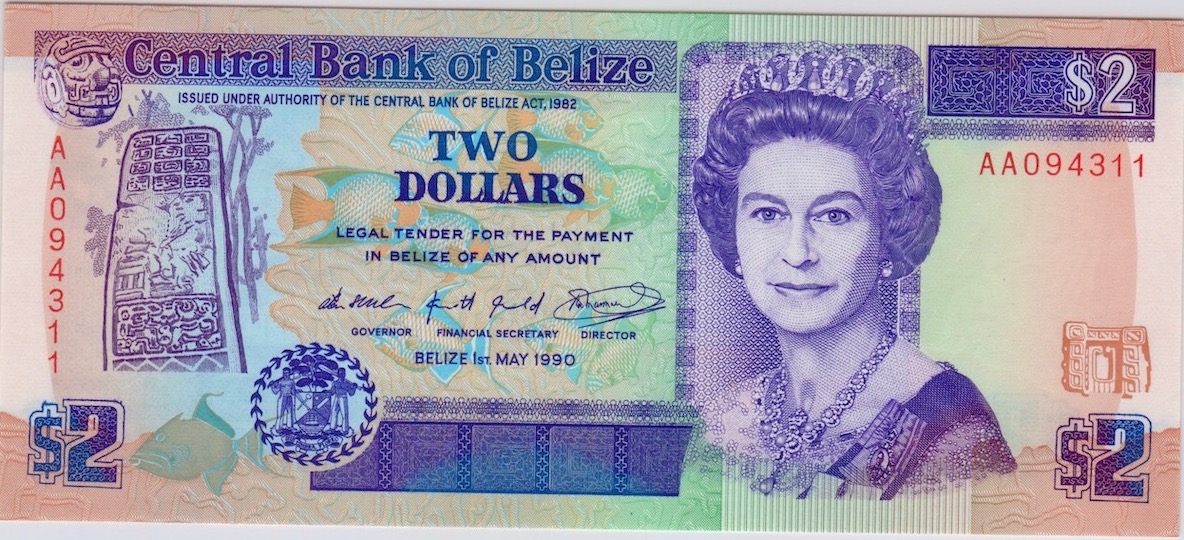 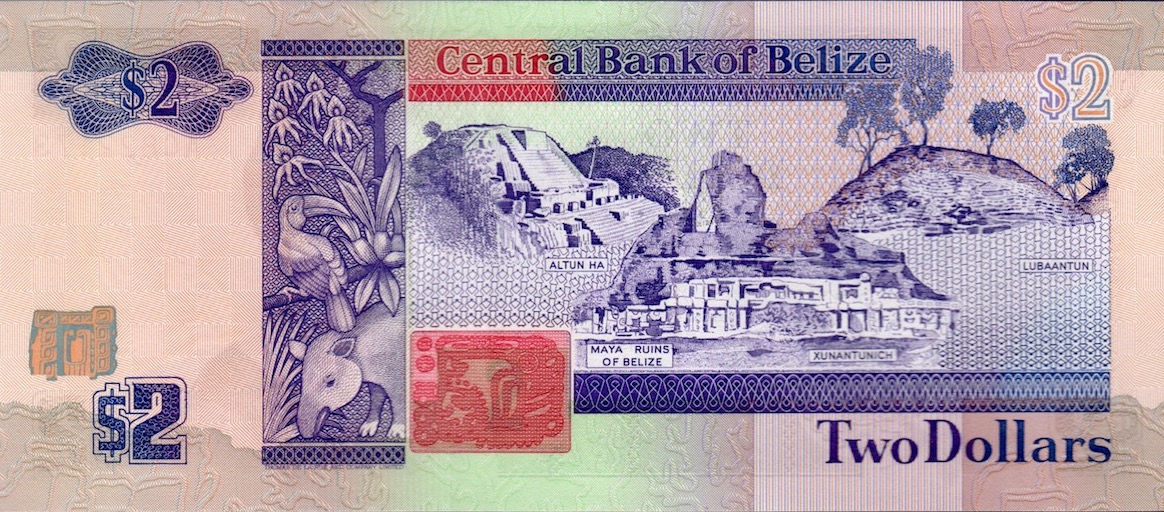 P-53 ($5.00) to P-57 ($100) should not be that difficult but prices have remained high likely due to the fact that past series have been expensive. The 1990-1994 also introduces the first $50 denomination. A segmented thread is introduced in 1996 for the $5 (P-58) & $10 (P-59): https://en.numista.com/catalogue/note224920.htmlhttps://en.numista.com/catalogue/note224921.htmlYou may have noticed a renaming pattern that is similar to Bahamas, and like this nation it is the earlier/higher denominations that are most challenging to acquire. |
|
Moderator
United States
198004 Posts |
Lovely example! |
|
Pillar of the Community
Canada
2655 Posts |
Quote:
Lovely example! -thanks @jbuck, just wish I had a few more older examples! BERMUDABermuda, like Belize, modifies its earlier BWC printed design (of the King George VI series) and inserts the QEII portrait. In 1952, the " Bermuda Government" pre-decimal notes carry on the low denominations: A brown short-lived P-18 Five Shillings note (a & b) replaced by a coin in 1959: https://en.numista.com/catalogue/note202480.htmlA red longer running 10 Shillings note (P-19a,b,c) printed in 3 versions: https://en.numista.com/catalogue/note254394.htmlThe very popular blue-yellow £1 (P-20a-d) printed with 4 variations: https://en.numista.com/catalogue/note254395.htmlTwo first two have no security thread (toughest) while the 3rd & 4th have the security thread. The last version (P-20d) seems to be far more common than the other 3. The very scarce orange-yellow £5, P-21 which had very low numbers printed & issued: https://en.numista.com/catalogue/note275712.htmlThe seldom seen £10 with a tiny 250,000 (P-22) issued in 1964: https://en.numista.com/catalogue/note253967.htmlMy example of P-19b: 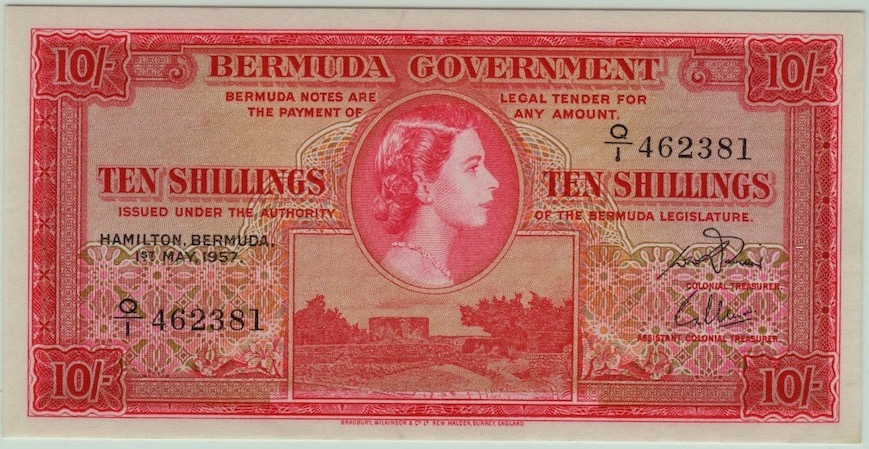 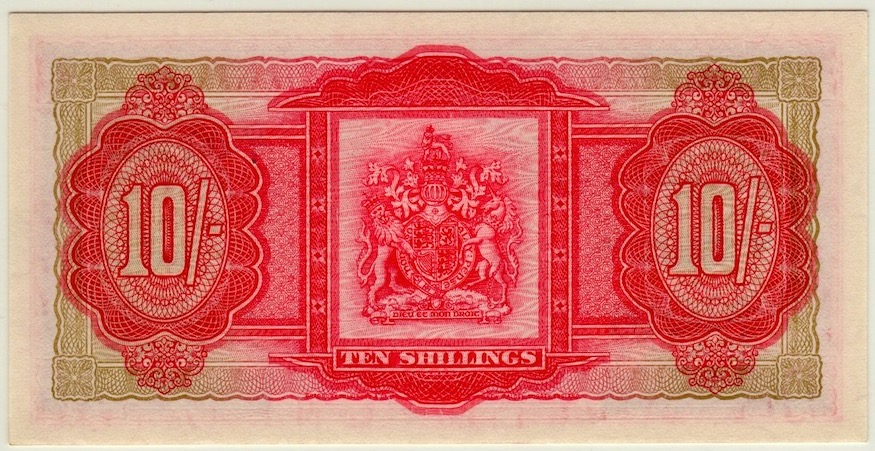 The " Bermuda Government" changes their design & currency (Dollar System) in 1970: ONE DOLLAR:https://en.numista.com/catalogue/note224926.htmlP-24 FIVE DOLLARShttps://en.numista.com/catalogue/note275834.htmlP-25 TEN DOLLARShttps://en.numista.com/catalogue/note275835.htmlP-26 TWENTY DOLLARShttps://en.numista.com/catalogue/note253968.htmland P-27 FIFTY DOLLARShttps://en.numista.com/catalogue/note275838.htmlOnly the mid-high denominations (P-25,26 & 27) are tough. Their prices, on the other hand, have shot through the roof. Why? It's anybody's guess but be aware that Specimen sets are quite easy (CHEAPER) compared to issued notes. I would avoid stand-alone specimens. Similar to the other nations discussed (Bahamas & Belize) Bermuda switches to " Bermuda Monetary Authority" in 1974 but the designs remain the same. Here is my example (P-28 1982): 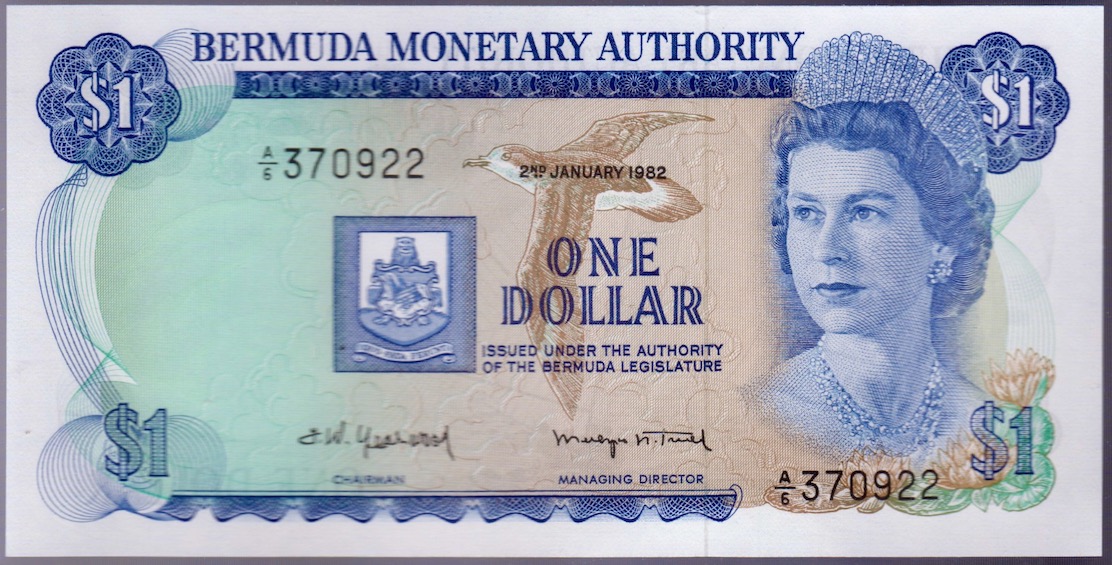 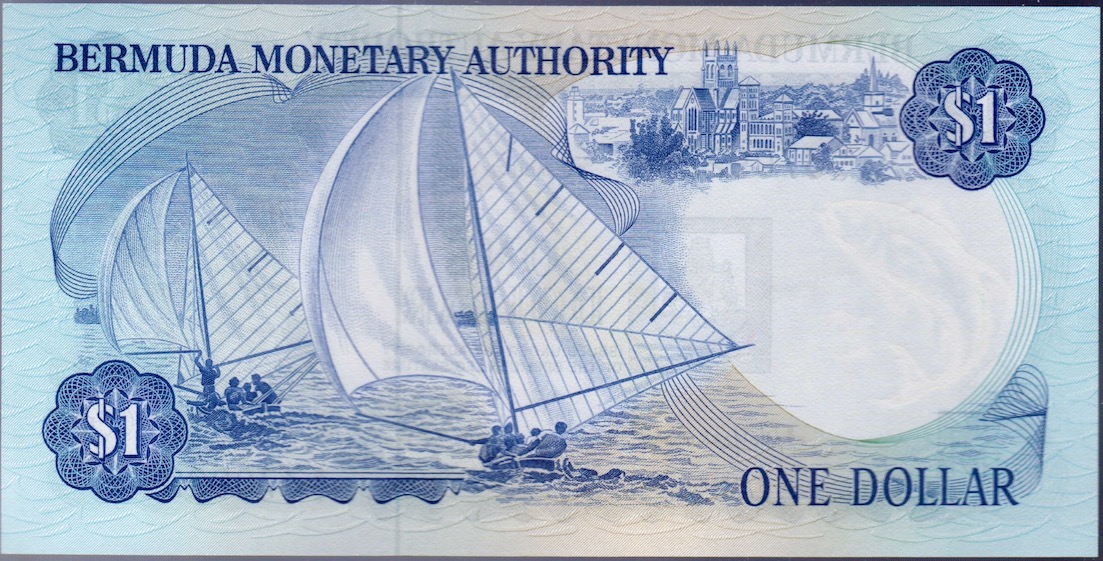 As you can see, the decimal system notes bring in motifs & symbols that better reflect Bermuda's unique national identity. Just like the previous series, the "Monetary Authority" has the same denominations but many signature variations as the series extends for another 14 years. They also add a tough $100 denomination (P-33) in 1982 which runs for 4 short years. In 1988, the Bermuda Monetary Authority redesigns their notes, drops the $1 for a coin, and introduces the $2 (P-34): https://en.numista.com/catalogue/note224924.htmlThere are 2 lines of text under the 1988 TWO DOLLARS & 3 lines of text under the next revised issue in the 1992-1999 issue. You can easily see the difference in the FIVE or any of the following denominations: P-35 FIVE DOLLARS: with 2 lines of text from 1988: https://en.numista.com/catalogue/note275846.htmlP-41 FIVE DOLLARS with 3 lines of text from 1992-1999: https://en.numista.com/catalogue/note224922.htmlThe big surprise for "Bermuda Monetary Authority" came in their next 2000 Series with the P-50b TWO DOLLARS released May 7, 2007 accidentally: https://en.numista.com/catalogue/note205517.htmlas bank officials were supposed to wait for the next series from 2009. Only a small quantity of these notes were released and are considered quite scarce (very expensive in any condition). I am still baffled why the current market of collectible Bermuda banknotes is so white hot. Certainly, P-21/P-22 no doubt are scarce & some of the higher denominations (P-25 to P-27) of the first "Bermuda Government" DOLLAR issues, but many of the 1980's versions are just crazy. I cannot think of any other comparison (except perhaps what has happened with notes from Sarawak, Straits Settlements and some African colonies). However, most of the colonial issues are very scarce in nice condition whereas some of the Bermuda predecimal and later versions are plentiful in high grade but priced in the stratosphere (IMO). Edited by walk2dwater
12/20/2021 10:58 am
|
|
Moderator
United States
198004 Posts |
Very interesting how different the styles are with these two. |
|
Valued Member
United States
413 Posts |
@walk2dwater,
Thank you so much for sharing fascinating tidbits on QEII banknotes!
My biggest mistake was selling older Cayman Islands notes, thinking I could get them easily next time as I need to raise some funds. When I was ready to collect them, the asking prices are skyrocketed. Sad, yes, but the market can be funny at times. Hard to understand this because the notes are made of paper (and now polymer).
Now I concentrate on the UK notes especially Scotland and NI along wifh England. I do collect isles such as Isle of Man, Guernsey and Jersey. Also, The Rock.
Anyway, I am looking forward to learn more about the notes here! I subscribed to this post so I do not miss out on your posts. :)
I wonder what happens if Her Majesty had passed on and does that mean the value of banknotes increased tremendously? I must admit I will be cringed seeing Charles on UK coins and Bank of England notes.
|
| |
Replies: 227 / Views: 25,718 |







 Posted 12/15/2021 10:04 am


