| Author |
 Replies: 114 / Views: 9,519 Replies: 114 / Views: 9,519 |
|
|
|
Pillar of the Community
United States
4705 Posts |
Edited by jimbucks
11/09/2022 8:59 pm
|
|
Valued Member
 United States
108 Posts |
I just e-mailed Tony.
I just learned that Germany made medals out of Uranium in 1956!
|
|
Pillar of the Community
United States
6437 Posts |
XRF scans through plastic may be very inaccurate. My local coin shop has a machine they use for checking jewelry. They scanned a platinum eagle in an NGC slab and the result was about 65% platinum plus a host of other elements. When the same unit scanned a raw Pt eagle the result was 99+ % Pt.
|
|
Valued Member
United States
108 Posts |
Edited by philoponus6
11/11/2022 10:32 am
|
|
Valued Member
United States
108 Posts |
Here is a photo! Not a lot of natural light today. There is also some mint luster remaining, and the reverse looks uniformly the same as the obvers. The coin was returned by NGC with a red dot sticker, and no explanation. 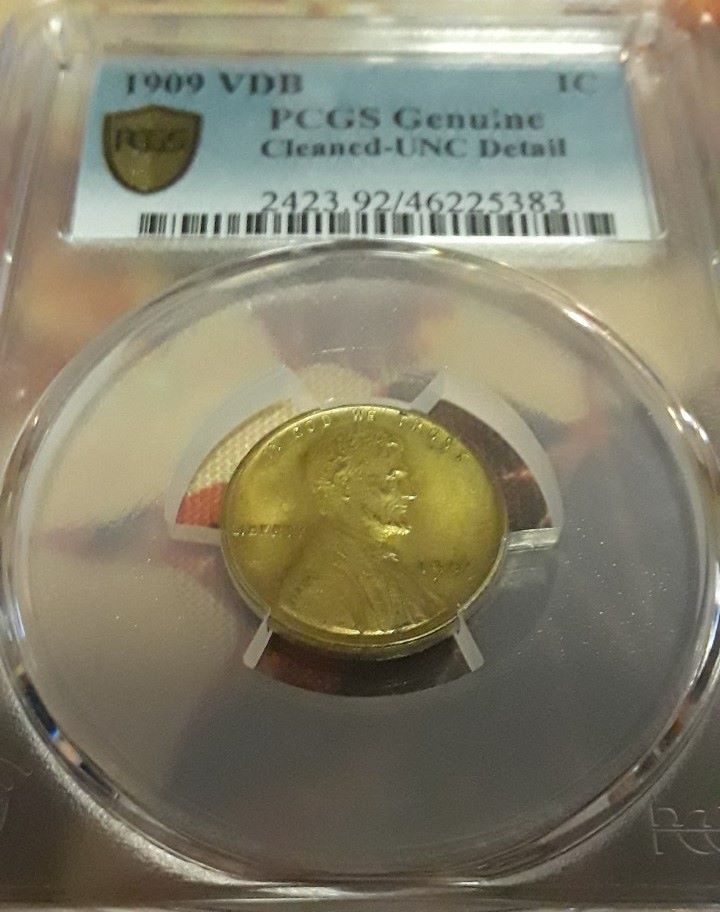 Edited by philoponus6
11/11/2022 3:42 pm
|
|
Pillar of the Community
United States
4705 Posts |
Plastic between the target object may indeed affect the reading, which doesn't surprise me. See page 10 of this reference. https://www.epa.gov/sites/default/f...fog_reg4.pdfOf course W would not be expected to occur in plastic. Suggest a repeat XRF be performed without anything between the coin and the detector if OP is cracking the coin out. I would also do an XRF on a control sample of a copper Lincoln Cent to make sure a false XRF reading is not occuring. Don't see that the current PCGS holder adds any value since it does not mention material so I would not hesitate from cracking it out. |
|
Pillar of the Community
Canada
6244 Posts |
I will give my opinion now on this very interesting post. 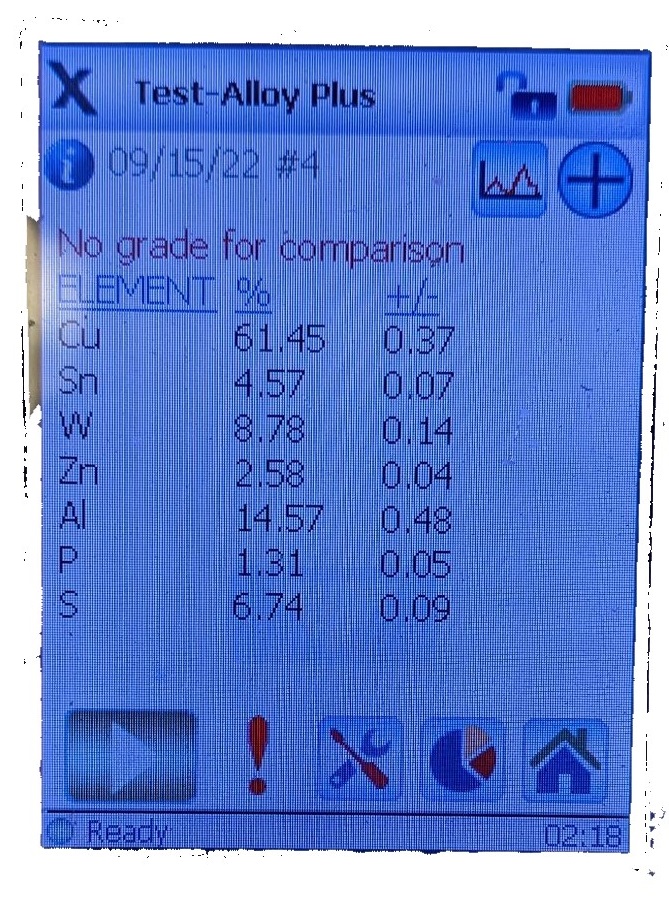 I took in consideration the result of the XRF (which was perform with an hand held XRF and not by a professional rotative XRF). BUT if WE presume the results are correct, then we have questions to put about alloy. The alloy composition show a combine between others alloys. WHY? because if we analyze the composition will be impossible to achieve. 1. LET go with melting points and the boiling points of the chemical components. (over the boiling points the chemical element will evaporate because the ionization will broke) first the melting poin and second the boiling point in Celsius degrees. a. Cu 1083 2567 b. Sn 232 2217 c. W 3410 5660 d. Zn 420 907 e. Al 660 2467 f. P 44 280 g. S 112 445 If look at those numbers we will understand that in 1909 was no technology to made this alloy. The elements here could not be melt in alloy independent if we do not have an previous alloy. I will not enter more inside the different possibility of combine the alloys, just give you a link of the W (tungsten) history of applications. https://www.visualcapitalist.com/hi...ongest-metalIn my opinion it is a copy, very nice done and due to the fact the China use the most of the tungsten (for molding rods) at 97% of the word production I presume has this origin. I will download and analyze the coin as per strike. Was long but I hope in some how useful. |
|
Valued Member
United States
108 Posts |
Here is another fact, not previously mentioned. The coin has been in storage since sometime before 1996. That I know for certain. It was purchased as part of a collection of a man who had a stroke in 1996, and died in 2001. I don't believe the Chinese were producing fakes back then.
The melting point of Tungsten does present a problem, however.
|
|
Valued Member
United States
299 Posts |
And the plot thickens.  |
|
Pillar of the Community
Canada
6244 Posts |
The Chinese produce fake coins and paper moneys from 2000 years. This thing was never forbidding there. The early US coin produce I know go back in early 1980's.
the point it is your coin alloy was impossible to be produce in 1909. To produce this alloy is need really new metallurgical technology. In 1909 no one in the word produce alloys in high pressure. Sorry you have to understand this.
The fact the coin it is in storage from long time and was not affected it is due to the content of W, which will keep your coin as is in any environments you will put. Only some few mild acids can affect. Please read the link of the history of the W and you has the answer.
|
|
Valued Member
United States
108 Posts |
I would wonder though, if it is a fake, why would someone go to the trouble (pre-1996) of making such a fake, if it was never presented as such.
Many of the coins in this collection are in 2x2 holders with rusty staples, and a fair number of them are in very stiff PVC pages - all very dated.
This particular coin was in an old 2x2 cardboard coin holder, and labeled "1909 VDB Gold Plated".
I do plan on taking the coin out of the PCGS holder. JimBucks is right - the holder doesn't add any value.
First I am going to measure the specific gravity and weight. Then I will look to have another XRF scan done, together with a control cent.
|
|
Pillar of the Community
Canada
6244 Posts |
The weight could give you an direction.
The specific gravity is direct proportional with the alloy, the temperature, the altitude, electromagnetic field and more.
The XRF on rotative, will cost you more.
The most accurate test it is EDS-EDX which cost much more.
So it is your coin, your choice, And to explain why those 1909 coins has many replica, from long time this year has a really high price and hard to have. If I look at the parabola of the price, today drop a little bit by rapport of the prices, time and inflation, but still be one of the most wish coin in Cents.
Up to you my friend (all here I consider as my friends)
|
|
Valued Member
United States
108 Posts |
Silviosi,
My point is there are still a lot of unanswered questions. If there is Tungsten in the coin, I agree that it is probably a fake.
The specific gravity of this coin should be about 5.7. Previously I said it would be over 8 but made the false assumption that the XRF percentages were by volume, and not mass. By mass I calculated a figure of about 5.7. Copper is 8.96.
What if the specific gravity is not 5.7? Then we have a false reading on the XRF and still the odd color that is more than a surface property, and not necessarily Tungsten present. As I mentioned earlier, my son scratched the edge and the yellowish color continues below the surface.
By the way, the most likely solution all along was that it is a fake.
China has indeed been producing fakes for quite a while, but the ones I looked at 10-15 years ago were not convincing. I don't believe any Lincolns they produced in the 1990's or earlier could fool PCGS, as this coin might have. Maybe someone can chime in here. China fakes good enough to fool PCGS is a recent thing, I believe.
|
|
Valued Member
United States
108 Posts |
Silviosi,
Thanks for all the useful information! I really appreciate it!
|
|
Pillar of the Community
Canada
6244 Posts |
Compare the specific gravity yes could be a test, if you has the official specific gravity. From part to other part of the roll could go more or less then the approved number (not to much). As per alloy composition to calculate the specific gravity and to has a correct results is very hard with out to know when the mint performed what was the temperature of the environment, the coin, the altitude, the liquid they use and his temperature. Mathematical this will never be exact or needier near. You wrote here in the same time I wrote, and I will answer to only one point: the TPG. They do not perform big tests to the coins if it is not really a big almost unique coin. So fake coins many time was certify as good. Your coin inside show the same color because has W., Cu, Sn, Zn and AL. Al and W will made the very vivid gold color and protect against the outside agents. Good luck and I still look from your results investigations. After I will analyze the photos I will come back. |
| |
Replies: 114 / Views: 9,519 |





 First Page
 Previous Page


 Posted 11/09/2022 9:13 pm





