| Author |
 Replies: 114 / Views: 9,522 Replies: 114 / Views: 9,522 |
|
|
|
Valued Member
 United States
108 Posts |
So much for facial recognition software. A computer scientist told me a few years back that it can be very inaccurate. Maybe if they took into account carbon spots?
|
|
Valued Member
United States
108 Posts |
The carbon spots previously spotted do give a certain amount of evidence that the coin has some age. There is some patina, although the yellow kind of washes it out in photos.
|
|
Valued Member
United States
108 Posts |
Here is a closeup of the LIBERTY. Not sure if the photo is compelling for doubling, but here goes: 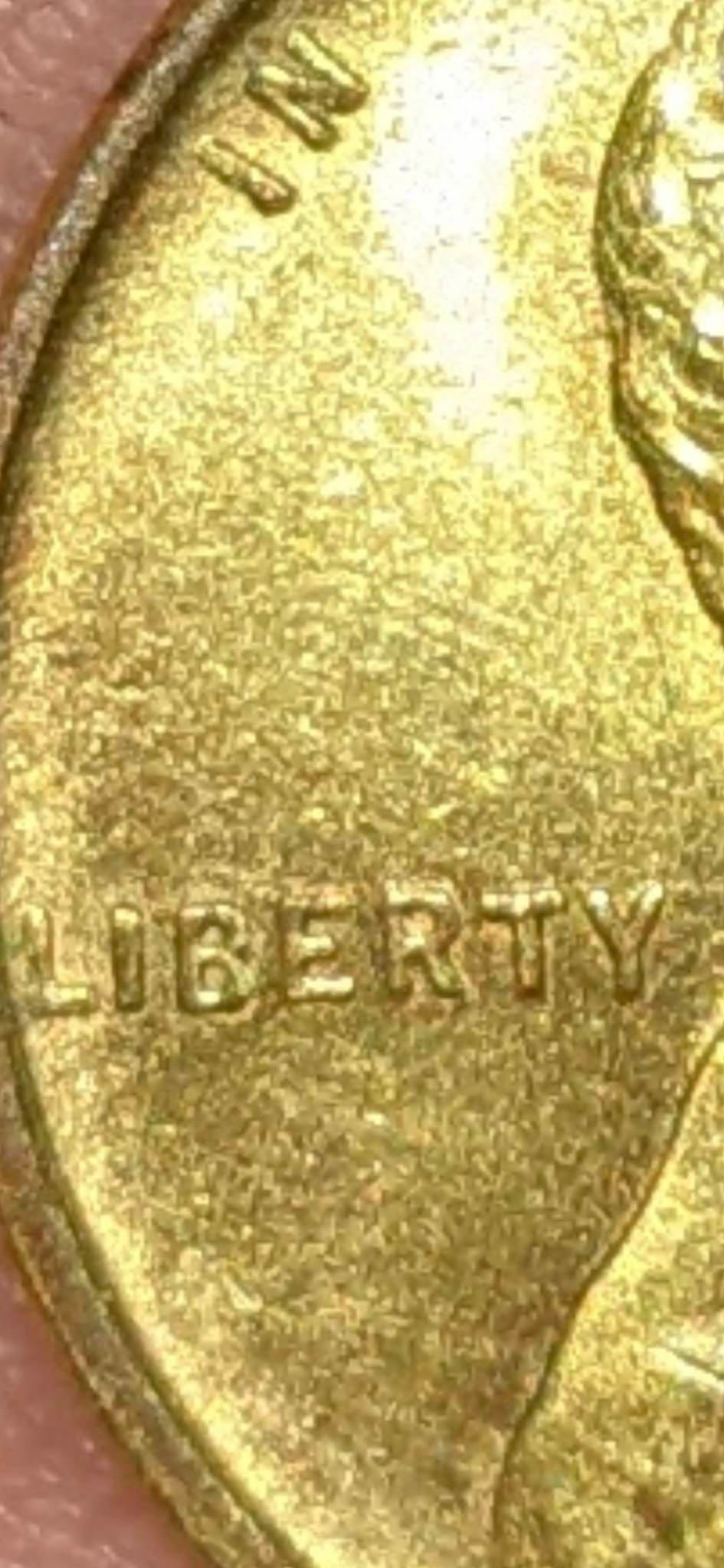 |
|
Moderator
 United States
34549 Posts |
No sorry not compelling at all for being doubled. Probably worth moving on with discussing another coin. I'm not sure that there are any new angles left on this one.
"If you climb a good tree, you get a push."
-----Ghanaian proverb
"The danger we all now face is distinguishing between what is authentic and what is performed."
-----King Adz
|
|
Valued Member
United States
108 Posts |
Also on the docket: grain size and shape. Tungsten looks much different than bronze, and we might be able to see the Tungsten grain, given the way it is all put together.
Edited by philoponus6
11/16/2022 06:14 am
|
|
Valued Member
United States
108 Posts |
XRF: going to be a couple weeks
Specific Gravity: Waiting for a new, holderless XRF to be done
Philadelphia Mint Archives: Posting on a message board of history nerds. I do know a very good research librarian.
In the meantime, I am very busy earning dollars, rather than researching a cent.
|
|
Valued Member
United States
108 Posts |
From NGC customer support:
Thank you for contacting us. Our graders noted that this coin would not cross at the requested grade. This is possible because they could not confirm the coin's authenticity or because of the condition, You can have the coin removed from its holder and try resubmitting it. We can not guarantee this coin would be graded however as this is up to our grading team once they have the coin in hand.
If you have any other questions, please let us know. Thank you!
Matthew M.
Customer Service
Certified Collectibles Group
|
|
Valued Member
United States
108 Posts |
The owner of the VDB pre-1996 was a machinist, and the thought did cross my mind of him having access to some sophisticated equipment to make a forged coin for the fun of it.
So, I spoke to a manufacturing engineer who is really, really knowledgeable. His father wrote the first CADD text, and put together the 3rd CADD lab in the country (after MIT and Cal Tech), and the son has worked in manufacturing and academia for a total of 35 years. He said that would have been impossible, or close to it.
|
|
Pillar of the Community
United States
4705 Posts |
Quote:
Also on the docket: grain size and shape. Are you going to use a SEM? |
|
Pillar of the Community
Canada
6244 Posts |
|
|
Valued Member
United States
108 Posts |
Jim, I have been told 10x magnification will suffice to see the grain. In other news, here is a fascinating resource for mint documents from 1909. You will have to copy and paste the URL, for some reason. https://archive.org/details/newmannumismatic?and[]=year:%221909%22 I plowed through hundreds of pages of correspondence between the mint director and the Philadelphia mint for 1909. So far I have discovered no record of an order for a die trial with Tungsten. There is record of die trial orders for the Lincoln Cent, and explicit instructions to destroy the trials, but no mention is made of the alloy. I will assume the alloy was bronze. Release of the Lincoln Cent began on August 1st, 1909 and people loved the Lincoln Cent. One drawback is they tended to get stuck in slot machines so there was talk of remaking the cent a little thinner. The mint director (acting director, at the time) tested out the Lincoln Cent in slot machines, and found only 1 in 15 gave him trouble. There are letters pertaining to chief engraver Charles Barber (1840-1917) and Victor D. Brenner, including the removal of the VDB. Brenner was paid $1,100 for his work at the mint. Two gold medals were also ordered for the Wright brothers - I would love to have one of those! Edited by philoponus6
11/17/2022 06:35 am
|
|
Valued Member
United States
108 Posts |
Here is a record of dies which were destroyed on Jan 3rd, 1910. Standard practice was all obverse dies were destroyed, and any worn out reverse dies. There are a lot of VDB dies in there, no doubt, probably some never used. 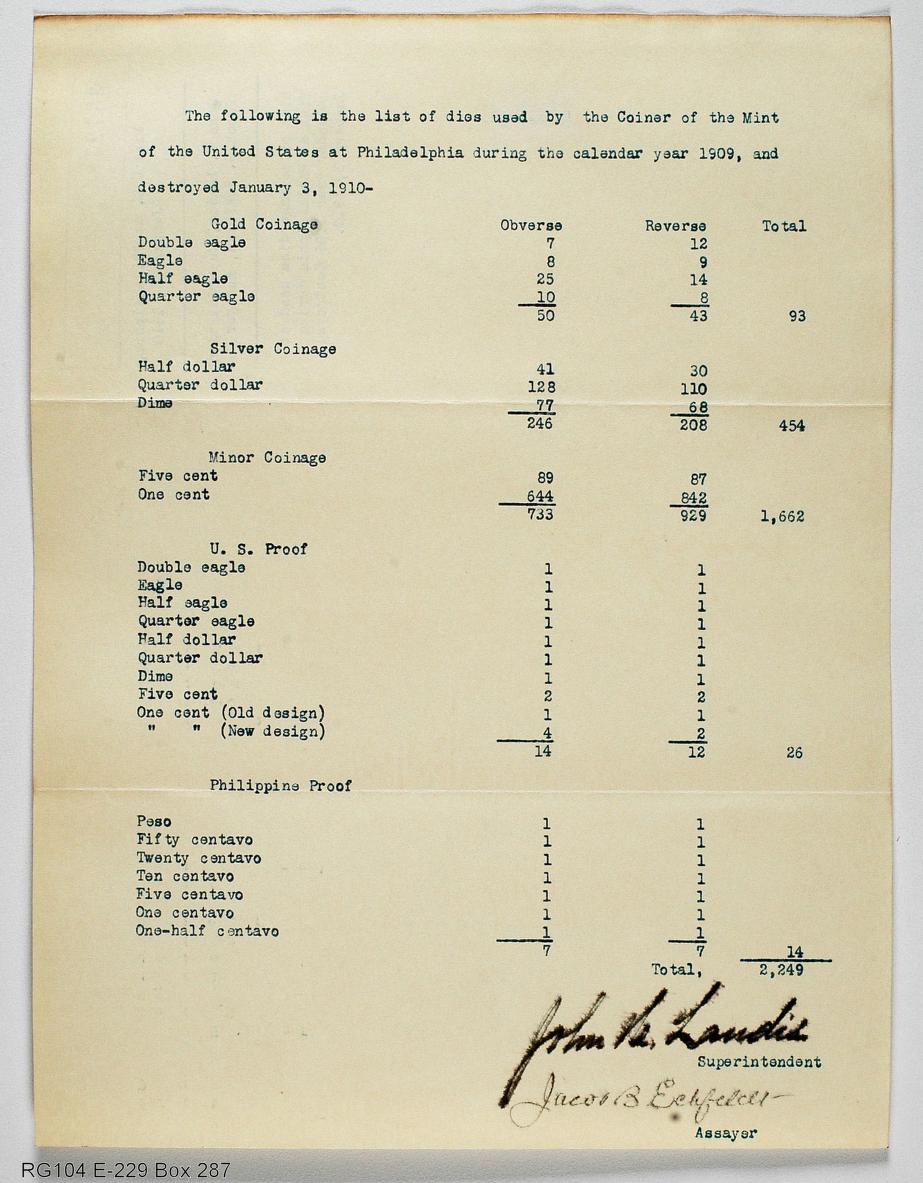 |
|
Valued Member
United States
108 Posts |
Edited by philoponus6
11/17/2022 12:15 pm
|
|
Valued Member
United States
108 Posts |
Now, before anyone gets their knickers in a twist, I am not suggesting the following is probable. I am only stating possibility.
1) Since the nickel/aluminum experiment directive came from the Secretary of the Treasury, these alloy trials may not show up in communications between the mint director and the Phiily mint.
2) Alloys are patentable, so the mint may not publicize their findings, or even the experiments themselves. Why risk having to pay someone else to use a particular alloy and related process?
3) Some of the old VDB dies may have been saved for future experiments. No doubt there were scads of unused ones. Why chew up a new, usable die in 1910 if you can do the same quality experiment with a 1909 die? If so, an experimental 1909 cent could have been produced some number of years after.
Edited by philoponus6
11/17/2022 12:22 pm
|
|
Valued Member
United States
108 Posts |
An 1893 communication, reproduced: 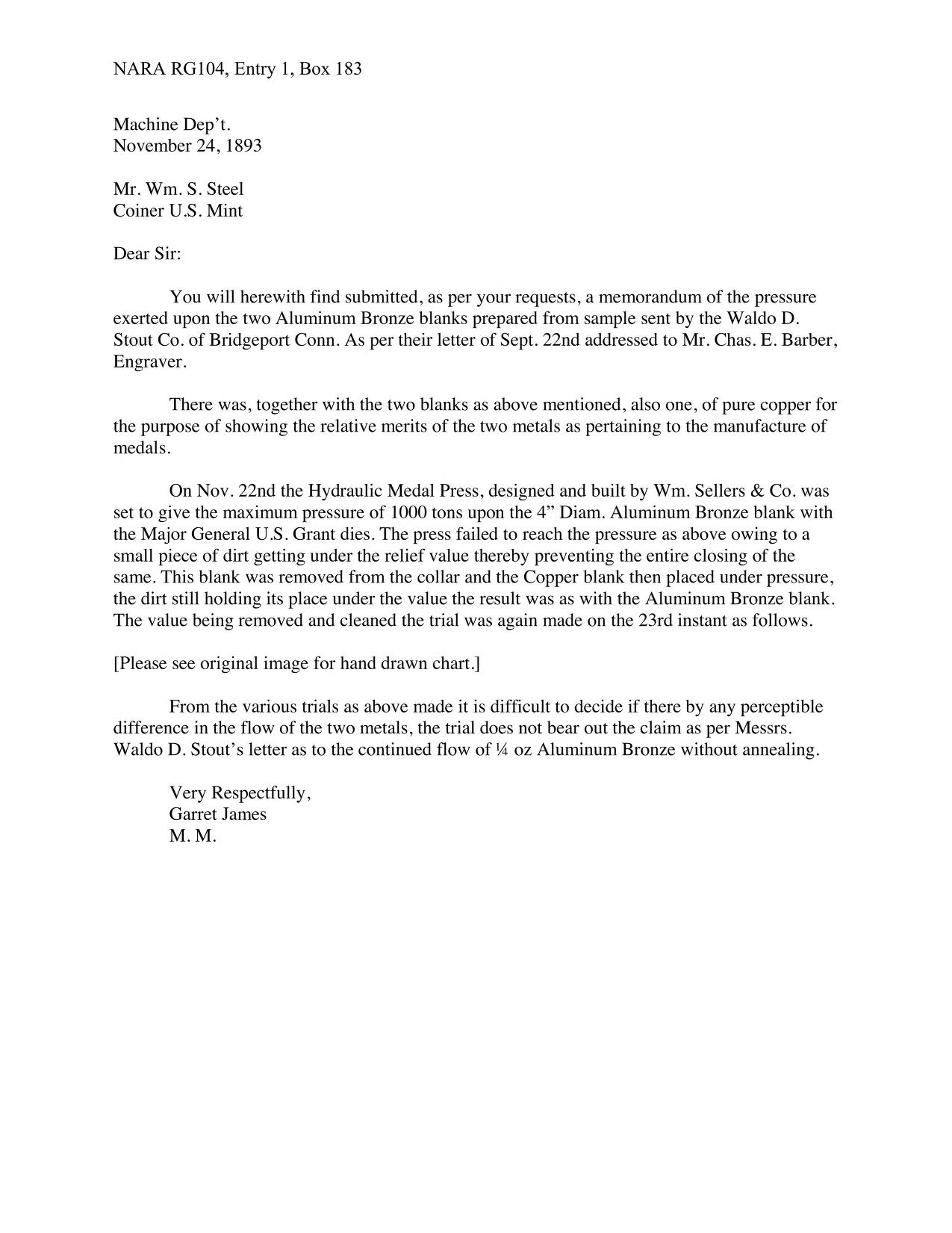 Edited by philoponus6
11/17/2022 12:21 pm
|
| |
Replies: 114 / Views: 9,522 |







 First Page
 Previous Page


 Posted 11/15/2022 6:52 pm





