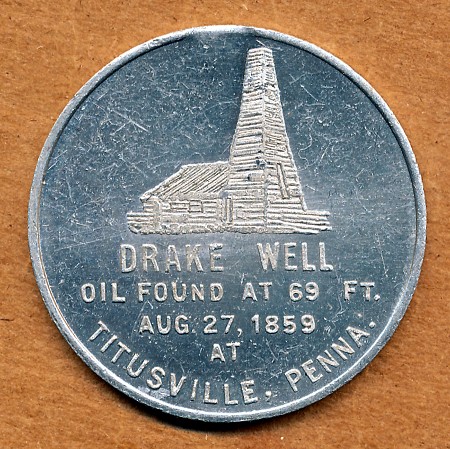
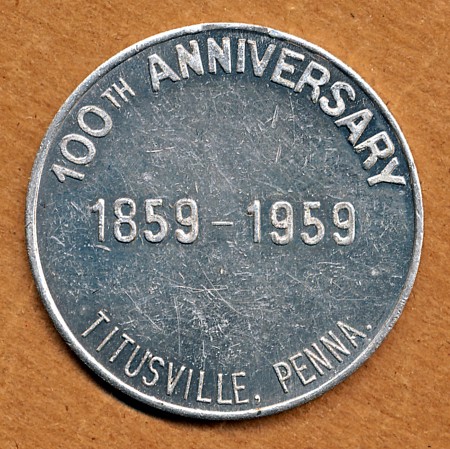
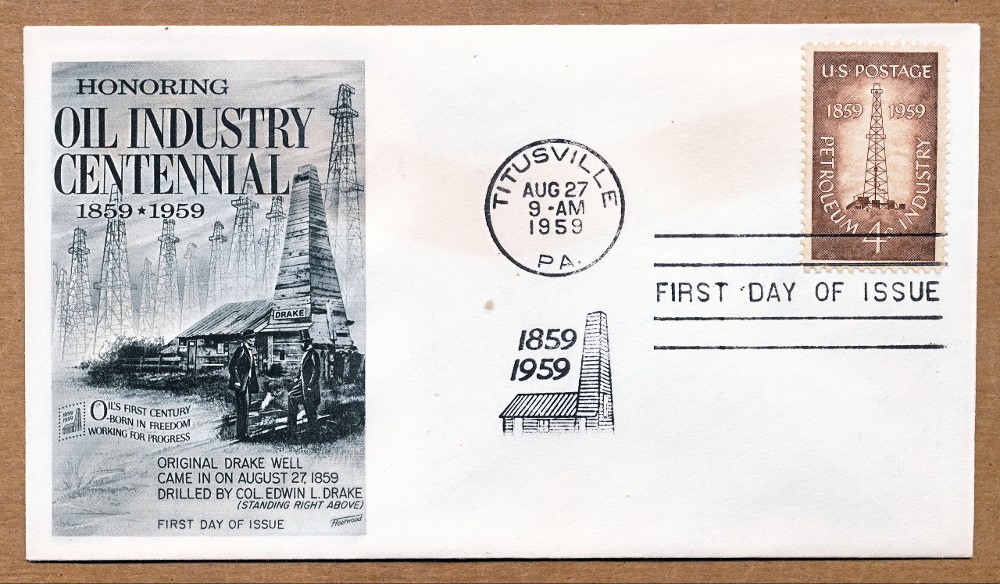
"Persistent" would have been a good adjective to describe Carroll Dudley Kearns (R-PA) in regards to his efforts to secure a commemorative half dollar for his home district in Pennsylvania that would "commemorate the centennial of the drilling of the first oil well at Titusville, Pennsylvania, in 1859." He introduced bills calling for the coin in the 84th, 85th and 86th Congresses (1956 - 1959).
Why commemorate an oil well in Titusville, PA?
It was in August 1859 that the first successful oil well was machine-drilled in Titusville, PA. With George Bissell and Jonathan Eveleth providing the lead financial backing under the banner of Seneca Oil, Edwin Drake led the well drilling project.
Based on a study and 1855 report by Benjamin Silliman Jr., a well-respected chemistry professor at Yale University, (commissioned by Bissell and Eveleth) the "rock oil" that was being found in and around Titusville by salt-well diggers was found to be a viable and more effective fuel than the coal oil and whale oil then being used to fuel lamps. The finding accelerated interest in commercializing the product.
Bissell and Eveleth initially formed the "Pennsylvania Rock Oil Company," but the venture was renamed "Seneca Oil Company" after a change in the mix of financial investors behind them. Edwin Drake was hired by Seneca Oil and, after multiple unsuccessful wells, succeeded in drilling a productive (though low-volume) "rock oil" well in Titusville - the first of its kind - on August 2, 1859!
Original Drake Oil Well (On-Site Reconstruction - 1945)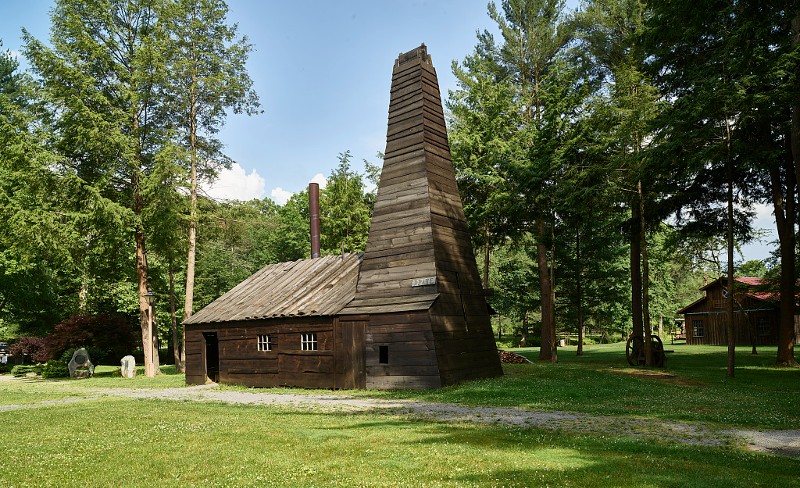 (Image Credit: Library of Congress, Prints and Photographs Division. Public Domain.)
From that humble beginning, today's huge petroleum industry developed. Everything has to start somewhere!
For more detailed background information, I recommend checking out
The First Successful Oil Well is Drilled in Titusville, Pennsylvania.
Representative Kearns' bills called for a minimum of 200,000 half dollars to be struck at the Philadelphia Mint (a direct connection to the Pennsylvania location of the first oil well); no maximum mintage was indicated, however. All coins were to be dated "1959" to coincide with the centennial of 1859. Representative Kearns certainly got an early start with his 1956 bill - IMO, he realized that a coin such as the one he was proposing would not be an easy sell among his colleagues (Congress was generally averse to new commemorative coin proposals at the time) and likely believed he would need ample time to gain support for it.
The Titusville, PA Lions Club was specified as the sponsor/beneficiary of the coin, but no minimum order size nor expiration date for coining authority was mandated in the bills. As written, the bills would have obligated the Mint to strike 1959-dated coins for the Titusville Lions Club for as long as the Club wanted them - as long as it could pay for them. (If consideration of any of the Kearns bills had proceeded, I believe this "loophole" would have been closed before its passage.)
The bills included specifications for the coin's design. Each required the coin to feature "either the likeness of Colonel Drake who drilled the first oil well or of an oil derrick similar to that used by Colonel Drake in drilling the first oil well."
Portrait of "Colonel" Edwin Drake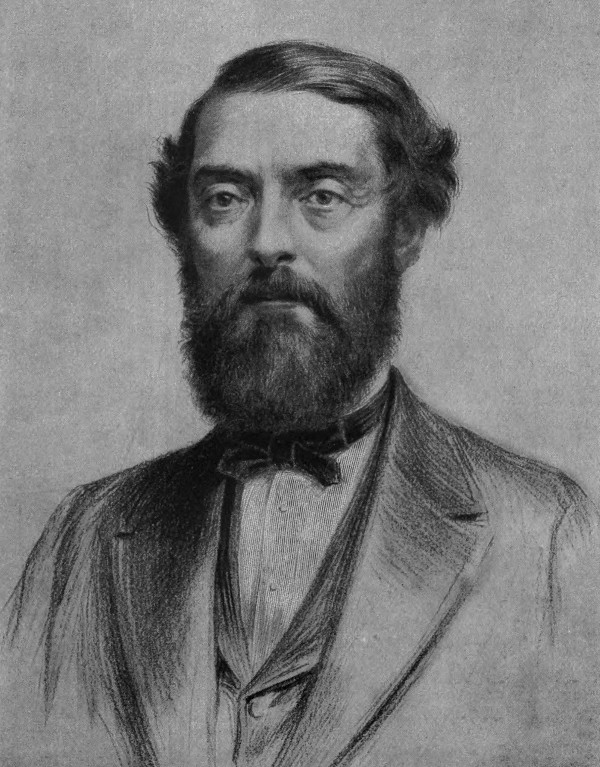 (Image Credit: Public Domain,)
None of the three bills was reported out by the House Committee, nor considered by the full House. With adjournment of each successive Congress, its respective Kearns bill died. After three unsuccessful attempts, and the passing of the anniversary year, Kearns dropped his Titusville coin proposal.
For more about the history of the Titusville, PA well, see:
-
Drake Well Museum and ParkFor other of my topics on commemorative coins and medals, including more What If? stories, see:
Commems Collection.







 Posted 12/21/2022 1:35 pm