Here's the story of another Statehood Anniversary coin proposal...In January, 1938, Andrew Edmiston (D-WV) introduced a bill in the House of Representatives that called for half dollars to be struck "in commemoration of the seventy-fifth birthday of the State of West Virginia." A companion bill was introduced in the Senate in February by Matthew Mansfield Neely (D-WV).
West Virginia was established during the Civil War - it was one of two such states, Nevada was the other "Battle Born State." It came about after residents of Virginia's western counties decided they did not want to secede from the Union along with the rest of the State. Virginia seceded on April 17, 1861 (the secession was officially ratified by Virginia voters roughly a month later on May 23).
Those living in Virginia's western regions began having issues with the advantageous status given to those in the eastern part of the State as far back as 1776, when the Virginia Constitution which favored those in the east was adopted. Issues continued into the 1800s, and though some compromises were reached, there were still divisions between those in the western counties vs. the rest of the State.
Following Virginia's April Ordinance of Secession, an anti-secession movement quickly gained momentum and delegates from Virginia's western counties met in Wheeling from May 13 to 15, 1861. After Virginia's voters approved the Ordinance of Secession, over significant opposition from those in the western regions, a second Wheeling Convention was held from June 11 to 25, 1861. As part of this Convention, it was decided to reorganize the western counties as a separate State.
The necessary steps followed, including the drafting of a West Virginia Constitution, and West Virginia became the 35th State admitted to the Union on June 20, 1863.
Virginia-West Virginia County Map - Circa 1863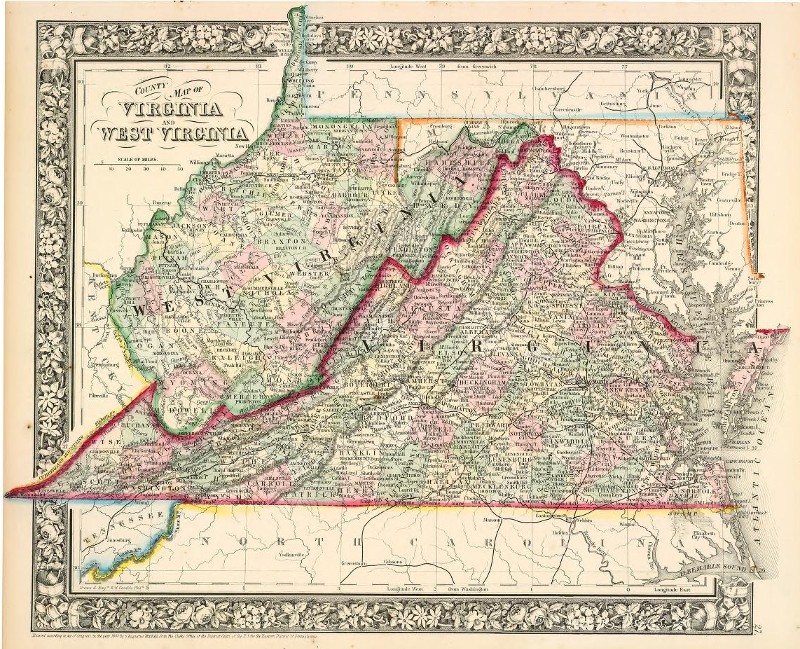 (Image Credit: Library of Congress. Public Domain.)
From the inaugural address of West Virginia's newly-elected Governor - Arthur I. Boreman:
"West Virginia should long since have had a separate State existence. The East has always looked upon that portion of the State west of the mountains, as a sort of outside appendage - a territory in a state of pupilage. The unfairness and inequality of legislation is manifest on every page of the statute book; they had an unjust majority in the Legislature by the original Constitution of the State, and have clung to it with the utmost tenacity ever since; they have collected heavy taxes from us, and have spent large sums in the construction of railroads and canals in the East, but have withheld appropriations from the West; they have refused to make any of the modern improvements by which trade and travel could be carried on from the one section to the other, thus treating us as strangers; our people could not get to the Capital of their State by any of the usual modes of traveling, without going through the State of Maryland and the District of Columbia."The commemorative coin bills called for 50,000 half dollars to be struck "in the mints of the United States." Such language would have allowed for coins to be struck in Philadelphia, Denver and/or San Francisco at the request of the West Virginia Commission appointed by the State's Governor. Net proceeds from the sale of the half dollars were to go toward "the development of the State-owned airport at Jacksons Mill, Lewis County, West Virginia."
Neither of the bills was ever reported out of the Committee to which it was referred upon its introduction - the House Committee on Coinage, Weights, and Measures or the Senate Committee on Banking and Currency, respectively - nor was either considered on the floor of its respective chamber. When the 75th Congress adjourned on June 16, 1938, hopes for a West Virginia Statehood coin bill ended.
Though the 75th Anniversary of West Virginia's Statehood was not recognized with a commemorative half dollar, 25 years later, in 1963, the State's Centennial was marked with a Congressionally-authorized, US Mint-struck commemorative medal. I plan to present it in a future post.
For more of my topics on commemorative coins and medals, including more What If? stories, see:
Commems Collection.





 Posted 01/18/2023 12:15 pm





