A circulating commemorative coin request...In March 1953, Hugh Joseph Addonizio (D-NJ) introduced a bill in the House of Representatives that called for "a special coin to commemorate the ideas of the founders of this country as depicted on the "Fugio Cent" of 1787."
The body of the bill further outlined the objective of the requested coins: "to commemorate and so to renew our confidence in the wisdom of the basic ideas of the founders of this country, as they are graphically depicted on the Nation's first cent, the Fugio Cent, 1787, adopted by the Continental Congress on July 6, 1787."
1787 Fugio Cent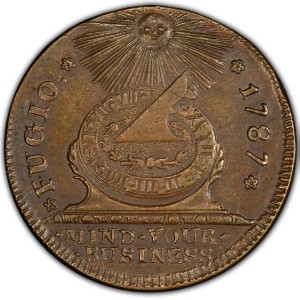
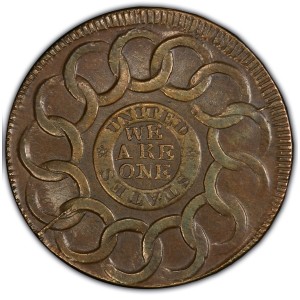 (Image Credit: PCGS CoinFacts.)
The Fugio Cent is generally acknowledged as the first Congressionally-authorized circulation coin of the United States. It was authorized by the Continental Congress, working under the Articles of Confederation on April 21, 1787. The Committee assigned to move the plan forward reported back with a design recommendation on July 6, 1787.
As recorded in the
Journals of Congress on Page 83:
"Resolved, That the board of treasury direct the contractor for the copper coinage to stamp on one side of each piece the following device, viz: thirteen circles linked together, a small circle in the middle, with the words 'United States,' round it; and in the center, the words 'We are one;' on the other side of the same piece the following device, viz: a dial with the hours expressed on the face of it; a meridian sun above, on one side of which is to be the word 'Fugio,' and on the other the year in figures '1787' below the dial, the words 'Mind your Business.'"
The coin's side that includes a sundial along with the inscriptions "FUGIO" (Latin for "I Flee") and "MIND YOUR BUSINESS" symbolizes how time "flies" (passes quickly) and that it's important for all Americans to remain vigilant and pay attention to their affairs to ensure America can build its economic strength and maintain its independence. The side that presents 13 interlocking rings symbolizes the strength to be gained from the Union of the 13 colonies/original states.
(Note: While the Sundial side is generally referred to as the obverse, as can be seen in the July 6, 1787 Committee Report quoted above, neither of the coin's sides was officially identified as the obverse or reverse.)The key feature of the coin proposal? It left it to the Director of the Mint and Secretary of the Treasury to decide which denomination was to be used for the special coin and what designs were to be featured. It did specify that the coin was to be struck to the standard specifications of the denomination selected (i.e., standard half dollar specifcations if the coins were to have a denomination of 50 cents). I can't help but wonder how close to the original designs the designs selected in 1953 would have been?
While the half dollar denomination was the dominant selection for US commemorative coins during the classic era, the other current circulating denominations would all have been possibilities for the Fugio Cent commemorative coin. The fact that the coins were to be circulation pieces would have made it
extremely unlikely that a one-cent copper coin of US Large Cent specifications would have been selected (even though it is the US coin with the most similar specifications to the Fugio Cent) as: a) the Large Cent was not in current circulation in 1953, and b) its specifications required too much copper to be produced profitably. Use of Large Cent planchets would have required a change to the bill's language/requirements.
The House Committee on Banking and Currency, to which the bill had been referred, did not take action on the bill and, as every reader of this post is aware, the US did not issue a circulating Fugio Cent commemorative coin in 1953 (or beyond).
For more of my topics on commemorative coins and medals, including more What If? stories, see:
Commems Collection.







 Posted 01/16/2023 12:41 pm





