In the opening days of the 76th Congress (January 1939), Senator Arthur Capper (R-KS) and Representative Edward Herbert Rees (R-KS) introduced companion bills in the Senate and House of Representatives, respectively, that called for half dollars to be struck "in commemoration of the late Major General Leonard Wood, United States Army."
Major General Leonard Wood (Circa 1920)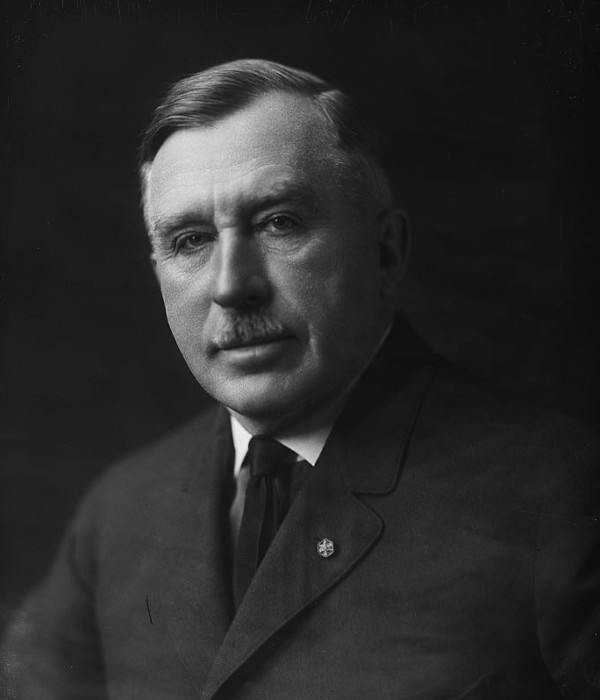 (Image Courtesy: Library of Congress, Prints and Photographs Division. Public Domain.)
Leonard Wood was born on October 9, 1860 in Winchester, New Hampshire. He was raised and educated in Massachusetts. Thanks to the generosity of a sponsor/philanthropist, Horatio H. Hunnewell, Leonard Wood was able to attend Harvard Medical School - he graduated in 1884. He began a US Army career in 1885, and served for nearly 40 years, ending with his retirement in 1921. During his career, he served as a surgeon, led troops in the Apache Wars (he was awarded a Medal of Honor for his service) and the Spanish-American War in Cuba, served stateside during World War I, served as the Army Chief of Staff, a Special Ambassador to Argentina and Governor-General of the Philippines.
A brief, but informative, summary of Major General Wood's career can be found at the web site of the Army Historical Foundation. Read it here:
-
Major General Leonard Wood BiographyThe bills called for 50,000 half dollar of standard specifications for the benefit of the Pearce Keller Post 17 of the American Legion in Manhattan. KS. (The Post remains active to the present.)
Why did an American Legion Post in Manhattan, Kansas sponsor a Major General Leonard Wood commemorative coin?
At the start of World War I, the US Army established Camp Funston southwest of Manhattan, KS as a training center. Major General Wood commanded and trained the 89th Division (served in France during WWI) and the 10th Division (created to protect the Panama Canal) at the Camp. Wood also trained African-American soldiers assigned to the 92nd Division (an African-American Division within the then-segregated US Army that saw its first action in World War I).
Net proceeds from sales of the coin were to be used by Post 17 for "the establishment and construction of a permanent memorial" to Wood. Neither Senate nor House bill was reported out of the Committee to which it was referred (the Committee on Banking and Currency for the Senate bill and the Committee on Coinage, Weights and Measures for the House bill). As a result, neither bill was successful.
During the 1st Session of the 77th Congress, Representative Rees tried again, introducing another General Wood bill in June 1941. As with the previous bills, the re-introduced bill failed to gain support and was never reported by the Committee on Coinage, Weights, and Measures.
Without the coin, it does not appear that Post 17 was successful in constructing a "permanent memorial" for General Wood.
For other of my posts about commemorative coins and medals, including many more What If? stories, see:
Commems Collection.









 Posted 01/25/2023 05:30 am


