A bill was introduced in January 1952 that called for the striking of half dollars of standard specifications "in commemoration of the two hundred and fiftieth anniversary of the founding of Mobile, Alabama." The bill was introduced by Senator John Jackson Sparkman (D-AL) on behalf of himself and Senator Joseph Lister Hill (D-AL); it was immediately referred to the Senate Committee on Banking and Currency.
The bill was one of several commemorative coins proposed in the hope of "striking while the iron is hot!" following Congress' approval of the bill in 1951 that amended the original Booker T. Washington Birthplace Memorial Half Dollar Act to enable the striking of the 1951-54 George Washington Carver-Booker T. Washington (GWC-BTW) National Memorial Half Dollars. It was hoped by the various bill sponsors that the passage of the GWC-BTW amendment had signaled a possible mood change in Congress regarding commemorative coins and that coin bills would once again gain approvals - the sponsors were wrong!
The Sparkman-Hill bill sought to mark the 1702 establishment of Mobile by Pierre Le Moyne d'Iberville and his younger brother Jean Baptiste Le Moyne, sieur de Bienville. "Old Mobile" as it has since come to be known, was a settlement built around Fort Louis de la Louisiane adjacent to the Mobile River. It was built up river (~27 miles) of the river's mouth - near the site of present-day Twenty-Seven Mile Bluff (a cliff overlooking the river that (true to its name!) is about 27 miles up river from the mouth of the Mobile River). It was during this time that Mobile became the first capital of the French Colony of Louisiana; its population was ~300.
Pierre Le Moyne d'Iberville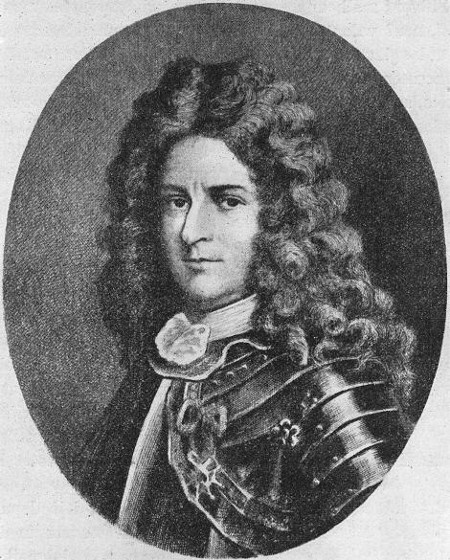 (Image Credit: Winsor, Justin, ed. Narrative and Critical History of America. Boston: Houghton, Mifflin and Company, 1884-89. Public Domain.)Jean Baptiste Le Moyne, sieur de Bienville
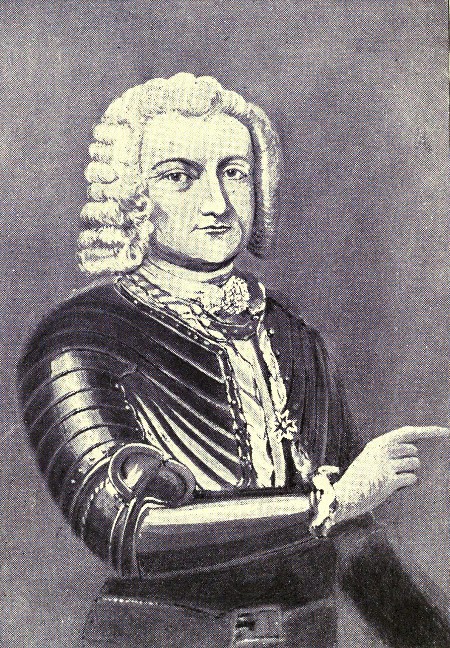 (Image Credit: King, Grace. Jean Baptiste Le Moyne, sieur de Bienville. New York: Dodd, Mead and company, 1892-93. Public Domain.)Side Note: Jean Baptiste also founded New Orleans (in 1718).
After facing a combination of natural hardships (e.g., floods) and attacks by local Native American tribes, the settlement moved down river in 1711 to near the mouth of the Mobile River under the leadership of Jean Baptiste. Mobile has remained in this location ever since, though it has expanded greatly over its history. (The move in 1711 is the reason why you will encounter Mobile 250th Anniversary commemorative medals dated 1961 in the marketplace.)
Today, Mobile, Alabama's only salt-water port, is the State's fourth largest city with a population of ~195.000 (at the time of the coin proposal, the population was ~129,000 and in the midst of a period of explosive growth). Mobile is the County Seat of Mobile County, Alabama.
When the bill was introduced, the number of coins to be requested was still TBD (i.e., it was left blank in the bill). The bill was a bit loose with other of its specifications as well: 1) No mention of the number of US Mint facilities that could be used was made, 2) No year/date to feature on the coins was defined (though "1952" was the anniversary year and seems the most likely) and 3) minimal ordering restrictions were imposed (the bill specified that the coins could be issued "in such numbers and at such times" to the Board of Commissioners of the city of Mobile but did not specify an expiration date for ordering authority.
Regarding the coin's designs, the bill specified that the "Director of the Mint shall give due consideration to the model coin depicting the founding of the Citv of Mobile in 1702 by Bienville which has been approved by the Board of Commissioners of the city of Mobile by resolution dated December 26, 1951." (I have not yet located a full description or image of the design.)
The bill was never reported out by the Senate Committee nor considered by the Whole Senate. As a result, it died for lack of action when the 82nd Congress adjourned and Mobile had to celebrate its founding without a US half dollar.
For other of my posts about commemorative coins and medals, including more What If? stories, check out:
Commems Collection.








 Posted 02/09/2023 10:19 am


