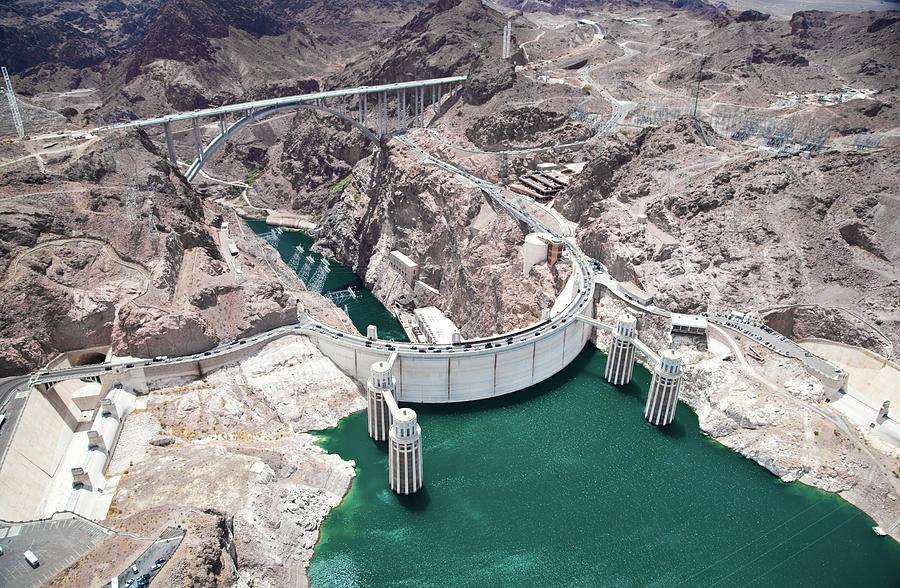
In June 1952, Senator George Wilson Malone (R-NV) introduced a bill to authorize "the coinage of fifty-cent pieces depicting the Hoover Dam" - the dam is near Boulder City, Nevada in the Black Canyon at the Arizona-Nevada border. The new coin was to be a circulating commemorative half dollar.
Construction on the engineering marvel that was to become the Hoover Dam began in 1930 after Congressional appropriations were approved; the dam was ultimately named in honor of Herbert Hoover - it was originally called Boulder Dam. It was designed to span the Colorado River and control the flow of water in the southwestern US (including the prevention of flooding) and to generate hydroelectric power for the region. The Dam was dedicated in 1935, completed in 1936 and began generating hydroelectric power in 1937.
The project was authorized by President Calvin Coolidge in December 1928 as he prepared to leave office in March 1929. Incoming President, Herbert Hoover, supported the project and ensured it would go forward. Hoover, in his prior role as US Secretary of Commerce, was closely involved in the dam project, brokering the Colorado River Compact in 1922. The Compact divided the Colorado River into Upper and Lower Basins and helped ensure that the water released from the dam would be proportionally split between the basins. The Upper Basin consists of Colorado, New Mexico, Utah and Wyoming; the Lower Basin is comprised of Arizona, California and Nevada.
Aerial View of Hoover Dam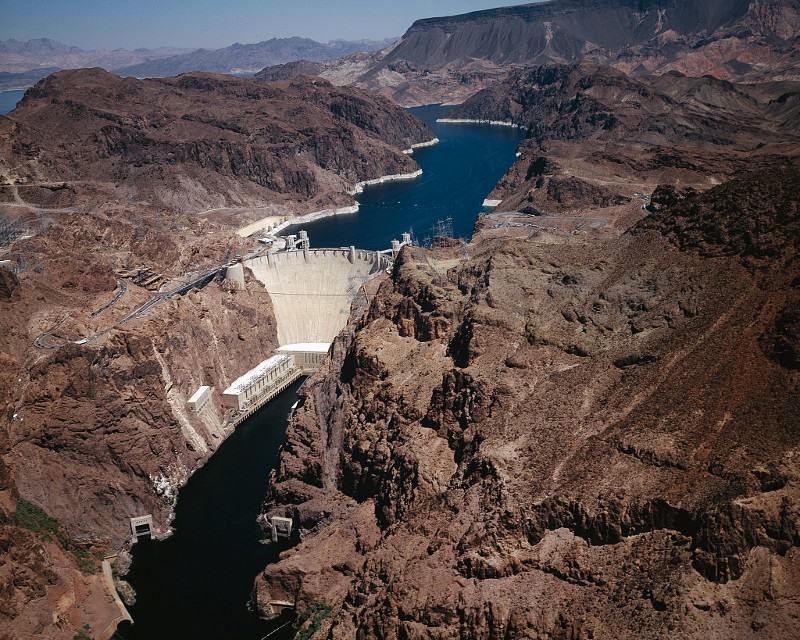 (Image Credit: Library of Congress, Prints and Photographs Division. Public Domain.)
The Hoover Dam is a concrete arch-gravity type that is 726 feet high and 1,244 feet long at the crest of its water-retaining component/wall (crest = the location of the roadway at the top of the dam). The water held behind the dam is referred to as Lake Mead; it covers approximately 247 square miles when at high-water levels.
From the National Archives web site:
"Today the Hoover Dam controls the flooding of the Colorado River, irrigates over 1,500,000 acres of land, and provides water to over 16,000,000 people. Lake Mead supports recreational activities and provides habitats to fish and wildlife. Power generated by the dam provides energy to power over 500,000 homes. The Hoover Compromise [Colorado River Compact] still governs how the water is shared."
The bill did not include a pre-defined mintage nor any reference to discontinuing the recently-introduced Benjamin
Franklin half dollar or replacing it with the Hoover Dam coin. It appears as if the Hoover Dam coin was meant to supplement the Franklin coin and circulate alongside it vs. eliminate it. Theoretically, it was to be a one-year type.
The bill did, however, include language regarding the design to be used for the coin, stating it "shall include on the obverse side of the coin a scene depicting the Hoover Dam located near Boulder City, Nevada." The details of the coin's designs were left to the Secretary of the Treasury.
Upon its introduction, the bill was referred to the Senate Committee on Banking and Currency. The bill did not gain much support in the Committee, however, and was never reported out. It died with the adjournment of the 82nd Congress on July 7, 1952. Senator Malone tried again in the 83rd Congress, introducing a duplicate of his bill in March 1953. The new bill fared the same as the previous - it was referred to Committee but never reported out. After two attempts, Senator Malone gave up and did not introduce the bill in the 84th or 85th Congresses; the 85th Congress was his last.
When considering anniversary years for significant Hoover Dam milestones, 1952 is not a year that immediately comes to mind. It is the 21st, 17th, 16th or 15th anniversary of the start of construction, its dedication, its completion or the start of hydroelectric power generation, respectively. None of which are anniversary milestones that typically merit a US commemorative coin. This fact likely played a role in the lack of interest in the coin's bill, though I suspect that the Treasury Department opposed such a coin on general principle.
The Hoover Dam was a prominent design element on a medal struck by the US Mint for the 100th Anniversary of Nevada's Statehood in 1964. (Subject of a future post!) It has also appeared on a number of privately-struck commemorative medals - the dam is certainly not a stranger to numismatics!
For other of my posts about commemorative coins and medals, including more What If? stories, see:
Commems Collection.








 Posted 02/26/2023 06:24 am