| Author |
 Replies: 46 / Views: 5,628 Replies: 46 / Views: 5,628 |
|
|
|
Pillar of the Community
 United States
4051 Posts |
Quote:
The coin is certainly not a counterfeit. Your observation is astute, but look at the L of LIBERTY in relation to the rim. Note that the fields actually rise as you go from about the inner side of the upright bar of the L to the inside rim edge. This is true most of the way around the coin and easily visible in the full obverse image. So the fields themselves are not flat as they approach the rim in that area, but do rise, as is evident at the clip as well. It is true the field rises, but it does not rise as far in as on your coin. To explain, I created the graphic below. The outer white dotted curve shows the radius where the field near the L starts to rise noticeably as it approaches the rim. The inner white dotted curve shows the radius where the field of the clip starts to rise. The red-enhanced area is the problem area where the field is rising where it should not. Indeed the field rises about the same amount along the length of the "clip". Perhaps someone could explain how soft coin metal could be "upset" in this area, when the die is very flat there? Can anyone show another clip that has this characteristic? 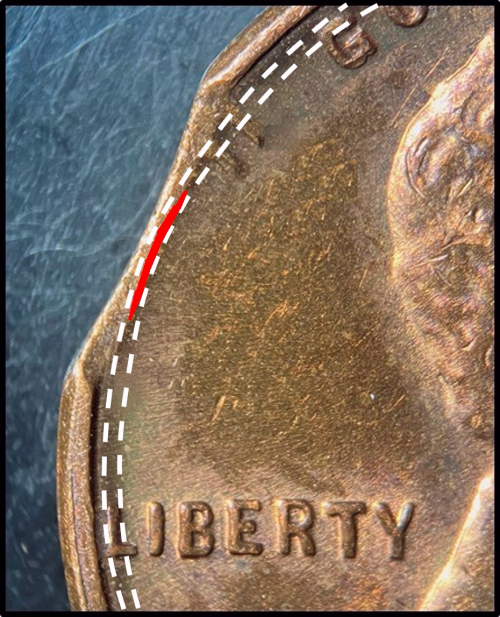 Edited to add: I see some further evidence of tampering wth this coin. I focused on the obverse field adjacent to the "clip", but if you look at the reverse field in same area, instead of the edge being raised (upset?) above the field near the clip, it appears to be recessed below the field. I believe this shows that the "clip" was cut post-mint, with a blade cutting from the reverse. The blade forced the metal downward where it cut, leaving a recessed edge on the reverse and raised edge on obverse. My conclusion would still be this is a very clever counterfeit, but if someone has an explanation for these phenomena consistent with the minting process, I'd be very interested in hearing it. Edited by rmpsrpms
11/23/2023 10:06 pm
|
|
Pillar of the Community
Canada
6244 Posts |
@ rmpsrpms Due to the 95/5 alloy in the small clips with Smith effect the borders will show a kind of rim. It is not a rim but more it is due to the internal flow of the alloy during the strike. Also on my lab when we do the material resistance and durity we constated that after the annealing the durity on the borders of the material drop about 5% by rapport of the inner center.
On the bigger then 10% clips this will not happened. But those bigger clips must be discuss in other topic when TB will find one in 95/5.
PS: 95/5 mean the alloy composition per rapport of the main metal Cooper.
|
|
Pillar of the Community
United States
4051 Posts |
Sure, but the "rim" should show on both sides. This coins shows asymmetry. There also should not be a rim in areas where only field is present.
|
|
Pillar of the Community
Canada
6244 Posts |
@ rmpsrpms:
Your point I will not cotradite because seem to be more then legit.
Me I have one question here: Why the side of the coin show the material structure instead of the blanking cut die? Could be an fracture in the main roll material and in the process of blanking fall out and took the cutting die form?
|
|
Pillar of the Community
United States
986 Posts |
After looking at a few of my clipped coins in comparison to TB's beautiful 1950 I believe the age of the die may play some role in the effect mentioned by rpmsrpms on clipped planchets. My 1978 D exhibits the same effect as TB's 1950. The later the die stage more pronounced the deformation of the field and device adjacent to the clip. Conversely, the earlier the die stage (1998) the less pronounced the deformation. The gillig effect. 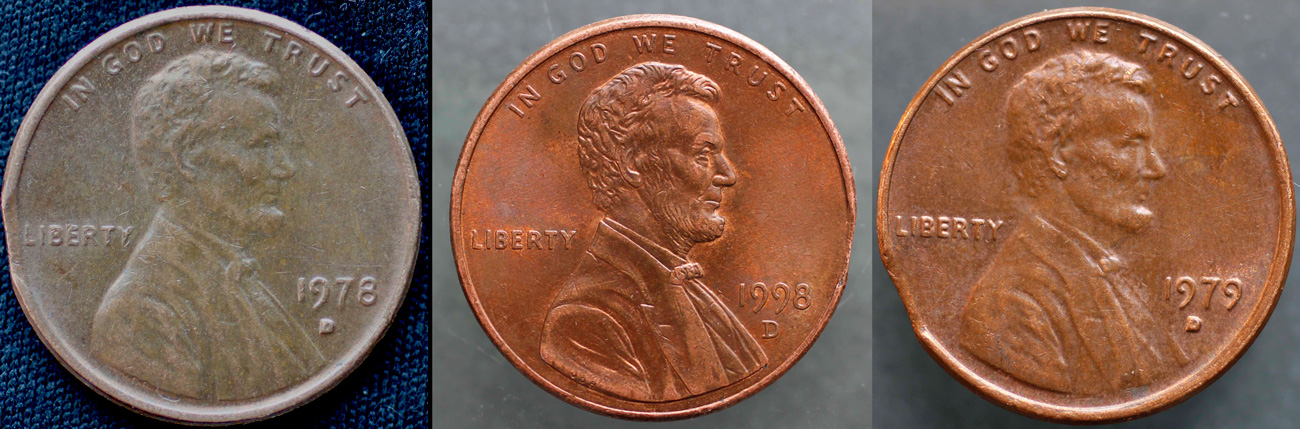 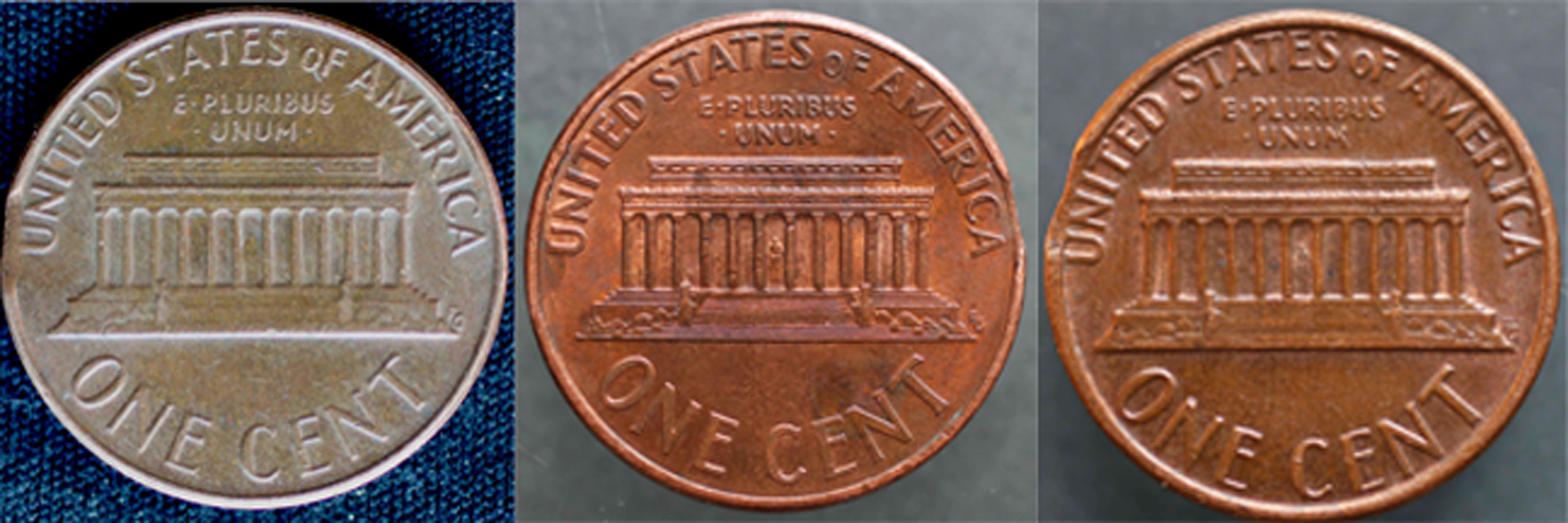 "We are all flawed, some MD and some PMD." NYI Edited by NY Islander
11/24/2023 12:29 pm
|
|
Pillar of the Community
United States
4051 Posts |
Quote:
Me I have one question here: Why the side of the coin show the material structure instead of the blanking cut die? Could be an fracture in the main roll material and in the process of blanking fall out and took the cutting die form? I think Occam's Razor would be a strong argument against a defect in the planchet matching the curve of the planchet stamp. Quote:
My 1978 D exhibits the same effect as TB's 1950 Unfortunately the three you show are not the best for comparison because their clips don't go far enough beyond the basining region to show the flat field. That said, if you would please post pics of the reverses of these coins, we could see if the raised rim/basining area exists on both sides, or if these also exhibit the asymmetry of the 1950-D. I am keying-in to the asymmetry as the primary diagnostic here. Can we see the reverses? Contact me for photographic equipment or visit my home page at: http://macrocoins.com |
|
Pillar of the Community
United States
2376 Posts |
Rpmsrpms A ridge like you are seeing on TB's coin would be an artifact from the blanking process, most likely happening as Drag during ejection. This is my 1924 straight clip with a similar ridge, though this one would have been from trimming the edge of the coin metal sheet 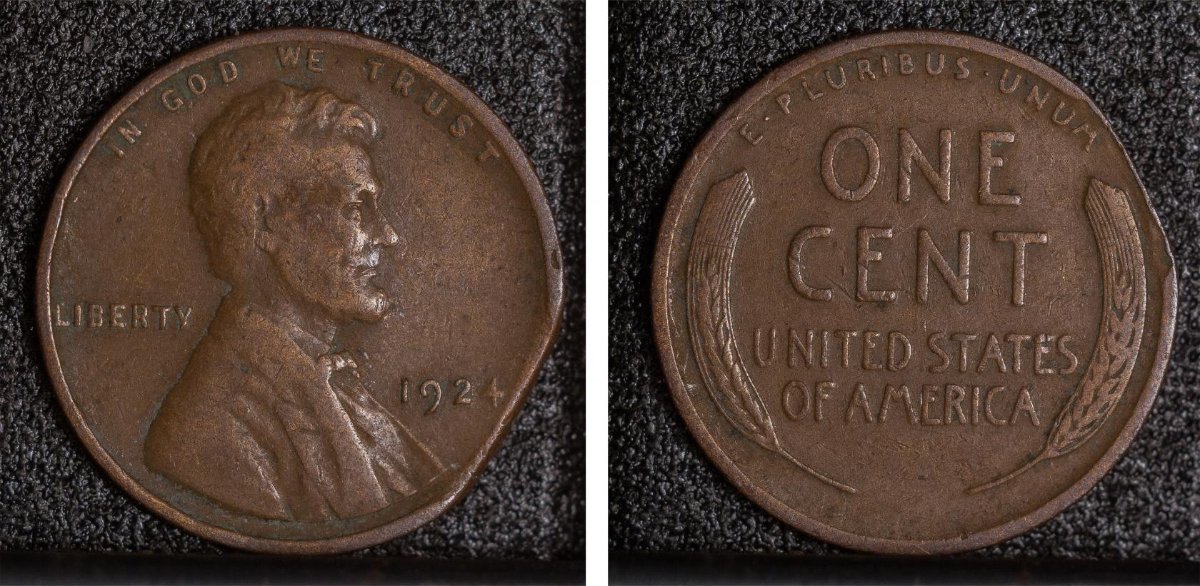 A working die is crowned slightly in the center to promote the strike to fill the design details in the middle of the die where they are usually the deepest part of the die.this will enhance the outward flow of coin metal towards the edge as the strike finishes. As I stated earlier, coin metal becomes fluid during the strike and will flow in the path of least resistance, which the void created by the clip certainly is. The ridge that you see is simply pushed into the void of the clip because there is no resistance to outward movement to force it up into the die. This outward flow of metal that is not strck away by the field can be seen on this strait clip dime. The IN of the motto shows flow lines of enlarged stretched letters because of the lack of force ,caused by missing metal , to push the coin metal up against the die as it flows towards the collar. 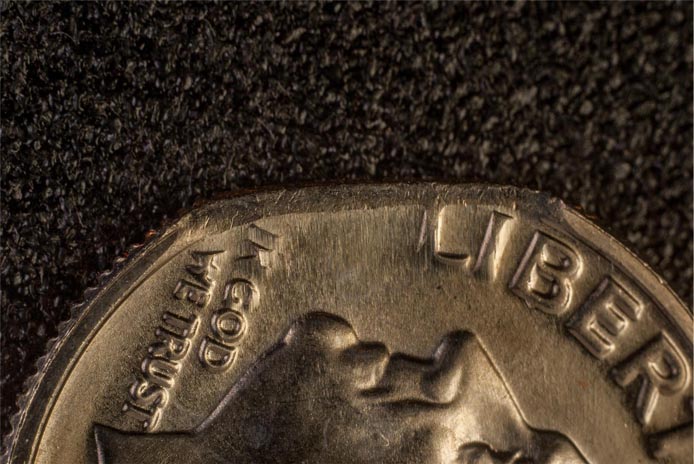 Edited by stoneman227
11/24/2023 11:15 am
|
|
Pillar of the Community
United States
4051 Posts |
It's still not clear to me how those ridges form. I can't think of a valid explanation, and none of the explanations provided seem to explain it. From what I can see on the Dime above, there is no raised ridge per-se, but it's hard to tell from the photo. I'll wager the field is rising in that area, but it then falls-off due to lack of metal at the edge. There are clearly raised ridges on the 1924 Cent, on both obverse and reverse, but the two ridges look different for some unexplained reason. Since they would have been simultaneously-formed by the two dies coming together, I'd expect symmetry. I looked through my oddity box and found a 1971-S with a curved clip. It exhibits a flat field at the clip on both obverse and reverse, as I expected, see below. 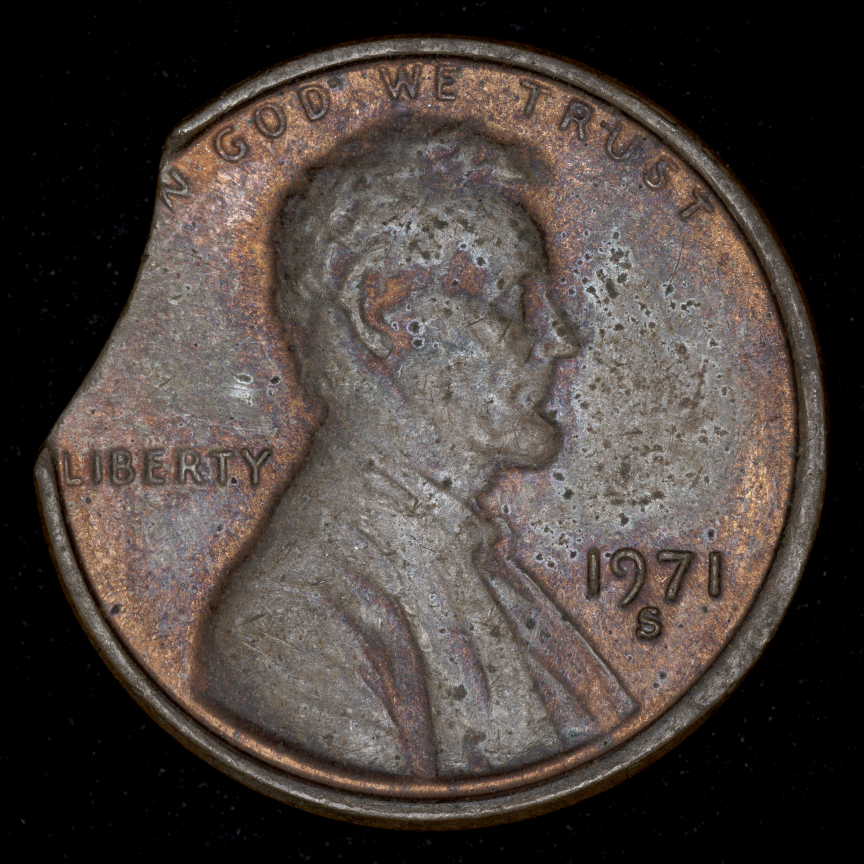 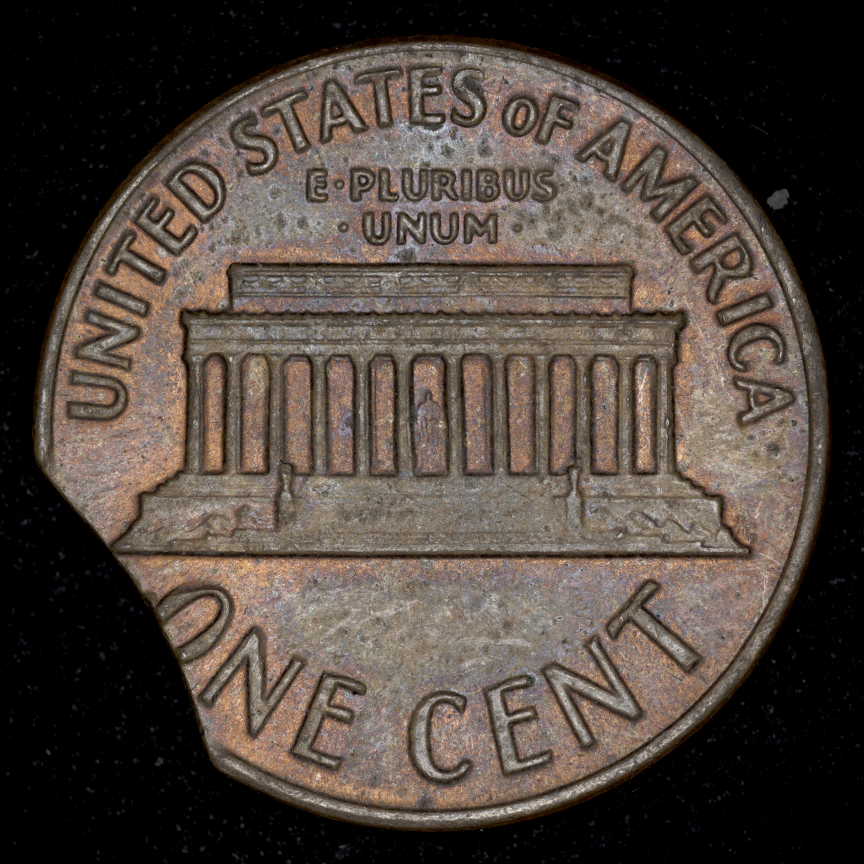 Contact me for photographic equipment or visit my home page at: http://macrocoins.com |
|
Pillar of the Community
Canada
6244 Posts |
Monday I will be home so I will look to all my clips. Interesting effect, which I think apply only to small clips.
|
|
Pillar of the Community
United States
4051 Posts |
I'll be very interested to see more clips to see how this tracks.
I would expect that if this "upset rim" phenomenon is related to small clips, then the phenomenon would appear closer to the edge of the coin, but even right up to the rim the field remains flat on the coin I show above.
I will look around for more clips.
Contact me for photographic equipment or visit my home page at: http://macrocoins.com |
|
Pillar of the Community
United States
2376 Posts |
"Since they would have been simultaneously-formed by the two dies coming together, I'd expect symmetry."
Rpm
What I was trying to say was that the ridges on at least the 24 were there pre-strike and were not formed by the dies.
The dime was just an example of the dies not filling in, even where the field should have contacted the planchet.
|
|
Pillar of the Community
United States
4051 Posts |
I believe what you're saying is impossible. Any ridges due to upsetting or some other mechanism would be obliterated by the strike, leaving just a flat field as you see on my 71-S. Hard steel always wins against soft bronze.
Contact me for photographic equipment or visit my home page at: http://macrocoins.com |
|
Pillar of the Community
United States
4051 Posts |
@NY Islander, thanks for posting the reverses. Indeed these look symmetric, showing similar charateristics on obverse and reverse.
|
|
Pillar of the Community
United States
2775 Posts |
 Metal Flow Metal Flow on a curve clip or other incomplete planchets. Quote:
Circulating coin presses use from 35 to 100 metric tons of pressure to strike the coins, depending on the denomination. https://www.usmint.gov/learn/produc...n-productionThe original clipped edge view seems normal enough. With no collar contact (nor upset) to provide any back-fill in that region, interior design weakness and or oddities can occur. The question of, the interior design region around the clip being raised or not. I think could go a few different ways. One not mentioned below. Quote:
Metal flow stops at the instant the dies are fully extended and there is no more pressure. However, in rare instances, as the dies retract some metal may spring back somewhat (by MOLECULAR MEMORY) and cause DIE DRAW. https://www.coinbooks.org/v21/esylu...1n32a16.htmlThanks, Doug. |
|
Pillar of the Community
United States
4051 Posts |
Die Draw is a normal process for any metal deformation, and varies inversely with malleability. However, Die Draw is a bulk process, so if it happens on a coin, the metal would pull back across the entire volume of metal deformed by the die. This would result in a symmetrical thickening of the metal at the edge of the clip, but with the 50-D the "Die Draw" only affected the obverse, which could not happen naturally.
Interestingly, the 24-P "clip" also does not show symmetry in the "Die Draw". The obverse and reverse are significantly asymmetrical, with the reverse showing obvious tooling to hide the edge of the cut. I suspect it is a counterfeit as well.
|
| |
Replies: 46 / Views: 5,628 |





 First Page


 Posted 11/23/2023 11:09 pm


