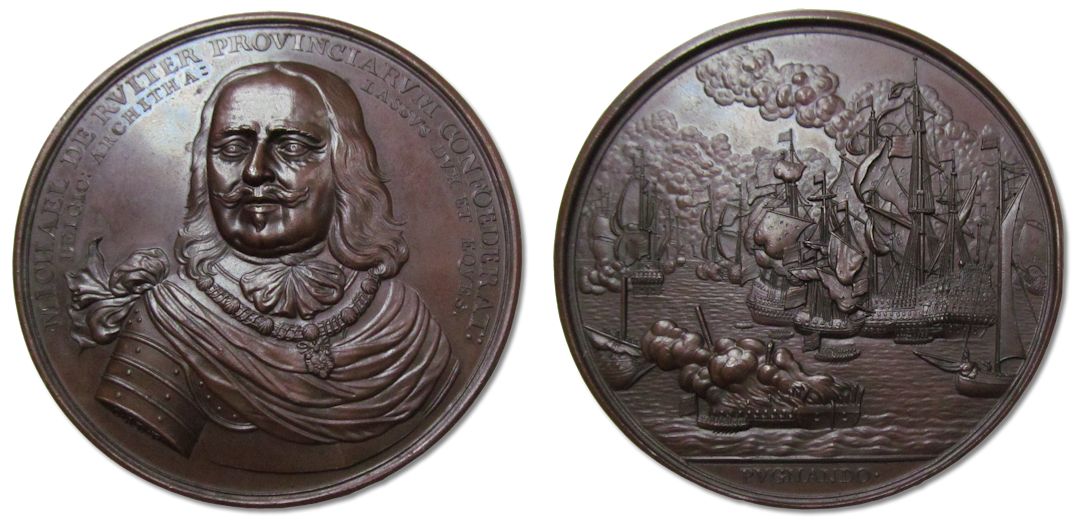
Michiel de Ruyter was a rare dutch admiral who fought on the side of my country in a sea battle. It is well engraved. It is from the baroque period. Good reasons for me to want it.
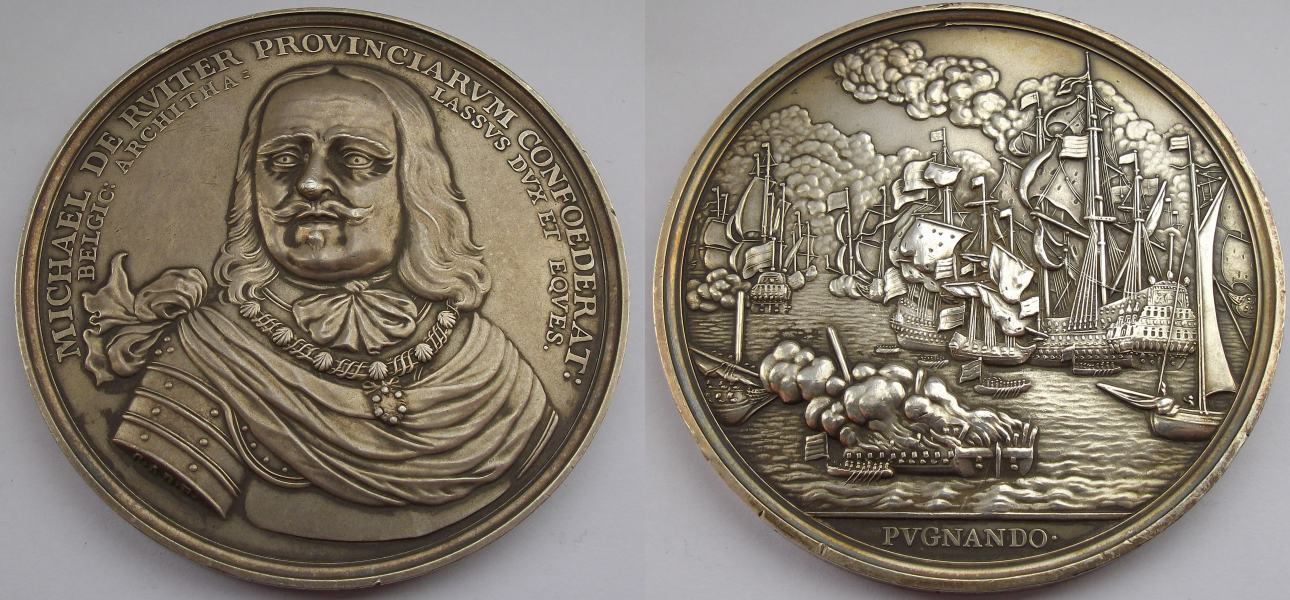
This medal can provide a topic for the benefit of beginners in the collection of medals. That is why I am writing this. Restrikes.
The most important thing to know is that many medals are not struck just once. They can be struck so long as there is demand and the dies exist. For the cast medals, so long as someone has access to a mold or a good original to create one.
There are two great categories of medals by issuer. Official issues, ordered by governments or rulers. Authorities who can pass laws. And commercial issues, done by private businesses.
Official issue medals sometimes have regulated and recorded mintages. Now that is the rule but was not always so. Sometimes it depends on the metal. The yearly papal medals have recorded mintages in silver and gold since their beginnings. I do not know of restrikes in these metals being allowed. But base metal versions could be struck by the die producers to satisfy demand. This right to strike base metal coins for sale could be part of the payment for their service. Even centuries later.
When medals are struck as commercial ventures the dies can be sold and resold. And used in different countries. One example I offered here before are the medals of the Kings and Queens of England engraved by Jean Dassier. They started in Geneve. The dies were sold by his heirs into England. Then used there to strike medals several more times. The older ones are very hard to distinguish from the later strikes. They can all be called originals, made in different centuries.
Sometimes medals are struck by the official mint, the national mint. The dies are then archived and left alone. But when a country falls into anarchy and there is money to be made from selling new manufactured rarities to collectors, who knows what use is made of dies in archive? This can also happen with coins.
In rare cases this reuse of dies in national mints is their policy. The Paris mint was for a long time ill regarded for taking over any left over dies used there and issuing more copies on demand by anyone. From its dies on store. Other mints were not so reckless.
On finding this medal on sale I searched about its history. Used to be very hard, involve going to archives and finding old books. For medals sometimes the only information was in newspapers of their issue date, where they were announced. Now the internet makes research a little easier. But know that only some information is online. Much is still in paper locked somewhere.
This medal was originally created in Amsterdam, in the occasion of the death of the admiral. The dies were created by Christoffel Adolfszoon. The silver medals from this issue now in museums have weights between 102 and 109 grams. After the production the dies we kept in the dutch
Royal Mint. It was centralized in Utrecht in 1813.
The second recorded strikes that I could find with the dies were made in 1907. The commemorations of the 300 years of the birth of admiral Michiel de Ruyter. I have not seen official reecords. But auction houses have published that 68 medals were struck in silver, with a weigh of 127 grams. And 95 medals were struck in bronze, with a weight of 148 grams. It is strange because silver is denser. Perhaps the bronze ones are thicker.
The third recorded strikes were made in 2007 for the commemorations of the 400 years. It was said that they also came from the same dies. The silver medals issued have weights of 140 grams and are pure silver.
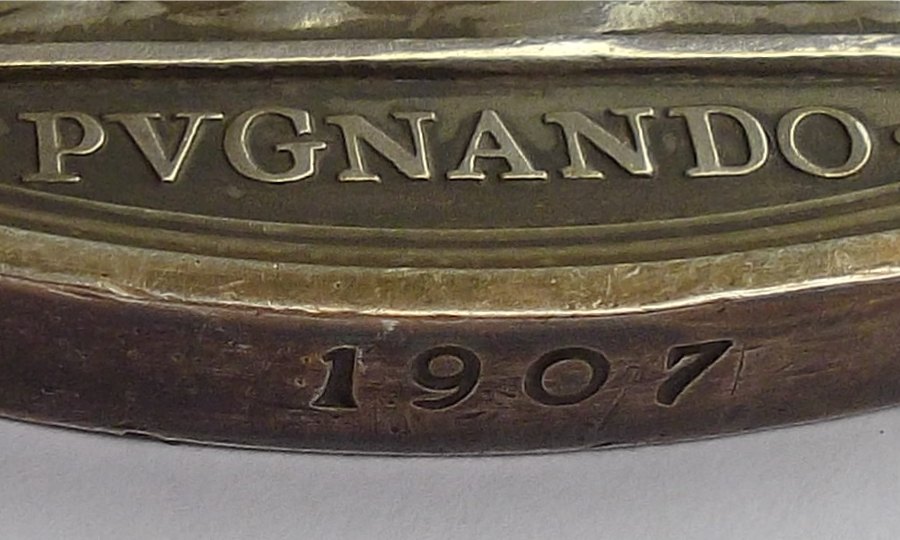
This is a case of responsible restrikes. The issuer chose different weights for each issue. The 1907 issue also has '1907' engraved in the rim. Also there the mintmark of the Utrecht mint, a very small caduceus. I do not know if the 2007 restrike has something engraved in the rim. But the weight difference is enough to identify it.
Some mints that reuse old dies go further and copy and change the die for new restrikes. Adding a date or some other difference, not making a perfect reproduction.
The problem with restrikes of old medals is the potential for fraud. Many old medals are expensive. We collectors all know: rarity makes things more expensive. Restrikes complicate this. A 1676 specimen of this medal is a museum grade rarity, worth very much. A 1907 version can be found with some patience in auctions, not very expensive for this kind of old style medal. A 2007 versions was very common to find for sale some years ago.
What happens then when an auction house or a dealer sells a 1907 version without informing buyers? This that I wound when researching the medal.
https://www.cngcoins.com/Coin.aspx?CoinID=191561This medal was bought by someone unfortunate to be deceived by the description and provenance. But the weight and the diameter show it must have been a 1907 copy. The selling company should know this because the copies carry the year 1907 engraved in the rim. It can not be missed. Perhaps there were some issued without that marking. I have seen pictures of this same medal, I think published by the buyer in that sale. It is exactly like mine. It corresponds to the 1907 restrike. Rare is relative. The 1907 edition was very limited. But for a medal it is not a rarity. 1907 restrikes in rougher conservation have boon on auction this century with base prices set at 50€.
This is an unfortunate common situation with medals. With this medal it could also happen with a 2007 restrike, they have had enough time to look aged. There are many frauds being done in auctions of old medals. This case was perhaps oversight, lack of expertise by the dealer to handle medals. But I have seen mistakes that were surely frauds being done by auction houses in specialized medal auctions. Restrikes or copies being put on sale without any warning. Medals misattributed against what the legends say. Defacing described as an original feature of the medal. Buyer beware.
Early cast medals are the worse. Because they are unique how can you tell a good copy from an original? If there was an intention to deceive a good forgery will be very hard to identify. There are ways. But that is for experts and laboratories.







 Posted 03/27/2024 09:41 am