During the modern era of US commemorative coins, there have been several instances of a Commission or Federal Department being authorized by the US Congress - and approved by the US President - to create souvenirs/memorabilia but without specific authorization for a US Mint struck coin or medal. They make for an interesting facet of the modern US commemorative medal series, so I thought I'd present a few that haven't gotten much "love" from collectors.
First up, the 1983 German-American Tricentennial...
In 1980, US President Ronald Reagan signed into law a Senate Joint Resolution (PL 97-472) that declared 1983 to be the "Tricentennial Anniversary Year of German Settlement in America" and established the President's Commission for the German-American Tricentennial ("Commission").
The goal of the Anniversary Year proclamation was to mark "the beginning of the immeasurable human, economic, political, social, and cultural contributions to this country by millions of German immigrants over the past three centuries."
The purpose of the Commission was "to plan, encourage, develop and coordinate the commemoration" of the 300th anniversary of German settlement in America which formally began in October 1683.
The first German settlement developed north of Philadelphia; it became known as Germantown. (Today, Germantown is within the city limits of Philadelphia.) The town was settled by 13 Menonite families (believed to include 33 individuals) that came to America on board the sailing ship
Concord; they departed from Krefeld, Germany and arrived in America on October 6, 1683.
The most public-facing legacy of the Commission is the German American Friendship Garden on the National Mall (near the Washington Monument) in Washington, DC. The Garden was dedicated by US President Ronald Reagan and German Chancellor Helmut Kohl on November 15, 1988 to celebrate and commemorate 300+ years of friendship and immigration between the US and Germany.
Per the description on the web site of the Trust for the National Mall, when it was launched, "the garden was composed of multiple planting beds, native plant species from each of the two countries and the original pair of fountains that flanked the garden -- all welcoming visitors to learn more about the long-standing friendship and diplomacy between the U.S. and Germany." Recently, the Garden was restored and refreshed, but the update was kept faithful to the original design created by German-born landscape artist Wolfgang Oehme (b. 1930; d. 2011).
Information Panel at German-American Friendship Garden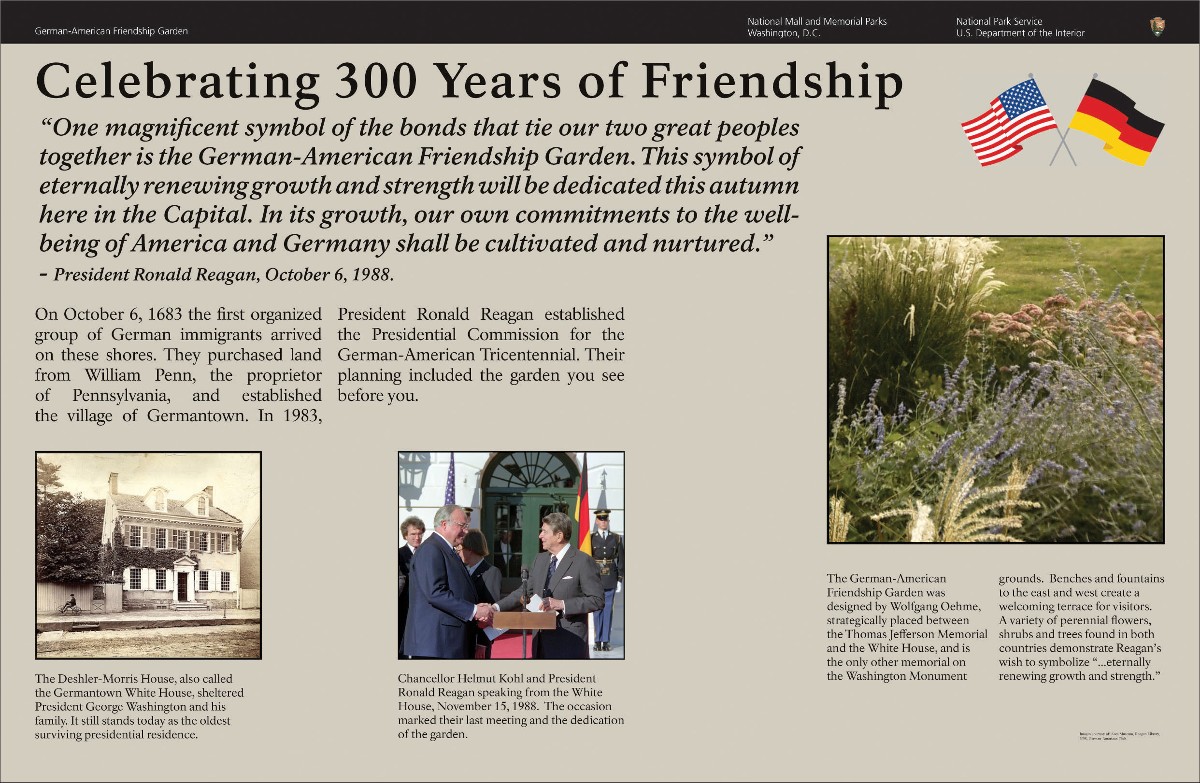 (Image Credit: National Park Service.)
The Commission's authorizing legislation required that it be self-funding. Thus, it sought donations (in the form of cash, goods and/or services) to cover its operating expenses. One fundraising avenue it pursued was the issue of a commemorative medal. Though no commemorative coin or medal was specifically authorized by Congress, the authorization did not prevent a medal from being produced. (Such a piece could be struck by the US Mint or a private company.) The Commission authorized an official commemorative medal, and sold bronze, silver and gold versions.
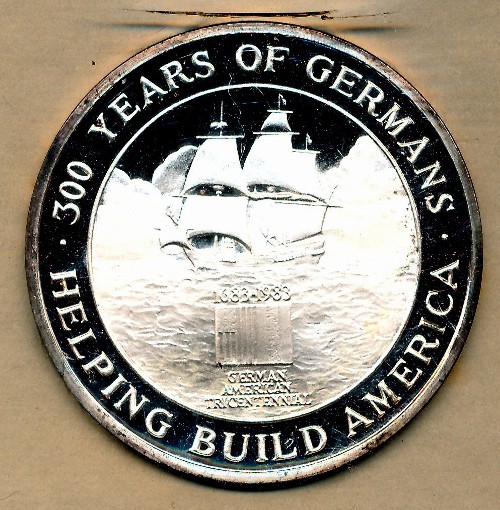
The obverse of the medal presents the
Concord - the sailing ship that brought the first German immigrants, above the logo of the German-American Tricentennial. The inscription "300 YEARS OF GERMANS - HELPING BUILD AMERICA" encircles at the rim.
The medal's reverse presents a collage of famous German-Americans. The portrait of Albert Einstein (the largest) is seen near the center of the design. Henry Kissinger and Dwight D. Eisenhower are positioned below and to the right of Einstein, with Babe Ruth and Marlene Dietrich directly to the right. At the 9 o'clock position is presented a portrait of General Armstrong Custer (German parents), at 10 o'clock is George Westinghouse (German descent, original family name was "Westinghausen"), at 11 o'clock is Baron von Stueben (Prussia-born, helped organize and train American troops during American Revolution), at 12 o'clock is Wernher von Braun (Poland-born, leading member of Germany's rocket development program during World War II) and at the 1 o'clock position is an astronaut (possibly an homage to Neil Armstrong - German descent).
Also included is a generic soldier figure representing German military contributions to the American Revolution, a horse-drawn wagon symbolic of the role Germans played in settling America and a colonial-era farmer representing the early German settlers.
1983 German-American Tricentennial Medal - Silver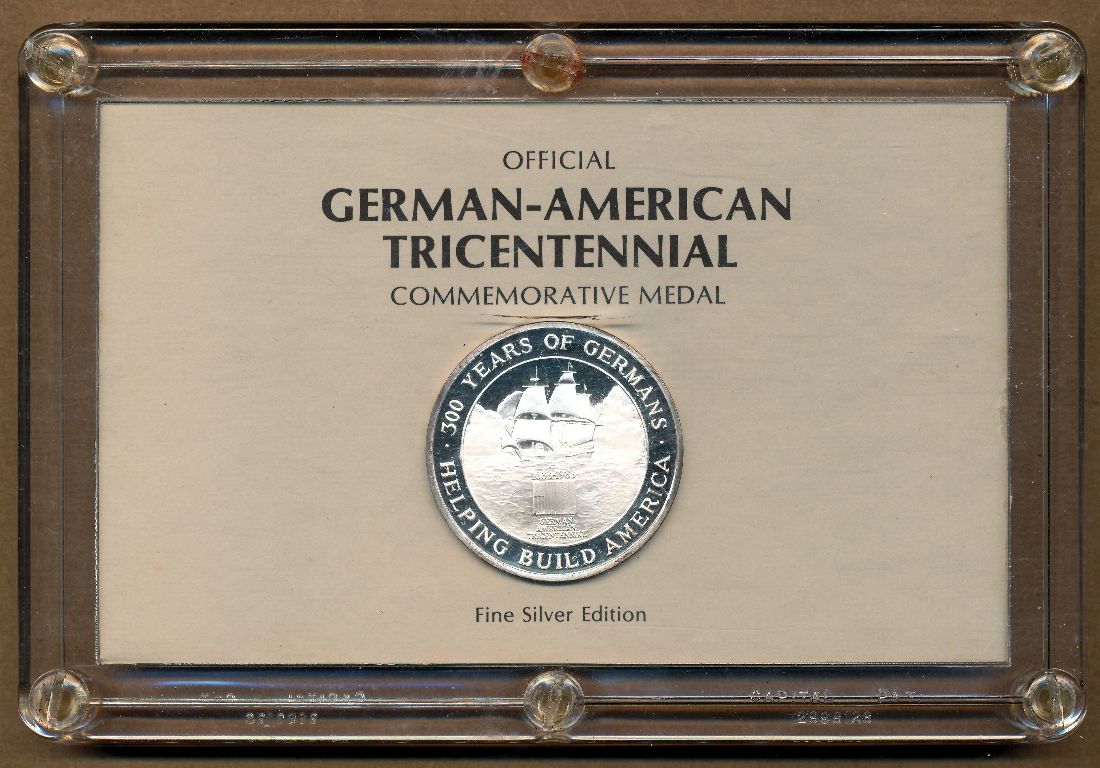
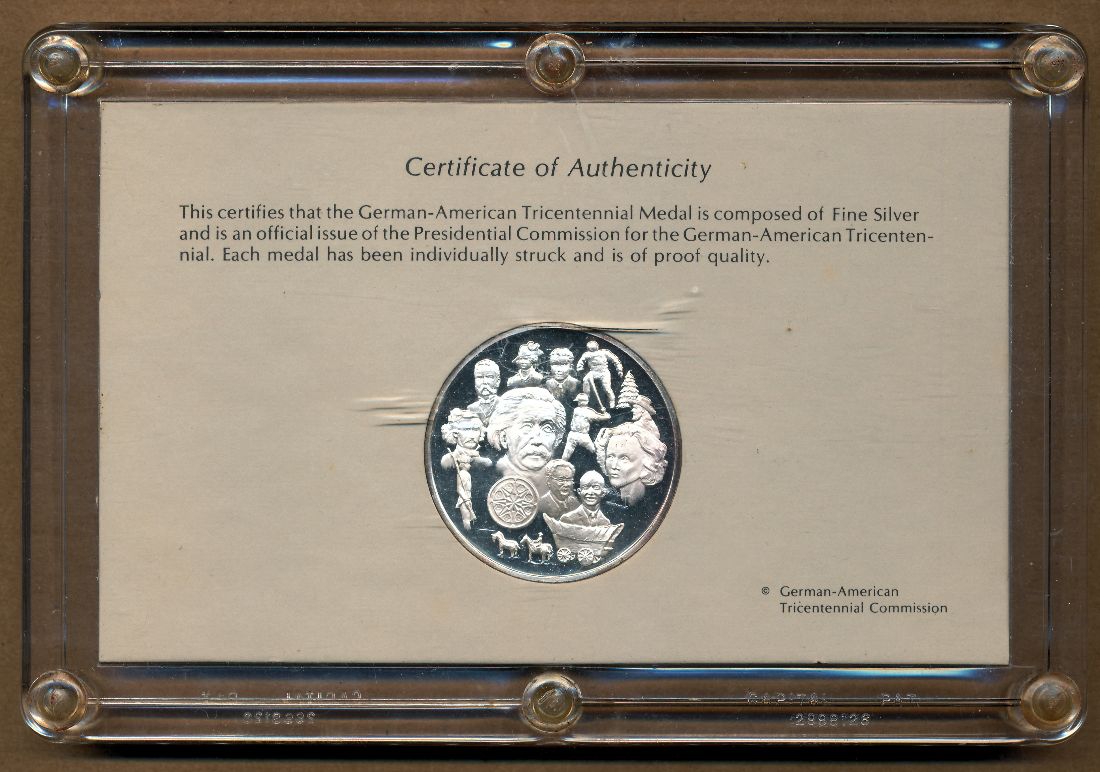
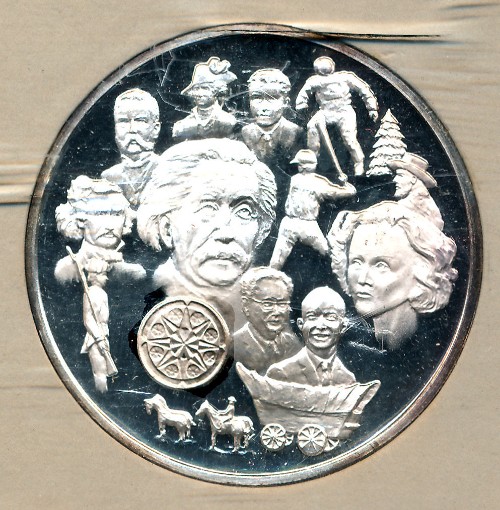
The medal was designed by Frans Kleimer and sculpted/modeled by Gladys Gunzer. The medal is 39 mm in diameter; its weight varied based on composition. It was struck by the Medallic Art Company (MACO).
The issue price of the gold medal (14 karat gold / 0.583 gold with a weight of 31.1 grams) was $775, the 0.999 fine silver (31.34 grams) was $49 and the base metal bronze was (27.22 grams) $8.95 - all were housed in a two-piece plastic case with insert card. The medals were edge-numbered. The three medals were available as a matched set for $895.
In 1983, the Federal Republic of Germany (West Germany) and the US released a joint issue of stamps to mark the tricentennial of the full-scale start of German immigration. Each of the stamps depicts the same core design, the sailing ship
Concord under sail on its voyage to America.
If you'd like to learn a bit more about the joint-issue stamp, check out:
-
1983 German Immigration Joint Issue Covers (And More!)For other of my posts about commemorative coins and medals, see:
Commems Collection.









 Posted 06/04/2024 10:17 am


