In 1923, the US Mint struck a half dollar that commemorated the 100th Anniversary of the Monroe Doctrine. In 2011, an effort was launched to honor James Monroe on the 200th Anniversary of his election as the 5th US President in 1816.
The bill, introduced by Representative Robert J. Wittman (R-VA), called for a three-coin program (a Gold $50 coin, a Silver Dollar and a Copper-Nickel (CuNi) Half Dollar). Yes, a $50 gold coin NOT a $5 Gold Half Eagle! The bill was referred to the House Committee on Financial Services, and subsequently to its Subcommittee on Domestic Monetary Policy and Technology.
Wittman presented the case for Monroe to be honored:
"The Congress hereby finds as follows:
(1) James Monroe was the only United States President besides George Washington to have actively served in the regular military during the Revolutionary War.
(2) James Monroe--
(A) participated in the Battles of Harlem Heights and White Plains;
(B) crossed the Delaware River in advance of George Washington;
(C) was seriously wounded at the Battle of Trenton and cited for conspicuous gallantry;
(D) wintered with the Continental Army at Valley Forge; and
(E) subsequently participated in the Battles of Brandywine, Germantown and Monmouth.
(3) James Monroe served at the State level in the Virginia House of Delegates and served 4 times as the Governor of Virginia.
(4) James Monroe served at the national level as a member of the Continental Congress, United States Senator, Minister to France (negotiating the Louisiana Purchase), Minister to Spain, Minister to England, Secretary of War, and Secretary of State (he was the only person to ever hold those 2 posts simultaneously, defending the Nation during the War of 1812), and finally as President of the United States from 1817-1825.
(5) James Monroe's accomplishments as President included the purchase of Florida, limiting the expansion of slavery, the admission of Maine and Missouri as States, and the promulgation of principles that became known as the "Monroe Doctrine" on December 2, 1823, expanding the concept of hemispheric independence beyond the United States—truly making him one of the most important figures in our Nation's history.
(6) The bicentennial of the election of James Monroe as President will occur in 2016, an election which ushered in what has been known since as the "Era of Good Feelings"."
As noted above, the bill proposed a $50 Gold coin vs. the more typical Gold Half Eagle ($5 coin). The Gold coin was to have a total weight of 33.921 grams (1.0909 troy ounces) with a net of one troy ounce of gold - a 91.6% fineness. The coin's diameter was specified as 32.7 millimeters. The specifications match those of the American Gold Eagle (AGE) $50 coin that was first struck in 1986.
The bill included specific details about the designs to be used on the coins. "The obverse of the coins minted under this Act shall bear the side profile image of President James Monroe based upon Rembrandt Peale's 1830 portrait which the James Monroe Memorial Foundation donated to The Commonwealth of Virginia in 1964...The reverse of the coins minted under this Act shall bear the image of the Monroe birthplace as drawn by the Colonial Williamsburg Foundation based on the 1830 drawing published as an etching." The coins were to be dated "2016" - Wittman was getting his coin proposal in early!
James Monroe Portrait by Peale, Circa 1825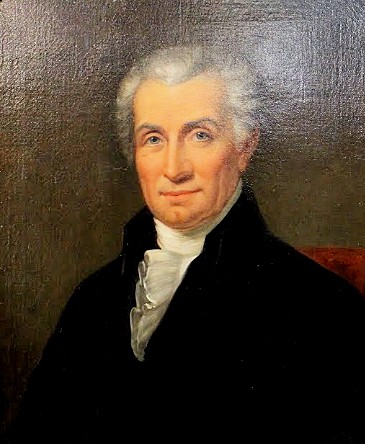 (Image Credit: The James Monroe Museum. Public Domain.)James Monroe Birthplace Etching, Circa 1845
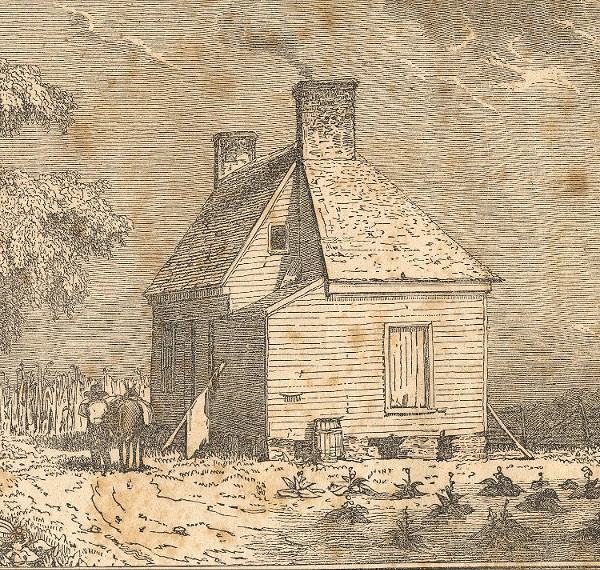 (Image Credit: The James Monroe Museum. Public Domain.)
Though it is not explicitly stated, the bill's language suggests use of a common design across the coin's denominations, though variations on the stated sources could have been developed for each coin.
Language in the bill specified that a given mint could strike either a Proof coin OR an Uncirculated coin of a particular denomination - not both. It seems likely that minting of the six potential coins would have been distributed among the various Mint facilities, with one possibility being the proof versions struck in San Francisco and the Uncirculated coins split between Philadelphia, Denver and West Point.
Wittman's bill requested 20,000 of the Gold $50 coin, 275,000 Silver Dollars and 500,000 CuNi Half Dollars. The surcharges specified for each coin were $35, $10 and $5, respectively.
Collected surcharges were to be paid to the James Monroe Memorial Foundation for its use in:
"(1) Development of the reconstructed birthplace of the 5th President, associated farm buildings, and a visitor and education center at the James Monroe Birthplace in Westmoreland County, Virginia.
(2) Continuing support of that facilities described in paragraph (1), including the acquisition of land originally owned by the Monroe Family.
(3) Supporting education programs about President James Monroe, the Monroe Doctrine, including an online library.
(4) Collecting and preserving artifacts and historical items related to President Monroe, the Monroe Doctrine, and his era which was known as "The Era of Good Feelings"."
Note: The James Monroe Birthplace and Museum celebrated its Grand Opening on October 2, 2021. Fore more, visit:
James Monroe Birthplace and Museum.The coin was not reported out of Committee and never acted upon in the House (or Senate) - but the Foundation's mission moved forward without it.
Had the coin program made it through Congress, and been approved by the President, I believe I would have supported the bill. I much prefer honest historical themes for US commemorative coins vs. pop culture designs.
For more of my stories about commemorative coins and medals, including more What If? stories, see:
Commems Collection.










 Posted 07/24/2024 08:56 am


