|
CCF Master Historian of Commemorative Coins
 United States
12515 Posts |
The 113th and 114th Congresses made attempts to authorize a commemorative coin program to mark the sesquicentennial of the adoption of the 13th Amendment to the US Constitution. The 13th Amendment abolished slavery in the United States; it achieved ratification by the requisite number of states on December 6, 1865 when Georgia became the 27th state (of 36 US States at the time) to approve it and thus meet the three-quarters of all states requirement. The bill was introduced in the House of Representatives in July 2013 (113th Congress) by Danny K. Davis (D-IL). The bill in the 114th Congress was a re-introduction of the bill, again by Representative Davis; it was introduced in July 2015. Each bill was referred to the House Committee on Financial Services. Representative Davis' bill included extensive "Findings": "The Congress finds the following:
"(1) The economic contributions of enslaved African Americans to the American economy between 1691 and 1860 were immeasurable. This labor force was used to build the foundations upon which America stands today.
"(2) From the 16th through the 19th centuries, most colonial economies in the Americas were dependent on human-trafficking and the use of enslaved African labor for their survival. This included the North American mercantile and shipping sectors that were dependent on slave-produced cotton, rice, sugar and indigo, and the profits derived from triangular trade with the West Indies, Africa, and Europe.
"(3) Enslaved Africans in the United States were also recognized as an important element in the political and economic capital in the nation's political economy.
"(4) Over the course of 246 years, slaves contributed an estimated 605 billion hours of forced free labor, the gain from which provided "seed capital" for the American economy, helped finance the birth of American finance and industrial sectors, contributed to the growth of most of the "Fortune 500" companies, and ultimately assisted the nation in financing both world wars.
"(5) During the Civil War, after Union forces repelled a Confederate invasion at the battle of Antietam in 1862, President Abraham Lincoln issued the Emancipation Proclamation, which declared that all slaves in states then in rebellion would be "forever free" as of January 1, 1863. By his action, Lincoln added a new and revolutionary dimension to the nation's war aims: from being a conflict to preserve the Union, the Civil War grew to be a crusade to end black slavery and fulfill the promise of the Declaration of Independence.
"(6) In the spring of 1864, Charles Sumner introduced an anti-slavery amendment in the Senate, much like the amendments that were introduced in the House by Representatives James Ashley and James Wilson in December of 1863, which declared all persons as equal, prohibited the slavery, and granted Congress the power to enforce these provisions. After extensive debate, the 13th Amendment was formed from this proposal, with the omission of the declaration of equality of all persons, and passed the Senate on April 8, 1864, by a vote of 38-6.
"(7) Debates between abolitionists and supporters of slavery focused on the moral issue of slavery and various interpretations of "natural law". Representative John Farnsworth of Illinois stated that "the old fathers who made the constitution believed that slavery was at war with the rights of human nature", and pointed out the contradiction between the existence of inalienable rights and the institution of slavery. Some members within the Republican Party, such as Charles Sumner, sought an interpretation of the Constitution that rejected slavery as incompatible with moral law.
"(8) President Lincoln took an active role in promoting the 13th Amendment in Congress. He ensured that the Republican Party's 1864 election platform included a provision supporting a constitutional amendment to "terminate and forever prohibit the existence of Slavery". His efforts were met with success when the House passed the bill on January 31, 1865, with a vote of 119-56.
"(9) On February 1, 1865, Illinois became the first state to ratify the proposed 13th Amendment; it was joined by 17 other states by the end of the month. Georgia ratified on December 6, 1865, becoming the 27th of 36 states to approve the Amendment, thus achieving the constitutional requirement that it be ratified by three-fourths of the states. Secretary of State William Seward declared the 13th Amendment to be part of the Constitution on December 18.
"(10) The Smithsonian National Museum of African American History and Culture (hereafter referred to in this section as the ("NMAAHC") was established by an Act of Congress in 2003, in Public Law 108-184.
"(11) It is fitting that the NMAAHC receive the surcharges from the sale of coins issued under this Act because the Museum is devoted to the documentation of African American life, and, among other areas, encompasses the period of slavery and the era of Reconstruction.
"(12) The surcharge proceeds from the sale of a commemorative coin, which would have no net cost to the taxpayers, would raise valuable funding to supplement the endowment and educational outreach funds of the NMAAHC."IMO, some of Davis' "Findings" include a bit of hyperbole, but the overall message is sound. In the Declaration of Independence, Thomas Jefferson wrote "all men are created equal". For too many years, the US did not live up too its own ideals - the mission of the NMAAHC is to educate the public on the under-reported history and culture of African-Americans. The bills proposed a three-coin program of atypical composition: $50 Gold and Platinum bi-metallic (Up to 250,000 coins), $20 Gold coin (250,000) and Silver Dollar (500,000). The bills included specifications for the designs to be used for the coins: "The design for the coins minted under this Act --
"(1) shall be based on the economic contributions of slavery, and include images of the pathway from slavery to freedom;
"(2) may include, on the $20 coins, that the design elements be in high relief;
"(3) may include, on the $50 coins --
"(A) on the obverse, an illustration of Columbia or similar figure representing Liberty, the female representation of America; and
"(B) on the reverse, a single eagle, and a set of stars on one or both sides;
"(4) shall be selected by the Secretary after consultation with the Commission of Fine Arts; and
"(5) shall be reviewed by the Citizens Coinage Advisory Committee."A "high-relief" $20 Gold coin definitely sparks the imagination (at least mine!). Surcharges collected were to be paid to "the Smithsonian National Museum of African American History and Culture to carry out the purposes of the museum, which goes beyond simply telling the history of African-Americans, creating an opportunity for anyone who cares about African-American Culture a place to explore, learn, and revel in the rich history of African-American Culture." Interestingly, the surcharge to be collected on the sale of each coin was $10 regardless of denomination. Neither bill was reported out of Committee or considered on the floor of the House. Each bill died for lack of action with the adjournment of its respective Congress. A potential reason for the failure of the bills could be tied to the fact that Congress, in 2003, had previously appropriated over $250 million to the museum as part of a public-private partnership in which the Federal Government was to provide 50% of the funds needed to design, develop and construct the museum with the other 50% of funds to be generated privately. Congress may have believed it had already supported the museum to the extent that it should with its previous appropriations. The commemorative coin program was one of multiple fundraising efforts considered by the museum's Advisory Council (a group of national leaders). Working with an outside consulting firm, the Council was able to reach its funding goals via donation from ~137,000 donors of all levels. Not getting an approved coin did not prevent the Smithsonian National Museum of African-American History and Culture from being built on the Mall in Washington, DC - the museum opened in 2016. Smithsonian National Museum of African-American History and Culture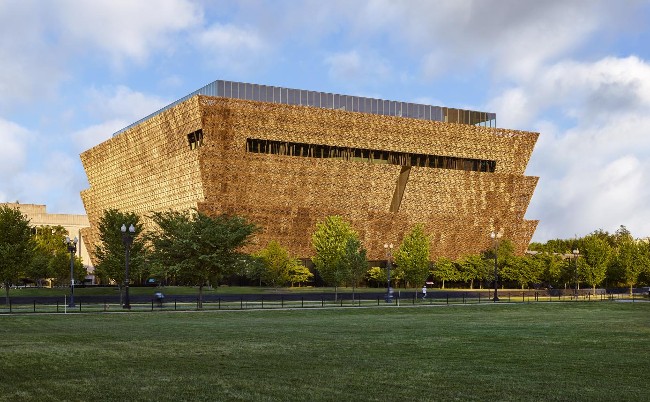 (Image Credit: Smithsonian Institution.) (Image Credit: Smithsonian Institution.)For more of my stories about commemorative coins and medals, including other What If? stories, see: Commems Collection. Collecting history one coin or medal at a time! (c) commems. All rights reserved.
|






 Posted 08/20/2024 2:25 pm