| Author |
 Replies: 51 / Views: 4,200 Replies: 51 / Views: 4,200 |
|
|
|
Pillar of the Community
United States
7381 Posts |
|
|
Valued Member
 United States
86 Posts |
Gold would be sweet! Don't think the budget will allow, unfortunately.
|
|
Moderator
 United States
194256 Posts |
Quote:
Don't think the budget will allow, unfortunately. Yes, I can relate to that.  |
|
Valued Member
United States
86 Posts |
Is a light brown patina on a "Lifetime" Alexander III good, bad, neither, personal preference? Is it a sign of a fake? If it's a legit patina, is it due to a rust problem?
Without seeing a specific coin, I realize it's probably difficult to answer these questions. But any insight would be appreciated and helpful!
|
|
Pillar of the Community
Russian Federation
5186 Posts |
Quote:
Gold would be sweet! Don't think the budget will allow, unfortunately. A Byzantine solidus, or a late Roman tremissis, would technically fit within the given budget. I imagine that you're probably looking for something more significant, though, and that indeed wouldn't quite fit. |
|
Valued Member
United States
86 Posts |
I just lost my first live online auction (bidding on an Athens Owl on Heritage), which is fine. The auction option is fun, but I don't have the patience to wait for these coins to make it to live bidding. So I'm wondering if buying retail is the way to go. But as much as I don't like waiting, I hate even more to pay more than I should.
Are coins sold at retail significantly more expensive than coins sold at auction? Is there a general percentage that can be applied (retail coins are typically x% more expensive than their auction counterpart) to judge fair retail price?
For example: If I find an Athena Owl on vcoins for $800. How much would that exact same coin in exact same condition sell for approximately at an auction on the same day? $600 (with buyer premium)?
And maybe there are too many variables to make a generalization. I'm still trying to find my "coin" feet when it comes to making that first purchase.
|
|
Moderator
United States
34530 Posts |
I think that it is hard to say. In an auction with no other bidders on your coin you could get it at the minimum bid. But if there are a couple folks who want the coin no matter what then the price will reflect that commitment.
Right now you are looking mostly at spendy but available coins. Take your time and as you say get your feet underneath you. As you go deeper, you will start to find coins you want that are rarely up for sale. Those are the ones on which you don't want to exercise patience.
"If you climb a good tree, you get a push."
-----Ghanaian proverb
"The danger we all now face is distinguishing between what is authentic and what is performed."
-----King Adz
|
|
Moderator
Australia
16954 Posts |
Quote:
Is a light brown patina on a "Lifetime" Alexander III good, bad, neither, personal preference? Is it a sign of a fake? If it's a legit patina, is it due to a rust problem?
Without seeing a specific coin, I realize it's probably difficult to answer these questions. But any insight would be appreciated and helpful! Silver doesn't "rust", but it can acquire a layer of back or brownish horn silver (silver chloride) if buried in the wrong conditions, but horn silver is both difficult to remove and "ugly", and would never be described as patina or toning. Patina or toning on a silver coin is, generally, a sign that the coin is not newly-dug-up. All ancient coins in existence and on the market today have been buried in the ground for 2000 years or so, and dug up again some time in the last 200 years or so. Silver coins that have been underground for over a thousand years tend to build up a layer of gunk so they look like this, and this needs to be removed. The chemical agents used in such cleaning usually strip away whatever original circulation-patina might have been present on a silver coin, leaving freshly-dug recently-cleaned ancients looking bright white. So an ancient silver coin that has the same coloration as a 100 year old modern silver coin, has either (a) been around above-ground for about a hundred years, or (b) has been artificially re-toned. Unlike the case with modern coins, there isn't much demand from ancients collectors for "nicely toned coins", so not as much premium is assigned to them. On the plus side, it means that most such toning is probably genuine, since there's little financial incentive to try to doctor a coin's toning. Don't say "infinitely" when you mean "very"; otherwise, you'll have no word left when you want to talk about something really infinite. - C. S. Lewis
|
|
Valued Member
United States
86 Posts |
Okay... so I fully understand the importance of buying from reputable dealers/auction houses. But what about the description these places provide? Are they always trustworthy?
I'd like to get an Alexander III/Zeus tetradrachm that was minted during his lifetime. Some sellers/auctions state in their descriptions "Lifetime," "Lifetime-Early Posthumous," or "Posthumous." I'm guessing if the coin is shown in an NGC case and the case description states one of those three conditions, I can trust their findings. But what if it's a reputable dealer who states one of these conditions but there is no NGC confirmation? Can their dating be considered trustworthy?
|
|
Moderator
United States
34530 Posts |
@flo, it is going to come down to trust. You need to be able to trust the seller to have not only sold you a real coin but also one that has been correctly attributed. You can rely on slabs and their labels for this information, but they are also fallible and counterfeit-able--perhaps to a lesser degree. If you can take the time to learn about this hobby, you will begin to develop an understanding of what to look for and what to avoid. Fakes and mis-attributions are part of the hobby and can present opportunities as well as pitfalls.
On another note, if you are still looking for an owl from a trustworthy seller, Frank Robinson has one up on his current auction. DM me if you would like details about how to contact him.
"If you climb a good tree, you get a push."
-----Ghanaian proverb
"The danger we all now face is distinguishing between what is authentic and what is performed."
-----King Adz
|
|
Valued Member
United States
86 Posts |
Hi, Spence!
Thanks for the Owl lead! Unless I'm missing something, it seems I haven't posted enough to be given message privileges. When I click "email poster" I get a message saying...
For security reasons new members do not have access to the email system. There is typically no reason for new members to email since.....
1. You are not allowed to buy, sell, or trade yet.
2. It's not fair to invade someone's privacy to ask them a question privately when there is an entire forum waiting to help you.
I am definitely interested in taking a look at Frank Robinson's Owl. Is there another way to contact you?
|
|
Moderator
United States
34530 Posts |
done
"If you climb a good tree, you get a push."
-----Ghanaian proverb
"The danger we all now face is distinguishing between what is authentic and what is performed."
-----King Adz
|
|
Valued Member
United States
86 Posts |
I've seen this brown stuff (patina?) on a few coins. Is this to be avoided? Does it decrease the value of a coin? Will it get worse? Is there a way to remove it, or does removing it hurt the value of the coin? As always, huge thanks! 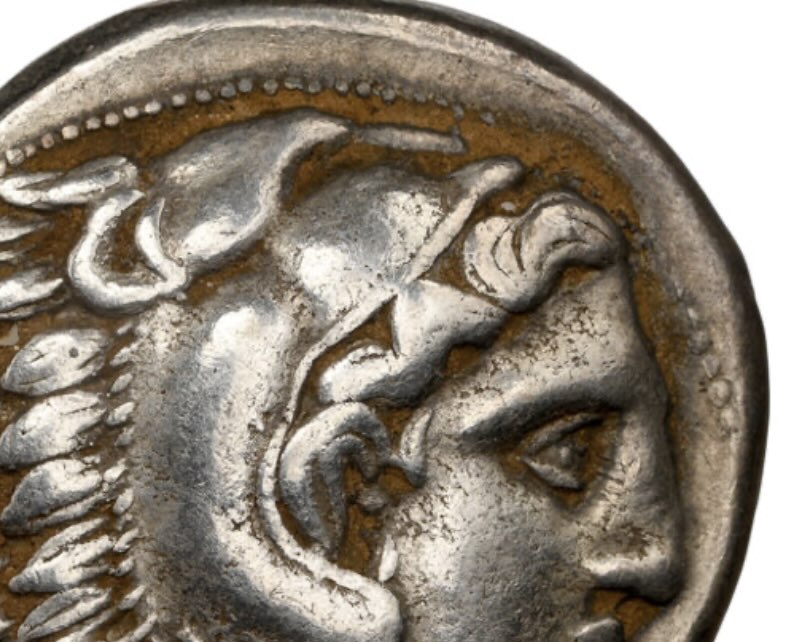 |
|
Moderator
United States
34530 Posts |
No that doesn't hurt the coin. You shouldn't pay more for "desert patina", but having these sorts of earthen concretions is fine. On the other hand, blue chalky deposits on a copper alloy coin may be bronze disease and should be avoided until you have a little more experience (and maybe even then).
"If you climb a good tree, you get a push."
-----Ghanaian proverb
"The danger we all now face is distinguishing between what is authentic and what is performed."
-----King Adz
|
|
Valued Member
United States
86 Posts |
Can the "desert patina" be removed? Or does removing it hurt the value of the coin?
|
| |
Replies: 51 / Views: 4,200 |







 First Page


 Posted 02/10/2025 10:41 am





