I previously wrote about the efforts of Senator Ben Nighthorse Campbell (R-CO) to commemorate the history and culture of Native Americans via a three-coin program of silver five-cent pieces featuring
James Earle Fraser's original design for the "Buffalo" nickel of 1913-38. You can read it here:
What If? 2000/2001/2002 Buffalo Nickel.
As I wrapped up that discussion, I mentioned that Senator Campbell substituted a Silver Half Dollar bill for his original Silver Five-Cent coin bill; the substitution was made via an amendment to his original bill in June 1998.
Shortly thereafter, in August 1998, George E. Brown, Jr. (D-CA) introduced a companion bill to Campbell's amended bill in the House of Representatives ("House"). The bill was referred to the House Committee on Banking and Financial Services, with a further referral to its Subcommittee on Domestic and International Monetary Policy.
When he introduced his bill, Brown stated "this year marks the sixtieth anniversary of the issuing of the Buffalo Nickel. This nickel is still very popular and widely collected today. It remains a respected and cherished symbol.
"That is why it is my pleasure to introduce the House companion bill to [the bill] sponsored by Senator Ben Nighthorse Campbell of Colorado."
Though described by Representative Brown as a "companion" bill to Senator Campbell's amended bill, he was technically incorrect as his bill had several wording differences when compared to Campbell's, and included a significant difference in coining specifics. Campbell's prior (amended) bill called for a three-year program of Silver Buffalo Half Dollars, while Brown's bill specified only 2001 as the year of issue.
CAMPBELL: "during the 3-year period beginning on January 1, 2000, the Secretary shall mint and issue each year not more than 500,000 half-dollar coins"
BROWN: "The Secretary may issue coins minted under this subsection only during the period beginning on January 1, 2001, and ending on December 31, 2001."
A mintage limit of 500,000 coins was included in both bills. In Campbell's bills it was an annual limit for each year of the three-year program. In Brown's bill, it was effectively a program maximum as the proposed coins were only to be struck in 2001.
Both bills included a $3.00 per-coin surcharge. Collected surcharges were to be paid into the Numismatic Public Enterprise Fund and subsequently made available to the National Museum of the American Indian for:
"(A) commemorating the tenth anniversary of the establishment of the Museum; and
"(B) supplementing the endowment and educational outreach funds of the Museum.''
So, while the National Museum of the American Indian would not receive the surcharge funds directly, as with Campbell's Buffalo Nickel bill, The Museum was to have access to the funds for the same purposes.
Campbell's amended bill was referred to the Senate Committee on Banking; Brown's bill was referred to the House Committee on Banking and Financial Services, with a further referral to its Subcommittee on Domestic and International Monetary Policy.
Neither bill proceeded out of Committee for further consideration. If they had, the differences between them would have had to have been resolved before being passed and/or approved.
Campbell was back in the 106th Congress, with the re-introduction of a slightly modified version of his Half Dollar bill in February 1999. While introducing the bill, he commented:
"This legislation reflects the goals of all interested parties, and still maintains the original goal of raising funds for the preservation of Native American artifacts in the Museum of the American Indian. I urge my colleagues to support passage of this bill."
The new bill still called for a three-year Silver Half Dollar program, but stated it would commence in 2001 (vs. the previous 2000); the 500,000 coin annual limit remained in place.
The design specifications and design approval process remained the same as specified in his earlier bill, as did the provisions for the minting of Proof and Uncirculated versions of each coin and each version being limited to being struck at one mint facility.
The per coin surcharge was again $3.00, with collected funds to be deposited in the Numismatic Public Enterprise Fund and made available to the National Museum of the American Indian for the purposes outlined above.
The bill was referred to the Senate Committee on Banking, but progressed no further.
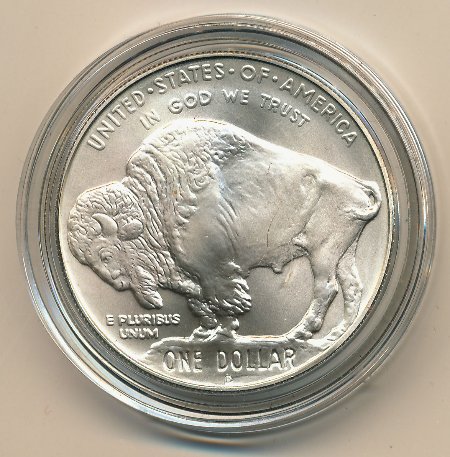
Things would change for Ben Nighthorse Campbell during the Second Session of the 106th Congress (2000) as he returned with a new bill (and a House partner) that called for a one-year Silver Dollar program to be issued in 2001. The result of his new approach yielded a collector favorite.
2001 American Buffalo Silver Dollar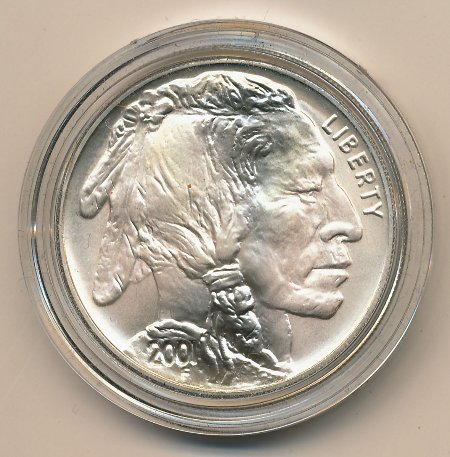
For other of my posts about commemorative coins and medals, including more What If? stories, see:
Commems Collection.





 Posted 09/12/2025 11:01 am





