| Author |
 Replies: 531 / Views: 79,896 Replies: 531 / Views: 79,896 |
|
|
|
Pillar of the Community
Canada
1005 Posts |
Nice find o train!
Will you post a photo of the s in cents?
|
|
New Member
Canada
34 Posts |
George V. 5 cents, from 15 coins; 1931, 1932, 1934 - below the line. (Low) 1924, 1928, (2)1929, 1930, 1935, 1936 - touch the line. 1927, (2)1930, (2)1936 - above the line. 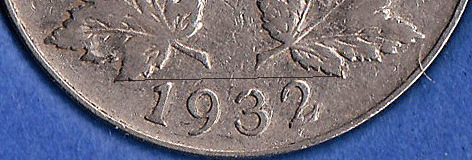 |
|
Valued Member
 Canada
402 Posts |
ArchW,  to this topic : " 5 cents 1932 ( Varieties : Far 2 and Near 2 ) ". If you check, on page 25 of this topic, the pics of coins Far 2 of Canadian Beaver Hunter and o-train, you will see that your coin 1932 is a pattern of the variety Near 2 ( 2 near the leaf ). When the coin is very used, it is important to put the line on the extremity of the leafs . See also the following points to identify more easily the varieties Far 2 and Near 2 : - on the coins of CBH and o-train, the 2 is near 3 and the 2 is near rim. : so these coins are patterns of the variety Far 2. - on your coin, the 2 is far 3 and the 2 is far rim : so your coin is a pattern of the variety Near 2. |
|
Pillar of the Community
Canada
519 Posts |
Thanks, does the distance of the S from the rim also matter with this variation? I'm hoping to go to a coin show today so I will bring the coin along and confirm if it is a near or far rim.
|
|
Valued Member
Canada
402 Posts |
I think that the Far 2 is also a far S from the rim, but the distance of the S from the rim is not an item that I retain to identify the variety Far 2.
|
|
Pillar of the Community
Canada
1005 Posts |
O train. Your 1932 is a far 2. (nice find!!)
Seeing more of your coin then just the date is not important to knowing if it is a far 2.
I am curious what the S looks like, maybe others are too,
(And the other side of the coin too.)
|
|
Pillar of the Community
Canada
519 Posts |
If I get a chance I'll post more pictures. I brought the coin to the ONA show today and a guy put it under a microscope. He said it is probably an F-10. I tried finding more but no luck.
Edited by o-train
04/20/2013 6:46 pm
|
|
New Member
Canada
34 Posts |
Thank you za75, Near 2 will do.
Because I am easily mixed up, I referred to the line, not the Near or Far. That is your turf.
Earlier this year I found I have Near and Far 1953 Nickel's.
Canadian Coins - 61st. Edition. Pg. 68 - Far Maple Leaf is Far from the rim, Near is Near.
The same as Pg. 45, 16th. Edition 1998. (I only have two books :-)
There is a chance that a Leaf on any year could be slightly rotated, double stamped or out of place.
"When the coin is very used, it is important to put the line on the extremity of the leafs."
Unlike mine, dialog_gvf has a beautiful coin on page 4.
No body looks at the distance of the date on a coin that has the Rim worn off.
o-train will confirm if his coin is a Near or Far S.
|
|
Valued Member
Canada
402 Posts |
Good morning ArchW,
The trade names Far 2 and Near 2, for the varieties of 5 cents 1932, are the same that were used with the varieties of 5 cents 1926, Far 6 and Near 6.
Maybe the real name could be " 2 far from the right leaf ", but I think that this is too long for the inscribing in the books.
On the other hand, my references to 2 near 3 and 2 near rim are only some additional indications to identify easily the variety 5 cents 1932 Far 2.
I refer you to the Charlton's book, 61sh Edition, at the end of page 63 : you will find an explanation for the varieties of the 5 cents 1926 and I believe that this explanation is the same for the varieties of the 5 cents 1932.
|
|
New Member
Canada
34 Posts |
Good evening za75
You have explained everything clearly, we both wish you did not have to.
There is a standard for grading coins, If there is a standard for describing them, I haven't seen it.
Getting people interested in collecting might be easier if there was.
When I can't read or understand a grocery label, I don't buy it, no matter what the clerk says.
Good work with the survey, don't let me waste any more of your time.
|
|
Valued Member
Canada
402 Posts |
Good morning ArchW,
Sorry if I don't understand very well your commentaries : my english is poor !
1- In your post, 04/20/2013, you say :
" Georges V, 5 cents, from 15 coins;
1931,1932,1934 - below the line. ( Low )
1924, 1928, (2)1929, 1930,1935, 1936 - touch the line.
1927, (2)1930, (2)1936 - above the line. "
and you present a photo of 5 cents 1932, where the date ( 1932 ) touch the line : I don't understand this.
You can see, in the 26 pages of this topic that all collectors, and me too, have used the line only to explain, to fix clearly the difference between the Far 2 and the Near 2 of the 5 cents 1932. We have not use the line with others dates and I don't see the opportunity to proceed like this.
2- In your post, 04/22/2013, you say:
" There is a standard for grading coins, if there is a standard for describing them, I have't seen it. "
I don't understand your commentary : " ..standard for grading coins ". For me, I don't see a standard of grading when we use the line but an easy method to see the difference between a Far 2 and a Near 2, on 5 cents 1932.
With this method, I have obtain without identification's error, in the last trend, from members of this site and from members of Numicanada, the following result : 34 "Far 2" and 4318 "Near 2", with 4352 exemplaries of 5 cents 1932.
Best regards.
|
|
Pillar of the Community
Canada
1005 Posts |
CCCS names it in their description quite well 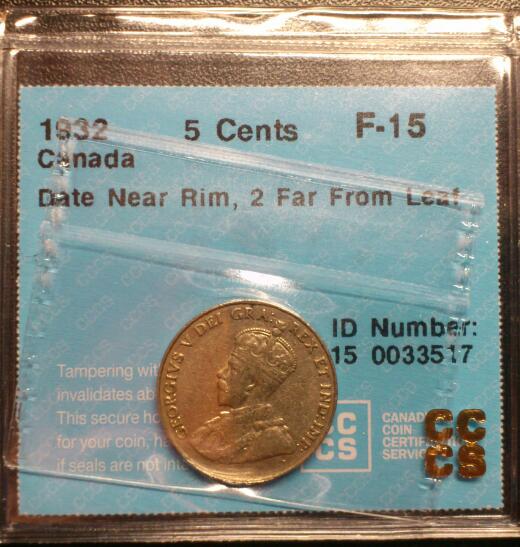 |
|
Valued Member
Canada
370 Posts |
Bm0ney, I agree CCCS did a good job at naming this variety.
I was a bit confused with the 'near' vs. 'far' for the 1932. I know the 'near' and 'far' variety for 1926 refers to the distance that the '6' is from the leaf. But in the years 1922, 1929, 1934, & 1936 there is a 'near' and 'far' variety that refers to the distance from the top tail of the 'S' in cents from the rim.
|
|
Moderator
 Canada
10473 Posts |
For years 1922, 1929, 1932, 1934 and 1936, the original name used to be 'flat rim' and 'concave rim' - which described the relationship between the rim edge and the fields... using the terms 'near' and 'far' from rim is a misnomer, because there is no difference of the spacing of the device elements and the rim edge - it is an optical illusion, because the concave rim edge makes it appear closer to the devices...
"Discovery follows discovery, each both raising and answering questions, each ending a long search, and each providing the new instruments for a new search." -- J. Robert OppenheimerContent of this post is licensed under a Creative Commons Attribution-NonCommercial 3.0 Unported License. See: http://creativecommons.org/licenses...0/deed.en_USMy eBay store
Edited by SPP-Ottawa
04/25/2013 8:22 pm
|
|
Pillar of the Community
Canada
902 Posts |
 It may be more correct to call them convex or concave field. |
| |
Replies: 531 / Views: 79,896 |








 First Page
 Previous Page



 Posted 04/20/2013 01:36 am


