| Author |
 Replies: 1,299 / Views: 152,136 Replies: 1,299 / Views: 152,136 |
|
|
|
Pillar of the Community
United States
683 Posts |
Here are some closeups of the cracks. Belly crack: 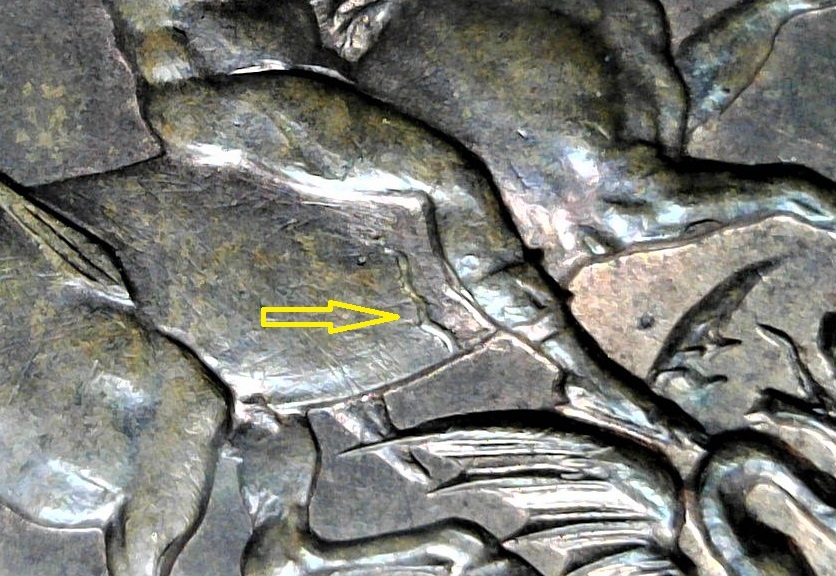 Repunched or reengraved date - base of 1 and knob of 5: 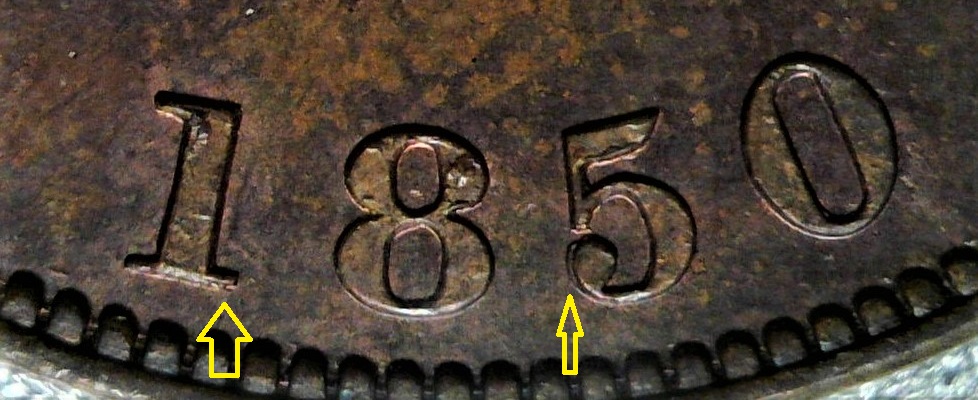 Crack at halF: 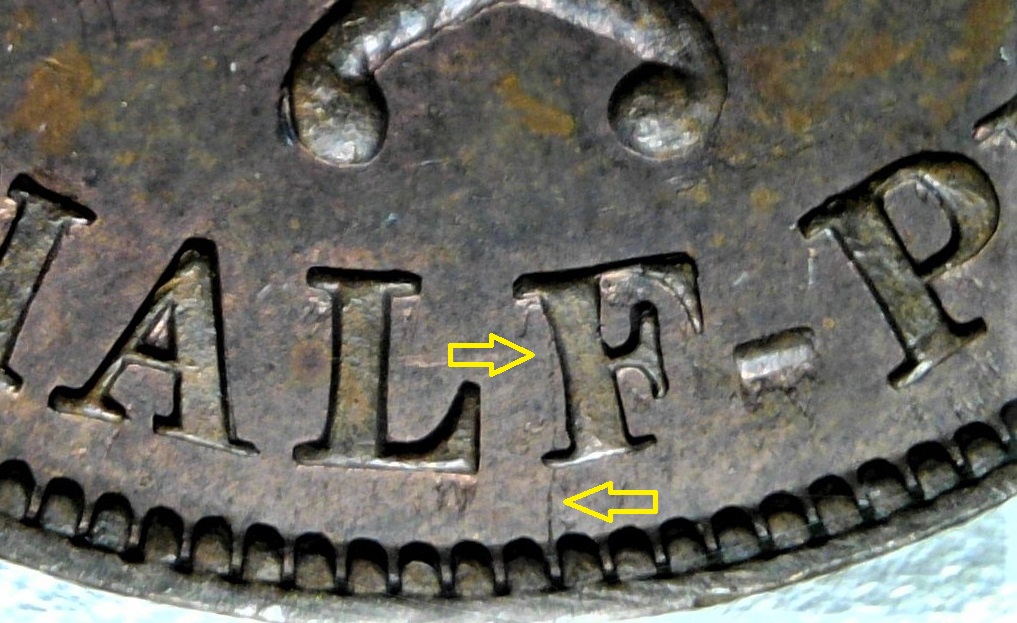 Crack at crown: 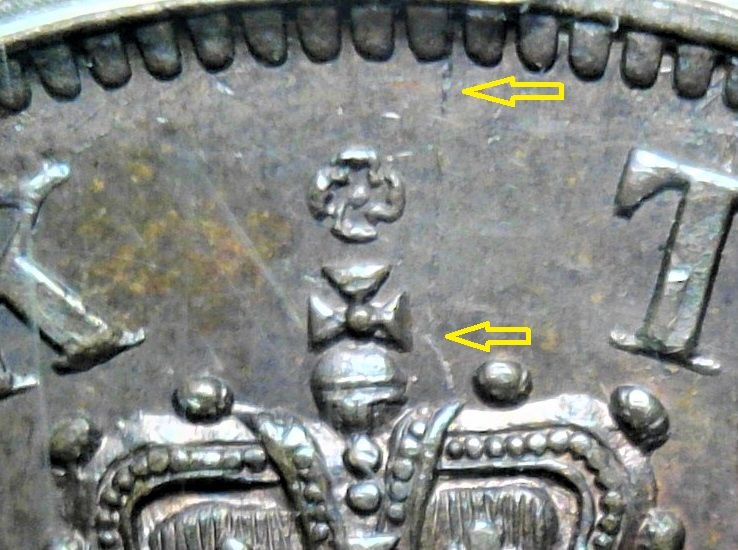 Crack at top of baNK: 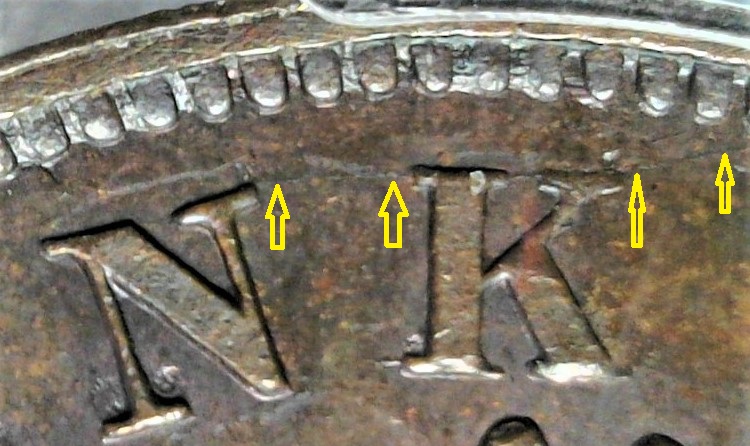 |
|
Pillar of the Community
United States
840 Posts |
Courteau 40 is another possibility.
Need enlarged photos.
doug
|
|
Pillar of the Community
United States
840 Posts |
Been concentration on a different project for the last ten years. Should return in another six months.
This is a work-up I did decades ago. This data is a combination of the late Dr. Davis McLean's collection and mine.
1 Perf 10
1-1 McLean New Variety
2 Perf
2A 1 D/C
2B 2 D/C 45
2C 3 D/C 45
3 Perf
3A 2 D/C 30
3B 3 D/C
4 1 D/C
4A 3 D/C 40
4B 4 D/C 55
4-1 1 D/C 20 New Variety
4-1A 2 D/C 30
5 1 D/C 40
5A 3 D/C 40
5-1 McLean New Variety
5-2 McLean New Variety
6 Perf
6A 3 D/C 20
6B 4 D/C
6C 7 D/C 60 ICCS
6-1 1 D/C 40 New Variety
7 2 D/C 30
7A 4 D/C 45
7-1 1 D/C 55 New Variety
8 Perf 06
8A 2 D/C 60 ICCS
8B 3 D/C
8C 4 D/C 45
8-1 Perf New Variety
9 Perf doubtful in perfect
9A 3 D/C
9B 6 D/C 45
9-1 Perf 20 New Variety
10 Perf 06
10A 1 D/C 30
11 2 D/C 45
11A 4 D/C 40
11B 5 D/C
12 1 D/C 55
12A 2 D/C 45
13 Perf
13A 1 D/C 20
13B 2 D/C 15
13C 3 D/C 15
14 Perf 55
15 1 D/C 55
15A 2 D/C 50
16 Perf
16A 1 D/C 40
16B 2 D/C 30
16C 5 D/C 40 Scratches
16D 7 D/C 55
17 2 D/C 60 ICCS
17A 3 D/C 45
18 Perf
18A 1 D/C 30
18B 2 D/C 20
18C 3 D/C 20
18D 4 D/C
19 1 D/C
20 Of doubtful existence
21 Perf 10
21A 2 D/C 06
21B 3 D/C 45
21C 5 D/C 30
21D 9 D/C
22 Perf
22A 3 D/C 45
22B 6 D/C 15
22-1 3 D/C 15 New Variety
23 Perf 45
23A 1 D/C 20
23-1 20 New Variety
24 2 D/C 45
24A 4 D/C
25 Perf
25A 1 D/C 20
26 Perf 60
26-1 1 D/C 45 New Variety
27 3 D/C 45
27A 4 D/C 45
28 2 D/C
28A 3 D/C
28B 4 D/C 60 ICCS
28C 5 D/C 60 ICCS
28D 6 D/C 55
29 1 D/C
29A 2 D/C
29B 3 D/C 30
30 Perf ICCS 60 unlisted as such
30A 1 D/C 45
31 Perf
31A 2 D/C 55
31B 3 D/C 15
32 1 D/C
32A 3 D/C 45
32-1 3 D/C 45 New Variety
32-2 Perf 20 New Variety
33 Perf doubtful in perfect
33A 2 D/C 50
34 1 D/C 30
35 1 D/C
35 1 D/C 55
35A 2 D/C 55
35B 3 D/C 55
35C 4 D/C
36 4 D/C 55
36A 5 D/C 60
37 6 D/C 40
38 Perf
38A 2 D/C 40
38B 3 D/C 60
39 Perf 50
39A 2 D/C
40 Perf 40
41 1 D/C 15
42 Perf 12 unlisted as such
42A 1 D/C 30
42B 2 D/C 40 corroded
42C 3 D/C
43 Perf 63
43A 4 D/C
43B 4 D/C 55
43C 9 D/C
43-1 2 D/C 30 New Variety
44 1D/C
44A 2 D/C 45
44B 4 D/C
44C 9 D/C 20
44D 12 D/C 45
44-1 2 D/C 55 New Variety
44-1A 4 D/C
44-2 4 D/C New Variety
45 1 D/C 60
45-1 1 D/C New Variety
46 Perf 30
46A 2 D/C 55
46B 3 D/C 15
47 Perf
47A 1 D/C 40
47B 2 D/C
47C 3 D/C 55
47-1 Perf 40 New Variety
48 2 D/C
48A 4 D/C 55
49 1 D/C 30
49A 5 D/C 20
49B 7 D/C 60
50 Perf doubtful in perfect
50A 1 D/C 30
51 1 D/C 15
51A 3 D/C
51B 6 D/C
52 Perf
52A 1 D/C 30
52B 2 D/C
52C 3 D/C
52D 4 D/C
53 4 D/C 15
53A 5 D/C 20
54 Perf doubtful in perfect
54A 1 D/C 55 ICCS
55 Perf 30
55A 1 D/C
55B 2 D/C 12
56 Perf 30
56A 1 D/C 40
57 2 D/C 20
57A 7 D/C 30
57B 8 D/C
57-1 7 D/C New Variety
58 Perf doubtful in perfect
58A 4 D/C 55
58B 5 D/C 50
58C 6 D/C 30
58D 7 D/C 55
59 1 D/C 45 corrosion
60 3 D/C 45
60A 6 D/C 45
60B 6 D/C 55
61 1 D/C AU 50 NGC
61A 2 D/C 20
61B 6 D/C 40
62 4 D/C 40
62-1 4 D/C 50 ICCS New Variety
62-1A 6 D/C
63 5 D/C 55 ICCS
63A 6 D/C 60 ICCS
64 Perf 55
65 Perf 20
66 2 D/C 30
66A 3 D/C 50
66B 5 D/C 55
67 Perf 20
67A 1 D/C 55
67-1 3 D/C 55 New Variety
67-1A 4 D/C 45
68 Perf
68A 1 D/C 30
68B 2 D/C 45
69 Perf
69A 1 D/C 20
70 Perf 50
70A 1 D/C 55
70B 3 D/C 45
71 Perf 12
71A 1 D/C 45
71-1 1 D/C New Variety
72 Perf NEED McLean
73 Perf doubtful in perfect
73A 1 D/C 08
74 Perf 30
74A 1 D/C 40
74B 3 D/C 30
74C 5 D/C 30
75 3 D/C 10 �
Note - 'unlisted as such' indicates no mention by Doctor Courteau in the specific die progression.
'doubtful in perfect, is in reference to the specific die progression. Variety 20 is the sole unknown variety.
Note - Entries absent a grade are die-states ensamples from Dr. McLean's collection, and absent in the authors'.
|
|
Pillar of the Community
United States
840 Posts |
My notes on Courteau 27...
Forgive my alignment. My cut-and-paste is terrible.
27 R-10
Obverse Characteristics: The same as variety 40.
The Man's right Foot is perfect.
The left Wing of the Dragon is perfect.
Two horizontal lines are below the left Wing of the Dragon.
The left Bridle Rein shews well.
A round Knob is to the Dagger Hilt.
The Date is Perfect.
The Legend is Perfect.
A forked line is below the Man's right Arm. The upper branch is longer and thinner.
The Belly of the Horse is not double-cut.
A Wavy line is on Horse along the Man's Leg.
This heavy wavy vertical line is from the bottom of the Belly of the Horse, extending to the lower section of the Man's Thigh, running slightly distant from, yet parallel to the Man's Calf.
Latter die states have this line forked and joined to a 2nd line. A 2nd line runs vertically from the bottom of the Belly of the Horse, on-line with the Heel of the Man's left Foot, and extends to the Man's Haunch. A diagonal line runs across the lower section of the Belly of the Horse, joining the two lines.
From broken dies.
A long forked Die-Crack is from the B in BANK to the UPP in UPPER.
This long Die-Crack is from the left-section of the Denticle above the serif of the B in BANK, extending to the top of the same letter, on-line with the left-side of the upright of the same letter, and forking. The lower branch continues through the same Upright and entering the hollow of the lower section of the same letter and forking. One branch extends to the lower section of the Tail of the Horse, the other to the left-section of the ground.
The primary branch exits the Shoulder of the same letter, and enters the left Leg of the A in the same word (on-line with the cross-bar), exiting the base of the Stand of the right Leg of the same letter, touching the Stand of the left Upright of the N in the same word, and extending below K in the same word, and forking nearing the O in OF. The upper branch extends to the base of the same O, the lower branch extends to the UPP in UPPER.
Note - On early die states, this Die-Crack is not present.
Note - On mid die states, this Die-Crack is barely discernable.
A Die-Crack to the 1st A in CANADA.
This Die-Crack is from the right-section of the Denticle above the Stand of the left Leg of the 1st A in CANADA, extending through the lower section of the left-side of the same Leg, through the Stand of the same Leg, extending slightly above the Ankle of the left Foreleg of the Horse.
Note - On early die states, this Die-Crack is barely discernable.
A Die-Crack to the 3rd A in CANADA.
This Die-Crack is from the right-section of the Denticle above the 3rd A in CANADA, extending to the centre of the top of the same letter.
Reverse Characteristics:
The St. Andrew's Cross frame below the E in TOKEN is broken in the middle.
The end of the outline of the Union Jack is forked.
The Anchor Ring is perfect.
The Battle-Axe Head has a hole
The lower ornamental Ball is present.
The Stand of the T in TOKEN is weakly struck.
The Stand of the N in TOKEN is half struck to the left, and fully struck to the right.
The right-side of the Stand of the Upright of the K in BANK is weakly struck.
The right-side of the Stand of the Leg of the K in BANK is weakly struck.
The right-side of the Stand of the Leg of the K in TOKEN is weakly struck.
The right-side of the Serif of the right Arm of the Y in PENNY is weakly struck.
The right inner ornamental ball is connected to the Cornucopias.
From broken dies.
A Die-Crack is betwixt the K in BANK and the upper Rosette.
This straight Die-Crack is from atop the right section of the 2nd Denticle to the immediate left of the upper Rosette, extending to the Crown, betwixt the upper inner large Crown Jewel and the Globe.
Note - This Die-Crack is similar to variety 21, but originating from a different Denticle.
Note - Early die states shew this Die-Crack very faint.
A Die-Crack is betwixt the L and F in HALF.
This straight vertical Die-Crack is from betwixt the Denticles betwixt the L and F in HALF, extending betwixt the same letters, and touching the left end of the Serif of the same F, and extending to the upper section of the Handle of the right Cornucopia, slightly to the left of the vertex of the Cornucopias.
Note - On early die states, this Die-Crack is barely discernable.
Thus:
27 Perfect - No Die-Cracks.
27A A Die-Crack is to the 1st A in CANADA.
27B Die-Crack as above, plus a Die-Crack is betwixt the L and F in HALF.
Die-Cracks as above, plus a Die-Crack is betwixt the K in BANK and the upper Rosette.
27C Die-Cracks as above, plus a Die-Crack is from the B in BANK to the U in UPPER.
27D Die-Cracks as above, plus A Die-Crack is to the 3rd A in CANADA.
This is the Die-Crack progression.
Note - The authors' have a moderately corroded low grade ensample shewing no discernable Die-Cracks. Concerning the grade, the authors' are reluctant to say perfect die ensamples exist.
|
|
Pillar of the Community
 Canada
5644 Posts |
Wow, Doug! Good to se you back. The token world has missed you. Are you planning on riding your bike(s) up to T.O. in the next year or so for a show?
|
|
Valued Member
Canada
222 Posts |
@Colonialtokens:Glad to see you back with us. This is what I believe to be the Courteau #020 variety. Sorry for the quality of the pictures, this token that is in my collection is in an ICCS flip (In 10 years, this is the third one I've seen): 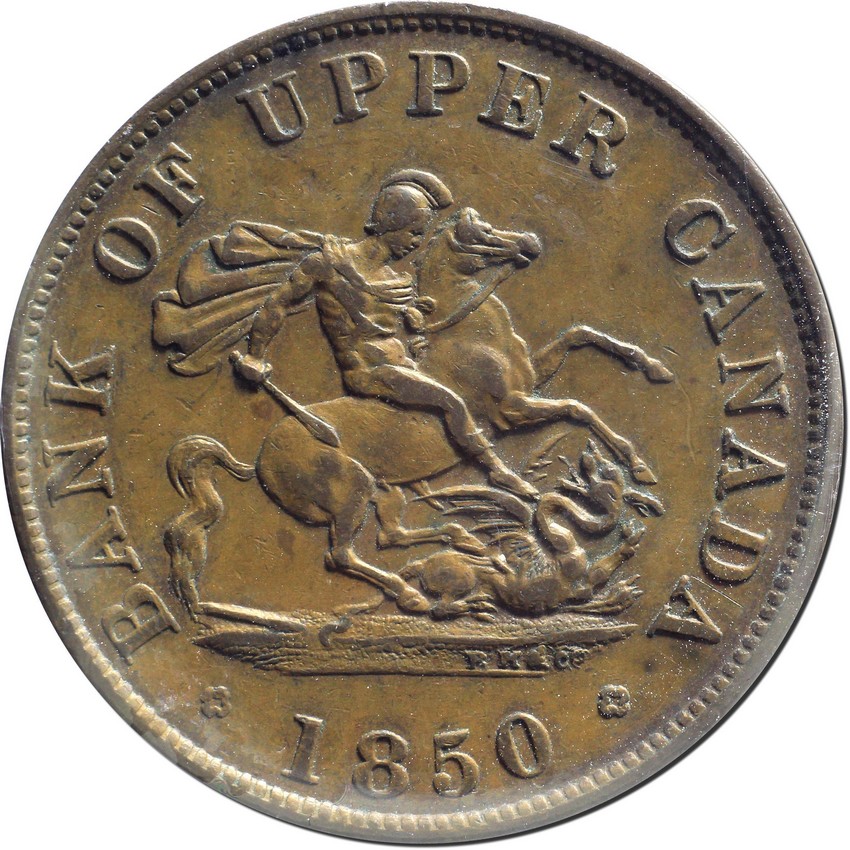 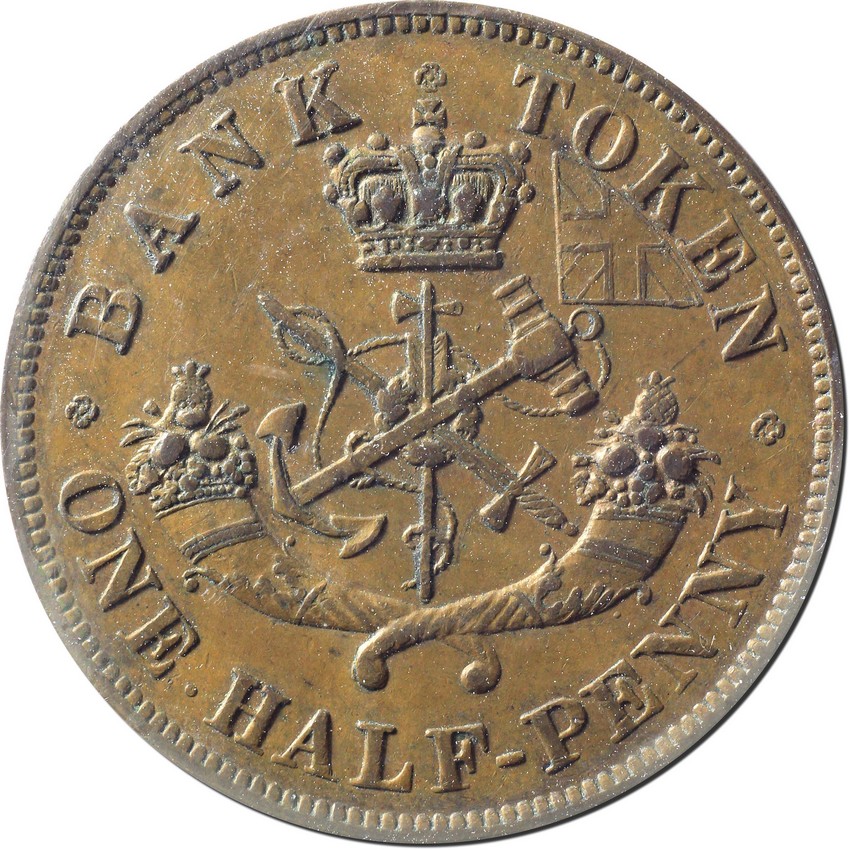 Otherwise, for the 1960NYGiants token, the reverse is different from Courteau #040, (As an example, the letter «pEnny» is complete)
I'm sorry if my English isn't perfect... I'm learning a little more every day.
Edited by ainsivalavie
04/11/2023 09:44 am
|
|
Pillar of the Community
United States
840 Posts |
This is a copy of a work-up I did some 25 years ago and I have been studying this series for better than 40 years. The late Dr. David McLean had a winter
residence an hour North of my home in SW Florida. Every winter he would bring one of his series of St. Georges and we would diligently compare his with
mine. Unfortunatly, due to health conditions David was only able to work at this 3 or 4 hours an afternoon for 2 afternoons a week, and his stay was only a
couple months. Our study was primarily instrumental in confirming and determining the die-crack progressions. And we would study and confirm the new
varieties identified.
20 R-10 The authors' are unaware of this variety being found in any collection.
The following data is the gist of Doctor Courteau identification. This data has not been verified.
Obverse Characteristics: Basically the same as variety 11.
The Man's right Foot is perfect.
The left Wing of the Dragon is perfect.
Two horizontal lines are below the left Wing of the Dragon.
The left Bridle Rein shews well.
A Knob is to the Dagger Hilt.
The Serif of the N in BANK is double-cut.
The Serif of the K in BANK is double-cut.
The Serif of the left Upright of the N in CANADA is weakly struck.
A forked line is below the Man's right Arm. The upper branch is thinner and longer.
The Belly of the Horse is not double-cut.
Reverse Characteristics: Basically the same as variety 16, but having a Speck.
The Stand of the Leg of the K in BANK is fully struck.
The St. Andrew's Cross frame is broken in the middle.
The end of the Union Jack is forked.
The Anchor Ring is perfect.
The Battle-Axe Head has a hole
The lower ornamental Ball is present.
4 Dots are betwixt the Feather and Anchor Shaft.
The Anchor Rope Dots terminate with one Dot and a short line.
A Dash is to the left of the A in BANK.
A small speck is betwixt the Feather and Anchor.
This is more like a half-moon shaped dash mid-way betwixt (and on-line with) the top of the upper right-side Feather and the centre band on the left-side of the Anchor Arm.
Note - The Speck is not readily discernable on lower grade ensamples.
A lump is to the right of the Y in PENNY.
This Lump is to the right of the upper right Arm of the Y in PENNY. This Lump is close to the same Y.
Note - The Lump is not readily discernable on lower grade ensamples.
Currently no additional information is available.
20-1 R-10 NEW VARIETY
This unlisted variety is perhaps what Dr. Courteau referenced as variety 20, but differences abound.
Obverse Characteristics: Basically the same as variety 20.
The Man's right Foot is perfect.
The left Wing of the Dragon is perfect.
Two horizontal lines are below the left Wing of the Dragon.
The left Bridle Rein shews well.
A Knob is to the Dagger Hilt.
The Legend is perfect save the Serif of the left Upright of the N in CANADA is weakly struck.
Whereas the tops of the N and K in BANK on variety 20 are double-cut.
Perhaps the same letters on variety 20 was shift entry doubling on the ensample referenced by Courteau.
The Date is perfect.
A forked line is below the Man's right Arm. The upper branch is thinner and longer.
The Belly of the Horse is double-cut.
From perfect and broken dies.
A Die-Crack is betwixt the 0 in 1850 and the right Rosette.
This wavy Die-Crack is from atop the left-side of the Denticle betwixt the 0 and the right Rosette, extending betwixt the C and O in the abbreviation below the right ground.
Note - Variety 21 shews different Die-Cracks and no reference is made by Courteau concerning Die-Cracks on variety 20.
Reverse Characteristics: The same as variety 21, but from the perfect die.
The Stand of the Leg of the K in BANK is fully struck.
The St. Andrew's Cross frame is broken in the middle.
The end of the Union Jack is forked.
The Anchor Ring is perfect.
The Battle-Axe Head has a hole
The lower ornamental Ball is present.
4 Dots are betwixt the Feather and Anchor Shaft.
The Anchor Rope Dots terminate with one Dot and a short line.
A Dash is to the left of the A in BANK.
A small speck is betwixt the Feather and Anchor.
This is more like a half-moon shaped dash mid-way betwixt (and on-line with) the top of the upper right-side Feather and the centre band on the left-side of the Anchor Arm.
Note - The Speck is not readily discernable on lower grade ensamples.
A lump is to the right of the Y in PENNY.
This Lump is to the right of the upper right Arm of the Y in PENNY. This Lump is close to the same Y.
Note - The Lump is not readily discernable on lower grade ensamples.
From perfect dies.
Thus:
20-1 Perfect - No Die-Cracks
Note - Variety 20-1 differs from varieties 20 and 21.
Variety 20-1 shews the NK of BANK (obverse) as normal,
Whereas on variety 20, the same letters are double-cut.
Variety 20-1 shews a Die-Crack betwixt the 0 and right Rosette,
Whereas on variety 20, no mention of Die-Cracks are referenced.
Variety 20-1 shews no obverse Die-Clashes,
Whereas variety 21 shews heavy Die-Clashes.
The reverse of variety 20-1 is perfect,
Whereas variety 21 shews Die-Cracks.
doug
|
|
Valued Member
Canada
222 Posts |
@Colonialtokens:
I had the chance to exchange on the subject with David McLean a few years ago (He was looking for a Courteau #083, among other things). I didn't know he had passed away. Sorry for your lost.
I am currently preparing the third edition of my book on the subject, with several dozen new varieties to add to those of Dr. Courteau.
I'm sorry if my English isn't perfect... I'm learning a little more every day.
Edited by ainsivalavie
04/11/2023 1:07 pm
|
|
Valued Member
Canada
222 Posts |
@Colonialtokens:
On 2 of the 3 tokens of what I thought was the Courteau #020 variety, a light die crack was present to the letter «cAnada» (Similar to Courteau #011, I even thought it was the same die). Is this something that you had noticed on your variety #20.1? The die crack is very slightly visible on the picture of the token I published above.
Your work on this subject is certainly remarkable. Having spent a considerable number of hours studying the subject, I can't imagine how long it took you to produce all these summaries.
I'm sorry if my English isn't perfect... I'm learning a little more every day.
Edited by ainsivalavie
04/11/2023 1:34 pm
|
|
Pillar of the Community
United States
840 Posts |
More trivia:
Obverse Die-Cracks
betwixt numeral 1
and left Rosette 58.
thru 85 9.
thru 850 37, 39, 74.
left of numeral 5 32, 32-1.
Numeral 5 47, 49.
thru 50 35.
Numeral Zero 4.
thru 1850 to 3rd A 60.
right of Zero 47-1.
left Rosette 44, 44-1.
right ground 21, 28, 44, 53, 62-1, 63.
left ground 21, 22, 22-1, 24, 28.
B in BANK 6, 9, 37, 39, 42, 53, 63.
A in BANK 52, 60.
thru ANK in BANK 57, 74.
N in BANK 21, 22, 22-1.
thru NK in BANK 36.
K in BANK 35, 37, 44, 61.
thru BANK 32, 32-1, 44, 71.
Betwixt K in BANK 13.
& O in OF
NK in BANK to 27.
to U in UPPER
NK in BANK to 38.
O in OF
O in OF 53, 62-1, 63.
Betwixt O and F in OF 8, 13.
F in OF 4-1, 74.
F in OF thru UPP 52.
in UPPER
OF thru UPPER 60, 61.
U in UPPER 6, 13.
UP in UPPER 57.
1st P in UPPER 36, 69, 69-1, 70.
2nd P in UPPER 3, 4, 11, 12, 16, 17, 18, 21, 38, 43, 44, 44-1, 59.
betwixt P/E in UPPER 7-1, 29
E in UPPER 7, 37.
ER in UPPER 75.
R in UPPER 58 (x2).
thru CANADA 66.
C in CANADA 47.
to CA in CANADA 36.
Betwixt CA in CANADA 42
1st A in CANADA 4, 11, 27, 32, 55, 63, 73, 74.
N in CANADA 21, 52, 61, 75.
Thru 2nd A and D 9.
thru ANAD in CANADA 53.
2nd A in CANADA 6, 35, 47, 57.
D in CANADA 8, 16, 17, 24, 46.
betwixt DA in CANADA 49.
thru DA in CANADA 74.
3rd A in CANADA 11, 22, 22-1, 66.
To Mantle 42, 44, 67, 68.
Initial C under ground 7.
from Nose toward R 12.
Haunch of Horse 63.
to Hoof of right Leg 37. �
Obverse
Die Clash 5, 5-1, 6, 9-1, 17, 21, 22, 22-1, 23-1, 24, 26, 28, 32-2, 34, 44, 45, 47, 47-1, 49, 58, 60, 61, 64, 65, 66, 69, 69-1, 75.
Reverse Die-Crack
B in BANK 22, 24, 28, 58.
Betwixt B and A in BANK 31.
A in BANK 6.
AN in BANK 35.
N in BANK 48, 57.
Betwixt N and K in BANK 50.
To NK in BANK 16, 36, 43, 49, 58, 60, 62-1.
BANK 44, 62.
K in BANK to T in TOKEN 9.
Crown 2(x2), 5, 6, 18, 21, 51 (x2).
from Crown toward B 67-1.
Betwixt K & Rosette 27, 58.
left of upper Rosette 16, 18, 19.
upper Rosette 8, 11, 22, 25, 31, 33, 43-1, 44, 44-1, 61, 62, 62-1, 66, 67-1, 70.
to Maltese Cross 43.
right of upper Rosette 63.
betwixt Rosette and T 46, 48, 49, 52.
T in TOKEN 28.
OK in TOKEN 48, 49.
K in TOKEN 3, 3-1, 7, 7-1, 9, 57.
Betwixt K and E in TOKEN 53, 74-1.
E in TOKEN 28, 51, 56.
N in TOKEN 5, 6, 44.
TOKE in TOKEN 15, 43, 61.
TOKEN 6, 16, 21.
O in ONE 3, 3-1, 7, 9, 44.
ON in ONE 36.
ONE 16, 21, 57, 62.
to ALF in HALF 1-1, 29, 44.
L in HALF 22, 44-1, 57.
To LF in HALF 24.
Betwixt L and F in HALF 5-1, 5-2, 18, 24, 27, 48, 49.
F in HALF 1-1, 2, 4, 4-1, 5, 6, 6-1, 8, 10, 11, 15, 16, 17, 21, 23-1, 28, 29, 30, 31, 32-1, 33, 34, 37, 38, 43-1, 44, 45, 46, 51, 54, 55, 57, 58, 60, 61, 62, 62-1, 66, 67-1, 68, 70.
1st N in PENNY 51.
thru NY in PENNY 51.
EN in PENNY 21, 62-1.
Y in PENNY 2.
PENNY 44.
Long running 60.
Long running (different) 66, 67-1.
Long running (different) 62, 62-1.
�
Reverse
Die-Clash 2, 3-1, 5, 5-1, 5-2, 6, 7, 7-1, 9, 11, 17, 21, 22-1, 26, 26-1, 28, 32-1, 32-2, 43-1, 44, 45, 47-1, 58, 60, 61, 62, 62-1, 69-1, 70, 71, 74-1.
Noteworthy Miscellaneous
OBVERSE
3, 3-1, 4, 6, 6-1, 7, 7-1, 9-1, 29, 47-1, 50. Defective numeral 1.
13. A small Dot is on the Horse close to the Man's Thigh.
This Dot appears somewhat triangular, and is very close to the Man's Thigh.
This Dot is at the midpoint of the Man's Thigh.
35. A defect is on the Horse from the Man's Calf.
This is a heavy wide wedge-like cloven mass emerging from the upper section of the Man's Calf. The upper branch extends horizontally through the Belly of the Horse, terminating on-line mid-distance to the Man's left Foot. A lower branch runs diagonally downward at approximately a 45#778; angle from the horizontal branch. The lower branch does not extend as far as the horizontal branch.
27, 40. A Wavy line is on Horse along the Man's Leg.
This heavy wavy vertical line is from the bottom of the Belly of the Horse, extending to the lower section of the Man's Thigh, running slightly distant from, yet parallel to the Man's Calf.
Latter die states have this line forked and joined to a 2nd line. A 2nd line runs vertically from the bottom of the Horse's Belly, on-line with the Heel of the Man's left Foot, and extends to the Man's Haunch. A diagonal line runs across the lower section of the Belly of the Horse, joining the two lines.
15, 16, 17. A small line is on the Horse below the Man's Thigh.
This is a diagonal crooked blotchy line emerging from the upper section of the Man's Calf, running parallel to and slightly below the Man's Thigh. The line terminates on-line with the mid-section of the same Thigh
Rust Spots are found below the line.
26-1, 46. A 'V' shaped defect is on the Horse's body.
On higher grade ensamples, this 'defect' is comprised of two heavy parallel, nearly horizontal and short lines. The defect is situated in the centre of the Belly of the Horse, and on-line with the Man's Haunch. The lines are very close together, and soon erode into a solid blob. A short vertical line can be detected emerging from the mid-section of the upper line.
62-1, 63. Defects are about the Man's right Leg.
A rectangular mass on-line with the top of the Boot of the Man's right Leg emerges from the Calf of the same Leg. A globular mass is attached to the right-side of the Man's Knee. A thick curved line extends from this mass to the base of the Shoulder of the right Leg of the Horse. This defect is less pronounced than found on variety 63.
73. An 'N' shaped defect is on the Horse (below the Man's Thigh).
61. An elongated blotch is on the Belly of the Horse. The blotch is situated on-line with the upper section of the Man's left Foot and the mid-section of the Calf of the Man's right Leg.
66. On high-grade ensamples a defect on the Side of the Horse is discernable.
This defect resembles a vertical Ladder having four rungs, situated above and on-line with the left rear Leg of the Horse.
15, 16, 17. A short heavy diagonal line is from the hollow above the Knee of the left rear Leg of the Horse extending to the mid-section of the right-side of the Thigh of the right rear Leg of the Horse.
36. A Small Dot is on the Neck of the Horse.
This modest size Dot is in the lower throat area, well below the reins and above and to the right of the Horse's right Shoulder.
36. A line is on the Horse.
This is a short line on the upper section of the Back of the Horse, running close to and parallel with the buttock of the Man.
26, 52, 53, 58, 59, 60, 61, 62, 62-1, 63, 66, 69-1, 70, 71. double cut belly
53, 62, 62-1, 63. Hook
REVERSE
62-1, 63. Defects are about the Man's right Leg.
A rectangular mass on-line with the top of the Boot of the Man's right Leg emerges from the Calf of the same Leg. A globular mass is attached to the right-side of the Man's Knee. A thick curved line extends from this mass to the base of the Shoulder of the right Leg of the Horse. This defect is less pronounced than found on variety 63.
28. A small bold Dot is above and to the right of the K in BANK (reverse).
This Dot is slightly above the Serif of the Arm of the K, and on-line with the left-side of the Denticle to the immediate right of the same letter.
5, 6, 36, 44. A Speck is to the right of the E in ONE.
10, 11. A faint Dot is betwixt the Battle-Axe, the Crown, and the Anchor.
20, 21. A small speck is betwixt the Feather and Anchor.
This is a modest size vertical dash in the field mid-way betwixt the upper right corner of the right-side Fledgling and the centre band on the left-side of the Anchor Arm.
45. Two Specks are betwixt the Crown and Union Jack.
There are actually four Specks, or globular masses situated betwixt the upper section of the right-side of the Crown and the upper section of the Shield. One is rather large, and touching the Crown, and is betwixt the two right-side Crown Jewels. Two other rather large Specks are situated one below the other. These are nearer the Shield than the Crown, and the upper is on-line with the bottom of the upper right-side Crown Jewel, the lower is on-line with the upper section of the lower right-side Crown Jewel. The fourth Speck is the smaller of the group, and is situated betwixt the two Specks just mentioned, and is touching the Shield.
26, 26-1. A Speck is above the K in TOKEN.
This is a large oblong globular mass in the field betwixt the top of the Upright of the K in TOKEN and the Denticles.
31, 32, 32-1. A Speck is to the left of the T in TOKEN.
This Speck is actually a diagonal massing of five oblong shaped masses on-line above the inner right-side Crown Jewel. The lower left mass is on-line with the upper corner of the right Lobe of the Maltese Cross; the others stack diagonally toward the lower corner of the Serif of the left Arm of the T in TOKEN.
40, 41, 42, 43, 43-1, 44, 45. The mid-section of the base of the E in PENNY is as a thin line.
12, 13, 14, 15. A defect is to the inner ball of the right Cornucopia.
This is a semi-circular arched 'blemish.' The right end of the 'blemish' is joined to the left-side of the inner ball of the right Cornucopia.
60, 61, 62, 62-1. A small line is towards the Crown from the left arm of the Anchor.
This line is from the lower section of the left-side of the left Anchor Arm, extending toward the Crown. However, under high magnification the line actually curves to and meets the upper right-side of the Battle Axe Head.
18, 54, 55, 56. A small line is from the Oak Wreath to the Anchor Rope (to the left).
This is a short heavy line in the left quadrant of the Oak Wreath, at the juncture of the Anchor, Sword, and Battle Axe. Doctor Courteau's description is some-what confusing as there are two Anchor Rope lines in this quadrant. The remoter (from the centre) Anchor Rope line is to the upper end of the Sword. The inner Anchor Rope line is atop the Anchor Shaft. The small line being referenced is a small line from the Oak Wreath to the right-side of the Anchor Rope line atop the Anchor Shaft. Early die states shew the line emanating from the upper section of the lower Oak Leaf within the left quadrant of the Wreath, and extending to the upper right section of the Arc of the Anchor Rope Dots atop the Anchor Shaft. Latter die states shew the area betwixt the mid-section of the line and the Oak Leaf blocked (filled in), and the well defined upper edge of the blocked area passes to the right of the lower Oak Leaf and extends to the mid-section of the upper Oak Leaf within the same quadrant. A small void remains betwixt the upper extension of the latter upper line and the vertex of the Oak Leafs.
17. A short line is from the Crown toward the Tip of the Sword.
63. Two small Dots are to the right of the upper Rosette.
The Dots are situated one above the other. The upper Dot is slightly larger. The Dots are betwixt the bottom of the right Lobe of the upper Rosette, and the top of the upper Lobe of the Maltese Cross. The 'Dots' are on-line vertically very slightly to the right of the right-side of the upper Lobe of the upper Rosette and the right Lobe of the Maltese Cross.
68. A defect is below the K in TOKEN.
This 'defect' is comprised of two large circular Dots situated on the under-side of outline of the outline of the Union Jack. The Dots are at the vertex of the outline of the Union Jack and the vertical of the upper section of the Shield.
68. A Dot is on the Shield.
The 'Dot' resembles a nearly vertical somewhat rectangular globular mass in the centre of the left Arm of the St. Andrew's' Cross.
68. A small Dot is betwixt the Globe and inner upper right-side Crown Jewel.
22-1, 32-1. 'Spikes' emanate from the right-side of the Crown.
70. A line is from the P in PENNY.
This diagonal line is from the upper section of the left-side of the Upright of the P in PENNY, extending into the field above the centre of the Hyphen. The terminal of the line is on-line vertically with the mid-section of the Hyphen, and horizontally with the lower end of the vertical of the Arm of the F in HALF.
20, 21. A lump is to the right of the Y in PENNY.
This Lump is to the right of the upper right Arm of the Y in PENNY. This Lump is close to the same Y.
4, 4-1. Circular Lump to the right of the upper Leaf in right Cornucopia.
70. A line is from the N to K in BANK (reverse).
This faint line from the right-side of the Serif of the Arm of the N in BANK, extending to the left-end of the Serif of the Upright of the K in the same word.
71. A Defect is to the Battle Axe Head.
This 'Defect' appears as a thick, wide, somewhat rectangular mass emerging from the lower section of the left-side of the Battle Axe Head, extending horizontally into the field.
71. A Dot is above the H in HALF.
This 'Dot' is situated midway betwixt the right Upright of the H in HALF and the left Cornucopia. The 'Dot' is on-line with the right-side of the same Upright.
6, 72, 73, 74. A line is from the Anchor to the Crown.
This line from slightly above the mid-section of the left end of the Anchor Arm, extending to the base of the Crown, slightly to the left of the lower right corner of the same Crown.
72, 73, 74. A line is from the Union Jack towards the Crown.
This diagonal line is from the left-side of the Shield, on-line with the horizontal of the lower right quadrant of the same Shield, extending to mid-section of the right-side of the Crown.
73, 74. A line is from the Battle Axe to the Anchor.
This line is from the lower corner of the left-end of the Anchor Arm, extending to the upper right-section of the Head of the Battle Axe.
73. A large bold Dot is close to and directly below the left-side of the Stand of the right Leg of the B in BANK (reverse).
75. The usual 'comma' shaped mark to the left of the A in BANK (reverse) is missing.
|
|
Pillar of the Community
United States
683 Posts |
Glad to see you back Doug @colonialtokens.
|
|
Valued Member
Canada
222 Posts |
@colonialtokens:Thanks, I will be able to compare with my data. But at first glance, I would say that it is indeed the Courteau #020 variety. Apparently we went through some of the same steps :) However, in my case I used a slightly different way to summarize the die cracks, since it was to be printed in a book, and I had to limit the number of pages as much as possible. So, in the example below, the bolded varieties correspond to the first major die cracks, while the underlined varieties correspond to the ones that are directly connected to the edge of the token without touching any other design element during the run. However, I am looking to improve these tables for my next edition, as for some issues, for example the 1/2 Penny 1854 and 1857, the table is getting really crowded, and I haven't even added the new varieties not listed by Courteau yet. 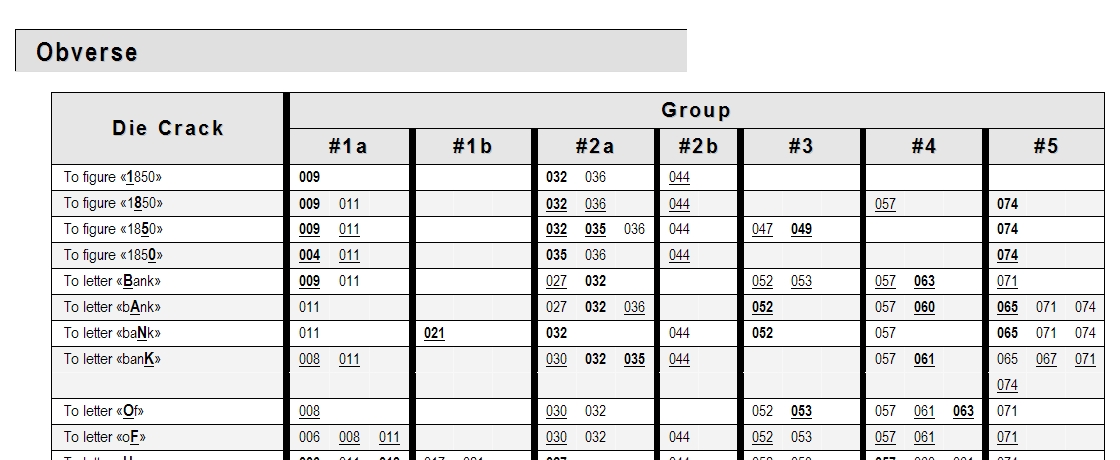
I'm sorry if my English isn't perfect... I'm learning a little more every day.
Edited by ainsivalavie
04/12/2023 09:14 am
|
|
Pillar of the Community
United States
840 Posts |
Extreme caution must be exercised in identifying Die-Cracks (D/C's). Courteau is often vague in describing D/C's.
Courteau habitually describes a D/C to the F in HALF. Well there are some 41 different D/C's to this letter on the
1850 HALP PENNY series and most of them follow a different path. D/C's do not normally appear and disappear
and re-appear in a different location.
Yes, on some ensamples an early-state D/C may appear, but on late-state stages the same D/C may fade into
oblivion as more severe D/C's elsewhere emerge requiring considerable metal mass thereby leaving the initial
weaker D/C insufficient remaining metal mass to fill the crack. This D/C may disappear, but will not move.
The two current photos of the D/C to the F in HALF are classic ensamples.
The photo of the D/C in the insert photo Ainsivalavie's insert photo shews the D/C running from the field above the
F and passing close to, but not touching the left of the upper Serif of the F and continuing downward passing close
to but not touching the right-side of the vertical of the Stand of the N in the same word and exiting along the right-side
of the Denticle below the same vertical.
Whereas the enlarged phots shews a different D/C from a different, howbeit similar variety. This D/C emerges from the
upper left-side of the Upright of the F in HALF and continues through the left-end of the Stand of the same letter, and
exiting betwixt the denticles below the left-side of the same letter.
Absent careful scrutiny and adequate ensamples for comparasion one can not rely on Courteau's vague D/C descriptions alone.
I am thankful for all Dr. Courteau provided and I am confident had he lived longer he would have made many update in future revisions.
Unfortunately, the died before publication.
doug
|
|
Valued Member
Canada
222 Posts |
@Colonialtokens :I totally agree with you. That's why in my book I try to use photos as much as possible when describing die cracks. This is only a working example for the 1/2 Penny 1850 that I'm working on. It will not be the final version: 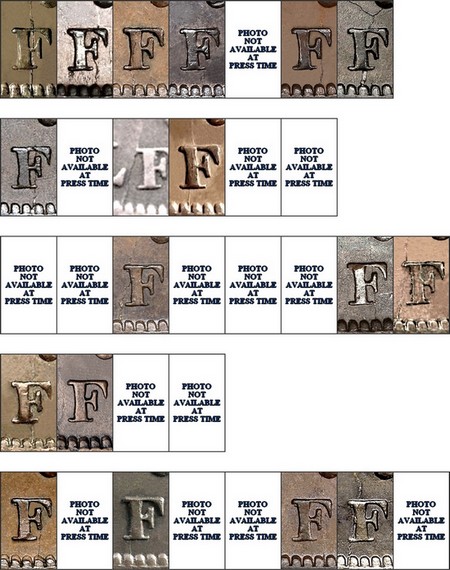
I'm sorry if my English isn't perfect... I'm learning a little more every day.
Edited by ainsivalavie
04/12/2023 11:36 am
|
|
Pillar of the Community
United States
840 Posts |
Great job. Great photos.
I need to get a Dinolite or good camera plus the knowledge of computers and the inputting of photos.
I need a ten year old grand-kid to teach me. Heck, I'm still looking for a smart-phone with a rotary dial.
A good photo is worth a thousand words. In the prehistoric days when I began my study my descriptions were written in narrative form.
Sometimes it was fun trying to clearly explain and identify something whereas now a good photo tells all.
Your photos are an excellent representation of some of the 41 (thus far) different D/C's. And some varieties share the same reverse dies, thus having
the same D/C. And as such, later reverse dies may shew later-state D/C progressions.
doug
|
| |
Replies: 1,299 / Views: 152,136 |
To participate in the forum you must log in or register.
Disclaimer: While a tremendous amount of effort goes into ensuring the accuracy of the information contained in this site, Coin Community assumes no liability for errors. Copyright 2005 - 2026 Coin Community Family- all rights reserved worldwide. Use of any images or content on this website without prior written permission of Coin Community or the original lender is strictly prohibited.
Contact Us | Advertise Here | Privacy Policy / Terms of Use
|
| Coin Community Forum |
© 2005 - 2026 Coin Community Forums |
| It took 0.56 seconds to rattle this change. |
 |
|






 First Page
 Previous Page


 Posted 04/11/2023 12:49 am





