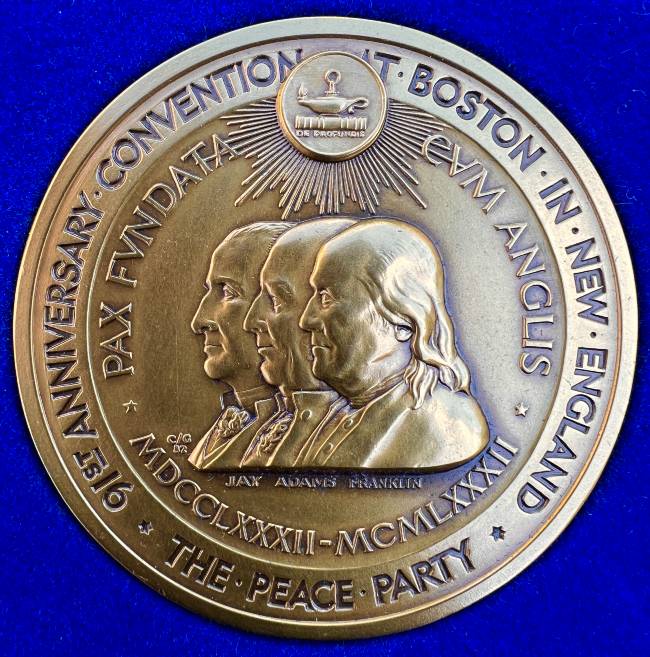
The 91st Anniversary American Numismatic Association Convention of 1982, conducted in Boston, issued the 2-1/4 inch "table medal" shown below. Struck by MACO, the medallion's obverse commemorates 200 years (1782 - 1982 ) of peace with England (formalized by the 1783 Treaty of Paris) and shows in profile three prominent members of the United States delegation: John Jay, John Adams, and Ben Franklin. At the top center, a lamp of knowledge with the Latin inscription "De Profundis" -- "out of the depths" -- oversees the portrait. "Pax Fundata Cum Anglis" -- "Peace Established with the English" -- is inscribed around the obverse's interior rim:
The reverse is an update of a 1782 medal first catalogued by Charles Wyllys Betts [
https://auctions.stacksbowers.com/l...imen-63-pcgs ] which commemorated the April 19, 1782, recognition of the United States of America as an independent nation when John Adams was admitted by the States General of the Dutch Republic as Minister of the United States of America. This was the second diplomatic recognition of the United States as an independent nation:
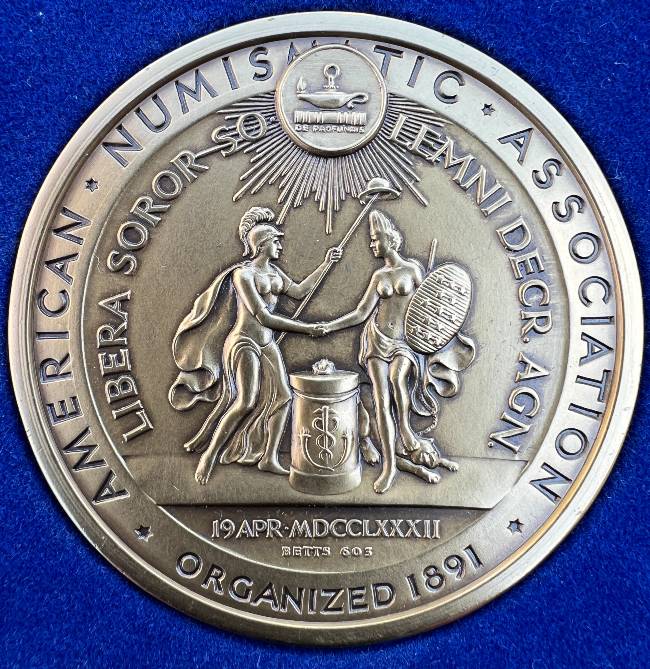
Allegorical images of "free sisters" "solemnly" acknowledge each other as they shake hands above an altar of commerce adorned with a caduceus -- a symbol of commerce and negotiation-- and topped with a rose of friendship. The figure on the right bears a shield with 13 stars; her left foot rests on a vanquished lion which symbolizes England.
Listed in the
ANA MACO Specimen archive as #1982-077, the medal was issued in 2-1/4, 1-1/2, and 3/4 inch versions. The same archive credits Barbara Hyde with the design. That's inaccurate. I found a New York Times Numismatics column published 8/8/1982 by Ed Reiter wherein he describes the medal in question:
Quote:
This year's medal commemorates the efforts of three American statesmen - John Adams, Benjamin Franklin and John Jay - to bring about a negotiated settlement of the war with England 200 year ago following the American victory at Yorktown. As ambassadors to Holland, France and Spain, respectively, these three were instrumental in diplomatic efforts that laid the foundation for the 1783 Treaty of Paris. Two of the three, Messrs. Adams and Franklin, had important ties with Boston, a fact that makes the subject particularly apt for this medal.
The medal was designed by James Ford Clapp, a well-known Boston medalist, and sculpted by Edward Grove. [Their initials appear on the obverse] Its obverse depicts the left-facing jugate heads of Adams, Franklin and Jay encircled by the inscription ''Pax Fundata Cum Anglis'' (''Peace founded with the English'') and the Latin equivalents of the dates 1782-1982. The reverse is an adaptation of a Betts medal portraying Holland greeting her free sister union, the United States of America. The Dutch government was the first to extend such recognition, doing so on April 19, 1782.
The medal is being struck by Medallic Art Company of Danbury, Conn., in four varieties. Two of these - a 1 1/ 2-inch version for men and a 3/4-inch counterpart for women - are being sold in bronze as part of the official convention badge. A 2 1/4-inch bronze table edition and a 1 1/2-inch, .999-fine silver version also are being made. Price for either badge is $6.50. The 2 1/4-inch bronze version is priced at $17.50, the silver version at $45.
Reiter's wrong about the Dutch goverment being the first nation to officially recognize the USA as an independent nation. That distinction belongs to the Kingdom of Morocco, which did so in 1777. American ships were a target for pirates in the Mediterranean Sea so the U.S.A. sought to establish relations with North African countries to protect its ships; Morocco was the first to respond and granted American ships protection and free access to Moroccan ports.





 First Page
 Previous Page


 Posted 12/22/2023 7:27 pm