First Page
 Previous Page


 Posted 04/24/2021 05:36 am


@whatdowehavehere
It seems like you want to label my coin as counterfeit regardless of arguments and evidence and convince everyone. Fine if you are in it like that, I'm not worried about it but just wonder why you put so much energy into it.
Maybe it would be an idea to apply to Stack's, this would save them a lot of time as you can conclude from my amateur photos within a few minutes that the cracks are contrived, the scratches are new, the patina has been created with spit and other means , and so on.
What I do worry about is that you know people who can easily fabricate such a patina and you also have a good recipe for this. Then in my opinion you are busy with the wrong intentions.
As I have said, years ago I bought an antique coin cabinet. I bought the cabinet from a woman, her father had once bought it at an antiques auction in the Netherlands and it had been there for at least 15 years before I bought it.
In principle, the purchase was only about the cabinet, the content was a side issue at the time.
The price for the cabinet was decent so that I could still earn nice on the sale, so no reason for the saleswoman to place a counterfeit coin in the cabinet, let alone spit on it to also get a patina on it.
I myself am also sure that I have not spit or tampered with it.
Obviously it is possible that it has a recent scratch on it because I did not attach much value to it in the beginning and just threw it in a tray with other coins that was on my desk, so it has been deposited here for at least a year before I started working on it.
After my first contact with Stack's, there was already a great belief that this was a genuine example.
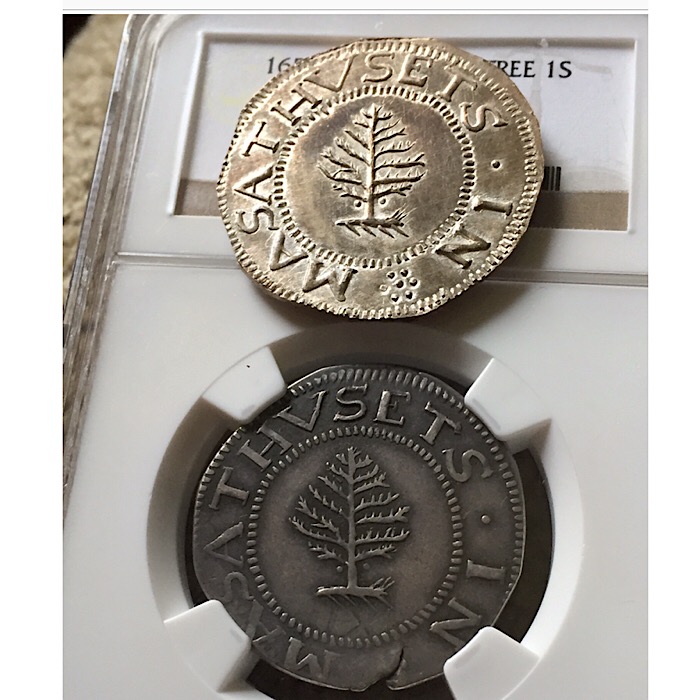
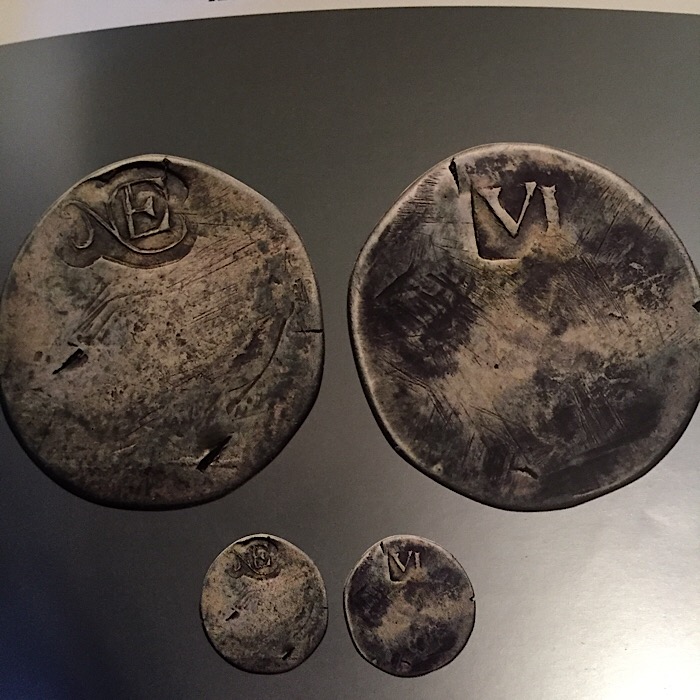
Later they performed a detailed analysis of my coin and compared the punches with the MHS specimen at a very close level. It appeared to be a perfect match accounting for some variances in the striking.
@kbbpll
@that coin dude
I am also convinced that the similarities and accuracy are too great for a forgery.
We also have to see that the coin has a diameter of only about 19mm, which makes according to my calculations that the legs of the three I's are only half a millimeter wide.
In my opinion, such precision cannot be reproduced in these small dimensions.
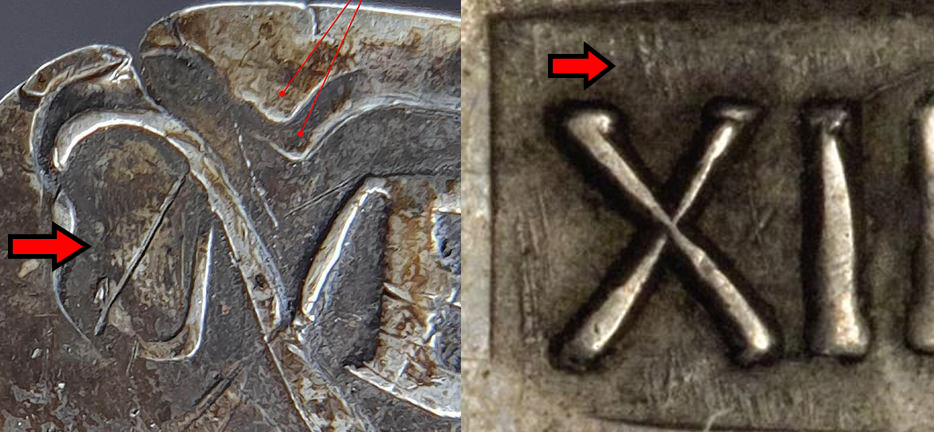
Yesterday I was studying some photos of NE coins and found something in a punch of a NE Shilling auctioned by Heritage.
In the NE punch of my coin you can see faint lines, I also found this line in the punch of the NE Shilling.
Could these be toolmarks, prints of the tools the original stamps were made with at that time?
It seems like you want to label my coin as counterfeit regardless of arguments and evidence and convince everyone. Fine if you are in it like that, I'm not worried about it but just wonder why you put so much energy into it.
Maybe it would be an idea to apply to Stack's, this would save them a lot of time as you can conclude from my amateur photos within a few minutes that the cracks are contrived, the scratches are new, the patina has been created with spit and other means , and so on.
What I do worry about is that you know people who can easily fabricate such a patina and you also have a good recipe for this. Then in my opinion you are busy with the wrong intentions.
As I have said, years ago I bought an antique coin cabinet. I bought the cabinet from a woman, her father had once bought it at an antiques auction in the Netherlands and it had been there for at least 15 years before I bought it.
In principle, the purchase was only about the cabinet, the content was a side issue at the time.
The price for the cabinet was decent so that I could still earn nice on the sale, so no reason for the saleswoman to place a counterfeit coin in the cabinet, let alone spit on it to also get a patina on it.
I myself am also sure that I have not spit or tampered with it.
Obviously it is possible that it has a recent scratch on it because I did not attach much value to it in the beginning and just threw it in a tray with other coins that was on my desk, so it has been deposited here for at least a year before I started working on it.
After my first contact with Stack's, there was already a great belief that this was a genuine example.
Later they performed a detailed analysis of my coin and compared the punches with the MHS specimen at a very close level. It appeared to be a perfect match accounting for some variances in the striking.
@kbbpll
@that coin dude
I am also convinced that the similarities and accuracy are too great for a forgery.
We also have to see that the coin has a diameter of only about 19mm, which makes according to my calculations that the legs of the three I's are only half a millimeter wide.
In my opinion, such precision cannot be reproduced in these small dimensions.
Yesterday I was studying some photos of NE coins and found something in a punch of a NE Shilling auctioned by Heritage.
In the NE punch of my coin you can see faint lines, I also found this line in the punch of the NE Shilling.
Could these be toolmarks, prints of the tools the original stamps were made with at that time?