| Author |
 Replies: 38 / Views: 16,457 Replies: 38 / Views: 16,457 |
Page 3 of 3
|
|
|
|
Pillar of the Community
United States
648 Posts |
There seems to be some talk ( in spain )about the coins being from a shipwreck, cleaned then re-patina? So if they needed to be cleaned, would not the faces look more corroded?
I do own some nice Chinese ones with the same (to me ) looking brown patina.
|
|
Valued Member
Germany
194 Posts |
Regarding realeswatcher's comment "It's amusing, regarding the "1776" piece, the poster makes a comment to the effect "I came cross a group of 8 Reales and this was the best..." and Google Translate rendered that as "I made a batch of 8 reales coins". Perhaps Google Translate is smarter than we think..." There's no "like"-button here, so I put up a big fat  ! With regard to the coins on the "Imperio Numismático" pages, this is really incredible that nobody seems to be suspecting anything. So many different coins and so similar their look... |
|
Pillar of the Community
United States
648 Posts |
|
|
Pillar of the Community
 France
1591 Posts |
Tokenmast : can you paste a picture ? I'm curious :)
|
|
Pillar of the Community
United States
648 Posts |
MathieuMa The patina treatment shows up better on my 1893 Morgan ( copy )so included that photo. The pillar 8r has a total fantasy edge but does show similar surfaces?   |
|
Pillar of the Community
France
1591 Posts |
Wow, that pillar is indeed a very bad copy :p
The fake patina is interesting, looks like something was applied, and the coin was cleaned after.
It doesn't have the same usual color as chinese recent patina, which is dark black usually.
|
|
New Member
United States
2 Posts |
I have a 1748 8 Reales....I do not know anything about coins, but do see a few differences between yours and mine. I hope mine is not a fake. It belonged to my late husband and I am not sure where he even acquired it from.
|
|
Pillar of the Community
France
1591 Posts |
Post your pictures in a new thread, we'll gladly help you figure out if everything looks like :)
Take both side, and the edge as well (that's somewhat difficult to get correctly in pictures if you are not used to).
For the edge, if you manage to take it, get 2 or 3 pictures with the two places where the edge design is stopped (if you see one stop only, take the exact opposite on the rim so we can check it out)
|
|
New Member
United States
2 Posts |
I will try it. My phone doesn't take very good pics, but I will try : ) Thank you!
|
|
Pillar of the Community
France
1591 Posts |
|
|
Pillar of the Community
United States
648 Posts |
MathieuMa
Thank You for the update.
|
|
New Member
Romania
1 Posts |
i need your help. you are probably better develop from this point of view, considering that I have a little mini collection time. I bought a currency at a very low price and now I wonder if it's real or not. will post pics here . thank you 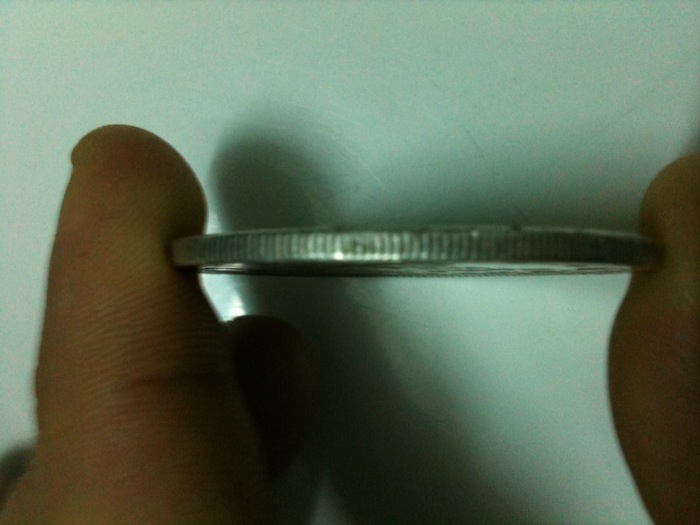 |
|
Pillar of the Community
United States
5362 Posts |
MathieuMa You say: Quote:The coin originally mentioned in this thread was genuine after all. It was checked by a spanish specialist, and went through XRF analysis. More can be read about it here : http://blognumismatico.com/2012/05/..8-de-mexico/ I read the thread completely and the supporting report. The owner seems to WANT the coin to be genuine and he seems to be reading the results to achieve that wish. The credentials of the specialist are very good. Josep Pellicer I Bru is President of La Asociación Numismática Española and is an author of several books on earlier Spanish coins and ancients. I am concerned as to the casual nature of the "authentication" by this person regardless of his qualifications. The owner notes the process is simply a subjective opinion by one man - a qualified one. But the nature of the inspection is not given. Was anything other than a loupe used? How long did it take? Did he make any cautionary disclaimers? The owner uses the XRF tests as a "Coup de grace" to prove his case. There are several SERIOUS problems with the authentication as presented. The XRF device used by this "new" testing firm (which the owner of the coin has been involved with since its inception) was essentially worthless as a method of proof the coin is genuine. The Niton XL3T 980 is a hand held XRF devise that provides a level of accuracy that is good for a junk yard purchase of scrap metal but it is not capable of testing for the trace contamination of gold that must be present to authenticate the coin. If you refer to the website for Niton you will notice this model is not recommended for precious metals testing. It is a general industrial tester. The stated error rate for the silver content (91.8 % average) is plus or minus one quarter of a percent. That result is actually too high for an original. The results DO NOT MENTION gold at all. There is about 1% of the content missing which is referred to as "other trace elements". That is simply NOT ADEQUATE as an XRF result. So, far from being proven genuine - the results seem to indicate the coin could just as easily be a Numismatic Forgery made from 91.8% silver and 7.2% copper a few weeks ago as it could be a genuine coin made in 1748.
|
|
Pillar of the Community
United States
5362 Posts |
Just realized I did not post an opinion on the coin.
I believe the coin is most likely a forgery. The edge design is very poorly applied and the design is poor. I also wonder if the coin is simply not too thick.
This not my area of specialization but I would not buy the coin as genuine based on what is known about the coin.
|
|
Pillar of the Community
United States
5362 Posts |
When I re-read the comments made on that other web site - I am fearful that the XRF technology is not only generally misunderstood by coin collectors but is actually being miss applied in an effort to subvert the science behind the use of XRF to disclose modern forgeries.
The starting point is simple. In 1748 no one on the face of the earth had the capability to remove all of the gold that is naturally found in Mexican silver deposits. Today parting gold and silver to 99.999 fine levels is rather easy - but in 1748 99% pure was acceptable and 99.9% was an impossible industrial standard.
So if you find NO gold or gold on the order of less than 200 ppm - you have a forgery pure and simple.
XRF tests which can look for this trace level of gold are essential. The use of HANDHELD XRF testers is worthless in this context. They are simply not accurate enough - PERIOD.
The handheld XRF testers are good only to screen out really bad coins - 5 or 10% off. They are in the same class as Specific Gravity testing - NO MORE than that.
The laboratory XRF tester looks at all 100% of the elements contained in the coin from Carbon to Uranium to a level of 1 ppm if needed and achieves a balance of 100.0000%. The gold can not hide from this test. Nor can other equally important trace elements that should or should NOT be present.
This capability will actually make forgeries harder to create. Just consider that a modern ore refinery uses a lined furnace with a surface that can contaminate the metal being refined to 10 ppm. How do they remove this "modern signature" contamination?
Even if they simply melt genuine coins - how do they do it to avoid furnace and fuel contamination or the loss of the mercury trace that came from the original patio process?
Finally how about copper? Today commercial copper is NOT pure. It is not valuable enough to be refined to a level beyond 1000 ppm. How does the forger purify his copper to avoid modern contaminants without losing needed contaminants that would have been there in 1748?
I am trying to illustrate why XRF could be the answer needed to put 99.9% of all forgers out of business. If a fake of a $100 coin costs $200 to make - they will NOT be made. The most important thing to do is to eliminate in a simple way silver forgeries.
|
|
Page 3 of 3
|
Replies: 38 / Views: 16,457 |
Page 3 of 3
|






 First Page
 Previous Page

 Posted 02/14/2012 6:15 pm


