| Author |
 Replies: 18 / Views: 5,259 Replies: 18 / Views: 5,259 |
Page 2 of 2
|
|
|
|
Pillar of the Community
United States
4897 Posts |
Here. I stole this from a random website.... Quote:
How is a proof coin made?
The Mint must use a special minting process to achieve the proof finish and overall look. The minting methods have actually improved through the years, resulting in superior proof finishes. Here's that process as described by the United States Mint:
"Proof blanks are specially treated, hand-polished, and cleaned to ensure high-quality strikes. The blanks are then fed into presses fitted with specially polished dies and struck at least twice to ensure sharp, high relief. The coins are then carefully packaged to showcase and preserve their exceptional finish."
When breaking down the distinct parts of creating a proof, you can see a clearer picture of the process:
Proof Dies:
â- Each is inspected and only the best are chosen
â- Each go through special polishing and are cleaned with soft cloths
â- After several uses, the dies are cleaned again
â- They're replaced frequently
Proof Blanks and Mint Press:
â- Each are polished and cleaned with a soft cloths
â- Each are hand fed into a coin press one at a time
â- Each is struck at least twice by the press, providing high detail
â- Higher pressure settings are used when pressing, also giving greater detail
Proof Processing:
â- Much slower speed and care is taken
â- Unique inspections for quality are performed
â- The proofs are never touched by bare, human hands
â- Each coin is sonically sealed in special coin holders/cases
|
|
Moderator
 United States
56855 Posts |
The easiest way is to look for the mirrored back round. Even a circulated proof will show some of the shinny mirror like back round. Also all of devices will be different then the non proof of the same year and MM. The devices on a proof are sharper and more detailed. John1  |
|
Pillar of the Community
2226 Posts |
Quote:
Not all proofs have an S "And not all S mm are proofs" - Is this not also true? |
|
Moderator
United States
56855 Posts |
That is true. John1 |
|
Pillar of the Community
United States
4901 Posts |
I think the OP was not referring to the "shiny, mirrored" obvious proof but to the sometimes found in circulation proof. The mint mark would be one way but you would have to know the circulation quality MM's before noticing the outlier. They differ by coin and date....and sometimes that is no help either...
A 1968-S cent can be a proof ..... or not
|
|
Moderator
United States
56855 Posts |
The 1968-S LMC was minted in proof and in business strike. John1 |
|
Pillar of the Community
United States
4901 Posts |
Quote:The 1968-S LMC was minted in proof and in business strike. Correct....as I said |
|
Valued Member
Egypt
139 Posts |
I think just lately, the end of the 20th century specifically, where San Francisco Mint was minting just proofs. The older S mark coins weren't necessarily proof. Can anybody tell me if that is true or not?
|
|
Pillar of the Community
Australia
7096 Posts |
A proof coin will always stand out from the rest of the crowd. 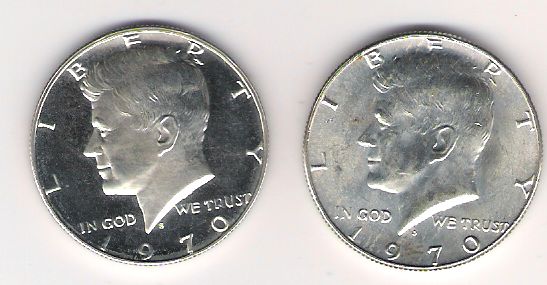 |
|
Pillar of the Community
Canada
3692 Posts |
The field is a big indicator. It will be very reflective. There's also what I would like to describe as a coating, but there's probably no coating of anything. You'll know it when you see it.
|
|
Bedrock of the Community
13014 Posts |
Libertad come to think of it proofs kind of do look like they have been coated with something
|
|
Bedrock of the Community
Australia
21792 Posts |
Modern NCLT proof product is fairly easy to recognise, as amida17 has pointed out. Often the detail is sacrificed a little, either by laser etching or sandblasting, in order to produce the cameo effect.
Bit more tricky to pick 19th Century proofs from excellently struck uncirculated examples. In most cases, the dies were not polished or the details sandblasted to produce the cameo effect. The selected planchets were not polished, either.
In this case, selected unused dies and selected planchets were used. Double striking was often employed to completely bring up the die detail. The idea was to produce the highest quality example of the coin as possible, usually for record and archival purposes. They were not necessarily intended for sale to collectors. Most of these types of proofs are rare or very rare.
After the proof production, the dies were used normally as for normal circulation strikes.
|
|
Valued Member
United States
88 Posts |
Sel_691 has brought up an interesting fact about older proof coins. The word "proof" as applied to modern coins struck for collectors is technically incorrect. The original and correct use of the word is to describe those coins that were used to "prove" a die! It can be considered as related to the hobbing method of die-duplication. Thus the coin itself is the "proof" that the master die is good. A very few "proof" examples would be made and distributed among those who would examine them closely for any potential problem. If approved the die would be put into production... or... if it is a master, a matrix would be struck from it in steel, and the matrix used to duplicate the master die. The cloned second generation dies would be very very close to exact copies... but there are always some small difference, particularly in textural elements such as hair etc. So the "proof" coins made from the actual master would be the best of the best.... struck from the die closest to the original art, and they would be the very first coins struck, while the die was still new and unworn.
So it's easy to see that among early coin collectors there would be a very keen competition for who got to keep the "proof" strikes from a new die! And that demand would filter eventually to a decision-maker who would determine that the mint boys should make more than just two or three "proofs" so that political cronies could have them. And finally we reach the current completely "degenerate" situation in which an entire mint (SF) basically does nothing but create fake "proof" coins for the collector market. Yes I used the word fake... because the coins everyone refers to as proofs are NOT in fact proofs at all but simply collector quality production strikes. The ordinary numismatic use of the word proof is a misnomer, such that it becomes difficult (as noted by Sel_691 above) to distinguish ACTUAL proof coins, coins struck specifically to prove a die.
|
|
Bedrock of the Community
United States
12437 Posts |
tmaring,
Applying your definition essentially means that proof coins have not existed in the US for well over a century. It is an old and outdated definition that should no longer apply to anything from the 20th century forward. Modern proofs are much more than "collector quality production strikes"- the planchets are different, the dies are different, and they are struck in a different manner from business strikes- hence the classification as a "proof strike".
|
|
Bedrock of the Community
Australia
21792 Posts |
tmaring: I couldn't have said it better myself.
biokemist6: I think your point is equally valid, and I agree with that as well.
|
|
Page 2 of 2
|
Replies: 18 / Views: 5,259 |
Page 2 of 2
|








 First Page


 Posted 07/08/2012 05:10 am


