| Author |
 Replies: 19 / Views: 3,618 Replies: 19 / Views: 3,618 |
Page 2 of 2
|
|
|
|
Pillar of the Community
Australia
4411 Posts |
Are you sure they are percentages and not estimated mass?
If it is mass then:
The first one totals 776881. The copper content is 551805. That makes 71%.
The nickel content is 198381 which is 25.5%, Mn is manganese and is less than 2%
The second one totals 915790. The copper content is 590253. That makes 64%. The nickel content is 382950 which makes 42%. Manganese is almost 3%.
I would guess that its ppm though but the above calculations work out pretty close to what it should be if it was mass which is weird.
Anyway the surface is pretty corroded so might be completely different to the inner parts.
Edited by enworb
05/10/2013 04:25 am
|
|
Moderator
 Australia
16982 Posts |
In any scientific test, it's always good to have a "control". If you've got two coins you wish to investigate, then submit a third coin for analysis, one that seems perfectly normal and has no issues or problems whatsoever. That way, you can tell the difference between things that are actually strange about the sample and things that have gone wrong with the testing.
I have two quick questions about the test.
First, what was the test, exactly? XRF? You still seem to have the coins with you, so it's safe to assume it wasn't an ICP test like we use in the lab where I work - for that test, you need to dissolve the entire coin in acid first. The nature of the test will also affect the interpretation; XRF is surface analysis only, and doesn't tell us whether the coin is solid coppery metal or whether it's simply picked up a coppery coating from someplace.
Second, as others have asked, what are the units? It's impossible to interpret results that are just a bunch of numbers, without knowing what the numbers represent.
Don't say "infinitely" when you mean "very"; otherwise, you'll have no word left when you want to talk about something really infinite. - C. S. Lewis
|
|
Pillar of the Community
 Australia
1041 Posts |
I think its ppm 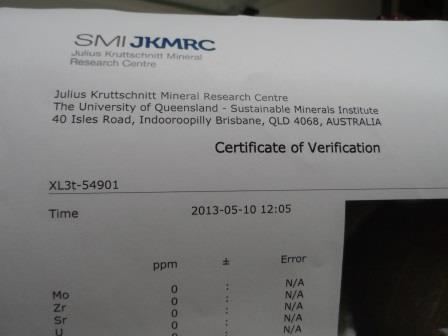 there just seem to be no environmental damage 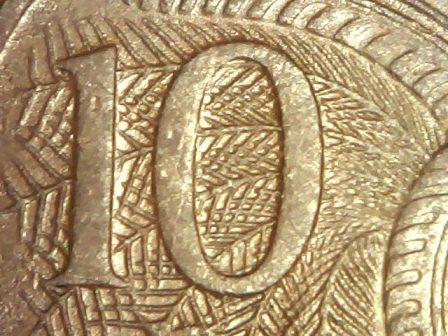 |
|
Pillar of the Community
Australia
1041 Posts |
the other ten cent piece with no reading on edge micro views of the rim with a another 10c beside it 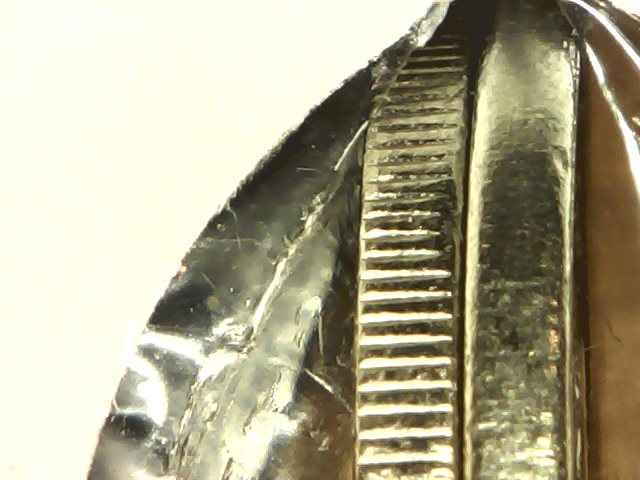 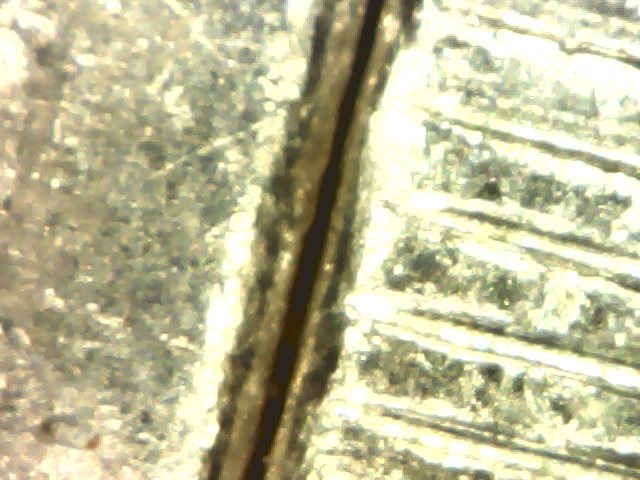 |
|
Pillar of the Community
Australia
750 Posts |
Shane, if you don't mind me asking, how much did the tests cost? Did you take them there, or post them? Thanks!
|
|
Pillar of the Community
Australia
1041 Posts |
cost nothing had 5 items done took about a hour sorry cost me a bottle of vodka will let you know the other items when I have done some more home work
|
|
Pillar of the Community
Australia
2180 Posts |
There's traces of silver in it? That doesn't seem right.
|
|
Pillar of the Community
Australia
4411 Posts |
|
|
Pillar of the Community
Australia
2180 Posts |
I suppose, but ~0.36g of silver per 10c piece adds up when they're made by the million. Probably depends how economical it is to separate it I guess, assuming there actually is silver.
|
|
Pillar of the Community
Australia
4411 Posts |
Its possible (pretty likely) the silver was picked up by the coin rather than having been there in the original planchet.
|
|
Pillar of the Community
Australia
2180 Posts |
Yeah you're probably right. Looking at that list it must have been in contact with all sorts of weird and wonderful things.
|
|
Rest in Peace
United States
10625 Posts |
The second coin with no rim is coated with mercury, Hg. I wouldn't touch it with bare hands.
|
|
Rest in Peace
United States
2668 Posts |
I helped a young girlfriend get mercury off of her jewelry after she played with a broken thermometer. It's a fairly simple procedure, if you know how to handle the right acid.
After her shower, I insisted she clean her entire small apartment, wash all of her clothes, and detail her car. I helped her with the clean up.
|
|
Moderator
Australia
16982 Posts |
OK, I've figured it out now - they've used one of these, a handheld XRF analyser. I work in a lab at UQ St Lucia; I didn't know somebody local had access to one of these. Which does answer my previous question: XRF is a surface analytical technique; it won't tell you if the result is just surface contamination, or if the composition is like that all the way through. That being said, there does not appear to be a lack of nickel in your "coppery" coin; the opposite, actually, with a Cu:Ni ratio of 2.8:1 rather than 3:1, there is a slight reduction in copper content; this would not account for the copper colour. I'd still conclude it was environmental damage. For a relatively pure metal, adding up all the ppm figures "should" give you pretty close to the theoretical 1 million parts per million; this coin falls far short, meaning there's an awful lot of undetectable elements (oxygen, carbon, nitrogen, chlorine, etc) sitting on the surface. The "rimless" coin has the same problem, only worse: a distinct overabundance of nickel, with a ratio of 1.5:1, twice what it should be. What it doesn't really tell you is why: is there twice as much nickel as there should be, or is half of the copper missing? Copper being stripped from the surface selectively is far more probable than vice-versa, as copper is more electropositive than nickel. But I don't know if such "surface enrichment" is normal for well-circulated cupronickel alloy coins. Here is where a couple of controls might have come in handy: a bright, mint-fresh coin, and a well-worn but otherwise normal coin. As for the trace levels of other stuff (manganese, silver, mercury, etc), that's pretty much par for the course with raw metals that are sourced as cheaply as possible. It's too expensive to remove those last few fractions-of-a-percent of contaminants, if you don't really need to do so. It doesn't really mean too much, except that such trace-level detection can in theory be used to "fingerprint" the metal and trace it back to its origin. I've read about analytical work done on ancient coins that demonstrate the likelihood that certain ancient coins were likely to have had their metal mined from a certain place, as opposed to another place. Don't say "infinitely" when you mean "very"; otherwise, you'll have no word left when you want to talk about something really infinite. - C. S. Lewis
|
|
Pillar of the Community
Australia
1295 Posts |
Quote:
I've read about analytical work done on ancient coins that demonstrate the likelihood that certain ancient coins were likely to have had their metal mined from a certain place, as opposed to another place. We had an academic do a presentation at our coin club that covered exactly this. A world wide program to "fingerprint" the silver used in ancient greek coins so they can tell where the silver was mined. |
|
Page 2 of 2
|
Replies: 19 / Views: 3,618 |
Page 2 of 2
|








 First Page


 Posted 05/10/2013 05:49 am


