| Author |
 Replies: 18 / Views: 3,982 Replies: 18 / Views: 3,982 |
Page 2 of 2
|
|
|
|
Pillar of the Community
United States
1801 Posts |
jglenn...where have you ever seen evidence that there are any examples of the 1772 MoFM without the inverted assayer and mint mark? I have been collecting portraits for a long time and never seen a legitimate specimen. No reference to one in any established research book that I can find.
Edit by author, I just saw the other posting and commented on the two listings that were sited on that post. Possible misunderstanding of the way the coins are listed in the guides.
Edited by jfransch
05/07/2014 11:32 am
|
|
Pillar of the Community
 Czech Republic
803 Posts |
Jack, as jfransch mentioned - I believe the "few known examples of the 1772 non-inverted" in this context refers to the two known 1772 pillar designs, with one of those being in the Bank of Mexico collection, if I remember correctly.
|
|
Pillar of the Community
United States
1156 Posts |
I had checked my Calbeto first, which lists the dates sequentially, without a break between pillars and portraits. You are certainly correct that Elizondo lists the 1772 with the pillars.
|
|
Pillar of the Community
United States
1156 Posts |
While the subject is still warm, could this PCGS certified coin have a less than genuine host? I've been a bit suspicious about the way some of the lettering is less than fully formed. 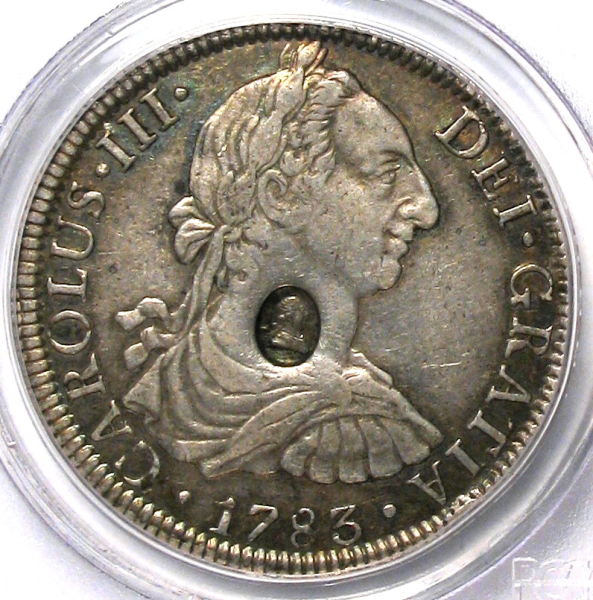 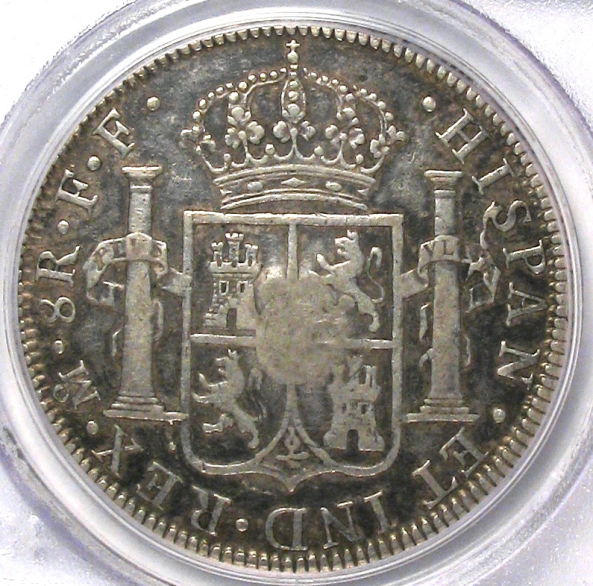 |
|
New Member
United States
12 Posts |
Bumping this thread, I'm also curious what others think of the 1783 posted above.
|
|
Pillar of the Community
United States
1962 Posts |
The stamp and corresponding reverse spot on the 1783 look fine from a distance, with the reverse spot seeming to indicate some honest circulation post-counterstamp... Looking at the host's surfaces, it's definitely something with age to it, not "modern". Considering the above, I'm going to make the assumption that we can't be dealing with any of Bob's mid-late 1800's bullion strike "8R" introduced to a fake (or even somehow real?) BOE stamp for the purpose of numismatic forgery within, say, the last 50 years.
So, you either have a genuine 1783 Mexican host or a near-perfect British-origin Birmingham/Sheffield plated type - I'd say the host is far too well executed to be any other kind of contemporary forgery. The design elements are clearly just about (or in fact perfectly) accurate - certainly much, much better than some cartoonish plated BOE types you see (and also better than the decently executed, for its purpose anyway, "1772" shown above - compare castles, for example).
Then the surfaces... while the toning on the reverse has a bit of an odd tint in the photo (is that accurate?), for the most part, we are generally seeing a perfect circ look, and in fact a pronounced "circulated cameo" effect on the reverse. With the fair amount of circulation that the coin has seen, for the high points to look that light colored in an uninterrupted fashion, I don't think this could be a plated piece - even a super thick plating. With this amount of wear, the very highest spots would almost certainly show some sign of wear in the plating, no?
Now, the one really pronounced detail break is obviously that E in DEI... looked at some (non-Cazador) 1783 and I didn't find any others with a matching break there, but I that COULD be chalked up to die wear.
Try to find some other examples of other 1783-Mo host BOE 8R... If you find others with matching dies and a similar broken "E"... then you're on to something.
|
|
New Member
United States
12 Posts |
Here's a genuine 1783-MO FF for comparison. 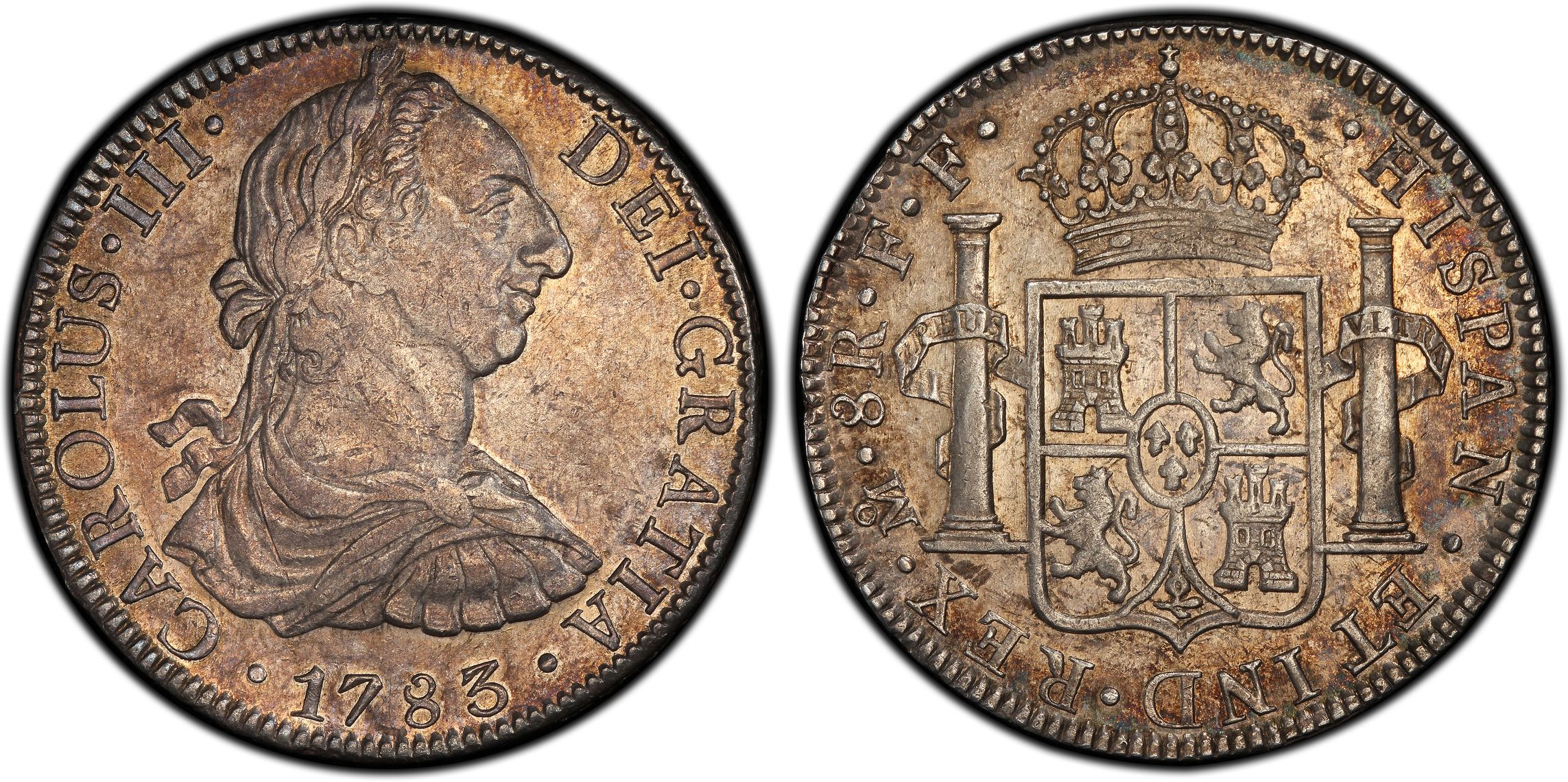 I notice a few differences, although most could be explained away if different dies were used. - the bottom of many serifs are fancier on the stamped coin, although not all of them are which is odd. - the lions heads look thinner on the stamped coin - to my eyes, the CAROLUS letters don't look quite right. Close, but something's off. - the above mentioned weakness in the E in DEI On the other hand, what's the likelihood of finding a die crack on the reverse of a plated coin. I guess one could fake that to make the coin seem more authentic. |
|
New Member
United States
12 Posts |
|
|
Pillar of the Community
United States
1156 Posts |
Thanks for the bump cochese, and your comments and those of realeswatcher.
Yes the obverse has a bit of blue-green toning through the obverse legend especially at the III.
Regarding the E in DEI, what sort of die wear would result in the missing arm (if I have the typographic term correct) at the top of the E? That part of the die would have to be filled in, right?
Unfortunately, I can only find one other 1783 BOE 8R and it does not have matching dies.
cochese your comment about the fancier serif is quite obvious at the bottom of the I in DEI but not the other "I"s -- suspicious since they would share the same punch.
|
|
Pillar of the Community
United States
1962 Posts |
The lions do not seem to be markedly dissimilar - the apparent visual difference is due to the weaker strike on the PCGS example coin. Referring to the indentations (they could be viewed as stylizations at first glance) on the bottoms of some of the letters in the legend... and yet not on other instances of that same letter on the same coin - that wouldn't seem to make sense on the surface as you would think all the letters should be identical (should be done from the same punch, you would assume). However, this is something you do see some on portraits... I don't know exactly, technically "why" (Bob?), but a couple guesses... It could have something to do with the detail punches being stamped into the dies a bit inconsistently... or perhaps, the bottoms of some of the punch letter fraying/chipping... or maybe even the diecutter would intentionally touch up the finished dies to give the lettering a bit of flair? Not sure, just speculating on possible causes... At any rate, you see examples where all the lettering is intact, with "straight" bases/serifs... some where certain letters are markedly "indented" at their base... and others which sort of look "halfway", with some hint of indentation, or perhaps the detail is "there", but doesn't achieve the same relief (height) as the upper part of the character. Just pulling a few pieces quickly from auct. archives (see group photo), observe how on the lettering you find a mix of flat/intact bases, clear indentations, and some partial ones...  |
|
Pillar of the Community
United States
5362 Posts |
The first coin with the odd 2 was certainly not made that way in Mexico City. The situation points to the inability of any group to know EVERY type of coin. The TRGs need an expert in JUST Portrait 8Rs.
I consider myself generally good with counterfeits but I claim to be "expert" with regard to only two very specific types. The Portrait 8Rs and the Cap and Ray 8Rs. I know my limitations which is why I can not speak authoritatively on MANY other coin types. This highly focused and specialized area of expertise is typical of avid collectors.
Regarding the reasons for various Portrait counterfeit emissions there were at least 3 major incentives for forgery which were distinctly DIFFERENT and tended to occur at different times.
Counterfeits made of variable amounts of base metal gives a forger a profit based on the difference between metal value and the face value of a coin. That is a typical reason for counterfeiting. It also happens most during periods of economic uncertainty or emergency. This is why counterfeits appear in bunches clustered around historic event.
The George III emergency issues of the Bank of England are a sub-set of this first group but they can derive profit differently. The stamped dollar was worth MORE than the face or the intrinsic value. It was a token worth more. The forgers could use silver coins of full weight - apply a fake stamp and make a profit. A token has a Fiat value - a value set by law which is unrelated to either face value or intrinsic value.
The third case is the reason there were full weight silver restrikes made for the China trade. This case is tied to the Commodity value of money. At times, to secure a specific type of money traders pay a premium. The premium is based on what the market will bear. In the case of the Bustman dollars the interior Chinese preferred payment with ONLY that one kind of coin. The premium average 16% over silver value but for decades sat at 26% and reached a high of 80%. This commodity value of money drove a third distinctly different wave of forgery that happened AFTER most of the actual coins made in Mexico City were removed from circulation. No available supply PLUS a high premium equals incentive for counterfeiting.
|
|
Pillar of the Community
United States
1156 Posts |
The subject coin of this thread is offered at Goldberg's Pre-Long Beach Auction, Sale 81, Lot 2239. It's attributed as a genuine counterstamp on counterfeit host. |
|
Pillar of the Community
United States
5362 Posts |
I am wondering if the coin was a Class 2 silver counterfeit? The inverted MO and assayer would have been of no interest to the Chinese and even the English bankers would have treated a full weight silver imitation as genuine for countermarking purposes. However, bottom line it is a COUNTERFEIT coin.
Too bad it is in a plastic tomb - no SG or XRF possible.
|
|
Valued Member
Spain
110 Posts |
Genuine counterstamp?
There are lots of not genuine counterstamps.
Making a counterfeit 8R valuable because genuine counterstamp?
Just thinking aloud
|
|
Pillar of the Community
United States
5362 Posts |
The stamp lacks facial details and has a less than convincing outline. I can not believe it is genuine.
|
|
Page 2 of 2
|
Replies: 18 / Views: 3,982 |
Page 2 of 2
|






 First Page

 Posted 05/07/2014 3:45 pm


