| Author |
 Replies: 37 / Views: 3,722 Replies: 37 / Views: 3,722 |
Page 3 of 3
|
|
|
|
Pillar of the Community
United States
740 Posts |
Neat find CoinMasters! Look at RCD-1c-1984-02R on http://cuds-on-coins.com/retained-c...esent-rcd-2/ and compare to the black areas I pointed out on your coin. Notice the similar movement/slant of the rim? Also, since you have the coin in hand please check the gray areas as much as you can for any indication of the crack continuing. Because it is a 35 year old coin circulation might have taken the rim crack with it. 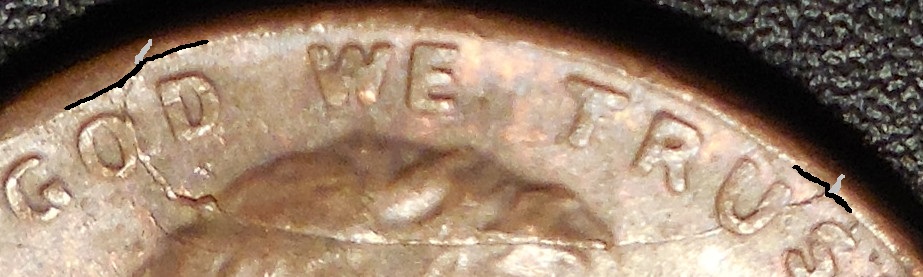 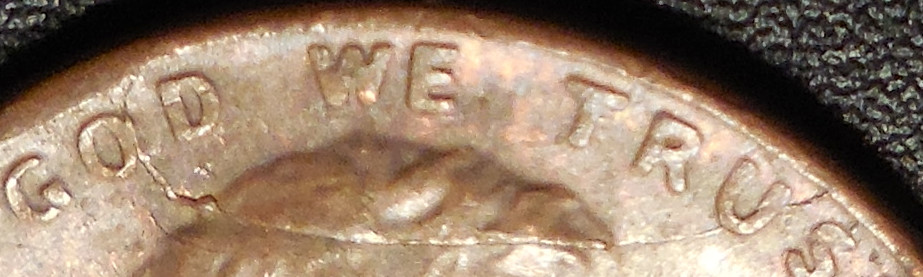 Edited by BlueSolo
08/29/2015 02:59 am
|
|
Pillar of the Community
United States
1781 Posts |
One of the reasons I call it a rim-to-rim die crack is because the wear involved at the rim prevents one from being 100% sure it actually cracked all the way through the rim. It may have and be hidden by wear but there is no positive evidence of it. There also does not seem to be any displacement of design suggesting that the piece of die in question is still connected to the body of the die. Additionally, very few obverse dies (what was the hammer die 99.9% of the time in those days), actually fell away to cause an actual Cud. As such, we have to assume that if gravity did not cause most dies like this to develop into known Cuds, that they probably weren't fully separated from the die and most probably never developed into full blow Cuds. To be a Retained Cud, the piece of die within the rim-to-rim die crack must be fully separated from the body of the die. Edited by koinpro
08/29/2015 09:18 am
|
|
Pillar of the Community
United States
3363 Posts |
Quote:
very few obverse dies (what was the hammer die 99.9% of the time in those days), Is there a listing anywhere which shows hammer and anvil dies with information as to which was the Obverse? |
|
Pillar of the Community
United States
1781 Posts |
Pete, the cent dies of the time had a longer shaft for the reverse die so that it could eject the coin. That's probably still true.
|
|
Pillar of the Community
United States
1781 Posts |
Here is a die that has a massive rim-to-time die crack. The crack is so severe that there is obvious displacement of design sitting at two different levels. A medal struck from this would surely be called a Retained Cud, yet the chunk of die within the circular crack is still well connected. The bottom line is that the lack of actual Cuds known for the majority of coins listed as Retained Cuds suggests that most are not really Retained Cuds by current definition. 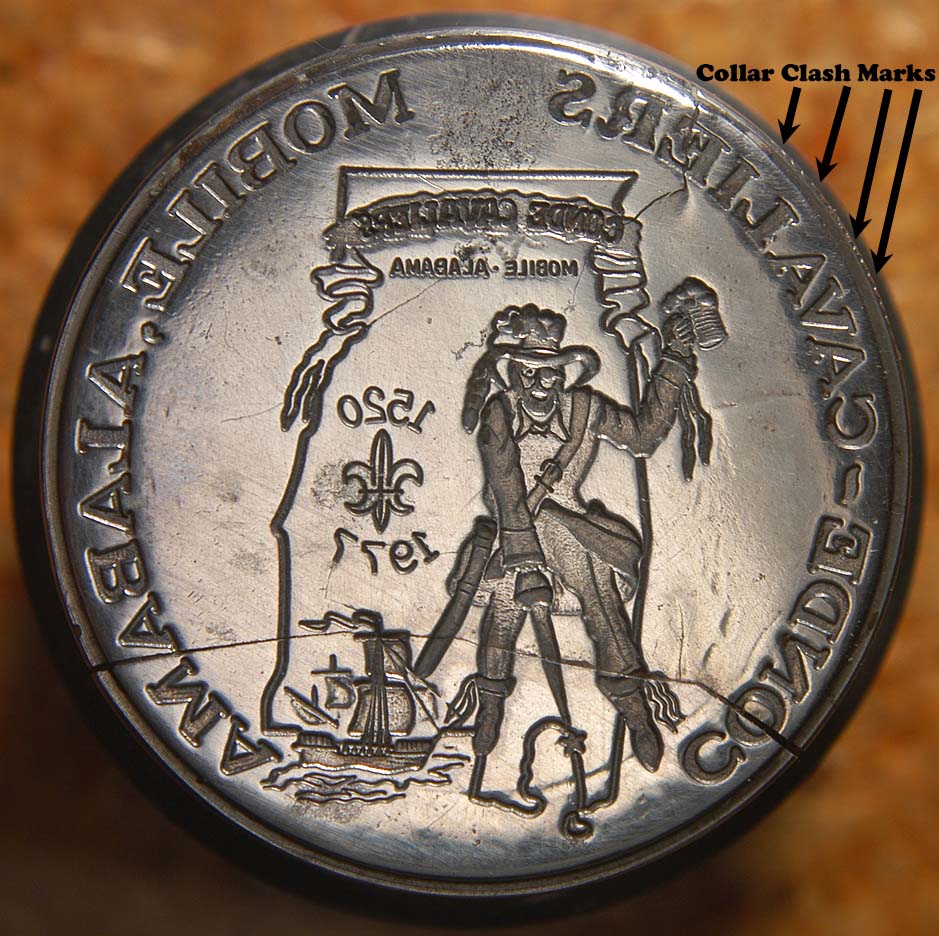 Pay no attention to the notes about the Collar Clash and notice the rim-to-rim die crack within the lower half of the coin. 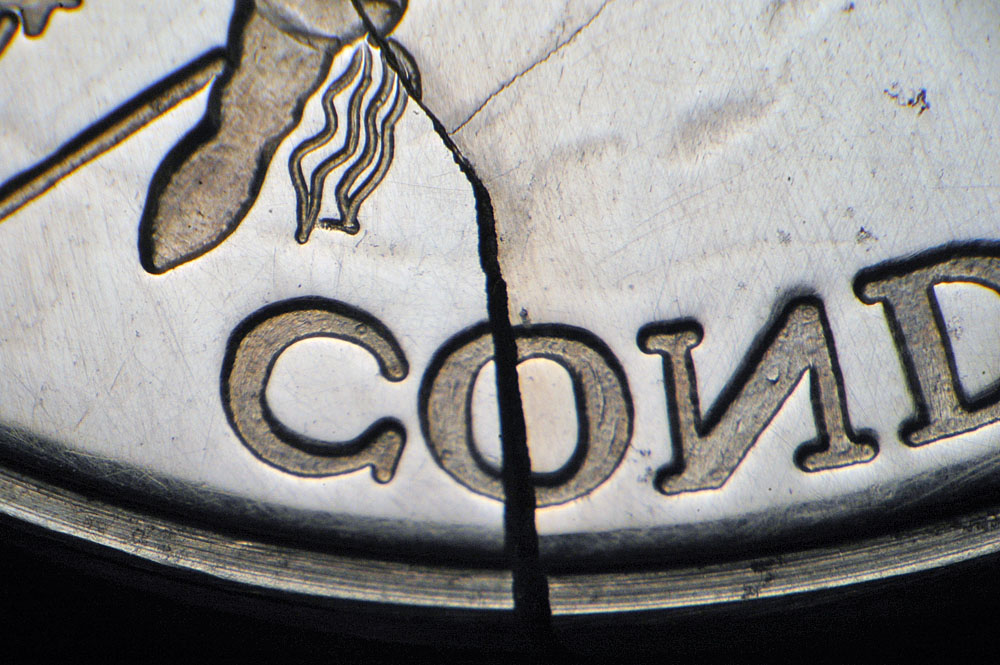 Notice the amount of metal displacement as the crack runs through the O or CONDE. 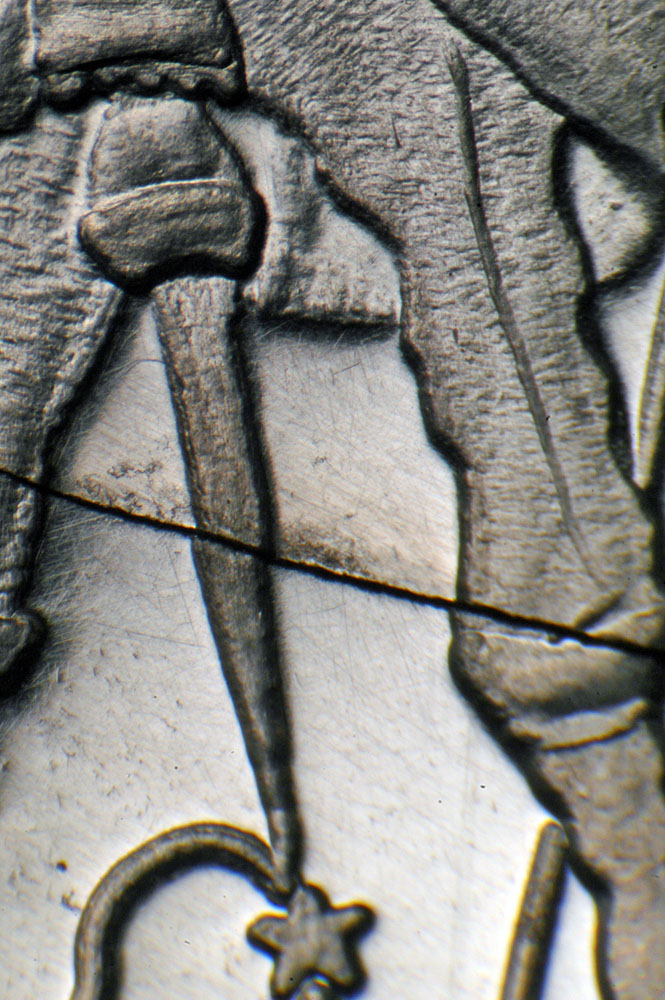 Metal displacement of the sword. 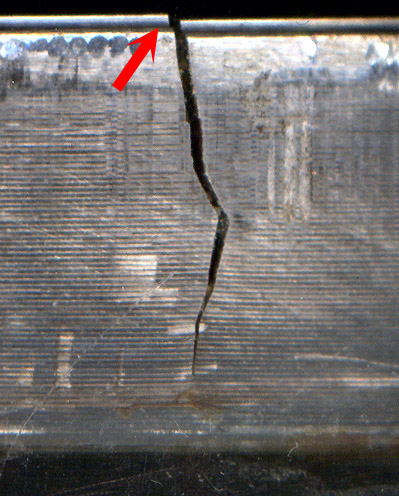 A side view of the right side of the rim-to-rim die crack showing how one side of the crack is up higher than the other. Edited by koinpro
08/29/2015 09:41 am
|
|
Pillar of the Community
United States
4809 Posts |
Ken - your explanation seems to make sense. I guess I envision that an interior die break (retained Cud?) would perhaps have enough irregularities in the break to keep it from falling out with gravity where as one break rim-to-rim wouldn't. |
|
Pillar of the Community
United States
1781 Posts |
Rackster, if deep enough, I suppose it's possible that the retaining tooling could keep a piece of die in place but I'd really have to be a deep break. Otherwise, I would think the force of striking a coin alone would shake any completely separate piece of die loose and gravity would carry it away.
|
|
Pillar of the Community
United States
4809 Posts |
My thoughts exactly. I've seen a few dies where you could see the interior piece was retained and appeared as if you could move it with your finger (but it wouldn't move). But under tons of force, you would see that it was by the varied witness marks left on the subject items it was producing.
This was a good, informative thread!! I like these kinds of threads!
|
|
Pillar of the Community
United States
1781 Posts |
|
|
Moderator
 United States
23522 Posts |
OK, the new images are clearer. There is plainly break displacement and metal filling that displacement in the fields. I can see more of that in the head now as well. The thing that got to me is, if there's detail displaced something has to fill the space that detail moved away from and I couldn't see any fill in the head area.
Although - as has been mentioned - circulation has obscured proof that the break reaches the rim, it's reasonable to assume it does so if the break can be observed to be widening as it approaches the rim at both ends. It's clearly so at the right end on this coin, less-so on the left, but judging from the displacement I kinda doubt that section of the die was connected to the rest by the time this coin was struck.
|
|
Pillar of the Community
United States
1781 Posts |
SsuperDdave, Where are the new images? I could not find them. Anyway, if you look at my images a couple posts up you will see how easily there can be be both horizontal and vertical displacement and the portion of the die within the cracks still be fully attached to the main body of the die. The bottom line is that few so-called Retailed Cuds actually have full blown Cuds known for them. It then reasons, that most so-called Retained Cud listings really aren't for Retailed Cuds by current definition. A better term for these unprovable so-called Retained Cuds has been around for some time - "Pre-Cud Die Break." Edited by koinpro
08/29/2015 12:35 pm
|
|
Pillar of the Community
 United States
5964 Posts |
First of all I want everyone to know I truly appreciate your time and thoughts on this coin. To answer a few questions, Slamnbass, I'm not sure which is horizontal and vertical displacement, I assume vertical is when the coin is laying flat and part of it is higher, and horizontal is how far apart the break is. In either case, I will check the U as well as the entire coin both ways. If I see something, I will post it. As far as BJ goes, I filled out the contact page on his site, but never heard back from him.
Blue, I will check the gray areas, anything noted will be posted.
Drew, you nailed it!
Barring further developments, I will label this one (in pencil) a Pre-Cud Die Break. Very informative indeed. Thanks all very much.
|
|
Pillar of the Community
United States
2775 Posts |
After reviewing the first pics more than twice, my eye/gut was telling me Retained Cud, because of the rim to rim die crack. After reviewing the points of die crack rim to rim, but still not completely fractured down the die also being that it is the hammer die and the gravity theory should apply makes one think other wise. I have to go with a politician mentality and say "who am I to say this strike of this coin was not the final blow that busted this die into a full blown Cud? If so its retained, if not its not". Thanks, Doug. |
|
Moderator
United States
23522 Posts |
Quote:
Where are the new images? I could not find them I was referring to BlueSolo's blowups, which were a great help for my visualization. Your die is a pretty clear illustration of the process and leaves little to the imagination. It leaves me wondering what and where metal compresses in order to leave that gap; the only way a gap appears is if the same amount of metal now fills a smaller space. Perhaps vertical displacement provides that extra space. |
|
Pillar of the Community
United States
740 Posts |
I agree with KoinPro though. Since it is the hammer die gravity should have taken the chunk of the die. Otherwise this chunk is still attached to the die as in KoinPro's photos meaning by definition the crack is pre-cud not Retained Cud. If it were the anvil die however, I am assuming the collar keeps the chunk of the die in place after it has fully detached from the die, which would mean the potential for a Retained Cud. Edited by BlueSolo
08/30/2015 3:25 pm
|
|
Page 3 of 3
|
Replies: 37 / Views: 3,722 |
Page 3 of 3
|





 First Page
 Previous Page


 Posted 08/29/2015 09:13 am


