| Author |
 Replies: 17 / Views: 3,434 Replies: 17 / Views: 3,434 |
Page 2 of 2
|
|
|
|
Pillar of the Community
United States
1249 Posts |
|
|
Moderator
 United States
56855 Posts |
I agree with what chequer said. John1  |
|
Bedrock of the Community
 United States
10065 Posts |
Pic is bad, one of a number of the ones I found. Pic I took a couple weeks ago when I found these. Different lighting, but details in hand are the same. Also taken at a slight amgle so the doubling appears to taper in my pic (only) and apparent extra line at top of some letters is also not on the coins. 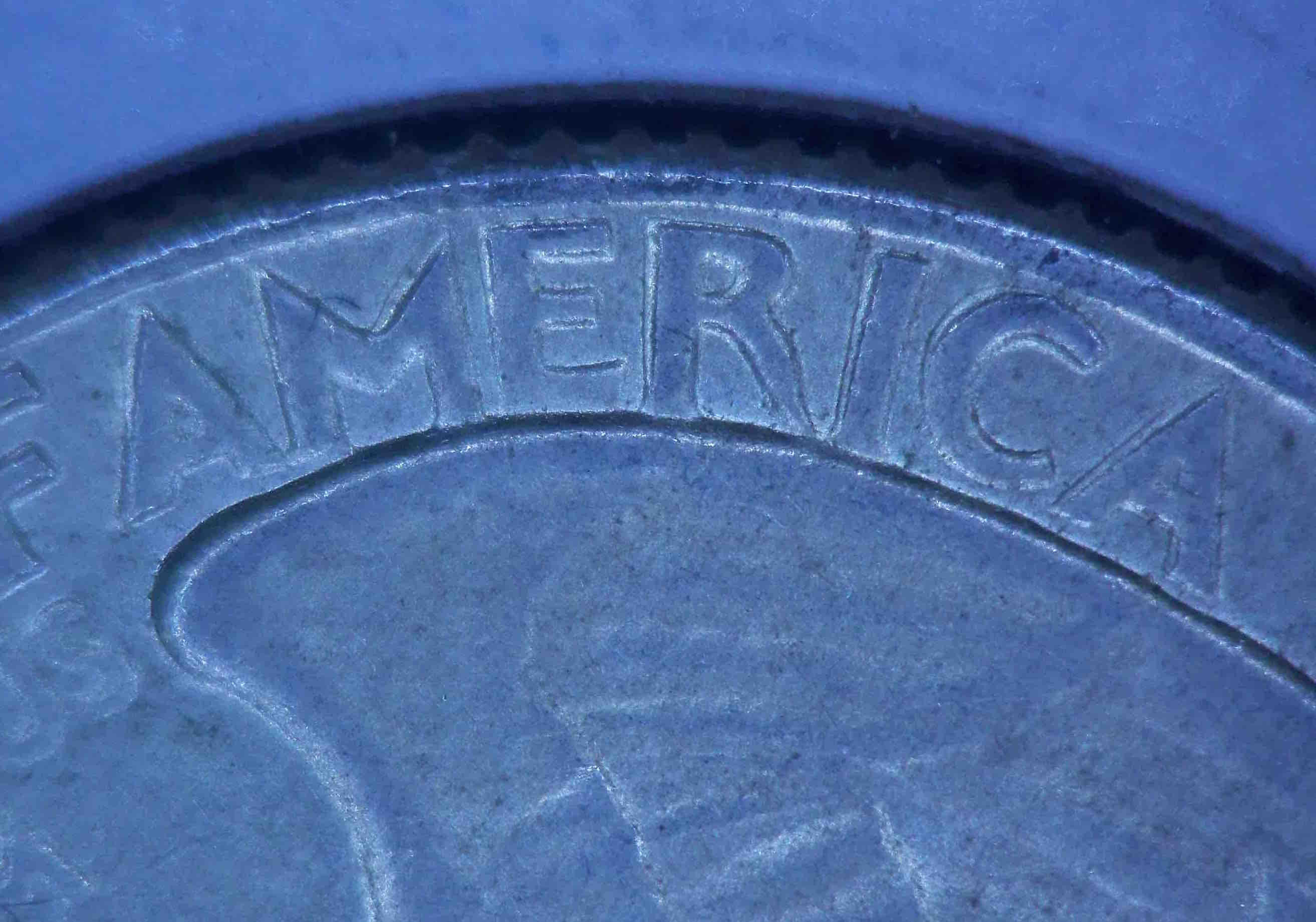 |
|
Pillar of the Community
United States
7390 Posts |
That one sure does look like md from that pic ?
What gets me are the ones where the doubling isn't really there but the expansion of the letters is. Doubling is one of most tricky things to get a handle on and yet its also one of the most simple. Go figure
|
|
Pillar of the Community
United States
3213 Posts |
I think pic of this one is good enough to say MD{machine doubling damage}. No split serifs, flat shelfs, VLDS {very late die state}= worn out die, hopefully you will find one in the stack.
|
|
Bedrock of the Community
United States
10065 Posts |
I appreciate people giving their opinions on my coin, but the thread is to ask why the coins in the official pics are not MD. The notching is weaker than in the VV pics and on the online PCGS slabbed pics I could find (that were large enough to see). I have been studying this off and on for a month before asking here. Here is another CCF thread where a 64D DDR identical to my coin(s) (in hand - remember I said my pic was angled and not accurate). It is said to be DDR - see the second pic especially. Coop there makes a comment about notching at the bottom of the letters (?). https://goccf.com/t/21752Here is another link with an obviously MD half dollar - and it looks like this quarter's doubling: https://goccf.com/t/78123- please look at the pics of the second half dollar listed. Note Coop ID'd it as "classic MD." I am trying to be able to know the difference. Yet the MD lettering looks doubled the same way as in the DDR pics above from Variety Vista. OK - picture is worth a thousand words right? Here is my dilemma in understanding: Pic explanation. Top in blue frame is CCF-verified MD half dollar lettering. Bottom in red is 1964 D DDR FS-801(025) picture from NGC website (sorry I said Variety Vista above). Color coded text and arrow point out similarities in both coins. 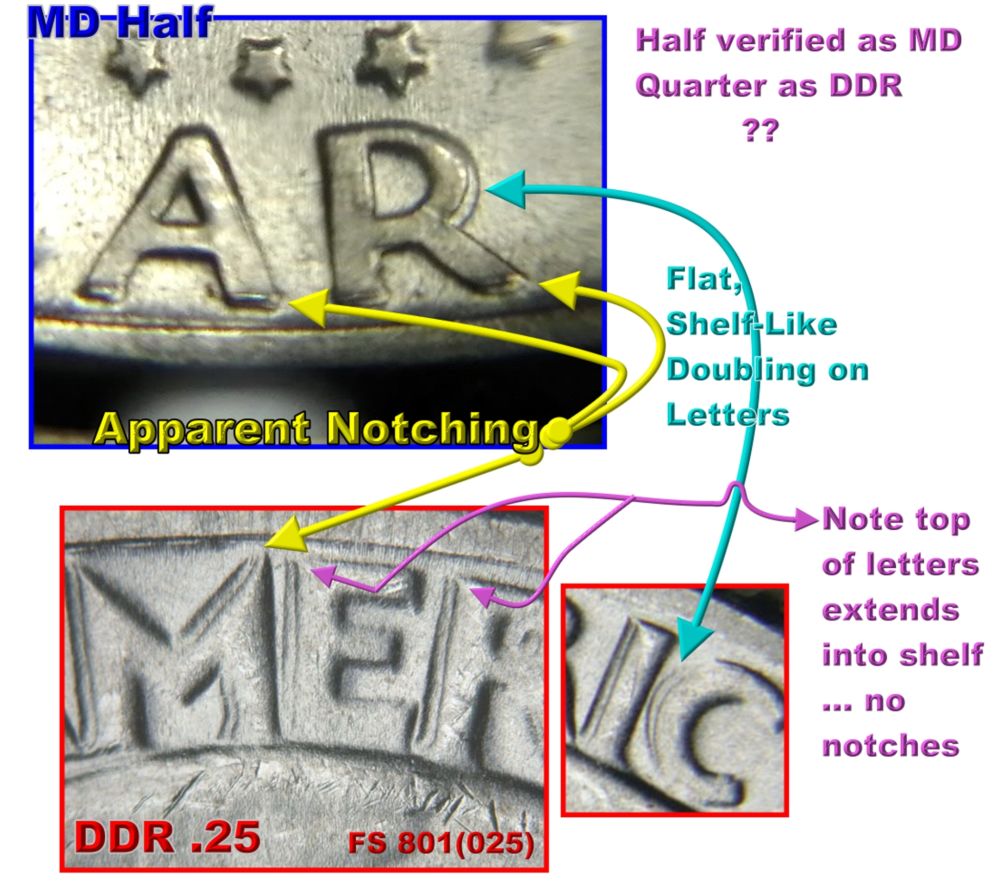 I have looked at thousands of JFKs (and other coins) and succefully ID'd DDOs (posted here and verified on CCF). As I said, I thought I had this down pat. But I would have missed this as actual doubling on the quarters b/c its attributes look so close to MD. I am wanting to know what I am missing in being able to tell ther difference. This is the first time in 3 years since being educated on this forum that I have been bamboozled by MD vs actual doubling - there are good teachers here  . Maybe Coop will chime in? How much squash could a Sasquatch squash if a Sasquatch would squash squash? Download and read: Grading the graders Costly TPG ineptitude and No FG Kennedy halveshttps://ln5.sync.com/dl/7ca91bdd0/w...i3b-rbj9fir2Edited by Earle42
09/07/2015 10:44 pm
|
|
Pillar of the Community
United States
946 Posts |
Earle hit it right on the head. Even though the pictures you posted look like MD they are doubled. The letters have a more of a round over edge to them instead of the usual flat shelf like appearance of the MD. Good question and I am sure others will chime in on it.
|
|
Bedrock of the Community
United States
10065 Posts |
jdiablo30 wrote: Quote:
Earle hit it right on the head. Even though the pictures you posted look like MD they are doubled.
I hope I am not misunderstanding. But the half in that link is definitely MD. You can see in some of its other pics... such as this one I labeled from the link: https://goccf.com/t/78123...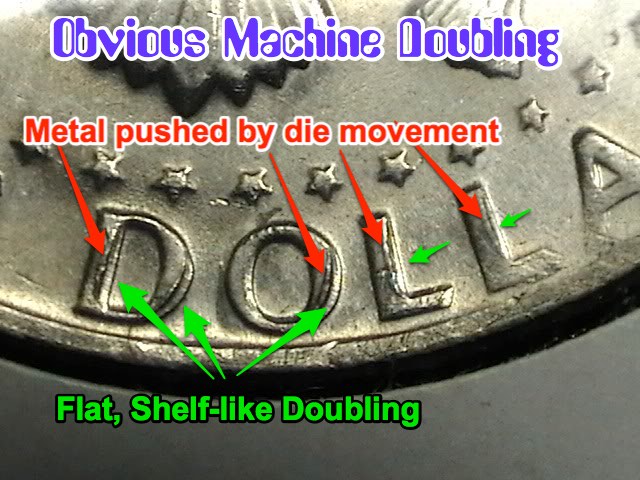 that the lettering was actually pushed up as the die moved and caused the MD. But there are a LOT of MD pieces that don;t have this pushed-up appearance on the letters and no evidence of notching. I am wondering how to tell the quarter doubling is not MD since it looks so much like it. chequer wrote: Quote:
Well, there is some notching, the doubling is not flat and shelf-like, but rounded
I guess I need help in understanding what is rounded-looking on the quarter's doubling. My perception at present... For both of these coins, if I were a very tiny insect stepping off the edge from the top of a letter, I would have a straight step down onto a flat, shelf-like area. From there I would step off that edge and be on the flat area of the coin's flat fields. What s my perception missing on the quarter that makes it DD and not MD? How much squash could a Sasquatch squash if a Sasquatch would squash squash? Download and read: Grading the graders Costly TPG ineptitude and No FG Kennedy halveshttps://ln5.sync.com/dl/7ca91bdd0/w...i3b-rbj9fir2 |
|
Bedrock of the Community
United States
62064 Posts |
The example from the site is hub doubling. While the coin is showing evidence of heavy die wear (between the tops of the devices and the rim) it is a doubled die. Try making a side by side of quarters from the same year of the same devices. When you see them side by side, you will notice that the example above's devices are wider. (classic for a doubled die) Also not the bottom of the "a" in AMERICA, that is notching. (split serifs are on mint marks, notching is the correct term on doubled dies) Note the color change between the spread? It get darker showing it is rounded and not flat like you see the same color in the machine damaged area. (another clue for hub doubling) 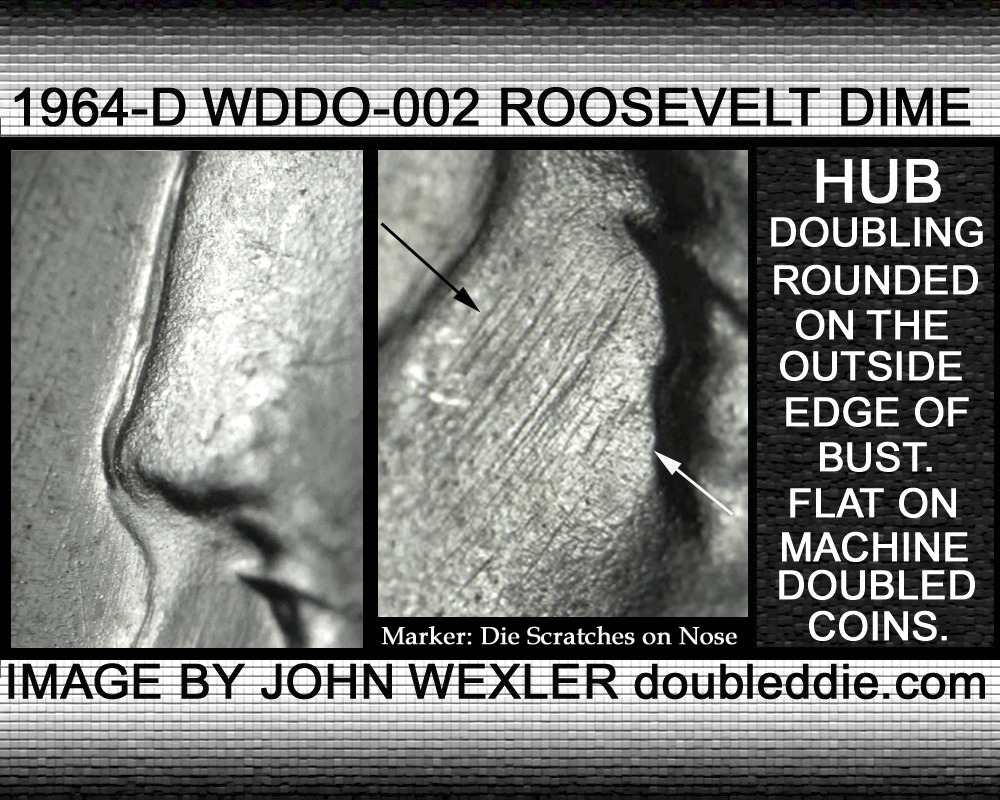 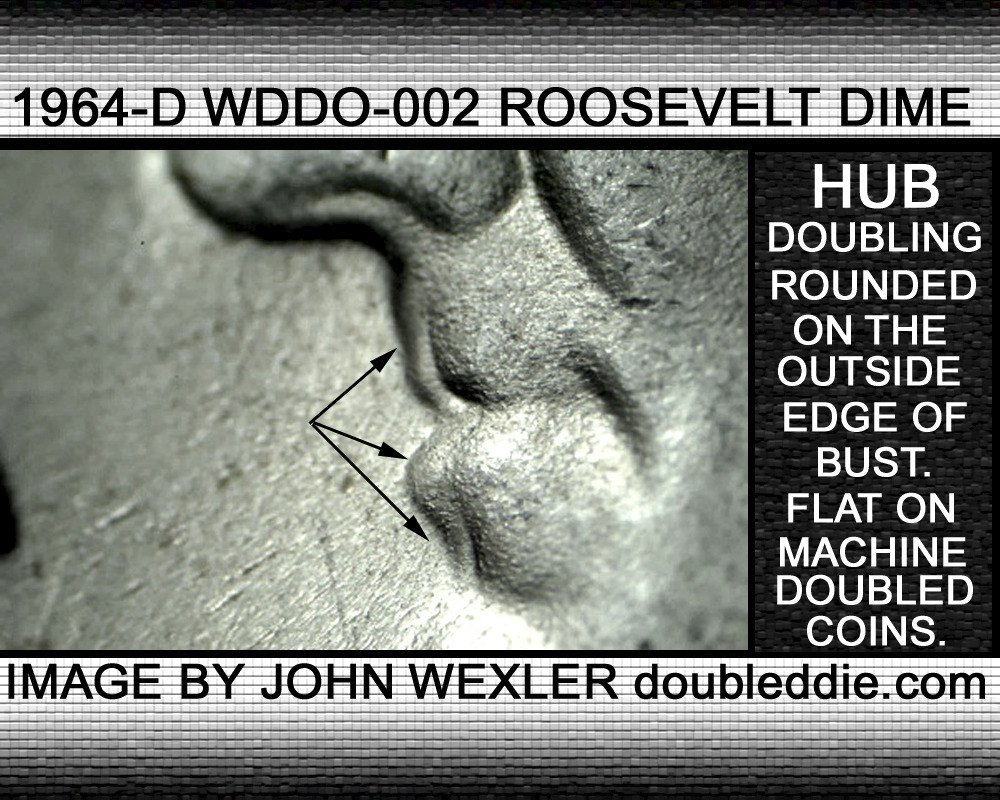 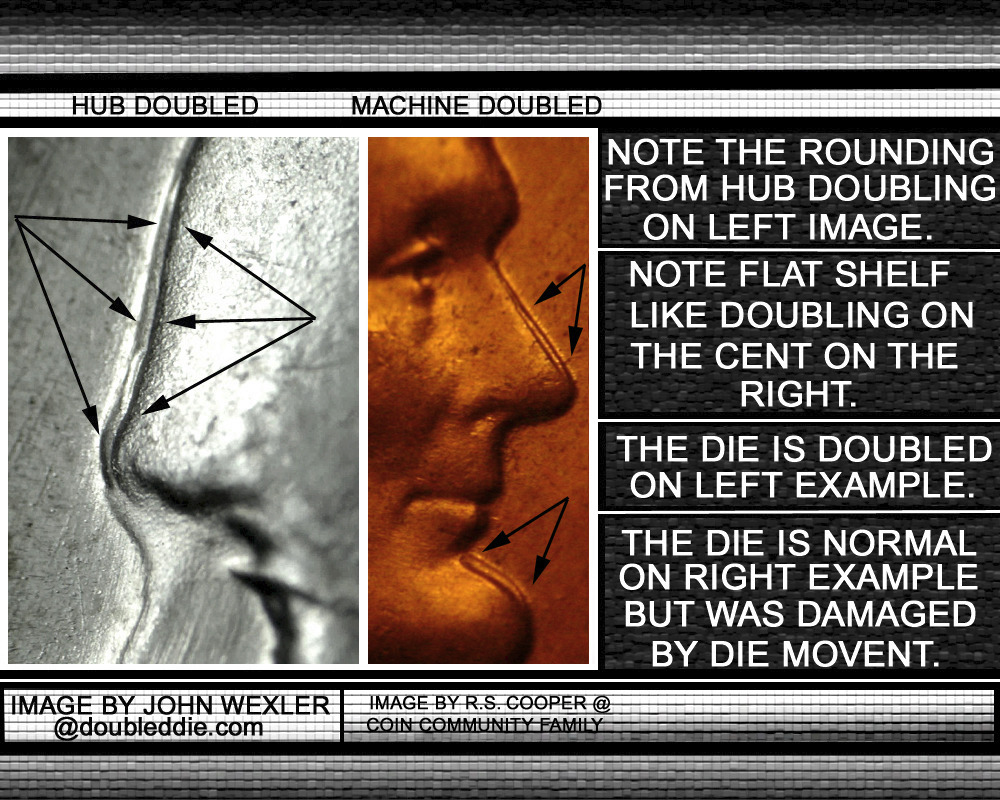 See the color change on the example on the left and the MD same color in the image. (The curve make a color change, the flatness shows one color)  Also note on the shape of the devices on the machine damaged example: Note how the devices are reduced in size. (hub doubling enlarges the devices overall size) Also note as mentioned the raised metal from the damaged devices on the green quarter. (evidence of die movement during the strike) So looking now back at the first images borrow from another site, (there should be ID to give them credit for their images on each image) we can see the color change and not the same color that flatness of machine damage shows. |
|
Pillar of the Community
United States
2376 Posts |
I am useing the pics you provided to show another indicator of MDing. Where I circled , your coin showes the shelf wrapping around the serif of the letter and on the true DD the lines of separation meet the field at the serif points. This wrapping the serif is a good indicator of MDing. 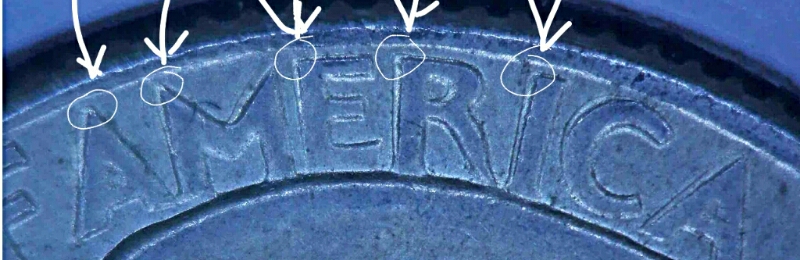 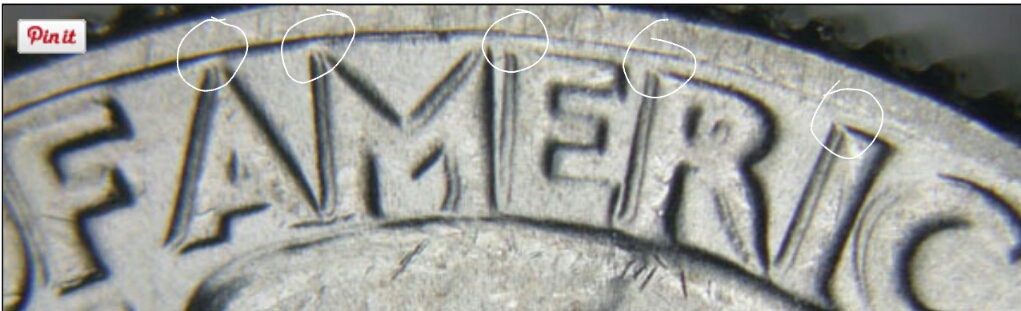 |
|
Bedrock of the Community
United States
62064 Posts |
Note the overall size of the devices. The hub doubled examples are wider. Note how the Machine Doubling reduces the size, damaging them to make it appear there is doubling. The color showing the same flat look, while the rounding is showing as a color change. The notching on the this hub doubled example are at the bottoms of the devices, showing that the hub rotated slightly. The machine damaged example shows a push in a direction. There is no notching present on the MD example. Note the shape of the "M" on both examples? The doubled die shows an even spread. The MD example is uneven in shape. The movement of the dies re-arranged the shape of the devices. The doubling on the die of the DDR will always shows the same doubling. Not the case in Machine Doubling. The doubling is on the die, not happening during the strike. Thus the term "Doubled die". |
|
Bedrock of the Community
United States
10065 Posts |
I appreciate all of the help here. I will need to review it more. I understand the principles behind the doubling types. And like I said, until encountering this specific DDR's picture while Cherry Picking, I thought I could ID MD vs Hub doubling without trouble. Another thing I found is the 64 and 64D quarters tend to be weakly struck on the back. Details of notching are not always so evident as in the pic from the book and online. When I can get back to getting some decent pictures, I will have to revive this thread. As to nothing on the bottoms of the letters, I see it on the A and the F, but not on the other letters -specifically "ERIC." There is a definite line between two separate parallel endpoints for the left leg of the A. And it appear the F also has a very easily seen similar line between parallels at its base. Could you point out (with arrows) all the notching you see on the DDR pic to help me Coop? Also, one more thing. That doubling on the quarter's C, to my eyes is a perfect match for the MD on the R of the half in the above comparison pic. Can you use arrow to point out the way you see these as different. Or is it just a case where lighting and picture have combined to make them look the same and they likely are different in real life? BTW coop...thanks also for the info on the pics. I put a link above them and did not realize it should be on the actual pics. But this makes a lot of sense. So I will get to work on fixing that How much squash could a Sasquatch squash if a Sasquatch would squash squash? Download and read: Grading the graders Costly TPG ineptitude and No FG Kennedy halveshttps://ln5.sync.com/dl/7ca91bdd0/w...i3b-rbj9fir2 |
|
Moderator
United States
196278 Posts |
Quote:
BTW coop...thanks also for the info on the pics. I put a link above them and did not realize it should be on the actual pics. But this makes a lot of sense. So I will get to work on fixing that Done.  |
|
Bedrock of the Community
United States
62064 Posts |
This is probably a class 2 doubled die:  Because the die warped a bit, it would explain why only certain areas are showing a doubled die? Thus some areas are stronger than others. "AM" "R" on AMERICA is where it is showing the notching on the lower left. |
|
Bedrock of the Community
United States
10065 Posts |
@jbuck Muchas spaceba mon fruend @coop  I believe after a 24 hour gray matter mulling, and again reviewing the thread I can tell what you are saying. I hate to think where CCF be without you two!  Edited by Earle42
09/09/2015 11:55 pm
|
|
Page 2 of 2
|
Replies: 17 / Views: 3,434 |
Page 2 of 2
|







 First Page


 Posted 09/07/2015 7:58 pm





