Coin Community Family of Web Sites Join Thousands of Coin, Bullion, & Money Collectors
300,000 items to help build your collection! Royal Canadian Mint products, Canadian, Polish, American, and world coins and banknotes. Vancouvers #1 Coin and Paper Money Dealer Coin, Banknote and Medal Collectors's Online Mall Join Thousands of Coin, Bullion, & Money Collectors Royal Estate Auctions - $1 Coin AuctionsSpecializing in Modern Numismatics


Username:
Password:
Save Password
Forgot your Password?


This page may contain links that result in small commissions to keep this free site up and running.

Welcome Guest! Registering and/or logging in will remove the anchor (bottom) ads. It's Free!

What Is This Coin?

To participate in the forum you must log in or register.
First Page  Showing last 15 replies.
Author Previous TopicReplies: 22 / Views: 3,847Next Topic Page 2 of 2
Pillar of the Community
Czech Republic
803 Posts
 Posted 12/01/2015  3:49 pm  Show Profile   Bookmark this reply Add TwoKopeiki to your friends list
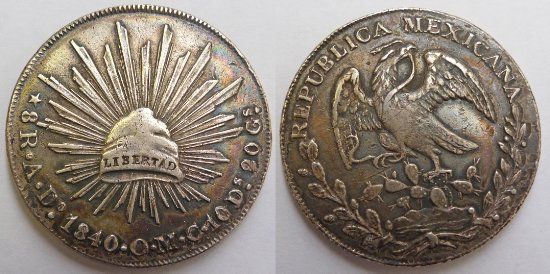
It's a pattern. This one usually comes in silver-plated bronze (Sheffield plate), although it is known in white metal and silver (both very rare). The plated variety is plentiful as patterns go, maybe 32-64 known.

They are thought to have been struck in Spain.

I owned one briefly in 2012.
Pillar of the Community
Czech Republic
803 Posts
 Posted 12/01/2015  3:54 pm  Show Profile   Bookmark this reply Add TwoKopeiki to your friends list
Found an old image of the one I had:

What-Is-This-Coin?
Pillar of the Community
United States
5362 Posts
 Posted 12/01/2015  4:50 pm  Show Profile   Bookmark this reply Add swamperbob to your friends list
My last post was actually written prior to John's last post. So he has let the cat out of the bag.

Here are the facts about the coin:

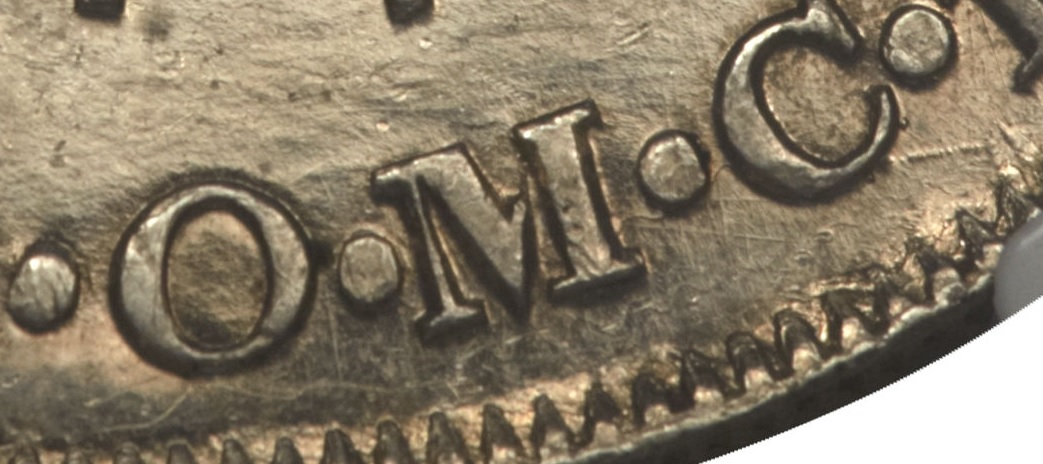
1. It has a non-sense legend that reads A. Do 1840 O.M.C. - which no one noticed sorry to say.
2. It is made of Silver plated bronze according to the seller, however, based on the copy I own it is actually a Sheffield Plate over copper strike.
3. The hole is positioned like a typical cancellation mark not a suspension hole. My copy of this coin is also holed and in addition it was test cut. The hole in my coin is also eccentric.
4. The coin has an about 90 degree die rotation - which is common among counterfeits but rather uncommon for genuine coins.
5. The coin has very odd looking 1 punch and on my copy several letters appear to be repunched.
6. The lettering is poorly layed out - crowded near the date widely spaced in the assayer notation.
7. The coin has a distinctive eagle - rather attractive but never employed at any mint. While the upper portion of the eagle is attractive, the lower portion is not as well done. Notice the crude way the foot "grasps" the cactus with toes extended horizontally in a very unnatural pose.

For me the conclusion when I first saw this coin was both simple and obvious - the coin is a Contemporary Circulating Counterfeit. It looks like a typical counterfeit and in fact has many of the characteristics of a counterfeit.

But John has now identified the coin as a rare pattern made for Durango - which is how Krause and several other works portray the coin.

I ran into these same posts long after I had collected my example of the 1840 A.Do O.M.C coin. So imagine my shock to find that in my collection of counterfeits sat a Rare Pattern.


Quote:
But is this coin a pattern as it purports to be?


It didn't seem to fit the facts, so I did some research.

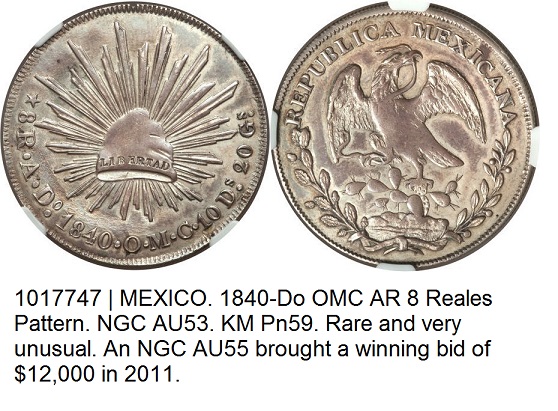
Here is one of the highest graded examples of this "rare" coin as it appeared in a Stacks Auction.
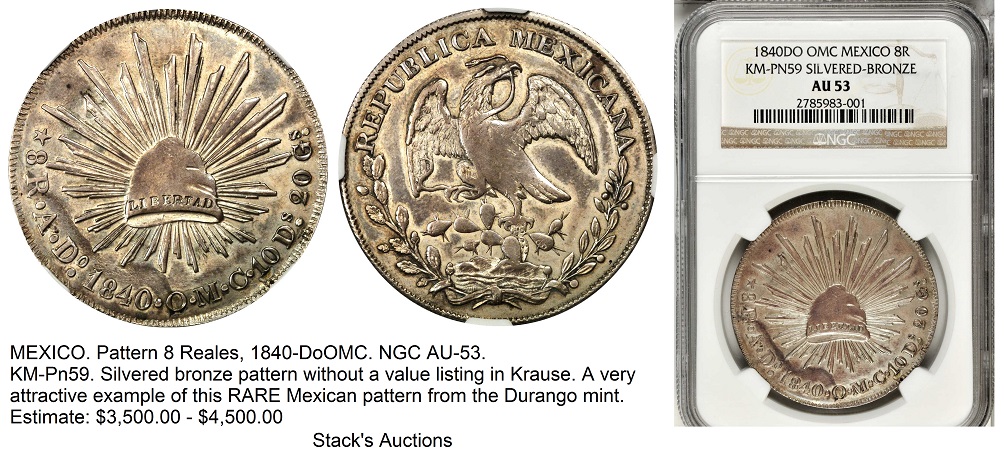

What-Is-This-Coin?


The coin is actually listed in several references, but some confusion exists. In Krause Fourth Edition 1801-1900 it is listed as:

Pn59 1840 Do 8 Reales Silver Plated Bronze no price.

Directly above the Pn59 listing and between Pn59 and the partial picture of the 1840 version is listed another pattern:

Pn57 1836 Do 8 Reales Silver $ 1,500.

Photos of all patterns are not given so I have to presume that the 1836 and 1840 Do patterns are unrelated.

The next entry is for PnA58 and Pn58 which might have been listed between 57 and 59 numerically except that PnA58 has an accompanying photo. Pattern PnA58 is a partially dated 184x Do in copper and Pn58 is listed as 1840 Do in white metal. Both of these are associated with a picture of a coin that uses the concave wing eagle seen on Guanajuato 2 reales.

We all know that Krause is noted for compiling errors, so I did more looking and found:

In 1967 Neil S. Utberg listed some patterns in his "Numismatic Sidelines of Mexico". Included is a picture of this same coin with a poor accompanying photo. The entry reads:

D6-3 Durango 8R Pattern . Milled edge. Silver. Proof.
* 8R A Do 1840 OMC 10Ds 20Gs This being the first year that three assayer initials used. Octavio Martinez de Castro. Use of "A" not known by me..... $ 250.

The coin is very reflective silver and appears to be high grade. Dies are the same. However, Utberg makes a statement at the end of his list of seven patterns that I find very interesting.


Quote:
This list of patterns for 8 reales is far from complete . I do want to stress the fact again that many people buy, sell, and display so-called patterns and trial strikes of Mexico that are nothing but brass or copper counterfeits. A pattern or trial strike will always have a beautiful appearance (even if mis-handled).


I think the 1840 A.Do fits into the counterfeit category because the coin is not beautiful - it is poorly finished - the dies were poorly punched and the surface were poorly ground before striking. Shiny or reflective does not mean the coin has a beautiful appearance. Anyone familiar with patterns will note that this coin does not look like a typical pattern.

I am concerned that a Sheffield plate coin has once again passed as silver and has been mistaken for a rare genuine issue.

Here is another instance where the coin was published:
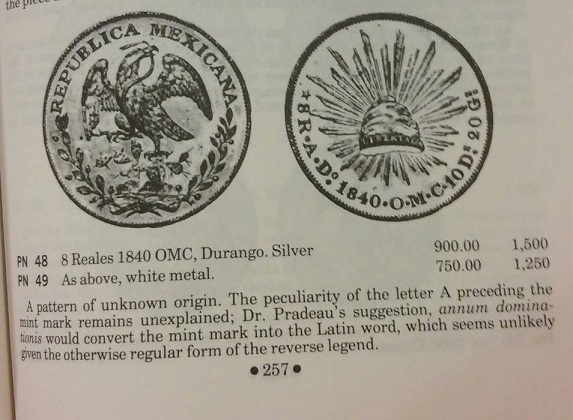
What-Is-This-Coin?

Here the reference is different - there is a claim there are silver and white metal copies listed as PN48 and PN49.

So are there silver, white metal and silver on copper copies? Or is there one single type silver on copper Sheffield?

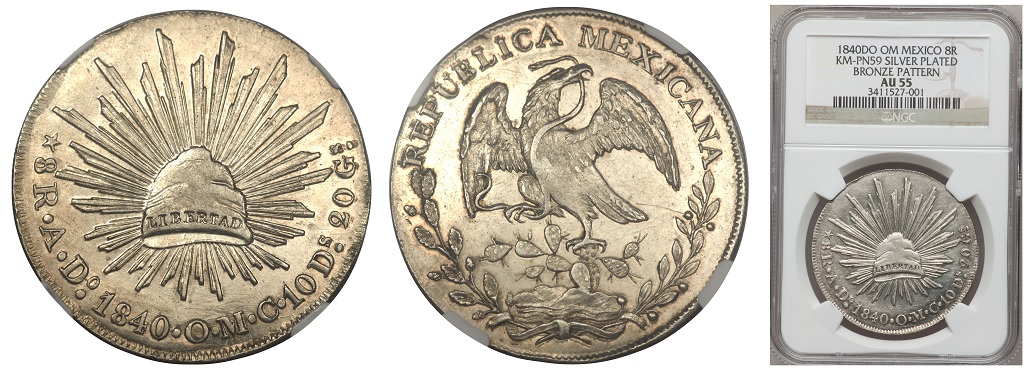
There is a Heritage listing as well:
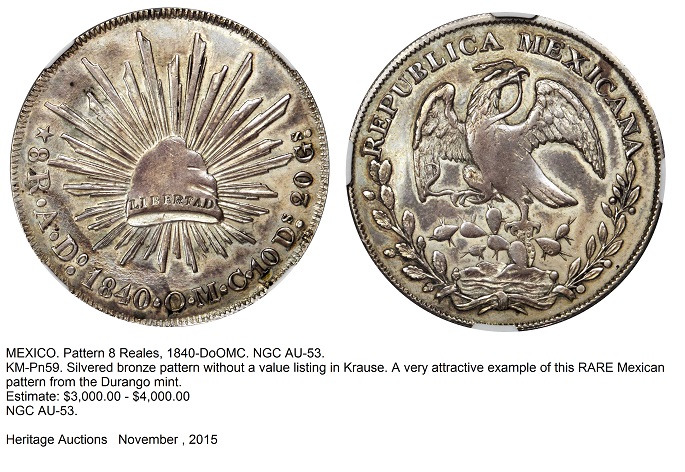
What-Is-This-Coin?

And here is another from 2011:

What-Is-This-Coin?

Where are the others? All three copies I can trace seem to be silver on copper or bronze. John can attest to how often copper is misidentified as bronze.

I will address the problems with the die work in a subsequent post.

Pillar of the Community
United States
1156 Posts
 Posted 12/01/2015  5:24 pm  Show Profile   Bookmark this reply Add jgenn to your friends list
The Stacks listing of the AU53 appears to be the exact same coin in the two Heritage listings.
Pillar of the Community
United States
5362 Posts
 Posted 12/01/2015  6:31 pm  Show Profile   Bookmark this reply Add swamperbob to your friends list
andyg Interesting comment about veneration. I am not aware of anyone who venerates the Mexican symbol or eagles as they would a religious icon. However, while an inverted suspension makes it easier to kiss the image right-side-up I would be more concerned that the inversion would be considered insulting or sacrilegious. The only other answer I have read for an inverted coin was as a protest with regard to unpopular French Kings.

TwoKopeiki Regarding Sheffield Plate - it does not work with bronze. Sheffield plate worked when the core metal was Copper or German Silver. The components did not expand and bend at identical rates with other alloys. Electro-plates on the other hand can use many different cores. Regarding the other facts - origin of the coin in Spain, the rarity of silver and white metal versions and the population of silver plated examples - where did they come from? Is it a conflation of other sources or from one definitive source?


Pillar of the Community
United States
5362 Posts
 Posted 12/01/2015  7:31 pm  Show Profile   Bookmark this reply Add swamperbob to your friends list
jgenn Yes the coins I showed are in fact the same coin. What I found to be most odd was the prices this pattern has gotten.

A slightly better version NGC AU55 sold for $13,800 as part of 2011 September Long Beach Signature World & Ancient Coins Auction #3015 Lot # 25311.

What-Is-This-Coin?

The coin I showed in the earlier posts is an NGC AU53 which sold for $ 2,232.50 as part of 2014 September 3 - 10 Long Beach Expo World Coins Signature Auction - Long Beach #3035 Lot # 31201.

Yet that same coin sold for $ 11,000 in 2011 at Stacks.

I am wondering if these people are buying the holder or the coin.

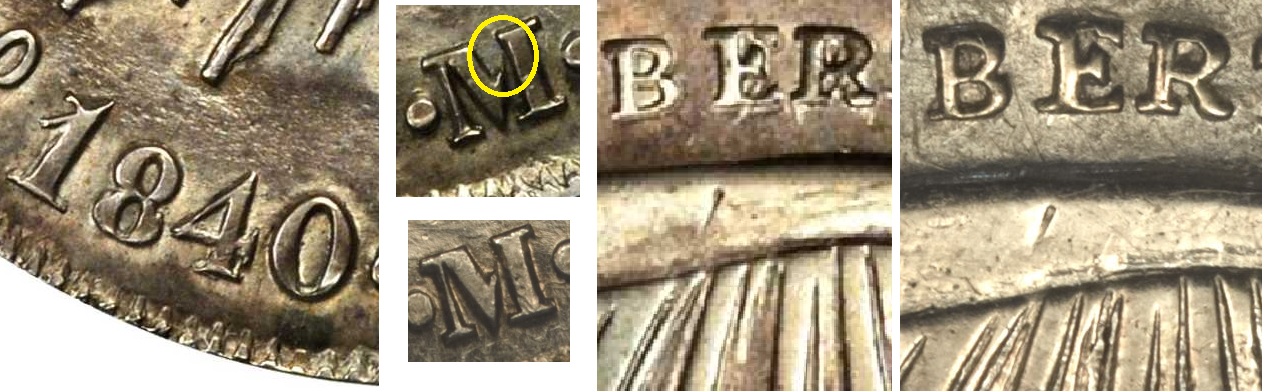
I said earlier that I would post pictures of what I see as indications in the die and surfacing that this coin is not up to the typical quality of a pattern. Here are just two. The first is a group of poor punches and the second shows the horrible die finish. I suggest that anyone review this in full size by going to the Heritage site and finding the coin that brought $ 13,800.


What-Is-This-Coin?


What-Is-This-Coin?
Pillar of the Community
Czech Republic
803 Posts
 Posted 12/01/2015  7:34 pm  Show Profile   Bookmark this reply Add TwoKopeiki to your friends list
Bob,

My information comes from a collector of mexican patterns, who's been researching them for close to 20 years. He doesn't post on these forums, but his handle at PCGS is pruebas. I will send him a note about this post and hopefully he can chime in.
Pillar of the Community
United States
5362 Posts
 Posted 12/01/2015  8:08 pm  Show Profile   Bookmark this reply Add swamperbob to your friends list
TwoKopeiki Looking forward to hearing from him.
Pillar of the Community
United States
1757 Posts
 Posted 12/01/2015  9:15 pm  Show Profile   Bookmark this reply Add colonialjohn to your friends list
Still not seeing any form of a Sheffield plate from these photos. Its either electroplating or a silver wash type application IMO. I am not even going to consider the accuracy of any numismatic firm calling something a white metal ... if some examples have crossed the block in this alloy.Bronze or low zinc brass? Would like to see one LIVE at an auction viewing ...

JPL
Pillar of the Community
United States
5362 Posts
 Posted 12/01/2015  11:53 pm  Show Profile   Bookmark this reply Add swamperbob to your friends list
John - If this coin is an electroplate (which I will admit it looks like in some of the photos), it would go along way toward proving that the coin is not a pattern.

I was operating from my old notes when I said my example of the 1840 A Do coin was Sheffield plate. The note is thin Sheffield plate. I do not have that coin here it is in the bank. So I have not been able to confirm my opinion.

When I did the book on Portraits, I used 1830 as a very conservative, but convenient, date for the cut - off between older methods and the introduction of several new technologies associated with counterfeiting.

In order to refine those dates for my second book on Cap and Ray types I have been trying to tie down the actual dates when these technologies were introduced.

This research points date about 10 years later for the development of electro-plating.

Counterfeiters use of electro-plate for their work does not date back before 1840. Electroplate was only developed in that year. It became popular with counterfeiters after the Civil War.

Most reference texts are not precise but if the first uses of electro-plate in an industrial setting date to 1840 it is unlikely that it was being used to plate patterns in that same year.

More research is needed of course, but as of right now - it would have to be Sheffield Plate to have any chance of being an actual pattern.

Of course, I believe it is a simple counterfeit in any even based on the way the coin was made. It that was the quality level available for a pattern I don't know how the factory would expect to sell anything.

Pillar of the Community
United States
1757 Posts
 Posted 12/02/2015  08:00 am  Show Profile   Bookmark this reply Add colonialjohn to your friends list
It seems so from Napier and his discussions of electroplating in terms of any pieces arising pre-1840 being unlikely as electroplated as the technology was not yet developed. Just realize coins can be backdated and perhaps true regals exist for this type? Usually when something spurious? like this arises its good to go back in time to 19thC catalogs and see the write-up of the piece. However - after all this time in CC research for 40 years I can't recall any patterns made with silver wash or electroplated silver if indeed this is the TOP LAYER or silver treatment ... this is a curious piece which seems to go against the definition of a Pattern.

A case in point some believe in that December Cayon Auction coming up in a couple of days that the NE counter-stamp piece is a spurious piece produced in the 1950-1960's ... this NE counter-stamp trying to link itself to the Massachusetts Bay Colony. It has a 2000E+ starting point. The jury is still out on that one ... again Cayon Numismatics have been WONDERFUL and I have personally picked up a lot of great pieces from this firm. Since this coin is out of my price range I have not investigated it further ... I do recall some discussions in the C4 sphere with this counter-stamp as NE Mass. Coinage currently brings $50,000 + on any survivor or denomination
Pillar of the Community
United States
5362 Posts
 Posted 12/02/2015  12:28 pm  Show Profile   Bookmark this reply Add swamperbob to your friends list
The date of 1840 is the date when the process was first patented and therefore 1840 is presented as the starting point. I have reference material indicating that initially it was not successful due to plates that were non-uniform and some reports of peeling. (I got this from a 1920 article on the history of the process). According to that article the process was not perfected until 1844 at the earliest.

So when did counterfeiters adopt the new process? That is the big question. Would they abandon a successful process like Sheffield Plate in favor of electro-plate. It also requires a different skill set and the availability of electricity.

I am leaning toward 1845 - 1850 as a watershed date before which electro-plated counterfeits would be very unlikely.

I completely agree that a pattern maker would be unlikely to produce a pattern in 1840 and have it electro-plated.

I believe the 1840 A.Do OMC is a Contemporary Circulating Counterfeit and nothing more. I plan to include it as such in my book on Cap and Ray counterfeits.

Pillar of the Community
United States
1757 Posts
 Posted 12/02/2015  2:52 pm  Show Profile   Bookmark this reply Add colonialjohn to your friends list
Still like to hear from that researcher.

Concerning some more information on this NE piece - Julia Purdy supplied this information to me:

Hi John - I think this may be what you mean? It is from the July 2015 C-4 Newsletter "NE" The Elusive New England Countermark by Kenneth Bressett.

I read this article and am still not clear on exactly what is going on with this coin. I think it is thought that this is the same coin as from the 1907 Stickney / Chapman sale which at that time had a Guatemala counterstamp. And that sometime between 1921 and 1976 the NE stamp was stamped over the Guatemala stamp?

And this was done so that the coin could be tied to Stickney's 1860 description of the NE stamp on a coin in his collection from the Castine hoard - which has never been found....?

These are all new to me until I read the Bressett article (which was super!)

FYI for everyone - I found the auction link here:

https://www.sixbid.com/browse.html?...&lot=2028697

JPL:

The pedigree on this piece is quite interesting: Chapman - Stickney: 2763; Chapman - J.S. Jenks: 7158 - H. Christensen: 886 (12/10-11/1976) - Cayon (5/10/2005): 5035.

No real conclusions on its tie in with New England. Cayon provides a reference but I did not read it.

Its a mystery coin and apparently unique with a formidable pedigree. No one yet has called it spurious or a fantasy but it does have a RECORDABLE pedigree back to Stickney (1907).

A GREAT conversational piece ... and apparently UNIQUE in terms of this NE countermark on ANY host coin from my research.

Note that the weight matches up EXACTLY to the Stickney recorded weight of 25.99 (Cayon lot description weight:26 grams).

Its common knowledge this American colony always had difficulty keeping silver within its borders so perhaps this was an attempt - you can also argue that with a date of 1652 is this just too good of a coincidence?

Again - no other countermark of this design has ever been discovered to my knowledge on any other host coin of any country.

JPL


Edited by colonialjohn
12/02/2015 3:15 pm
Pillar of the Community
United States
5362 Posts
 Posted 12/02/2015  9:27 pm  Show Profile   Bookmark this reply Add swamperbob to your friends list
Found two more records today that support the contention that no one could produce an evenly silver electro-plated coin anytime before mid-year 1844. That is the very earliest possible date for an electro-plated counterfeit and it presumes the counterfeiters had access to the sole facility with the required capacity.

By the time counterfeiters had access to the needed technology - that same technology had to have proliferated somewhat. I need to trace the history and production from any factory that could produce the generator required.


Pillar of the Community
United States
1757 Posts
 Posted 12/03/2015  09:44 am  Show Profile   Bookmark this reply Add colonialjohn to your friends list
Bob - something to consider - rather than just limiting yourself to a proposed 99% Ag reading with a XRF reading viewing the applied silver with a Scanning Electron Micrograph device (SEM) this will appear differently than a silver foil, Sheffield plate or even a silver wash application. Having your company perform SEM microstructure views (not metal % assays) of these FOUR application methods would prove most beneficial moving forward. In simpler terms for other readers what would the magnification of say 200X look like on a coins surface for these FOUR silver application methods on the surface of the coin.

You would need this standard to move forward on this so-called Pattern. You will need TWO tools here - the purity of the silver with electrodeposition and its mocrostructure view in terms of how it looks on the surface of a counterfeit at 200X (as an example - magnification).

These four microstructure standards can then of course be used for side by side comparisons on Sheffield plate and Ag electrodeposition - on other questionable examples - maybe - questionable - since to a trained eye with time this is indeed like apples and oranges (ie., a trained collector using a standard 10X loop cross-comparing Sheffield Plate with an electrodeposited Ag counterfeit say of a Cap and Ray which has been silvered and underweight or at or near regal).

I did a paper once which was buried in some C4 Journal on Sheffield Plate and its microstructure just to confirm it was just a physical process with no outside chemical influences - just Ag and Cu - bounded together with a certain application method. In the same article was a coin also showing Au and Hg as the two main ingredients used in gold gilding on a early 19thC English gilded proof in lower grade (i.e., impaired Proof). The usual types we see at auction (1804?). Soho Manufactory.

Just microstructure - can be a powerful tool to prove a point and CERTAINLY to confirm your suspicions here - true you would need a volunteer to send you one of these so-called 1840 patterns and then compare to these (4) standards - well - not so much the FOIL standard.

JPL
Edited by colonialjohn
12/03/2015 09:49 am
Page 2 of 2   Previous TopicReplies: 22 / Views: 3,847Next Topic Page 2 of 2
First Page  Showing last 15 replies.
To participate in the forum you must log in or register.


Disclaimer: While a tremendous amount of effort goes into ensuring the accuracy of the information contained in this site, Coin Community assumes no liability for errors. Copyright 2005 - 2026 Coin Community Family- all rights reserved worldwide. Use of any images or content on this website without prior written permission of Coin Community or the original lender is strictly prohibited.
Contact Us  |  Advertise Here  |  Privacy Policy / Terms of Use

Coin Community Forum © 2005 - 2026 Coin Community Forums
It took 0.39 seconds to rattle this change. Forums