| Author |
 Replies: 24 / Views: 5,294 Replies: 24 / Views: 5,294 |
Page 2 of 2
|
|
|
|
Valued Member
United States
439 Posts |
I found this a few months ago and thought is was interesting.
"The FIRST EVER coins or medals struck with that particular metal/element! (Gadolinium, Indium, Rhodium and Ytterbium are examples) This is what is available  The website: http://www.elementsales.com/ecoins.htm
|
|
Pillar of the Community
Australia
3839 Posts |
I just had to post this coin. Struck (?) in antimony. 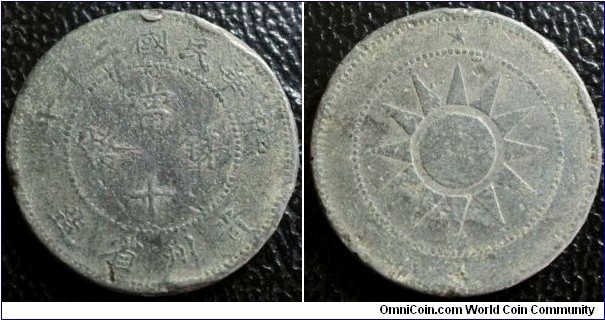 I personally like this coin due to the mixture of various elements.  Ring: 16 - 18% chromium, 0.75% nickel maximum, 0.12% carbon maximum, 1% silicon maximum, 1% manganese maximum, 0.03% sulfur maximum, 0.04% phosphorus maximum, the rest iron Inner core: Aluminum bronze The rest of element coins from my collection can be found here: http://gxseries.com/numis/coin_elem...elements.htmMy partial coin collection http://www.omnicoin.com/collection/gxseriesMy numismatics articles and collection: http://www.gxseries.com/numis/numis_index.htmRegularly updated at least once a month. Edited by gxseries
12/12/2015 08:45 am
|
|
Pillar of the Community
 United States
6130 Posts |
I suppose that manganese deserves an honorable mention as well, since to my knowledge, it was only used in the 1942-45 War Nickels (9%), and all dollar coins since 2000 (7%). Interestingly, the only use it seems to have on coinage is that it can alloy to provide the exact conductive signature of cupronickel. I have always struggled to figure our exactly how to classify the War Nickel alloy--with its 35% silver content, it is technically billon, but I have never seen it described as such, perhaps because it was not debased from a higher purity. Edited by Finn235
12/12/2015 09:04 am
|
|
Pillar of the Community
United States
4963 Posts |
I also consider the War Nickel alloy billon, although billon generally has a lower silver content than 35%. DrDarryl- That's fascinating. I'm quite surprised that they have used sulfur, selenium and mercury yet have not used tungsten, osmium or manganese. |
|
Pillar of the Community
United States
1119 Posts |
Quote:
although billon generally has a lower silver content than 35% I was always under the impression that under 50% precious metal content was billon Edited by Steele
12/12/2015 4:39 pm
|
|
Moderator
 Canada
10472 Posts |
I have a mining company medal that is struck in pure molybdenum...
"Discovery follows discovery, each both raising and answering questions, each ending a long search, and each providing the new instruments for a new search." -- J. Robert OppenheimerContent of this post is licensed under a Creative Commons Attribution-NonCommercial 3.0 Unported License. See: http://creativecommons.org/licenses...0/deed.en_USMy eBay store
|
|
Pillar of the Community
Sweden
1078 Posts |
|
|
Pillar of the Community
United States
4963 Posts |
I agree that they are not particularly lovely. In response to the question about billon, here is what Wikipedia says: Quote:
Billon ... is an alloy of a precious metal (most commonly silver, but also mercury) with a majority base metal content (such as copper).
The use of billon coins dates from ancient Greece and continued through the Middle Ages. During the 6th and 5th centuries BC, some cities on Lesbos Island used coins made of 60% copper and 40% silver. In both ancient times and the Middle Ages, leaner mixtures were adopted, with less than 2% silver content. Edited by Numisma
12/12/2015 5:50 pm
|
|
Pillar of the Community
United States
1119 Posts |
Quote:
most commonly silver, but also mercury Can anyone explain to me either how a coin can be made of mercury or how mercury is a precious metal? |
|
Pillar of the Community
United States
1119 Posts |
I do see this: Beginning in 2006, Dave Hamric (Metallium) [5] has been attempting to strike "coins" (technically tokens or medals, about the size of a US cent) of every possible chemical element. To date he has struck tokens of the following elements, Mercury (sealed in resin cast)
|
|
Pillar of the Community
United States
4963 Posts |
Quote:Quote:
most commonly silver, but also mercury Can anyone explain to me either how a coin can be made of mercury or how mercury is a precious metal? If mercury is alloyed with other metals, or if other metals are amalgamated in mercury, the resulting alloy will often be solid. |
|
Pillar of the Community
United States
1119 Posts |
they may be solid but are they stable enough under normal atmospheric conditions to be used for coinage? and not be poisonous?
|
|
Pillar of the Community
United States
4963 Posts |
Do you have a silver tooth? It's made of silver amalgam, which is a Ag/Hg alloy.
|
|
Pillar of the Community
 United States
1949 Posts |
Here's another Notgeld piece, this one from Mainz 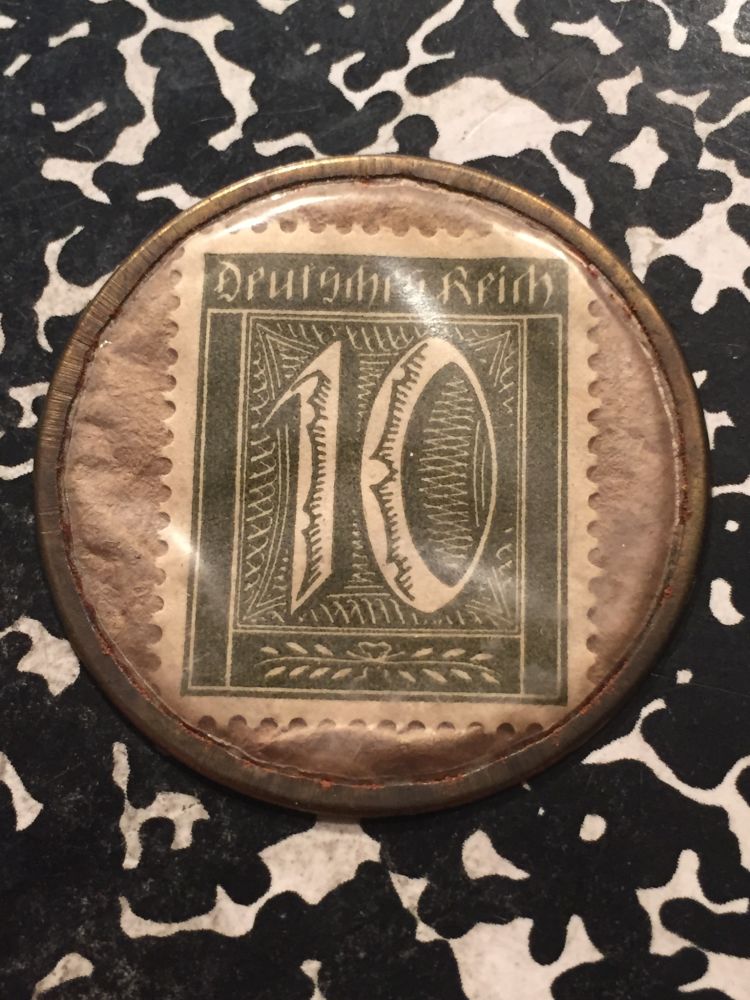 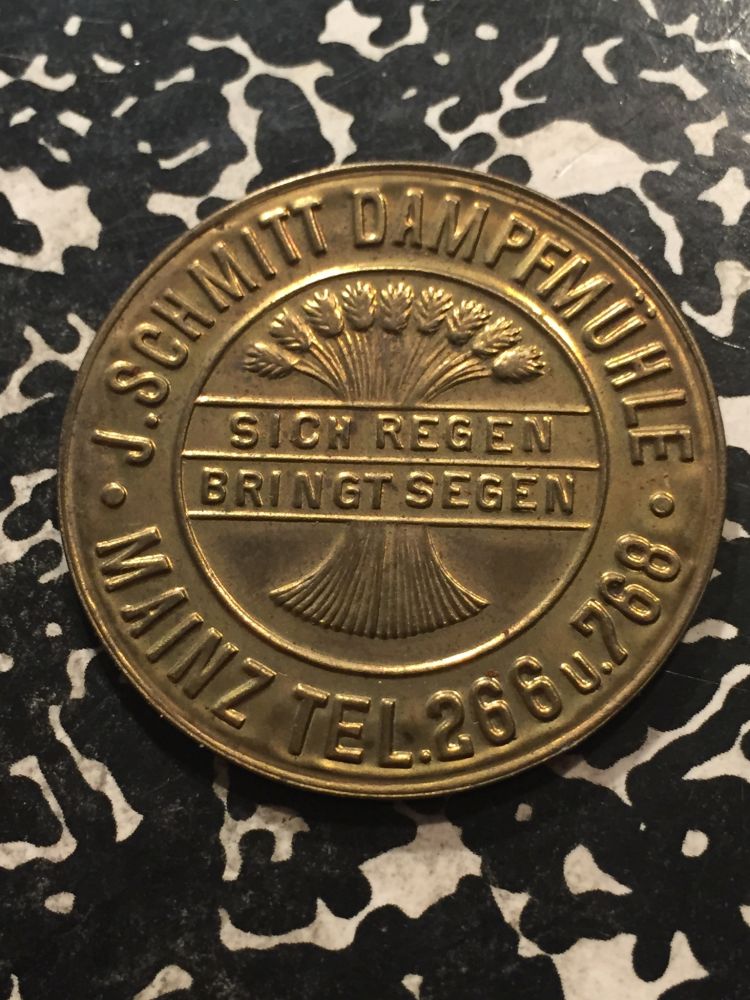 I guess you would consider composition to be brass, postage stamp, celluloid and whatever is in back of the stamp! |
|
Pillar of the Community
United States
6130 Posts |
Finally found one of these for a reasonable price:   Clay sen issued by a private firm for a few weeks or days at the final moments of WWII. |
|
Page 2 of 2
|
Replies: 24 / Views: 5,294 |
Page 2 of 2
|








 First Page

 Posted 12/12/2015 08:37 am


