| Author |
 Replies: 34 / Views: 5,573 Replies: 34 / Views: 5,573 |
Page 3 of 3
|
|
|
|
CCF Advertiser
United States
1533 Posts |
I pay nothing for SEM time, but how to design study? Buy different grades of acetone? Probably we'd see not much even on imaging, but the EDXA will pick up residual carbon on the surfaces.
|
|
Moderator
 United States
196572 Posts |
Quote:
People may be ok with what they can't see, but that doesn't make it harmless. DI water rinse, pat dry and let air out for a few minutes and its clean. So, you are okay with what you cannot see on whatever it is you are using to pat dry?  I still stand behind a final rinse with fresh acetone. |
|
Pillar of the Community
United States
1005 Posts |
I would probably source commercially available acetone from retail establishments accessible to hobbyists, since this is where coins collectors would get their's. And also throw in drug store nail polish remover too; we always say not to use it around here but it's worthwhile to try it too just to see.
I was thinking, the surface roughness of a coin in the SEM would likely be so high that you might have a tough time seeing exactly what is residue and what is topography of the metal surface. Of course you might see charging artifacts coming from the grime that would provide the contrast you want, but a better way to test the rinsing solvents would be on a very smooth surface (I would go with a doped Si wafer for this) and let the drop evaporate on the surface.
I think EDX is a great idea, but on second thought it might not work; to get a nice clean signal you would have to have a longer integration time and the electron beam beating down on the sample would likely vaporize most of the organic residue. You can see this happening on metal surfaces with fingerprint oil in live view as the beam scans, the droplets just shrink and disappear.
Mass spec sounds like a decent idea; I'm not as familiar with the required solvents for it though.
|
|
CCF Advertiser
United States
1533 Posts |
The topography of the coin won't be a problem as its not the imaging I'm after, just the elemental distribution with EDX. If I see spots with carbon, thats organic residue. I can't identify it, but thats where rinsing off and shooting it into a mass spec may give some ID info.
Jbuck, I got more faith in my clean paper towel than in your "fresh" acetone. You realize any sort of drip dry process concentrates impurities by hundreds? Still, you've got a point. Until we do some sort of measurement, its all just conversation.
Edited by Andrew99
05/03/2016 5:18 pm
|
|
Moderator
United States
196572 Posts |
|
|
Pillar of the Community
Canada
3049 Posts |
jbuck you might be right that this has been discussed before... but I don't think I've seen this discussion get so.... well... scientific!
GROG says "carry on... do tests.... come back and let grog know answers!"
|
|
Pillar of the Community
United States
1005 Posts |
I think perhaps the mass spec would be better used to measure the acetone itself instead of worrying about rinsing off a coin's surface. You could concentrate any impurities by allowing an open container of the acetone to evaporate for a little bit, and run it straight through; I think acetone should be usable by itself.
Depending on the source of the acetone/rinsing agent you could also contact them for a COA that should tell you the same thing.
Either way I think the most useful wisdom from the threads jbuck linked is to do a spot test with your acetone before using it; pour some into a spotlessly clean glass container and let it evaporate. If you see any residue, then beware. Will that residue harm your coins if you use it anyways?
|
|
Valued Member
United States
403 Posts |
Many good questions here. Same good questions in previous threads. Same anecdotal answers and opinions. It's frustrating... we need resolution, just a step at a time! This community has skills: tests, measurements, and pics. I'll do what I can.
|
|
Bedrock of the Community
United States
20057 Posts |
I agree with jbuck and bio. NEVER rinse with water after acetone as it will re-hydrate the surfaces. Ultimately, water is the enemy of coins as it leads to corrosion. After soaking in acetone, rinse the coin with clean, fresh acetone and put it into storage. No drying period is needed since acetone evaporates from a metal surface in seconds, leaving a nice dehydrated surface.
Personally, since I'm a chemist, I have access to reagent grade acetone. It's the only type I use. From my research, most consumer grade acetone is actually very good, usually >99% pure. You guys are getting over-the-top with concerns over residuals that may be present. Most of the impurities in a quality acetone are volatile enough to evaporate on their own.
|
|
Bedrock of the Community
United States
20057 Posts |
Quote:
@Andrew99, there's lots of controversy here. I work in an analytical laboratory too and often clean ion sources for mass spectrometers. As you know, even analytical grade acetone can leave a trace residue that causes molecular contamination and makes an ion source useless. The contamination levels are miniscule and invisible to the unaided eye. The numismatic community seems okay with what they can't see, and nobody to my knowledge has reported any long term effects from acetone usage, but there probably hasn't been a valid study either. If the acetone is technical grade or has become tainted (easy because it's such a good solvent and leaches out plasticizers and other compounds from containers) it's that much worse, so I recommended the evaporated-drop-on-a-mirror test since it's better than nothing. Personally I use acetone on selected coins to efficiently get rid of gunk and "people goo" but the final quick rinse is ethanol to get rid of the acetone, and pure ethanol leaves no residue. Many folks shy away from water even when distilled for a variety of reasons. For me I wouldn't use it as a final rinse because it dissolves CO2 from the air and becomes acidic... water exposure on a coin during the rather slow evaporation process can thereby lead to corrosion. I've been using acetone on coins for a long, long time, I have never seen no adverse effects. There is no residue and no ill-effects. It's totally safe on coins. I see no need for an ethanol rinse, it's less volatile than acetone and also susceptible to contamination. It's certainly not going to hurt but it's unnecessary IMO. Lincoln Cent Lover!VERDI-CARE™ INVENTOR https://verdi.care/
|
|
Bedrock of the Community
United States
20057 Posts |
Quote:
The topography of the coin won't be a problem as its not the imaging I'm after, just the elemental distribution with EDX. If I see spots with carbon, thats organic residue. I can't identify it, but thats where rinsing off and shooting it into a mass spec may give some ID info. Using SEM-EDXRF after an acetone rinse to detect "impurities" would be an exercise in futility. I work with an SEM-EDXRF almost daily. Pretty cool, today I'm meeting with Hitachi to go over a quote on this new instrument: http://www.hitachi-hightech.com/eu/...pn=em-su3500I'll be getting a new toy in my lab very soon!  |
|
Pillar of the Community
United States
1314 Posts |
My confessions on coin conservation have traversed the spectrum from enlightning to horrifying. Here is one more... A couple of days ago I stopped by my local coin shop to get my fix of cheap foreign coins for a world type collection. At my desk I can take a closer look. Working in batches of about 20 coins, I give them their first dip in acetone. Many require further attention that ranges from scrape with a putty knife to apply a half drop of Verti-Care. (You owe it to yourself to include a trial size in your next order from Wizard. It goes a lot further than I ever imagined.) With fresh acetone, they get a second dip. The results are shown in the picture. You can see how they might be covered with a film and contaminates from the bath, so I repeat the process until the bathing acetone passes the mirror test. 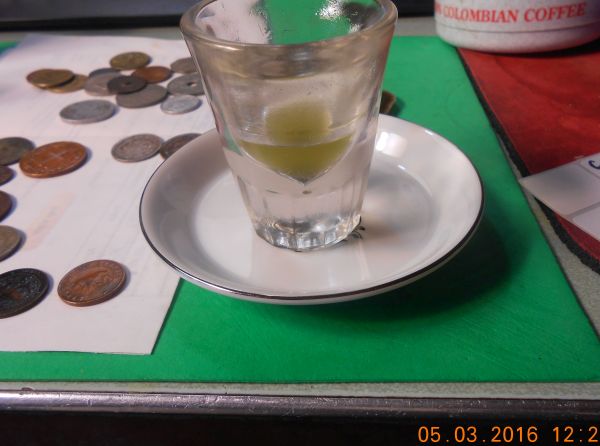 Edited by Chute72
05/04/2016 1:06 pm
|
|
Pillar of the Community
United States
1314 Posts |
One of the coins that I spent a little extra time on. Netherlands East Indies, 1941 1/4 Gulden (0.25 NLG) 1941 Silver (.720) 3.18 g 18.8 mm 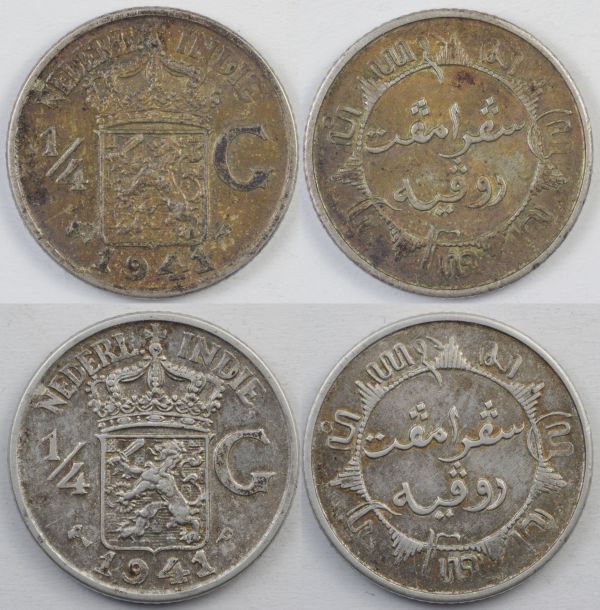 |
|
Valued Member
United States
403 Posts |
This is very interesting. My knee jerk reaction to seeing the top picture was that the coin was toned, and in a good way. Acetone doesn't remove toning, so the yellow/brown color was organic gunk? Did you need to use a brush or other implement?
|
|
Pillar of the Community
United States
1314 Posts |
I used small soft brushes like used for art work or lens cleaning. Too, I used Verdi-Care. The biggest thing was long soaking time. I wouldn't do this stuff to a MS coin, but this was one I plucked from the dealer's foreign bucket and I have no idea how long it had been it had been rattling around in there. Note that this should not be considered a typical result, as I processed about 150 other coins in that same purchase. 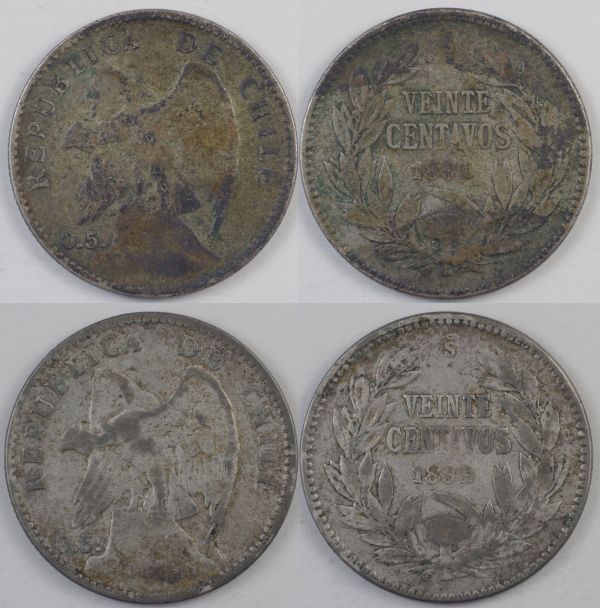 Same batch but worse condition. For this one I used harsher chemicals and rubbed with my fingers. Not recommended for nice coins, but part of my "research" on coins that were lowest on the totem pole. |
|
Page 3 of 3
|
Replies: 34 / Views: 5,573 |
Page 3 of 3
|






 First Page
 Previous Page


 Posted 05/03/2016 10:28 am


