| Author |
 Replies: 36 / Views: 4,673 Replies: 36 / Views: 4,673 |
Page 3 of 3
|
|
|
|
Pillar of the Community
Australia
7096 Posts |
Quote:
My question to you is this - where / how exactly do you see Eduard Kann's cataloging that seem to make it a "toy"? Mr Kann catalogued the Fantasy coins back in the early 1900's But who is to say that the Fantasy coins available Now are indeed from that period and are Not newly produced ? As these Fantasy issues do Not have any Mintage figures or any other official provenance anyone could produce these at any time. |
|
Pillar of the Community
United States
1916 Posts |
Some terms being used to describe present day fantasy designs having well known names, but are not actual authorized legitimate coinage are found in catalogs and online. They may be called Fantasy, Unrecognized, Unofficial, Privately designed and minted, Micro-Nations and so-on. Maybe it's novelty or perhaps making profit on one's skill as a designer by creating and then marketing coins appealing to certain segments of collectors. Some of these names are really oddball and may be minted by companies known for buttons or car wash tokens. I guess they have their following. I just think those described in Kann are rather unique and can be of special interest and even great value. I think there must be a distinction between old silver fantasies of China and those others that are being made today. Maybe I'm wrong. Heck, if comic books can be graded, if grading means anything to anyone, why not coins regardless of the source or what they are? Grading is not my cup of tea anyway.
|
|
Pillar of the Community
Canada
2786 Posts |
IMHO if it's dated 1908 then it have better been made in 1908, otherwise TPGs should have the integrity to deny slabbing the item or at least label it a TOKEN, JETON or IMITATION (while also keeping the "fantasy" designation).
|
|
Pillar of the Community
United States
1916 Posts |
Now you can get into another can of worms of having coins that are called re-strikes. Original dies having an original date but struck many years later. I think grading companies do use the term re-strike- not sure about that. I guess your main point could be full disclosure or honesty in labels or even refusal to grade some of the stuff being cranked out these days. I'm on board with that. I still think we need new words to distinguish between the bad and the good so the buyer knows if it is a fake, fraud, forgery, fantasy, imitation, copy, replica, contemporary counterfeit, whimsical, mint-sports, tributes, commemoratives, unusual coins, non-circulating legal tender and so on. It can be hard to choose words to describe things. Suppose you divided all insects into those that can fly and those that cannot. Now you have a winged and wingless ant. The same ant. Eskimos recognize 100 different kinds of ice. Gauchos have 200 names for colors of horses, but yet they divide all plant life into only 4 types. Coin collecting can be complex or simple. What is of interest, what is not? What is right? What is wrong? A million coin collectors, designers, makers and sellers all may have individual ideas and differing levels of importance to the various aspects in the coin collecting world. For me? I've come full circle. From novice to advanced then educated then to simple after realizing I know nothing.
Edited by Albert
01/15/2017 3:33 pm
|
|
Pillar of the Community
United States
5362 Posts |
Albert, Wade, trout1105, gxseries and anyone else interested.
There is only one item in the case that started this thread (unknown mintage) that can be identified as "Genuine". PCGS has chosen to identify that one precise type. I do not know if they are correct or not but it is a point from which to start. These can and should be encapsulated and graded. As a better example I would compare this to the unauthorized confederate cent - Lovett made dies and 12 original copies were struck in copper-nickel in 1861.
A very closely aligned sub-group of "genuine" are actual "restrikes" made using the original dies. These can be private issues made later in time. The criteria is the use of the same original dies. These also should be encapsulated. Carrying forward the example above, Lovett sold the dies and coins to either Maris or Hazeltine in about 1873 or 1874. They arranged with Kindler of Philadelphia to make re-strikes. There were 6 gold, 15 silver and 55 copper. The original dies broke on the 55th strike. There are NO coper-nickel restrikes. So all of the restrikes of 1873-4 can be encapsulated safely. So far 83 total coins.
A third class would be restrikes created from transfer die impressions of the original dies. The 1961 Bashlow restrikes of the Confederate cent were made from just this type of die. They are identified by the broken and rusted surfaces. Over 10,000 of these "restrikes" were made. These can be identified and encapsulated. So there are about 11,000 confederate cents that can be safely encapsulated and dated.
All other examples of the confederate cent are "not Genuine". These would include strikes from newly engraved dies (which could be called fantasy dies, replicas, copies or other names), cast copies made by transferring the image of any of the 11,000 restrikes. The entire group of all these new issues could simple be called "Numismatic forgeries" since they are made to defraud collectors (or could be used to defraud collectors). These of course can be encapsulated as fakes. That would fix in time a date when they already existed for future reference.
I do agree that numismatics needs a better set of terms than are used today.
If the Confederate Cent had actually circulated - contemporary circulating counterfeits (CCC) would have likely been produced. These can be identified in most cases by technology or metal used in production. While these do not actually exist for the Confederate Cent they do exist for most types of circulating coins.
I have tried to come up with an all inclusive list on many occasions unsuccessfully. Here is my best to date. I refer to the thing as an item which would include coin, medal, token or any other term denoting a coin-like object.
I. Genuine Item - the original items however made.
a. Cast Genuine - This can be subdivided by the way the
molds were made.
1. Engraved molds
2. Punched molds
3. Hubbed molds
b. Struck Genuine - This can be subdivided by the way
the dies were made.
1. Engraved dies
2. Punched dies
3. Hubbed dies
c. Engraved originals - one example made at a time
II. Re-Issued Genuine Items
a. Recasts - Items from original molds
1. Recasts made at later dates
2. Recasts made in other materials
b. Restrikes - Items made from the original dies
1. Restrikes made at later dates
2. Restrikes made in other materials
c. Casts made using original dies as molds
III. Re-issued - Duplicate Items - Officially re-issued
items
a. Casts made using a set of newly created molds.
1. Using original materials and mold type w/ date
2. Using other mold types (named) and materials
(named) w/ date
b. Strikes - Duplicate Items - Officially re-issued
1. Using original materials and die type w/date
2. Using other die types (named) and materials
(named) w/ date
IV. Contemporary Circulated Counterfeit - Unofficial
a. Profit derived from debasement or fiat
1. Identify method of manufacture - varies as above.
2. Identify materials used - varies as above.
b. Profit derived from premium placed on coin
1. Identify method of manufacture - varies as above.
i) Matches genuine method.
ii) Differs from Genuine method.
2. Identify materials used - matches genuine
V. Numismatic Forgeries - Unofficial - Fraudulent
VI. Replicas - Non-fraudulent - easily recognized
VII. Altered Items
A. Genuine Items - Altered for fraud
1. Altered dates - mint marks or designs
2. Coated or plated for fraudulent purposes
3. Polished or repaired to increase value
fraudulently
4. Mined to remove precious metals.
B Replica Items - Altered for fraud
VIII. Other Coin Like items - Not Fraudulent
A. Genuine Items - Altered
1. Engraved coins - love tokens - dog tags
2. Re-used - gears - badges
3. Buttons
4. Decorations - conchos
B. Non-Genuine Items - Altered
|
|
Pillar of the Community
United States
2589 Posts |
Some fantasy issues are created by separatist movements, monarchs and pretenders from deposed monarchies, governments in exile, ect. The purpose behind these is two fold, one is to excercise one aspect of soveriegn power by coining money and thus presenting an image of legitimacy, and second to raise money for their cause. This practice has been going on since the middle ages, there are many French and Spanish issues of deposed royal houses. For example, the Caralists from Spain regularly issued coinage in their right as the "King of Spain", despite the fact that different monarchs actually held the throne. Sometimes these fantasy issues would actually become legal tender in areas where the Caralists managed to take over. As such some of the issues blur the lines between fantasy issues and business strikes.
The Krause Unusual World Coin guide is filled with all sorts of strange and odd things. Some of the stuff in there is near worthless garbage issued to decieve collectors, but other fantasy issues have actual value in their own right as historical artifacts. For example if you want an 1874 Charles VII Spanish Pesetas coin in UNC it will set you back something like $3500. Some of these early Fantasy/Pretender issues are so valuable, that Counterfeits of them exist.
Edited by XavierOfGreen
01/15/2017 7:16 pm
|
|
Rest in Peace
10197 Posts |
Interesting dialog everyone, thanks for exposing this conundrum, boy! Silverai, your link for fantasy coin on ebay is now $512.00 with 25 bids and counting, wish I had that disposable income!  |
|
Pillar of the Community
United States
1916 Posts |
I like these guys.
They are sound logical well spoken members.
I wish they'd help me with publishing my catalog of counterfeit coins.
I agree the dialog has been interesting.
|
|
Valued Member
 Canada
117 Posts |
Crazyb0, I hope those bidders really know what they are bidding.
As you can see from the discussion, "fantasy" is not a standard term. I just want to point out a slabbed fantasy coin can be MISLEADING. A smart seller can send an unknown coin for grading, once the coin is slabbed, the seller can claim the "authenticated" coin is made in 1800.
If other members don't agree that, can they please tell me who made those 2 "fantasy" coins and in which year?
Edited by silverai
01/15/2017 9:09 pm
|
|
Valued Member
Canada
117 Posts |
swamperbob, nobody know when those 2 coins are made, not even the people who "graded" the coins. The seller just put a phony year on the auction page, so that buyers think they are bidding a valuable authenticated antique coin.
|
|
Pillar of the Community
United States
5362 Posts |
silverai Why do you say; Quote:
nobody know when those 2 coins are made, not even the people who "graded" the coins. The seller just put a phony year on the auction page, so that buyers think they are bidding a valuable authenticated antique coin. The 1908 China Kwangtung Silver Dollar Two Dragon Fantasy Coin PCGS K-B19 AU Details coin is listed in at least two places, the easiest to find is in Colin Bruce's "Unusual World Coins" under the Empire of China where the coin is listed as X#M130 (ND) and Edward Kann "Illustrated Catalog of Chinese Coins" where it is listed as B#19 attributed to Kwangtun Province and given the estimated date of 1908. PCGS has chosen to encapsulate an example of a coin as shown in the catalog and authenticate the coin as being genuine. Did you check the number on the slab to determine if the slab was in fact authentic? It is and apparently the Fantasy has sold twice in 2016 once at the Stack's/Bowers April 2016 Hong Kong World Coins auction for $ 1,554 and again on ebay World Coin Sales in May, 2016 for $ 1,483. The C. Bruce price in Unc. is a bit dated in my copy. Here is the coin as pictured on the Verification page at PCGS. You can check this for yourself. 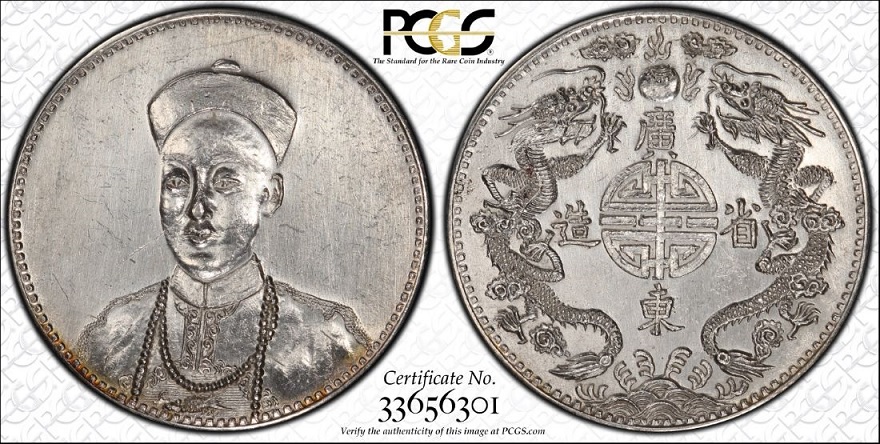
|
|
Valued Member
Canada
117 Posts |
|
|
Pillar of the Community
Australia
7096 Posts |
The reason why TPG's became successful was because they offered a genuine coin and an impartial grade and also weeded out the cleaned or otherwise treated coins. Now with these fantasy coins along with the AT coins and not to mention the practice of market acceptability grading all being put into righteous slabs, It is making the whole idea of using a TPG into a Joke. |
|
Pillar of the Community
United States
5362 Posts |
The items (not really coins) in the Fantasy group apparently come mostly from Kann's own collection. He mentions some (about 1% of the 1700) were supplied by Spink. He indicates that his book was an attempt to compile data from several earlier written sources. He completed his compilation by June of 1953 and his book was published in 1954. The earlier books noted were as follows: (1) Coins in China's History by Coole, 1936 and 1937 editions. (2) Illustrations of Chinese Gold, Silver and Nickel coins, by Tsiang 1939 which used drawn pictures of coins. (3) Modern Coins of China, by Shih published in 1949.
He does not catalog the bronze and copper coins which he said would take a lifetime to understand. Instead he covers silver and gold coinage from 1837 onward. He indicates that modern presses were introduced into China in 1889 and about 2 billion dollar sized coins were issued from 1889 until 1954. He also indicates that 1.1 Billion of these dollar coins were melted and the silver sold to the US before 1954. A total of almost 3 billion ounces of silver was sold by Nationalist China by Kann's estimate.
He does not cover foreign coins used by China as money.
He also covers nickel and aluminum coinage and indicates that issuance of those coins dates from about 1912.
The Fantasies are shown on plates 206 to 223 and consist of 110 items consecutively numbered 1-110. These numbers are all prefixed with the letter B. The locations were provided by Kann. The item referred to as B-19 is found on Plate 209. I know in one of the references I read the date of the set of silver emperor's was being estimated as approximately 1900-1910. The date of 1908 sticks in my mind but I can not find the reference.
The Forgeries are shown on plates 196 to 205 these are not numbered consecutively but all are preceded with F. I have never counted the number in this book but the numbers rise by hundreds apparently by type and there is room for additions in the future. I presume that was intentional.
Medallions are found in Plates 193 to 195. The metal used and the dates are typed into this section.
Souvenir Medals are found on plates 189 to 192.
Coinage issues run from plates 4 to 188.
Mint Sports - 5 in all are found on plate 224. These are not numbered and were believed by the author(s) to have been strikes using genuine muled dies (where obverse and reverse did not belong on the same coin.)
Many of the Kann items including the "fantasy issues" are now considered to be collectable. In fact when he wrote the book Kann said that some collectors were already interested in them which is why he included them. He was more of a purist and felt the coins were the most important. I agree with that. He did dismiss most counterfeit issues as not being collectable but he includes dozens of types. The most critical fact is that all of the coins illustrated in Kann were made BEFORE 1954.
Coins not illustrated by Kann may have been omissions on his part. However in most cases, items he did not illustrate can be thought of as being POST 1954.
This gives us a snapshot in time of the Fantasies, Medals and some of the Counterfeits (forgeries) that existed in 1954. He indicated that made for collector frauds were already being made in 1954 and collectors can only wish that he included pictures of all of these items so that we could see the circulating debased counterfeits as well as the numismatic forgeries that existed in 1954.
So if someone produces a new counterfeit, forgery or fantasy today it is unlikely to match precisely the illustrations of Kann. Since all of the gold and silver coins were removed from circulation forcibly by the Chinese Communists before 1954 (including privately held collections of rarities) at nominal values, many genuine Chinese coins were destroyed. Most of the coins that survived in high grades did so outside China. Only buried hoards (buried and forgotten because the owners died) remain to satisfy collectors.
Edited by swamperbob
01/16/2017 03:47 am
|
|
Pillar of the Community
United States
1916 Posts |
See, I told you guys swamperbob knows his stuff.
I have the Kann books but can't spell it out like s-bob does.
I can only add that Kann books are a great resource but the re-prints lack image quality.
A good book to add would be Lin Ming because images in that book are much better.
I rely on these books heavily in my documenting my collection of Chinese fakes.
Kann does not list it all. Some items just never got included. I've come across a couple errors that should be obvious, so maybe a few details of some of the coins could have mistakes with the weights or measures.
|
|
Page 3 of 3
|
Replies: 36 / Views: 4,673 |
Page 3 of 3
|





 First Page
 Previous Page

 Posted 01/15/2017 12:05 am


