| Author |
 Replies: 33 / Views: 3,189 Replies: 33 / Views: 3,189 |
Page 3 of 3
|
|
|
|
Pillar of the Community
United States
3463 Posts |
I am still curious to know the weight of this coin.  Similar coins that I have examined, have all been under weight, which is not caused by being struck through a die cap. Edited by cwb
03/04/2017 10:53 pm
|
|
New Member
 Canada
39 Posts |
The weight I will tell you soon....no balance yet
|
|
Bedrock of the Community
United States
62064 Posts |
I always felt the lines were caused by the coin being in a test tube or something small enough to make the coin stand upright eating away toward the top or from the bottom leaving them looking like that. The acid dipped coins are lower in weight as the metal is eaten away.A struck through a capped die does not reduce the weight of the coin.
|
|
Pillar of the Community
United States
5964 Posts |
Added metal from a Die Cap would add weight. Acid on one side, (as I stated when offering an explanation why they could go toward the center), would slightly reduce the weight. So, how much does it weigh? |
|
Bedrock of the Community
United States
62064 Posts |
Note the 1961-D cent on these images. Note the lines and also the edge shot with the same date. the weight is greatly reduced. 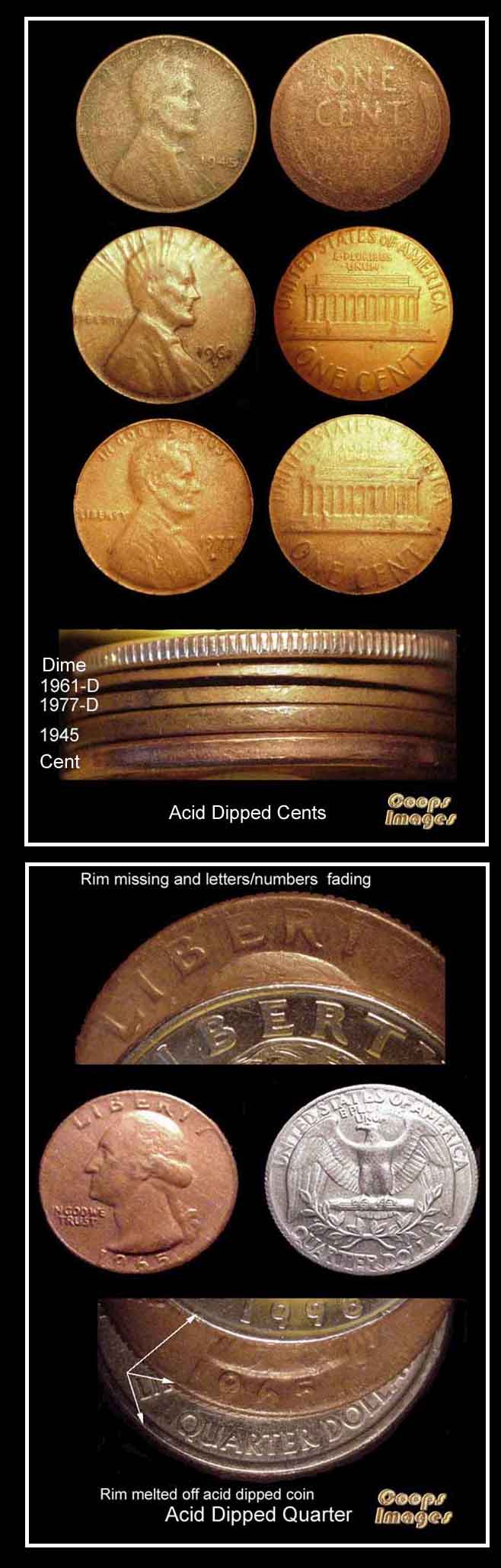 On a struck through a die cap, there is not added metal. The die cap is still on the die. The planchet is normal weight because the strike was prevented a bit. It is not a struck through a die cap.  Die cap: 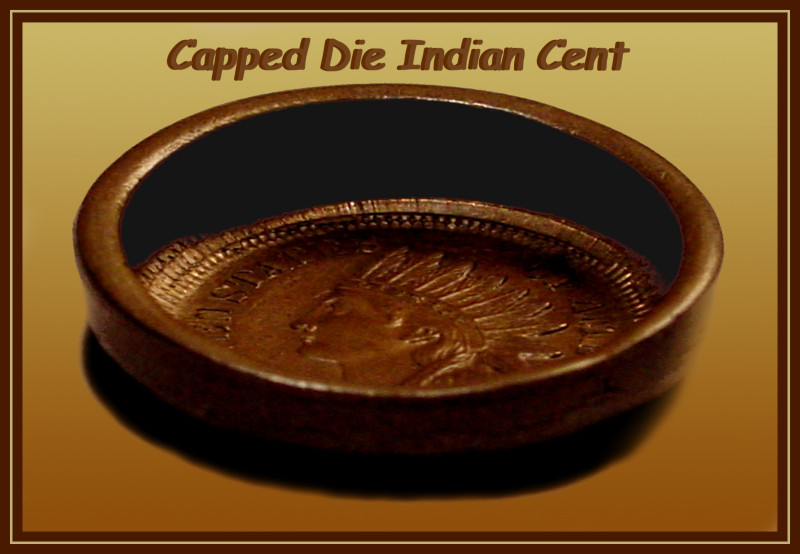 Edited by coop
03/05/2017 8:21 pm
|
|
Pillar of the Community
United States
5964 Posts |
Quote:
From the looks of the coin, it appears that the reverse has been struck through a very thin die cap (very late stage). The lines seen are actual metal left over from the die cap.
Regards,
BJ Neff I'm only replying to what's in this thread Coop. I'll leave that up to you experts. As far as the weight reduction, I believe it would be a little less if not completely submerged as I stated at the top of this page. |
|
Pillar of the Community
Canada
891 Posts |
I'm not an expert by any means, but wouldn't acid also affect the rim. I have seen two coins that are similar that were determined to be struck through a late stage reverse die cap  |
|
Pillar of the Community
United States
3644 Posts |
Yes the acid should affect the rims actually attacks that area first I believe. Waiting for the weight on this one but I also want to add I do not think bj meant that the lines were from added metal but from the deformed/deteriorating die cap or what was left of it when this planchet was struck. My guess is the weight will be normal on this one.
Edited by Slamnbass
03/05/2017 10:45 pm
|
|
Pillar of the Community
United States
5964 Posts |
I very well may know less about the OP's coin than you guys. I have very little experience with capped dies or acid dippeds. I am trying to help though, so Error will know what he has, and trying to help Coop figure out why the lines go toward the center. If you look at the 1961-D cent that Coop posted on the first page, you'll see it's labeled as acid dipped. It has less rim, yet resembles the OP's coin. I'm sure the length of time in the acid equates to the damage it causes. I suspect also, in most instances the rims are affected more because they are in contact with the acid and the container holding the acid, while the rest of the coin is only in contact with the acid. I think the container intensifies the effect of the acid, probably some containers more than others. I also think the effects of the acid starts on the entire coin at the same time. If Coop's 61-D is in fact acid dipped, so is the OP's coin, but probably from a friendlier container. I've seen some capped dies, they show blurry devices, not lines going toward the center of the coin. At the top of this page I offered a theory why they do that. In my opinion, even a thin late stage die cap wouldn't send them to the center, nor would a coin standing on it's edge. Numismatics is full of facts and theories. The experts know more facts which (among other things) helps them with their theories. There is no license required to think however, so even a layman is entitled to a theory - unless facts disprove it. I am going to believe what I believe unless someone disproves it or comes up with something more plausible.  Edited by CoinMasters
03/06/2017 02:32 am
|
|
Pillar of the Community
Canada
891 Posts |
Yes CM I can see what you are saying , but through my eyes, if you look at Coop's coin it has no rim at the top, while the OP'S coin has full rim and if you look at the ridges on the coin , one runs into the center of the O, yet the O is not affected . Also, one runs through the top of the wheat on the left , but does not appear to affect the wheat. My humble opinion anyway. Error, if you don't have a scale , take it to the post office, the weight will help a lot
Edited by oldmike
03/06/2017 10:55 am
|
|
Pillar of the Community
United States
3644 Posts |
Coop I'm curious is that 1961 D lincoln the only acid dipped cent you have a photo of with this effect?
|
|
Pillar of the Community
United States
5964 Posts |
I explained in my last reply why I think the rims are different. As far as the ridges, if they're caused by acid and go to toward the center, it must be because the field near the center (while being upside down in the acid) is higher in proximity to the edge. This has to be true at one part of the edge more than the rest of the edge because there are not ridges all the way around the coin or none at all. Either the edge was uneven or the coin was slightly tilted. The reaction of the acid was impeded by the devices, as evidenced by the lesser disintegration of the coin as shown in the form of the ridges. Of course my theory is a work in progress. Hopefully any kinks will be worked out on this theory and my Woody theory before my upcoming book entitled "Strike it, Witch". lol Seriously though, one thing is reasonably certain. If these ridges are caused by acid, they flow toward the center because it's directly uphill for each ridge.
Edited by CoinMasters
03/06/2017 1:36 pm
|
|
Pillar of the Community
Canada
891 Posts |
I don't think acid is field or devise specific , if it comes in contact with either it will etch it. None of the devices in the word one seem affected at all, so if the coin was upside down in acid , I think at least some part of the devices would come in contact with acid. I am no expert, just my humble opinion
|
|
Pillar of the Community
United States
5964 Posts |
Heck Oldmike, who's to say? We all have our opinions and I think that's good. Without the mint letting us conduct studies, I suppose there will always be some unproven theories. I think that's okay as long as they are recognized as theories and not matter of fact.
Edited by CoinMasters
03/06/2017 8:03 pm
|
|
Pillar of the Community
Canada
891 Posts |
|
|
Page 3 of 3
|
Replies: 33 / Views: 3,189 |
Page 3 of 3
|







 First Page
 Previous Page


 Posted 03/04/2017 11:03 pm





