| Author |
 Replies: 37 / Views: 7,816 Replies: 37 / Views: 7,816 |
Page 3 of 3
|
|
|
|
Pillar of the Community
United States
1962 Posts |
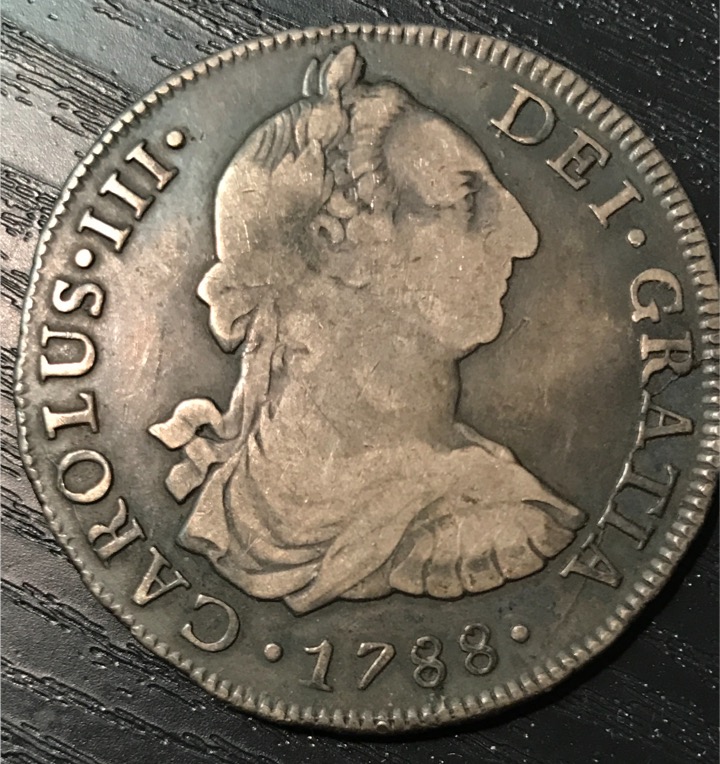
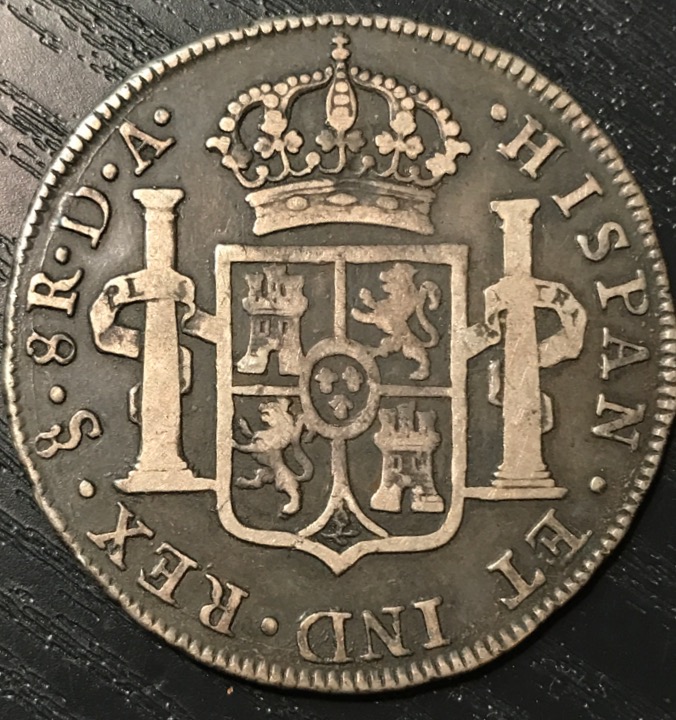
Yeah, I know, right? Should have asked if it was magnetic, too. Now, right off the bat, I understand we must completely ignore the common sense observations that the piece visually "looks" honest to the experienced eye (perhaps excepting the toning)... and was a 25+ year ago purchase, back in a time when well-worn 1788 Chile 8R was not what it is in today's market - let alone as a random "in the wild" local U.S. shop find. So, just looking at the details of the coin (does it jive w/known pieces... or is it even plausible for a Santiago emission): -- Regarding the purported, um, typical neat Santiago legend character alignment (!!)... On the NGC62 piece, this phenomenon is particularly observable in the most obvious part of the legend - the date. Note how perfectly those two "8"s are punched... There is variance on the reverses here as pointed out, but I looking at Santiago output in general, I don't see this being any kind of valid litmus test. -- The NGC62 Bob is showing and this piece clearly have different reverse dies... and **I THINK** diff. obvs as well. So what? Are we to assume that ALL of the 1788 Chile 8R HAD to come from one die pair? Some familiarity with the Santiago Char.III output is required here... Now, I don't know where they got those figures (Carlos J.?), but per what Krause shows, the 1788 was - as is the case for the other denominations - a highwater mintage for the Charles III pieces. Now, there is indeed a dearth of 1788 8R in recent searchable auction archives - esp. compared to the comparable-mintage, per Krause, 1787. However, knowing how relatively plentiful Chile 1788 1R and 2R are in the market compared to the other 1780s dates (4R as well, though all in lesser quantities)... those Krause mintage figures seem grounded in reality. So, perhaps the lack of 1788 on the market in recent auctions may be due to a meltdown event, or perhaps it's just a fluke... IDK, but I think it's certainly conceivable that enough could have originally been struck to justify several die pairings. ***SEE BELOW!! -- Now, if how different the style of punch placement on these two specimens seems to be concerns you... yes, somewhat curious, but it was a lower-output mint and things weren't always beautifully standardized. Look through some of the 1787 pieces out there, esp. the reverses... similar variance in how close to the rim the legend writing is. Overall, I see more than enough confirmation in terms of typical die/strike characteristics observed on Santiago 8s of this period - combined with the surfaces present - for my own personal satisfaction. I don't feel the need to go into such specifics on a public forum... some thorough study/comparison of the Charles III/trans. C-IIII w/C-III portrait 8R that are out there should be informative if you're that serious about Santiago 8R. As a vague example of what to look at... the most overt design element of the coin is absolutely normal style for 1780s-90 Santiago 8R. Beyond that, not that I personally needed to have this confirmation, but see below for what serves as fairly good validation of this coin's reverse: 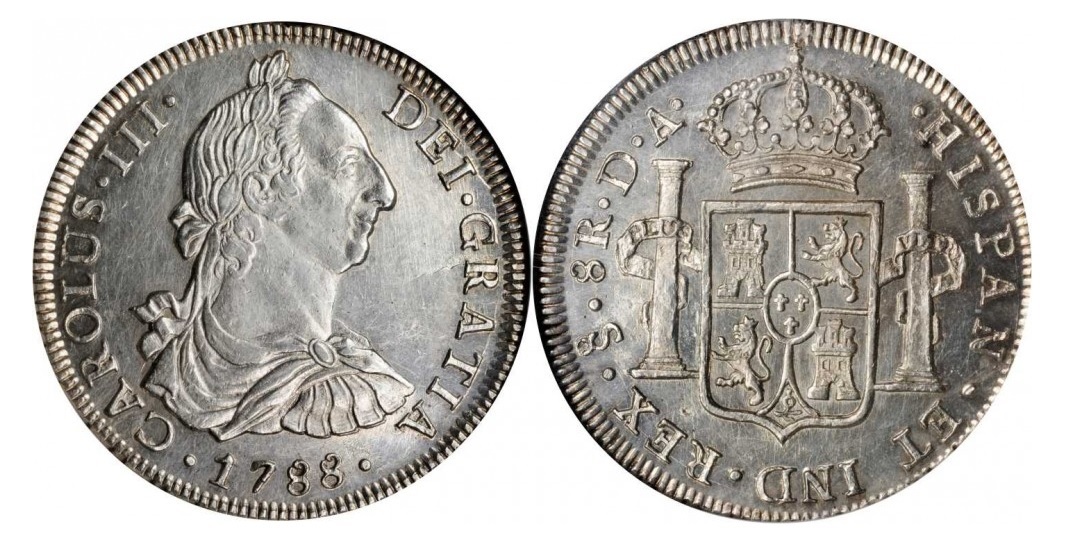 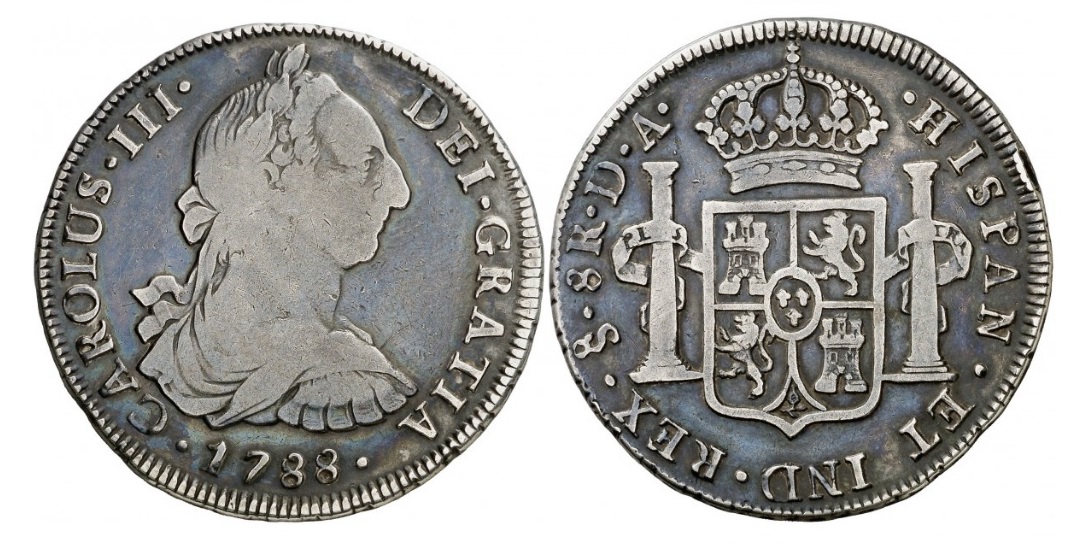 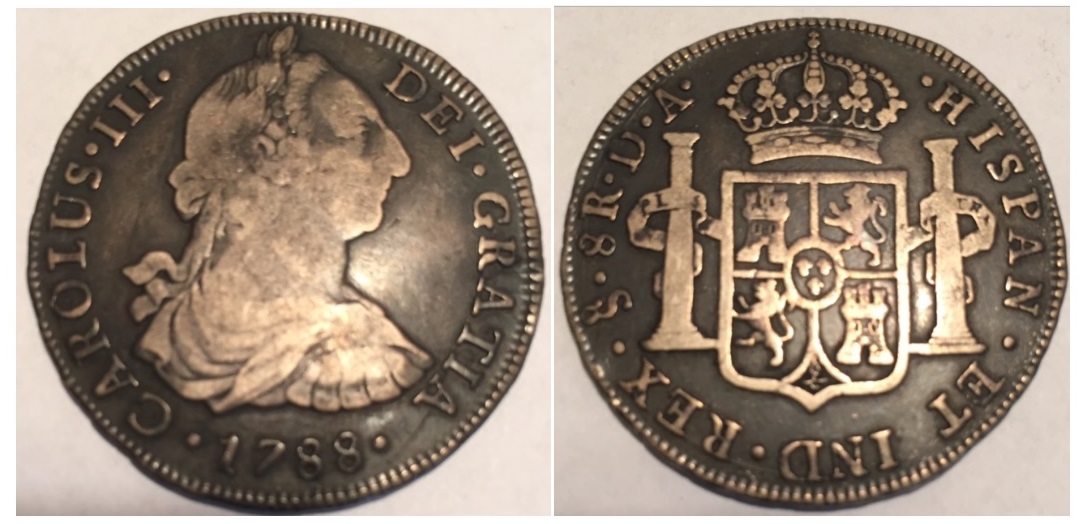 |
|
Pillar of the Community
United States
5362 Posts |
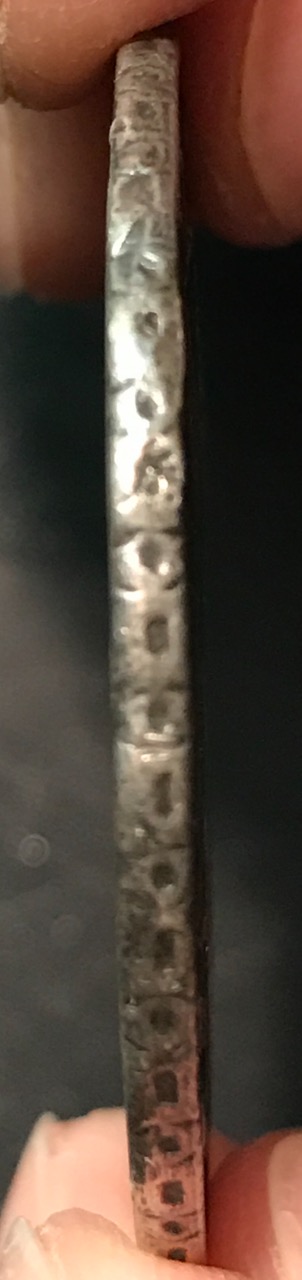
The variance in the details of the small punches that were used to create the reverse working die could very well be a valid litmus test. I am not postulating only ONE die pair for the mintage. I was trying to point out that the Matrix block set of punches should represent only ONE punch style for a given year. Matrix blocks were hardened steel blocks with each of the details of the 8R engraved into the block. These blocks were prepared in Spain not the colonies. The block was used to standardize the coins made in each mint. There were minor variations from mint to mint because the blocks were NOT identical at the outset. The punches used to make working dies were made by driving softened steel rods into ONE detail on the matrix block. This created a punch that could be hardened and then used to add that one detail to a working die. That way the same Castles, the same Lion, the same pomegranate, the same crown, etc. etc. would appear on each of the working dies. Knowing what each of these small punches contained is critical to authentication of an 8R by using the details present in a photograph alone. Now,what I really meant to convey was that because there are variations in the matrix punches used to create the working dies for the worn 1788 (thous coin) and the Heritage 1788, that I am suspicious that one of the coins is not genuine. I asked for all of the physical parameter checks we normally gather before making any statement as to authenticity. realeswatcher You are actually postulating that in 1788 there were two sets of punches made from different matrix blocks employed at Santiago. While that may in fact be the case, it must be supported by clear evidence of authenticity for both styles. Having two matrix blocks is not at all normal at any Spanish Colonial mint. Variations of the matrix block type are often seen in the smallest branch or provisional mints because those mints often had NO matrix blocks for standardization. They made needed punches without a standard pattern. The Fleur-de-Lis design in the central oval was made by a single punch which was created directly from a three fleur pattern engraved on the matrix block. The 8R type with the open top D assayer initial (the worn 1788 belonging to thous) uses a different sized Fleur and a different arrangement of the three fleurs. It becomes obvious when viewed side by side. In addition the 1788 posted by realswatcher also with an open top D uses the same fleur pattern. 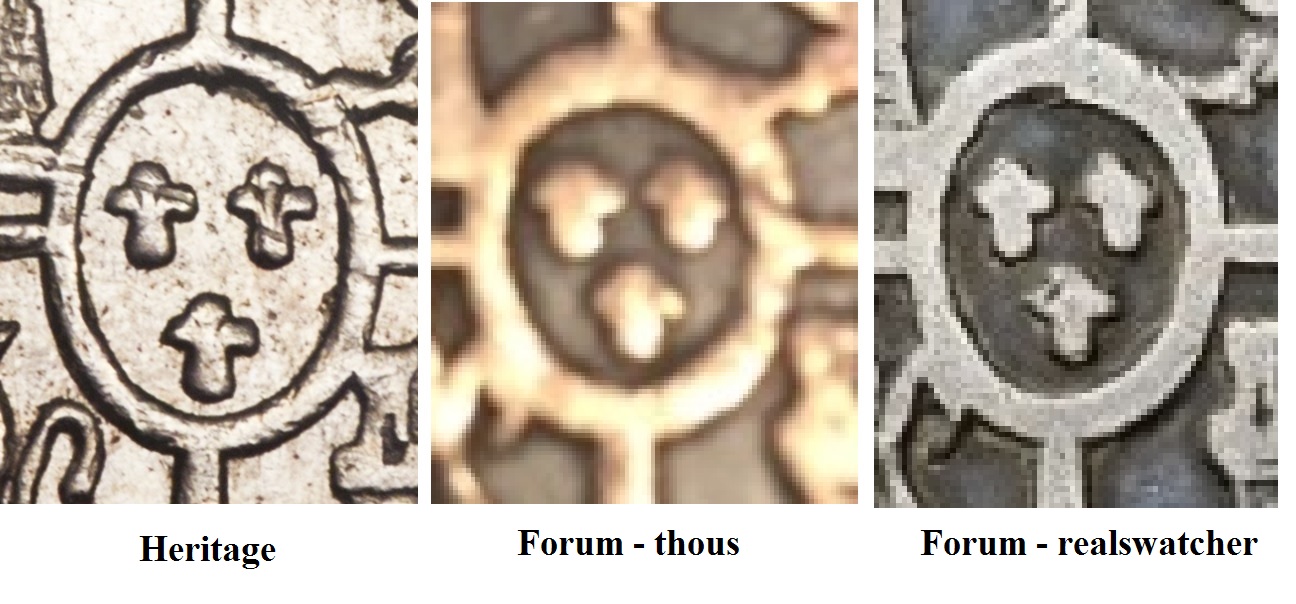 In addition to the fleurs the outline of the shield and the central oval are different. The shield outline is heavier on the open top D and the central Oval is clearly a different shape and height. Yet I would point out that each of these features is actually an element on the matrix block and that punches used to make dies must match the matrix block. I would also suggest looking very closely at the castles on the open D coin and the others seen in Calbetto and on Heritage. There are two styles so until we get a complete picture of the physical parameters I remain suspicious. I asked earlier about the edge design to see if it looked reasonable. Sometimes the edge design shows when a photo is taken of the faces of the coin. The thous coin is too blurred to learn much about the edge. However, there are clues on the realeswatcher example. The circle rectangle design can often be seen as marks on the edge that follow a pattern representing the circle - rectangle spacing. 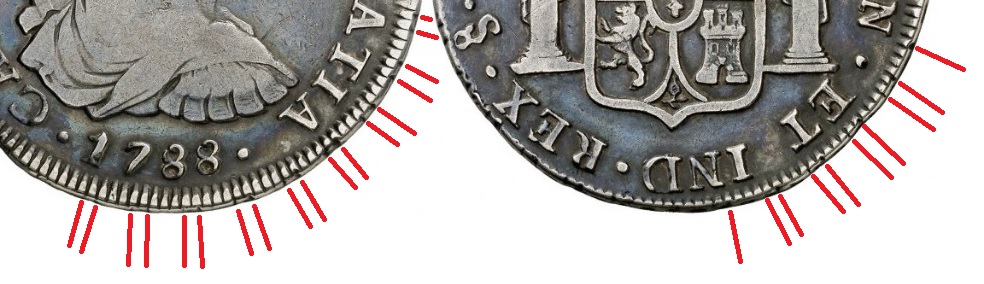 This spacing makes me wonder if the design is standard or not. When enlarged it appears that the spacings of the segments are not identical. So I think we still need to see the edge of one of the open top D coins. |
|
Pillar of the Community
United States
5362 Posts |
thous The edge of these coins was applied to the blanks BEFORE the coin was struck.
The design used was a circle and rectangle pattern. These features were cut (punched) into a grooved straight piece of die steel. The groove was roughly the width of an 8R. Each die was made using punches that contained 3 elements two rectangles and a circle in between them. Spacing of the edge pattern was maintained by placing the punches with ONE rectangle overlapping. That way the pattern stays straight and the circles remain round. All of the sides of the elements were matching thicknesses.
Two of the flat dies were used. One was fixed to a table surface and the second was mounted on a mechanism that moved parallel to the fixed bar. The bars gripped the blank tight enough to add the design to opposite sides of the blank at the same time. The movable bar was rolled along (cranked under great pressure) parallel to the fixed die and the coin blank rolled along adding details to the opposite sides. After 1/2 revolution the edge is complete and the pressure has upset the rim creating a planchet. The coin is rolled just over 1/2 the circumference and the dies lost their grip allowing the completed blank to drop into a basket below. There are always two areas of overlap that occur exactly opposite one another. These overlaps are the identical length. That is what you need to look for.
Counterfeit edges often have circles that are flat sided because the rectangle slightly overlapped the circle punch. A genuine coin will not show flat edge circles. Also any change in the alignment has to occur NOT at a circle but at a rectangle.
|
|
Pillar of the Community
United States
1962 Posts |
Bob, quickly... to keep things really, really simple here for a minute:
The Aureo piece I posted above (the middle photo in my post) pairs the obverse die of the NGC62 piece with the reverse of thous's piece.
|
|
Pillar of the Community
United States
5362 Posts |
The question remains - is the mule of the two styles genuine? It may be. It could also be a mule made by a forger. We still need the same facts to decide.
|
|
New Member
 United States
10 Posts |
Hello everyone and thank you for all the effort you're putting into this for me!
My name is Tim by the way.
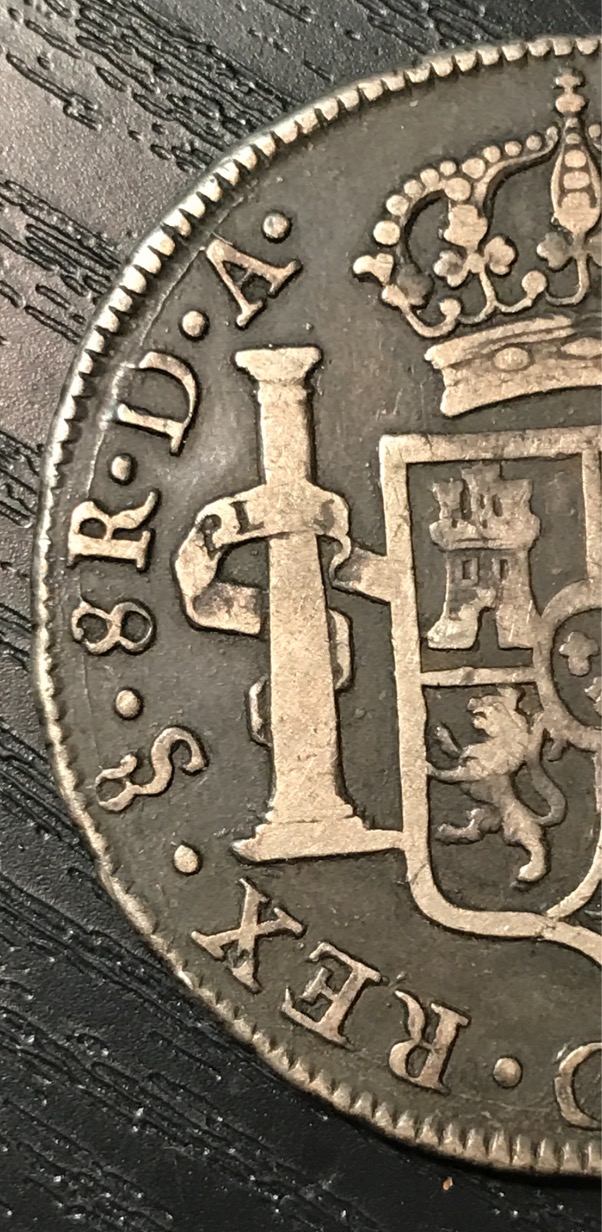
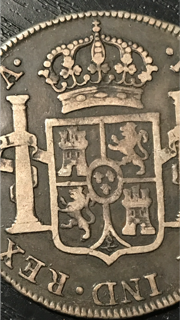
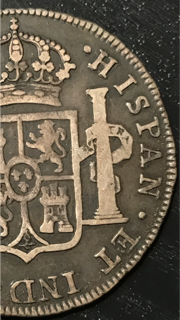
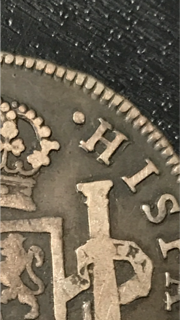
I was able to take better pictures of the coin but I'm having trouble uploading them for some reason. The reverse pictures are really nice. One of the pictures shows the repunched H in HISPAN and one shows the die crack running along the top of the R and D. That seems to clearly show that the reverse die on mine is the same as the one Realeswatcher calls the "Aureo" piece.
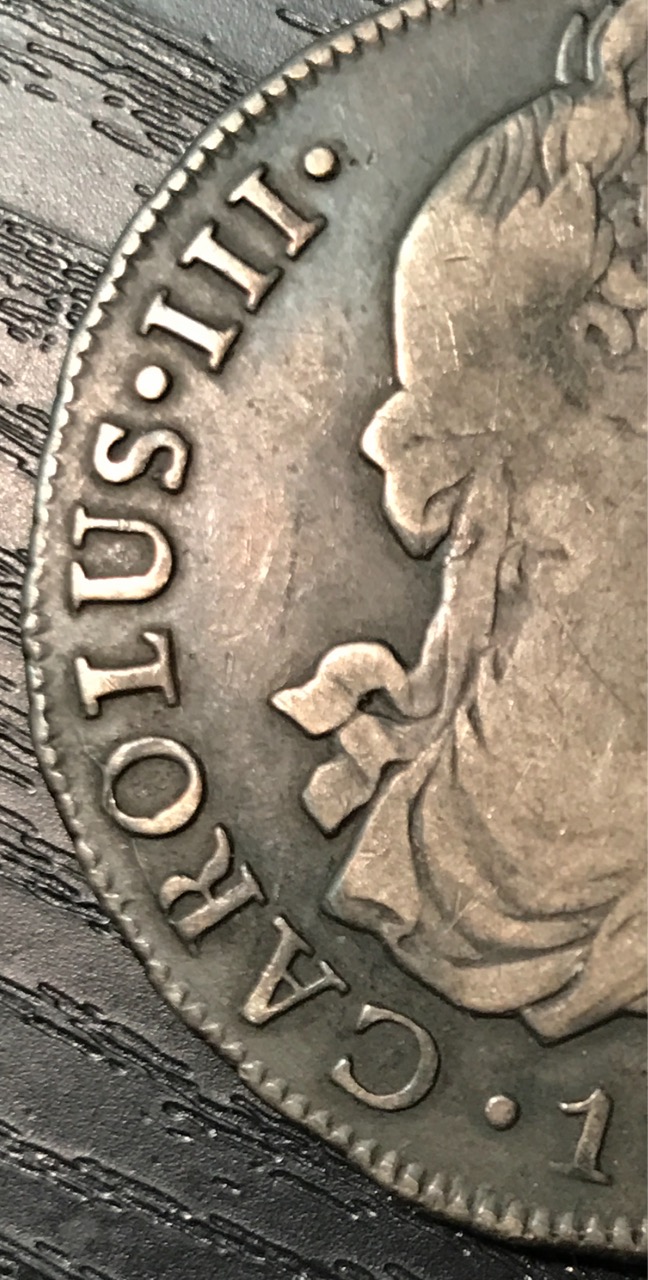
I'm actually a little skeptical that my obverse die is the same as Swamperbob's picture from NGC. That coin has what appears to be a die crack running along the top of GRATIA, while mine has a die crack running along the bottom of GRATIA. I also think that the date just seems to be laid out a little bit differently.
Swamperbob, I really appreciate your explanation of the rim design. I have some decent pictures to show you. I can make out the rectangle-circle pattern, but there is some deformation/wear/damage around the rim so it's just not real clear (to me anyway). I stacked the coin between two Mexico City 8 Reales coins that I GUESS are real, and the rim does not look nearly as nice as it does on those two coins. I'll try to show a picture of that comparison as well.
I'm putting these observations down now so that I don't forget anything when I finally get the pictures figured out.
I hope this weekend to stop into the coin dealer in town and ask if he will weigh it for me. This is NOT the guy that I bought it from.
|
|
Pillar of the Community
United States
4883 Posts |
Quote:
I hope this weekend to stop into the coin dealer in town and ask if he will weigh it for me. I'd highly recommend that you purchase a digital scale that weighs out to the hundredth of a gram. These are readily available on ebay as cheap as in in the $10 range. I know Bob will disagree with me on this, but my experience is that despite their having become so inexpensive, it's gotten to where they can still be impressively accurate. Colligo ergo sum
Edited by Lucky Cuss
03/03/2017 2:14 pm
|
|
Pillar of the Community
United States
5362 Posts |
The best available scale for the dollar spent is, in my opinion, the all mechanical Ohaus Cent-O-Gram 311g capacity 4 beam balance with the free arm support which is good for both weight and Specific Gravity. This scale is good for S.G to the 0.1 level. To get better results than that you need a cased analytical balance accurate to 0.001g - nothing less will do. The Ohaus is the typical College level laboratory scale. This model is a 4 beam balance and reads directly to 0.01 gram and can estimate to three decimal places. It is critical that with any scale that you confirm zero and repeatability every time you weigh anything. This scale is adjustable to make that easy. All scales come with an inherent "accuracy level" that must be understood properly. Most digital scales are accurate to only about 2% of the total weight being measured. If you are buying raw silver a 2% accuracy might work fine. The difference works out to +/- HALF a gram for a typical dollar coin and that represents roughly +/- 25 cents at present silver prices. So if you are comfortable with a price that could be 25 cents high or low - you have an acceptable scale. However, if you need better accuracy or wish to do Specific Gravity tests you need to do much better. The Ohaus scale is typically accurate to something better than 0.01g for a dollar sized coin. That in turn is better than a 0.02% accuracy or about a quarter of one cent for a dollar coin. Much better than 25 cents. This accuracy level gives a Specific Gravity reading with a precision (scientific notation) of 0.1. So a result of 10.3 for SG means "somewhere between 10.25 and 10.35". This in turn translates to a fineness between 870 and 920. This accuracy is good for detecting about 99% of counterfeits and forgeries you will encounter. I also suggest using different scales for different tasks. DO NOT USE ONE SCALE FOR ALL PURPOSES. Typically a scale works most accurately near the center of the weight range it was made for. So large capacity scales used to weigh bulk coins will actually be less accurate when attempting to weigh a single coin or a batch of coins near the upper limit of the scale's capacity. A good rule of thumb is to NEVER use a scale intended for Specific Gravity to weigh anything more than a single coin. So what does this scale cost? There is a new version of a Walter scale which I have never used but seems to match the Ohaus. https://www.amazon.com/dp/B00LOVPVWG?psc=1 A band new Ohaus scale of this type costs $ 215. See Amazon Prime: https://www.amazon.com/Ohaus-Cent-O...JZNCR2MNM342On ebay there are many examples. Nearly new: http://www.ebay.com/itm/Ohaus-Cent-...282179417708 Used but serviceable examples are much cheaper. For example: http://www.ebay.com/itm/Ohaus-Cent-...162416087108 The difference between a new and used scale would be the ability to accurately estimate the third place decimal (and repeat the test 3-5 times without any drift). Even used this scale is fine for what you need to do to get a 0.1 level specific gravity determination for a dollar sized coin. For that reason it is accurate enough to detect 99% of counterfeit types. They key element found on the Ohaus scale is the free arm support pan which you need for SG. Personally, I do not like the Dial-a-Gram type of the same model scale because the spring can stretch rendering the scale un-usable after only a few hundred uses. Make sure you get the stainless steel pan that comes with the scale to avoid having to make an added weight to compensate for the loss of this pan. I also suggest that you avoid older scales because of the knife edge - the balance pivot which can corrode or wear with long term use. So I would also pass on any scale with visible corrosion. This type scale is better and will last longer while retaining accuracy better than any of the inexpensive digital scales. Digital electronic scales are fine for determining weight. So Lucky Cuss I agree with you that one of the cheaper digital scales is fine for the task at hand. I have several scales like this and usually travel with one. I use them to weigh every coin when I first see it. However, I also expect to replace these scales every few months because they eventually drift. The problem with digital scales is that after a period of time - the weights displayed start to drift. The same weight for one coin can not be repeated time after time. I have tried using better grade electronic scales that sell for up to $ 50. These are good for an average of about 2-3 years. They work fine for weight determinations but will suddenly fail with no warning. They can not be repaired. Last week, I was weighing a lot of dollar sized coins that came in the mail and as I always do, I confirmed the weights by doing the group of 10 coins twice. After the second run through, I noticed that the weights for the same coins varied. I changed batteries and the results of the 10 coin double run were different once again. Then I tried weighing same coin 10 times in rapid succession and the weight varied by as much as 0.2g in both directions. This is typical of the sudden failure of electronic scales. This particular scale lasted over three years, so it was a success from a cost perspective. |
|
Pillar of the Community
United States
4883 Posts |
Bob, I'll concede that you shouldn't expect long term durability out of a $10 digital scale, and I've also experienced the sudden onset of innaccuaracy (or complete failure) you describe. But during its useful lifetime of such (and some styles seem much better in this regard than others) I've had excellent results in checking them periodically with standard weights as verification of their continuing utility. I'd further remark that although most have a calibration mode, that's a superfluous feature if they're simply becoming erratic.
What interests me is that all the coin shops I frequent (and these are really reputable places) have on the counter digital scales that are hardly better than what we're discussing, and they get years of constant use from them, through multiple validations by the state authorities. No shop I patronize seems to employ an Ohaus, unless it's in the back room.
Colligo ergo sum
Edited by Lucky Cuss
03/04/2017 09:03 am
|
|
Pillar of the Community
United States
5362 Posts |
The simple reason for coin shops not using Ohaus scales is that no coin shop I know of actually checks Specific Gravity of anything. As I said above, electronic scales are fine for gross weight of coins and metals just not for accurate SG tests.
Scientific authenticators on the other hand do perform SG tests use far more precise scales. Typical of these are Ohaus types or cased analytical balances.
I believe every coin collector should know how to perform SG tests as a form of self protection.
|
|
Pillar of the Community
United States
4883 Posts |
Quote:
I believe every coin collector should know how to perform SG tests as a form of self protection. You're "preaching to the choir" on that point with me. Not to belabor the point, but I'd add that maybe every dealer ought to have the capability for the protection of their clients. But obviously that's not going to happen across the counter, where dealers have to make snap buying decisions regarding material that walks in. Colligo ergo sum
|
|
New Member
United States
10 Posts |
|
|
Pillar of the Community
United States
5362 Posts |
The pictures are much better and the coin looks a lot more believable now.
I do note the presence of numerous small raised dots in the fields of the reverse die. These could be rust damage top the die. I see none that point to another method of formation.
The area at the top of the assayer initial D - is very odd looking and I am unable at present to come up with a satisfactory theory about how a die crack could produce what I see here. It appears to be some sort of repair to the die after a small part of the die chipped away. Have you examined the area using a binocular microscope? It appears to be a feature that is raised above the level of the field on the coin. In that case, it would be a depression in the actual die. The thing I can not resolve is the way it appears to be rounded. It looks like a tiny weld used to repair the die - but welding like that was not possible in the first half of the 19th century. Just makes me wonder.
I have studied far more Mexican edges than those from Chile.
This edge detail makes me rather concerned. The circles are in many cases not actually circles. They look like they are squared on the outside with a circle drilled into them. That edge on a coin from Mexico, Bolivia or Peru would move it into a "counterfeit" category.
Were you able to locate two overlaps? Are they of equal length and opposite one another?
|
|
New Member
United States
10 Posts |
Hi Swamperbob. Thank you!
I have to say that spot at the top of the D never stood out like that until I enlarged that picture. I'll have to try to focus on it close up and see what's going on there. It does seem to conform to the shape of the D, and the missing part of the D on my coin seems to be larger than the missing part of the D on the coin with the same reverse die that Realeswatcher showed us. Is it possible that a section of the D filled in with bits of metal that were squeezed into the die crack? It also seems that the top of the R on Realeswatcher's coin is missing, but on mine it is complete. Of course, that would be exactly the opposite of what's happening to the D!
The edge design as you can see is a little bit messy. Scrolling down, my second and fourth edge pictures are opposite sides. There does appear to be a gnarled-up area of rectangles and circles on those two sides, but that's the best that I can see.
|
|
Pillar of the Community
United States
5362 Posts |
Interesting overlap - I was able to align your pictures at the same scale so that the edge overlap can be seen. It appears to be the same length and the overlap priority is correct as well. This points to the use of a two die edger (casting machine or edge mill). However, the shape of the circles remains a problem in my opinion. I would suggest that other collectors with the same date coins need to post similar pictures to see if the genuine edge was created from a matrix block or not. 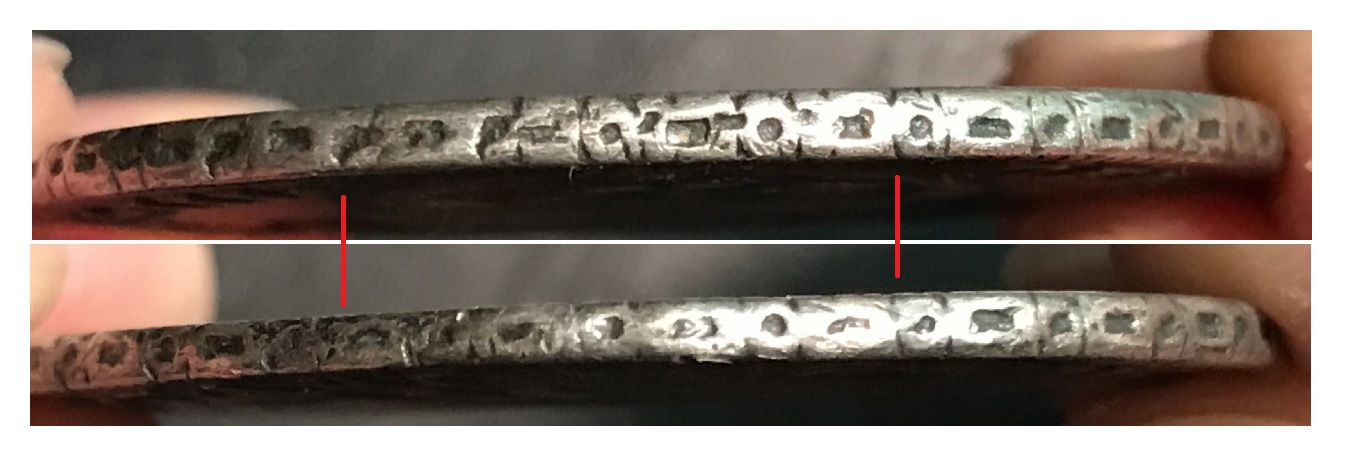 Edited by swamperbob
03/09/2017 11:21 pm
|
|
Page 3 of 3
|
Replies: 37 / Views: 7,816 |
Page 3 of 3
|





 First Page
 Previous Page

 Posted 03/01/2017 9:04 pm