| Author |
 Replies: 26 / Views: 3,159 Replies: 26 / Views: 3,159 |
Page 2 of 2
|
|
|
|
Valued Member
 United States
212 Posts |
When I looked up DDD, for the life of me I cannot see how you can reliably tell the difference between it and a valuable error. And I looked at LOTS of photo examples, along with several author's descriptions on what key differences to look for. There was so much overlap in diagnostics, and so much differently-interpretable language used for the descriptions, I don't see how even the highest experts don't have fierce debates over some coins. I'm not talking about very clearcut ones like the Duke Ellington 'ELL' one. --That's very easy to see and it's also not one of a kind. But every error coin with a population of 'multiple' must have a first one discovered by somebody, so what happens when the cause of doubling is 'if-y'? I'm not trying to argue about my 'nothing' quarter; if everybody says it's from a deteriorated die I obvioiusly have no leg to stand on. But can anyone tell me what details the see in my coin prove it's a DDD, and how it would look different if it had whatever more magical error that would make it valuable? By the way, why IS whatever other kind of doubling treasured while DDD is not? Seems like a very silly distinction, and in fact many of the 'legit' doubling photos I saw were barely-detectible compared to DDD ones (some of those looked pretty WOW to me). At least wrong-planchet coins make for kind of a cool story, as do coins that are rare because of some historical perspective, but "this malfunction" versus "that malfunction" occurring in a machine seems utterly arbitrary. Edited by Kawliga
10/15/2018 10:47 pm
|
|
Pillar of the Community
United States
8715 Posts |
You can see the flow lines stretching to the rims, along with the characteristic stretching of the devices to the rim. DDD. |
|
Valued Member
United States
212 Posts |
I forgot to ask, what could have caused that slash through the U in QUARTER? Also both A's in QUARTER and DOLLAR have a weird arc doubling inside the enclosed triangle. What causes that?
|
|
Valued Member
United States
212 Posts |
And thank you very much for the sincere apology John. You dont' see that very often on the internet.
|
|
Pillar of the Community
United States
8715 Posts |
|
|
Valued Member
United States
212 Posts |
Like I said, I'm NOT disputing Die Deterioration. I'm asking specifically how it could cause this particular result. Like why arcs instead of straight lines? |
|
Moderator
 United States
56855 Posts |
|
|
Pillar of the Community
United States
2752 Posts |
As John1 said, this is Die Deterioration, for the most part. On ATB Quarters, the incuse peripheral letters often show smearing, which can make them look closer to the rim. The smearing is often simply a side effect of the coin expanding during the strike, but it sometimes reflects slight die instability. In any case, it's nothing significant. Error coin writer and researcher.
|
|
Valued Member
United States
212 Posts |
Quote:I don't know if you read this link yet,it tells about all types of doubling http://koinpro.tripod.com/Articles/Doubling.htmI am going to ask one of our top pros to comment,Mike Diamond. John1 *** Edited by Staff to add Quote tags. [quote][/quote] Please use them in the future. ***Bah, that's the main site I was looking at the other day when I said I can't see consistent differences between valuable and worthless doubling (in fact I can't see any doubling at all on a couple of the supposed valuable ones). So does anyone want to take a crack at my question about WHY some doubling errors are valuable and others are worlthless? Like why is one kind of accident 'cooler' than another? Edited by Kawliga
10/18/2018 12:55 am
|
|
Moderator
United States
54298 Posts |
Quote:
WHY some doubling errors are valuable and others are worlthless? Like why is one kind of accident 'cooler' than another? When the die is cut twice by a hub - rare and valuable When the die is used improperly, worn excessively and over used - common and not valuable Hub doubling is what you call an accident (bad die made by mistake), Die Deterioration is not an accident (good dies that are improperly used ). Both, however, are something that could be caught so that none ever leave the mint. How do you tell the difference in a simple rule that you are apparently looking for? You can't. It takes experience and that takes time examining coins and understanding the minting process. The information you seek is out there but there isn't going to be a one sentence synopsis that allows you to determine what you have. 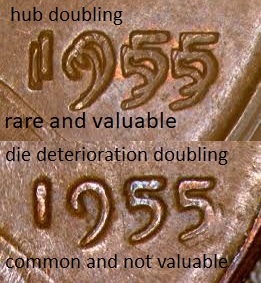 Note: the 1955 "poor man's doubled die" (lower image) is actually Die Deterioration and not hub doubling. |
|
Valued Member
United States
212 Posts |
Now that top ^ 1955 one looks great and there's no way anyone could miss it. But that website also includes ones that look no more impressive or clear than that bottom 1955 (the DDD one). Like this: 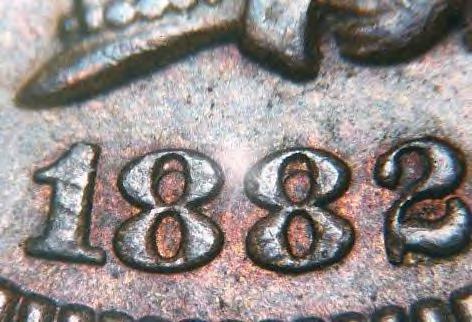 And this one is hilarious, the author says this 'P' is "a nice example of a quadruple punched mint mark." LOL! WHAT? I could stare all day at it, even with it this hugely magnified and I just barely see how it's doubled, never mind quadrupled, and I can't see how you could know this is repeat-punched, not deteriorated die. I feel like either the biggest idiot or the kid who could see the Emperor wore no clothes. 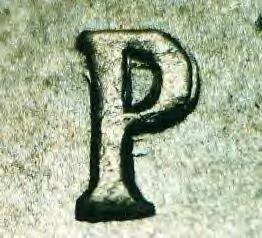 |
|
Moderator
United States
54298 Posts |
Mint marks and dates are a completely different ball game (before they started putting them on the hub). A long time ago dates, and until more recently mint marks were added by hand.
I told you this is not a simple subject.
|
|
Valued Member
United States
212 Posts |
Wow, you're not kidding. I've been wondering how one device/character could double but the one right next to it not. This stuff's crazy.
|
|
Bedrock of the Community
United States
62064 Posts |
A variety doubling on the devices and the mint marks, happen before the dies are put into use. Things that happen to dies in use, I refer to as die events. The difference? Die varieties are on all the coin struck with those dies. Die events happen during the aging of the die. It is actually a breaking down of a normal die. Stuff happens and alters the dies. They fix them up as best as they can. Thus I call them die events.
|
|
Valued Member
United States
212 Posts |
|
|
Page 2 of 2
|
Replies: 26 / Views: 3,159 |
Page 2 of 2
|






 First Page


 Posted 10/15/2018 10:53 pm





