First Page


 Posted 03/23/2019 9:01 pm


If someone like Albert wants a quick method of proving a coin like this is a counterfeit - the only easy way is Specific Gravity. That will take more than 5 seconds perhaps more than 10 minutes, but that was the method most mints, banks and large merchants identified counterfeit coins in 1835. That is how the US, UK and French mints checked authenticity of both silver and gold coins. In 1835 the UK officials in China taught the Schroffs (Chinese money authenticators) how to do specific gravity tests so that locally made counterfeits were not presented to UK merchants for payment of Opium sales.
To get to a point where you can look at a coin and know instantly - you will need to memorize what genuine 8Rs looked like by year and mint. I am confident that I can do that. Developing this expertise became far easier in 1999 when Mike Dunnigan published Resplandores. To catch up to where I am - you need to not only own that book but use it and test yourself OVER and OVER again. You need to look at that book until the pages shake loose and the covers have to be reattached with duct tape.
When I posted earlier I picked the Type 2 (eagle of 1843 type) very intentionally. It was a test.
Jfransch actually picked up on my point without saying so, perhaps without realizing what he was doing. The style of 1843 is an UNFAIR comparison to make with the 1842 Zs OM counterfeit and I wanted to see if anyone knew the difference between the common 1842 and the rare 1842 type. Why? Because there were remarkable changes in the eagle and cactus designs in 1842. By saying that the
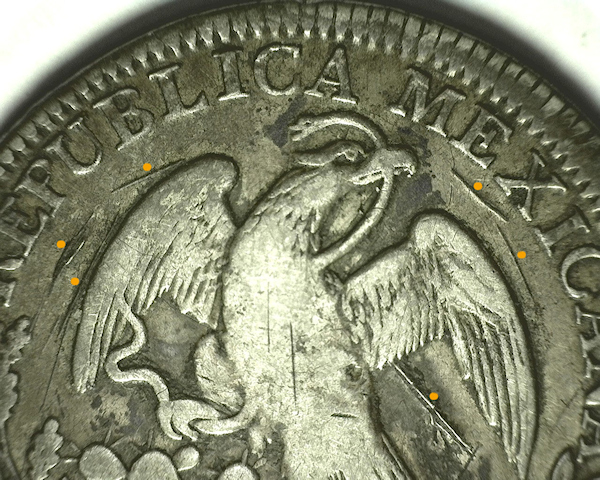
The counterfeiter who cut the eagle die in the subject coin used the TYPE 1 as his model and not the TYPE 2. When you compare the TYPE 1 (eagle of 1841) with the counterfeit the differences are fewer.
Here is the reverse die used on the rare 1842 Zs OM Type of 1841.
Here is the reverse die used on the very common 1842 Zs OM Type of 1843.
This is the "missing Pad variety of the 1842-1843 a sub-variety not listed in Resplandores. It is very common.
Here is the reverse die used on the type of 1843 with the pad.
These are facts you need to know to do what I do when I identify coins in this series.
The Cap and Ray coins of the First Republic (ending 1862) is my favorite coin series and has been since 1960 when I bought my very first Cap and Ray 8R. Back in those days I started taking 35 mm pictures of the C&R eagles in an attempt to do what Mike Dunnigan accomplished in 1999. When I began to fight with dealers who believed there were THREE genuine eagle varieties in 1842 at Zacatecas I was 14 years old. I knew that the Riddell # 237 existed and the "Chicken Eagle" (my name for this skinny bird) was counterfeit, but these older long term dealers were just as positive that I was wrong.
Today there is no excuse not to own Mike's book if you want to collect Cap and Ray 8Rs.
This is not an add for Mike's book although it could be. It is simply a fact that any serious collector needs to know what the genuine coins looked like.
So start by learning the series one mint at a time. You need to be at a point where you need only to look at the eagle to identify the mint.
I began with the Zacatecas mint for two reasons - my childish reason was that I liked the mint mark Zs, but I had a second more adult reason. I knew that Zacatecas was the most often counterfeited mint of all the 14 Mexican mints according to Riddell and my primary interest was in finding counterfeits. I first had access to Riddell's book in 1960 a dealer friend owned a copy but did not own a copy of my own until I could afford one of the reprints that were issued in 1969.
More to follow after those interested have had a chance to compare the 1841 versus 1843 styles and to see clearly that the attempt by the counterfeiter used a type of 1841 eagle.
To get to a point where you can look at a coin and know instantly - you will need to memorize what genuine 8Rs looked like by year and mint. I am confident that I can do that. Developing this expertise became far easier in 1999 when Mike Dunnigan published Resplandores. To catch up to where I am - you need to not only own that book but use it and test yourself OVER and OVER again. You need to look at that book until the pages shake loose and the covers have to be reattached with duct tape.
When I posted earlier I picked the Type 2 (eagle of 1843 type) very intentionally. It was a test.
Jfransch actually picked up on my point without saying so, perhaps without realizing what he was doing. The style of 1843 is an UNFAIR comparison to make with the 1842 Zs OM counterfeit and I wanted to see if anyone knew the difference between the common 1842 and the rare 1842 type. Why? Because there were remarkable changes in the eagle and cactus designs in 1842. By saying that the
Quote:
Cactus on the eagle side look all wrong to me.
Cactus on the eagle side look all wrong to me.
The counterfeiter who cut the eagle die in the subject coin used the TYPE 1 as his model and not the TYPE 2. When you compare the TYPE 1 (eagle of 1841) with the counterfeit the differences are fewer.
Here is the reverse die used on the rare 1842 Zs OM Type of 1841.
Here is the reverse die used on the very common 1842 Zs OM Type of 1843.
This is the "missing Pad variety of the 1842-1843 a sub-variety not listed in Resplandores. It is very common.
Here is the reverse die used on the type of 1843 with the pad.
These are facts you need to know to do what I do when I identify coins in this series.
The Cap and Ray coins of the First Republic (ending 1862) is my favorite coin series and has been since 1960 when I bought my very first Cap and Ray 8R. Back in those days I started taking 35 mm pictures of the C&R eagles in an attempt to do what Mike Dunnigan accomplished in 1999. When I began to fight with dealers who believed there were THREE genuine eagle varieties in 1842 at Zacatecas I was 14 years old. I knew that the Riddell # 237 existed and the "Chicken Eagle" (my name for this skinny bird) was counterfeit, but these older long term dealers were just as positive that I was wrong.
Today there is no excuse not to own Mike's book if you want to collect Cap and Ray 8Rs.
This is not an add for Mike's book although it could be. It is simply a fact that any serious collector needs to know what the genuine coins looked like.
So start by learning the series one mint at a time. You need to be at a point where you need only to look at the eagle to identify the mint.
I began with the Zacatecas mint for two reasons - my childish reason was that I liked the mint mark Zs, but I had a second more adult reason. I knew that Zacatecas was the most often counterfeited mint of all the 14 Mexican mints according to Riddell and my primary interest was in finding counterfeits. I first had access to Riddell's book in 1960 a dealer friend owned a copy but did not own a copy of my own until I could afford one of the reprints that were issued in 1969.
More to follow after those interested have had a chance to compare the 1841 versus 1843 styles and to see clearly that the attempt by the counterfeiter used a type of 1841 eagle.