| Author |
 Replies: 21 / Views: 2,063 Replies: 21 / Views: 2,063 |
Page 2 of 2
|
|
|
|
Rest in Peace
United States
1943 Posts |
Indian, isn't the rim formed here because the area where the field ends and the rim starts is the edge of the die? When you see a misaligned die it has a wide rim on one side and a thin or no rim on the other side. So the rim is actually caused by the pressure of the strike. This is an interesting coin and I don't know what happened either but post mint damage is my guess because of my rim assumption here. Correct me if I'm wrong.
|
|
Pillar of the Community
United States
3640 Posts |
Hi
I would also have to agree in my opinion that this coin most likely
has post mint damage. The collar holds the planchet in position
during the strike. Some coins are struck with no collar. Normal striking will push the metal out and around some. I think I understand what you are getting at though and why. Anything may be possible but I would like to hear what others who know more would say.
|
|
Pillar of the Community
United States
3640 Posts |
I looked closer at those pics. and have changed my opinion.
I beleive those marks (not sure what caused them yet) was
done at the press. They seem too clean and with no other damage
evident in the near surrounding areas. I think if you do not look at
them as possible lettering, you can see maybe tool markings or ?
Maybe this is a test ? :) O.K. who did the garage job ?
|
|
Pillar of the Community
United States
3640 Posts |
I looked closer at those pics. and have changed my opinion.
I beleive those marks (not sure what caused them yet) was
done at the press. They seem too clean and with no other damage
evident in the near surrounding areas. I think if you do not look at
them as possible lettering, you can see maybe tool markings or ?
Maybe this is a test ? :) O.K. who did the garage job ?
|
|
Rest in Peace
United States
1943 Posts |
I understand what you mean about the surrounding design. I struggled too with how this is post mint damage but it didn't damage the "A". I don't have an answer to that. But if one thing sticks out to me as post mint damage then I base the evaluation on that. The part I explained at the rim is the best explanation I can come up with. I'll have to stick with that until Mike or one of the other experts looks at this and changes my mind. It's funny how they can do that with a couple of key strokes! Also, as I said in my first post, this all changes if the marks are raised and not indented. But they appear to be indented. Nice coin LilBlue. Don't give up on it until you hear from an expert. Thanks for posting it.
|
|
New Member
 United States
43 Posts |
Thanks for commenting on this coin. The markings are indented. Here's another pic without me blocking the background light and you can see the indent. 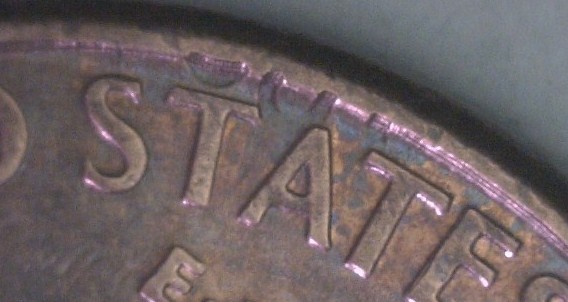 |
|
Pillar of the Community
United States
7629 Posts |
Although I still have no idea what caused the indentations on this coin, I can clear a couple of things up.
The rim of a planchet is caused by the upset mill before the planchet goes into the coining chamber on the press. The rim is further assisted by the bevels at the edges of the die, which helps form them. Coins that are struck off center flatten that rim when the coin is struck...so...
The rim is actually formed on a planchet before the strike, but can be flattened by the strike.
|
|
Rest in Peace
United States
1943 Posts |
Thanks for clearing that up Chuck. Then that means I am wrong with my guess that this could only be post mint damage at the rim. I really do appreciate you pointing out the details that I miss. When I answer posts I give details so that when I am wrong I know why and I learn from my reply. Learning when I am wrong is more important to me then being right. All the experts on this site make it a great learning tool and you are certainly one of the experts. Thanks.
So now this has been posted for several days and LilBlue still doesn't have an answer. Can anyone contact Mike or have any ideas what LilBlue can do next. Of course one option is to send the coin to one of the major grading services.
|
|
Pillar of the Community
United States
2540 Posts |
very interesting, and also very unusual.
|
|
Pillar of the Community
United States
5700 Posts |
Just to clear up some statements coppercoins states to help me better understand,
" The rim is further assisted by the bevels at the edges of the die, which helps form them "
1st the rim is partially formed before the die strike, and then at the die strike the rim is assisted(or made more defined and finished which would make the rim larger)?
|
|
New Member
United States
43 Posts |
Hi all,
Pyrbob, thanks for speaking for me (about still not having an answer).
If you all feel I should send it off somewhere for evaluation, so you all get an answer let me know and where. I wouldn't even know where to start.
|
|
Pillar of the Community
United States
526 Posts |
I took a look at this yesterday and my feeling was that it is a stuck through a foreign object. Since the letters (the T and A) were seemingly untouched, this gave me my first indication of what it was. If the letters had some damage, then I would have said post mint. As for the damage to the rim. Chuck is right, the rim is made before the strike, however, it is further formed by the collar which prevents the excess metal from the planchet escaping and making it into a broad strike.
If the foreign object was near the collar when the planchet was struck, I imagine that the impact area would be grooved vertically (movement of the excess metal) as shown above the first T. The second T also appears to have a grooved area on the inside rim which also may be from this anomaly.
It also appears that the die is beveled downward in that area, but that could be from the light's angle.
I just answered a similar question over in CONECA's forum and both Mike Diamond and myself agreed that a strike through is hard to evaluate from a picture. One big clue that Mike did give is that when observing the area that the strike through occurred, there should be no metal higher than the surrounding field where the indent has occurred. This would be pushed metal and indicate post mint damage.
BJ Neff
|
|
Pillar of the Community
United States
1571 Posts |
I may be very far a-field, but the marking is post mint, and may be a counter-sign of some sort. It is the "V", dit-dit-dit-dah!
Dick
|
|
Bedrock of the Community
United States
10284 Posts |
It almost looks like the date in size. Could you coin be a 2001? I can see (imagine) some of 2001.
I was thinking maybe somehow it got stuck by another coin that flipped into the process of it being stuck just at the edge where the date portion of another might have got caught where the date is located.
A raised date on one coin pressed into another would maybe leave an impression rather than a raised mark. Oh well, just thinking. (See my Disclaimer)
|
|
Pillar of the Community
United States
2752 Posts |
These letter traces appear to represent post-strike damage. If these were clash marks, they would be confined to the field. If they were a brockage then they would be surrounded by a depressed area. If they were dropped letters then they would be confined to the field, or at least be strongest in the field, and would probably be surrounded by some evidence of a larger piece of hardened crud.
Most likely they're a light impression from another coin.
Error coin writer and researcher.
|
|
Page 2 of 2
|
Replies: 21 / Views: 2,063 |
Page 2 of 2
|








 First Page


 Posted 10/27/2008 12:51 am


