Coin Community Family of Web Sites Join Thousands of Coin, Bullion, & Money Collectors
Specializing in Modern Numismatics Royal Estate Auctions - $1 Coin AuctionsCoin, Banknote and Medal Collectors's Online Mall Join Thousands of Coin, Bullion, & Money Collectors Royal Canadian Mint products, Canadian, Polish, American, and world coins and banknotes. 300,000 items to help build your collection! Vancouvers #1 Coin and Paper Money Dealer


Username:
Password:
Save Password
Forgot your Password?


This page may contain links that result in small commissions to keep this free site up and running.

Welcome Guest! Registering and/or logging in will remove the anchor (bottom) ads. It's Free!

Grading Company Claims/Expertise Questioned - The "No FG" Study

To participate in the forum you must log in or register.
First Page  Showing last 15 replies.
Author Previous TopicReplies: 17 / Views: 3,972Next Topic Page 2 of 2
Valued Member
United States
284 Posts
 Posted 12/22/2020  9:24 pm  Show Profile   Bookmark this reply Add Kcm to your friends list
This "contest of best judgment" between leviathans fascinates me. I followed Earle42's signature to this article a few days ago. I assume -with a bit of confidence -- that the leviathans' audience is not the expert numismatist, but rather the inexperienced coin collector (ICC herein). Given the article, as written, I ask:

@GrapeCollects: Do I understand you to advise that the outflow of the ICC's grocery money to TPG's is an acceptable risk?

@Earle 42: Do I understand you to advise that the outflow of the ICC's grocery money to TPG's is an unacceptable risk ?

Neither of you is under any obligation to accommodate my question. Yours may be a bilateral meeting of leviathans. ICC's must, at times defer.

Kevin
Edited by Kcm
12/22/2020 9:25 pm
Pillar of the Community
Learn More...
United States
8939 Posts
 Posted 12/22/2020  11:33 pm  Show Profile   Bookmark this reply Add GrapeCollects to your friends list
TF is an ICC?

The only ICC I know about is the inter-country connector.
Edited by GrapeCollects
12/22/2020 11:54 pm
Bedrock of the Community
United States
10982 Posts
 Posted 12/23/2020  07:58 am  Show Profile   Check BH1964's eBay Listings Bookmark this reply Add BH1964 to your friends list
The linked article in the OP's signature line states many falsehoods. From the article: (mistakes were made) "...by 3-4 expert Kennedy half dollar grading specialists" is ridiculous.

Computer grading could be used for technical grading only. The market has spoken and the market (read money) wants market grading. Something a computer can't accomplish at this time.
ANA #R3154474
Edited by BH1964
12/23/2020 08:03 am
Pillar of the Community
United States
4406 Posts
 Posted 12/23/2020  3:30 pm  Show Profile   Check Tanman2001's eBay Listings Bookmark this reply Add Tanman2001 to your friends list
I agree with a lot of the above replies.

This argument for computerized grading disguised as a breakdown of misattributed Kennedy half varieties completely falls apart when your key point (and only point) can be refuted by the fact that the graders do not attribute the coins.

Your explicit argument seems to be that PCGS's graders aren't qualified because they so often misattribute these No-FG halves (correct me if I'm wrong). But as pointed out earlier, the graders do not attribute the varieties. An attributer attributes varieties. One guy/gal. If a mistake is made there is no one to correct it. Understandably, PCGS does not guarantee attributions because of that. They should definitely be more transparent about this, but that's not your argument.

And with that copy-pasted article you put at the end, I can see that your implicit argument is that graders cannot be relied upon to be 100% consistent and may give the same coin a different grade when resubmitted, so a computerized system, or 'scientific system' as you say, may potentially be a more desirable method to grade coins in the future due to the value given to the grades themselves.

Grading is and has always been subjective. 10 people can give the same coin a different grade and none of them will be wrong. People have different preferences in luster, toning, circulation, etc. There is fundamentally no such thing as an 100% accurate grade. TPGs are the closest thing we have to any kind of 'accurate' grading system, because it can provide a reputable standard. Yes, there will be times it will give a questionable grade but you paid for their opinion and you got it. Should this opinion be given as much value as it has? Maybe not, but that's just how it is.

Should a 100% accurate, computerized 'scientific' system be given this value? Of course, a theoretically perfect system would be perfect because it's theoretically perfect. But how will a computerized system be developed? How would it calculate grades? What are the potential drawbacks? How will the hobby transition to this? How may it impact the hobby? And even though a system like this would be 100% consistent, wouldn't the grade still be subjective based on the preferences of the people who created it? Wouldn't grades still be debated?

If a computerized, photographic, scientific, whatever-you-want-to-call-it system is what you believe would solve all of the issues with TPGs and if this was what you were trying to get at with this "educational/research paper", you should think or write about questions like the ones in the last paragraph. You shouldn't waste your time writing a 20-page non-argument with only one fundamentally flawed piece of evidence disguised as an unrelated analysis. That last sentence is a little harsh but let's be honest, that argument you worked so hard on can be entirely dismissed because you neglected to differentiate graders and attributers.

Don't hide your arguments and find more than one example to back them up.

Don't get me wrong, this breakdown of how off PCGS is with these varieties is extremely useful. It is incredibly important to understand how PCGS deals with varieties. But surrounding that with all this unrelated nonsense about the graders not being qualified and computer grading being a concept that exists really bogs it down. It didn't need your opinions, it should have been purely factual.

P.S. A red pill/blue pill meme? Seriously? I can't put into words how ridiculous that is.


@Kcm

Your reply is very difficult to understand, I don't think you will get the response you want without rephrasing.

Here's how I interpret Kcm's reply (correct me if I'm wrong Kevin): Kcm sees Earle42 and GrapeCollects as people whose opinions in this community are the final say. He does this by referring to them as 'leviathans,' a word used to describe autocratic monarchs and rulers with absolute power. Kcm is amused by this disagreement because of that belief. He believes Earle42's essay to be directed towards inexperienced coin collectors (who he refers to as ICCS). As an inexperienced coin collector themselves, they ask both Earle42 and GrapeCollects do they see spending money on TPGing to be a waste of time and money or is it worth the risk? He then laments that he will probably will not get a response from either of them as he believes those he refers to as 'leviathans' ignore inexperienced collectors and prefer talking to other 'leviathans'. He fails to realize that the reason he won't get an answer to his question is because their abstruse language makes it difficult for people to appropriately respond to the question which would then reinforce his belief of 'leviathan versus ICC'.

I also, at times, have issues with a few people here whose opinions are taken immediately as the final say instead of waiting for a public consensus. Neither Grape nor Earle are not one of these people. They are both knowledgeable and experienced, and understandably their opinions may be valued slightly more than someone with just 100 posts, but I have not seen any example of people taking their word above others'.

And I know you didn't ask me the question, but I'll give you my answer regardless: it depends. It depends on the coin and what company you use. I feel like that would be any reasonable person's answer. Yes, grades may be overvalued and arguably overrated at times, but you can benefit from that if you can spot an under-graded coin or if one of your coins is over-graded. And let's not forget they also authenticate coins. That's a valuable service people so quickly forget they do. Also slabbing is good for protection and displaying, so there's that too.


This thread really brought up just about every topic in this hobby that I dislike.

Maybe I should keep this one in my drafts...
Bedrock of the Community
United States
17884 Posts
 Posted 12/23/2020  11:00 pm  Show Profile   Bookmark this reply Add Conder101 to your friends list
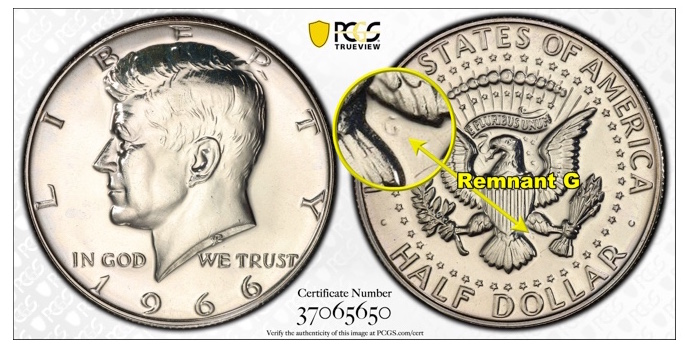
The missing FG is not a variety, it is a die stage. And since it is the result of overpolishing it is possible that more than one rev die ended up missing the initials. It also means that it is possible to exist with more than one obv/rev marriage so a die marker on the obv being present or not is not conclusive. And in the image shown indicating "remnants of the FG" I am not convinced they are.
Pillar of the Community
Learn More...
Canada
5404 Posts
 Posted 12/23/2020  11:17 pm  Show Profile   Check Pacificoin's eBay Listings Bookmark this reply Add Pacificoin to your friends list
Collecting die polishing errors can be fun , but I
Certainly would not throw a lot of money at it .
Bedrock of the Community
United States
10047 Posts
 Posted 12/24/2020  12:26 am  Show Profile   Bookmark this reply Add Earle42 to your friends list
Grape Collects is correct. The computer grading and NO FG examples/write-up are separated. I should have maybe put a definite split between the two. I was a bit rushed.

@BH964

Quote:
The linked article in the OP's signature line states many falsehoods. From the article: (mistakes were made) "...by 3-4 expert Kennedy half dollar grading specialists" is ridiculous.


Did you take the link to verify the PCGS claims? The wording used in the paper is derived from the wording of the PCGS quotation at:
https://www.PCGS.com/PCGS-grading-process-video

The words at that link are shown below:
"GRADING
The coins are now ready for grading. Each order is distributed to graders based on their particular skill and expertise. While the graders are generally trained to handle coins from virtually all eras, they are assigned coins based on their strengths. The sheer number of graders assigned to each coin can also vary depending on the type of coin submitted. In all cases, at minimum, 3-4 graders are assigned to every coin for grading and verification."

Note colors added for emphasis.

Each order is assigned to (at least 3 graders) "based on their strengths and expertise." This seems to imply that for the best grading, a (let's say) Washington quarter will be asigned to a grader with an "expertise" in these quarters.

Their wording is not just, "coins are assigned to three trained graders." PCGS's statement specifically references individual grader expertise, graders'strengths, and type of coin.

The terms "grading and verification" at the end of their paragraph seems indicative there is not only grading by at least three people, but a verification is also done by at least three people.

So it is unreasonable to expect a professional grader with an "expertise" and/or "strength" in Kennedy half dollars to not know basics about the coin they have an "expertise" in?

Variety attribution on slabs not to be trusted?
Now I may have missed it, and would appreciate correction, but I missed where PCGS claims their variety attribution is not to be trusted if on the label. The many coins shown in the paper were all labeled as No FG. So people trust/buy them as such. Yet these many examples contradict the PCGS "no trace showing" rule.

Please let me know where I missed PCGS says they will not not stand behind their variety attributions.


The plain, and verifiable data shown by the coins pictured is that PCGS has made many, what I learned as a rookie with Red Book level expereince when starting to collect Kennedy halves.

Whether a submitter has to indicate they want the variety on the label before submitting, or whether the grading companies have someone other than graders make the attribution would seem a bit irrelevant concerning the amount of money spent on these incorrect slabs (thousands in some cases) by people trusting the grading companies to give the expert service the companies claim to provide.

The facts show, using the grading company pictures themselves, that the grading company has broken its own cited rule of what they allegedly check before they put the "No FG" variety attribution on the label.

Don;t people expect more from the top level of experts in the hobby? Would you like to be one of the ones who spent a couple grand on a coin showing the initials but labeled as not showing them?


How much squash could a Sasquatch squash if a Sasquatch would squash squash?
Download and read: Grading the graders
Costly TPG ineptitude and No FG Kennedy halves
https://ln5.sync.com/dl/7ca91bdd0/w...i3b-rbj9fir2
Bedrock of the Community
United States
10047 Posts
 Posted 12/24/2020  12:40 am  Show Profile   Bookmark this reply Add Earle42 to your friends list
@concord

Quote:
The missing FG is not a variety, it is a die stage.

Correct for 1966 and 1972-D.


Quote:
And since it is the result of overpolishing it is possible that more than one rev die ended up missing the initials. It also means that it is possible to exist with more than one obv/rev marriage so a die marker on the obv being present or not is not conclusive.

There is an actual 1982-P REV die with no engraved FG that also (as the paper shows) has a different number 1 on the OBV. As far as I have read, seen, researched, looked at slabbed ones on NGC, PCGS, and scoured hundreds over the years on ebay, the baseless 1 on the OBV was only mated with the actual No FG REV. The paper shows mislabeled polished dies being called/sold on the market as the legitimate No FGs.


Quote:
And in the image shown indicating "remnants of the FG" I am not convinced they are.

Please look at the original pictures on PCGS, put them into high resolution. The remnants line up exactly with where the letters appear when not polished off. The "no trace showing" rule has been broken many times.

Yes, putting them into higher resolution is more than the 5X magnification rule the PCGS says to use. However, I am suggesting you view in higher resolution (as the website does) only to verify the remnants are exactly that...remnants. On every polished-FG half I have seen, the remnants are visible to the eye as you tilt the coin. You can find one that looks like no initials are present at a quick glance, but tilt it to the light to actually examine the coin, and the remnants show. They certainly show under 5X magnification. IN fact it is my experience that the higher the magnification, the more difficult it is to see the polished letter remnants.
How much squash could a Sasquatch squash if a Sasquatch would squash squash?
Download and read: Grading the graders
Costly TPG ineptitude and No FG Kennedy halves
https://ln5.sync.com/dl/7ca91bdd0/w...i3b-rbj9fir2
Bedrock of the Community
United States
10047 Posts
 Posted 12/24/2020  01:05 am  Show Profile   Bookmark this reply Add Earle42 to your friends list
@kcm

Quote:
@Earle 42: Do I understand you to advise that the outflow of the ICC's grocery money to TPG's is an unacceptable risk ?

Simple example to answer this from the research paper:
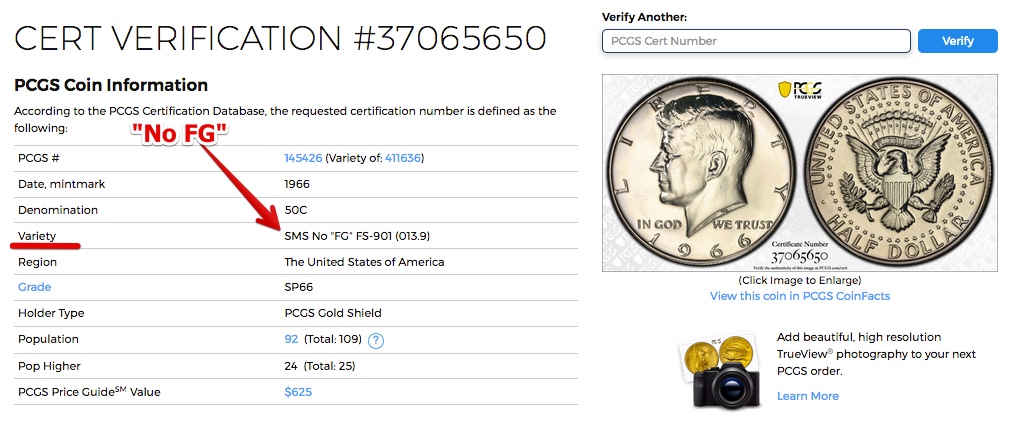
According to the PCGS website, the following "No FG" showing an obvious G sold for $625.00:
https://www.PCGS.com/cert/37065650
Grading-Company-Claims/Expertise-Questioned---The-
Here is a screenshot of the the webpage showing the selling price (compare the cert. numbers - same coin):
https://www.PCGS.com/cert/37065650
Grading-Company-Claims/Expertise-Questioned---The-

Also note the PCGS page lists this as a VARIETY even though, as Concord pointed out, its a polished die issue for this date.

Too man newbies have automatically thought that sending in shiny coin needs to be done so they can to hit the jackpot with a high grade slab and make money.
And...this is why there are so very many common slabbed coins that were not worth the grading fees to have slabbed.

You need to do the homework to see what roles these companies actually have in the hobby. Money CAN be made if you have experience and know what you are doing...but even then its a gamble.

Remember no coin broken out of a slab and resubmitted, even to the same company, is ever guaranteed the same grade. There is no science. People spend thousands on slab+label+coin - yet the coin could grade differently next time.

As the research paper says, the companies are not evil, and not out to get you. They are businesses looking to make a profit like any other business does.

Unfortunately their marketing departments are very good at selling the company "expertise" as being much more than an actual study of slabbed coins will show. The research paper hows many of the above examples, not just one or two.

As this forum says... Buy the COIN and not the Slab.
Here are two other very good links for beginners looking into slabbing:
http://goccf.com/t/346174#2967242
http://goccf.com/t/130186
How much squash could a Sasquatch squash if a Sasquatch would squash squash?
Download and read: Grading the graders
Costly TPG ineptitude and No FG Kennedy halves
https://ln5.sync.com/dl/7ca91bdd0/w...i3b-rbj9fir2
Edited by Earle42
12/24/2020 01:05 am
Bedrock of the Community
United States
10047 Posts
 Posted 12/24/2020  02:24 am  Show Profile   Bookmark this reply Add Earle42 to your friends list
@Tanman

Quote:
This argument for computerized grading disguised as a breakdown of misattributed Kennedy half varieties completely falls apart when your key point (and only point) can be refuted by the fact that the graders do not attribute the coins.

I do not understand how this paper was a disguise as at the beginning I mentioned computerized grading and also at the end. I do wish I had separated them though.

BTW - the paper does mention PCGS used a computer grading system in 1990 which they said was 90% acurate. It also mentioned Ron Barth (former PCGS president) said the "best" graders only get it "right" 85% of the time.

PCGS got rid of computer grading (as told int he paper) b/c people int the 90's were not trusting of computers. But they knew the system was more accurate back then - think of modern computers next to Win '95.


Quote:
Your explicit argument seems to be that PCGS's graders aren't qualified because they so often misattribute these No-FG halves (correct me if I'm wrong). But as pointed out earlier, the graders do not attribute the varieties. An attributer attributes varieties. One guy/gal. If a mistake is made there is no one to correct it. Understandably, PCGS does not guarantee attributions because of that. They should definitely be more transparent about this, but that's not your argument.


I freely admit I was unaware of this b/c I did not see it included in the paragraph PCGS has about how they grade coins.


Quote:
...PCGS does not guarantee attributions because of that...

I would ask to please know where PCGS specifically states they do not stand behind their attributions if you can provide it please. This way I can make corrections.

Also, now that I have been told by two CCF Family members that PCGS does not consider its variety attributions something they can stand behind, I see an even larger problem:
At https://www.PCGS.com/prices/detail/.../most-active
A normal PCGS slabed MS65 1972-D is priced at 16.00. But the attribution of No FG on the 1972-D MS65 is $3,000.00!

I know PCGS does not set these prices, but:
1. These grading companies are seen as "THE EXPERTS"
2. People pay them for the "best possible opinion" of their coin.
3. The companies know (according to the above statement) that these very expensive coins may or may not be what is claimed.
4. The company is willing to allow their name on possible wrong items people spend thousands on.
5. The company is allowing this kind of non-ethical practice to continue without mentioning it or upgrading their system to get a competent variety department.
6. The company does not make it abundantly clear that al they do is GRADE and a person paying for a variety attribution has to HOPE the attribution is right.
Al of this just, to me adds up to much worse non-respectable business practices (nice way of saying they don;t care about people being ripped off).


Quote:

Your explicit argument seems to be that PCGS's graders aren't qualified because they so often misattribute these No-FG halves (correct me if I'm wrong).

Not really.
I was pointing out major problems are happening that shed some doubt on their own claims cited as to how, specifically, they grade the coins sent to them.
I find it hard to see how three graders could let these errors slip through. I find it hard to see how coins assigned by type to graders having expertise in those areas could be mislabeled with three specialist (expertise) graders for that type of coin.

Now if variety attribution is not done by the graders, as you have said, and I don't know why that is not mentioned in the detailed grading process outline on their website(). Now we still have the major problem of people PAYING money to (what they consider) THE EXPERTS and not getting what they are paying for.


Quote:

And with that copy-pasted article you put at the end, I can see that your implicit argument is that graders cannot be relied upon to be 100% consistent and may give the same coin a different grade when resubmitted

Fact - Former president PCGS president ROn Guth, "Even the best grader only get it right 85% of the time." See ppaer for reference.


Quote:
so a computerized system, or 'scientific system' as you say, may potentially be a more desirable method to grade coins in the future due to the value given to the grades themselves.

Just like PCGS abandoned in the 1990s - see their own claims about the system back then (see paper for reference).


Quote:
Grading is and has always been subjective.

What goes up must come down - until Voyager 1.


Quote:
10 people can give the same coin a different grade and none of them will be wrong.

leads to the profit game of cracking and resubmitting.


Quote:
People have different preferences in luster, toning, circulation, etc. There is fundamentally no such thing as an 100% accurate grade.

Actual damage assessment can be calculated per unit of square area at the nanometer level if desired (used to do it with plastic parts in a plastic plant in the 90s). A level would need be agreed upon (such as they do now by saying to use a 5X loupe to grade) b/c absolutes are
fantasy. But the standards used in industry every day could be applied within a reasonable amount.

Luster, eye appeal, toning, all are already left up to the buyer. Nothing in this area changes if a technical analysis of the coins wear is performed. Look at all the ugly looking high MS coins in slabs already.


Quote:

TPGs are the closest thing we have to any kind of 'accurate' grading system, because it can provide a reputable standard. Yes, there will be times it will give a questionable grade but you paid for their opinion and you got it. Should this opinion be given as much value as it has? Maybe not, but that's just how it is.

There is a new computerized grading system being produced. You can look up Daniel Malone on youtube. He has, with a friend, developed an AI system which consistntly is grading coins at the same grade. Its still in the experimental stages.

How did they get a standard? They took many, many Morgans all graded by present companies at each grade level. So, lets use MS64. They had the computer scan and learn what MS64 "meant" over the hundreds of examples used. The AI was able to "average" and learn what MS64 meant from slabbed coins. The system now allows input of a picture of the coin, correct orientation is done by the person inputting or now (there is some auto formatting), and the program, so far, is yielding consistent grades for each coin. The system learns as it goes so it will only improve.

Personally, being a former science teacher, I would prefer the calculated damage per square unit of area to be used. This would take testing of MS70 coins for what "perfect" means to the human eye, and then percentages could be taken from there. The program (used to program also) could be given special parameters to focus on areas of high wear for each type coin as well (just like humans do).

Like I said, in the 90s, we did this to the nanometer with small plastic molded parts (electronics). We put one on the table, it was auto scanned, and auto evaluated (including printout of variances to inputs of what a "perfect" part would be. And comparing pocket computers now to back then...


Quote:
What are the potential drawbacks?

Grading algorithms would need be made available like modern grading standards are. Someone changing those algorithms would have a problem b/c if everyone simply had a phone app (IR camera - no need to worry about reflectivity/angle of ambient) everyone's phones would give the same grade to the same coin if the program was localized within the phone (also very possible).
And...attributions would be accurate as well so people would not lose thousands.


Quote:

How will the hobby transition to this?

The same way it does to any new concept. But this does not impact what the research paper is showing.


Quote:

And even though a system like this would be 100% consistent, wouldn't the grade still be subjective based on the preferences of the people who created it? Wouldn't grades still be debated?

See above. A scientific standard by percentages can be made just as it is with industrial parts. We have patterns to follow.

Quote:
How may it impact the hobby?

Verifiable certainty in buying/selling. Research papers like mine exposing an expensive (to consumers) and major problem would not likely exist. Eye appeal would be totally in the hands of the buyer (where it is anyway). The crack out and resubmit game would be eliminated (might be why they have not re-implemented computer grading). newbies would not be wasting money due to legitimate ignorance. No more face value coin in slabs. I could go on.

If my mechanic said he was only 85% sure, at best, my brake were fixed, I would change mechanics when a better one was available.


Quote:
Wouldn't grades still be debated?

If you are in base 10, then one plus one is always 2. Scanned parts in a R department will either pass the scan at a certain quality level or be rejected. Its been being done or decades in other areas of life. But making profits from older systems is not an issue in those areas.


Quote:
If a computerized, photographic, scientific, whatever-you-want-to-call-it system is what you believe would solve all of the issues with TPGs and if this was what you were trying to get at with this "educational/research paper", you should think or write about questions like the ones in the last paragraph. You shouldn't waste your time writing a 20-page non-argument with only one fundamentally flawed piece of evidence disguised as an unrelated analysis.

The concept which was not well put, evidently, was to show a major problem that exists. Faith in these systems we have has cost people a lot of money.
The 20 pages of non-argument are linkable, factual data that a lot of people have spent a lot of money b/c paid expert companies have a product which is provably unreliable (by showing their own data, facts, wording).
Waste of time? How about focusing on the wasted money people have spent putting major faith/money into a system which has produced falsehoods that bring undeserved high prices?
The information in the paper concerning this is fact. I just hope it might get into the hands of someone who will think twice and check the slab they are going to pay a couple thousand for before wasting their money on a professionally slabbed and mis-attributed error worth thousands of dollars less.


Quote:
That last sentence is a little harsh but let's be honest, that argument you worked so hard on can be entirely dismissed because you neglected to differentiate graders and attributers.

I openely and honestly thank you for correcting this. Although before I can make legit changes to the document, I must have linkable references so, like the paper now stands, people can check it for themselves.


Quote:

Don't hide your arguments and find more than one example to back them up.
Many examples. Not hard to find when you start looking, hence the paper's existence. And again I am sorry I failed in my presentation. The idea was to show the fallacies. It came to me while I was writing that this could have been solved by a legitimately scientific and verifiable grading system.


Don't get me wrong, this breakdown of how off PCGS is with these varieties is extremely useful. It is incredibly important to understand how PCGS deals with varieties.


Quote:

But surrounding that with all this unrelated nonsense about the graders not being qualified and computer grading being a concept that exists really bogs it down. It didn't need your opinions, it should have been purely factual.

I thought all the facts I gave were verified with links. This includes the 85% accuracy rate of the "best graders." I believe I only interjected my own opinion where I specifically stated I was putting in my own opinion. I may have slipped up here (I do not think so - but do not have perfect recall). I have authored a large volume of data/reference book where data was all important. I have a lot of experience writing with the mindset that I need to make sure my opinions are clearly stated as such. And I may be wrong, but going back through the paper with a fine toothed comb will likely show I kept to this mindset. If not, I would very much appreciate being show where so I can make the correction.


Quote:
P.S. A red pill/blue pill meme? Seriously? I can't put into words how ridiculous that is.

You are definitely entitled to your opinion.

My thought went immediately to this analogy when I saw how so many people have been living in a dream world of total faith without looking at the coins they plan to spend hundreds and thousands of dollars on. They have not taken the time to simply look at the coin and find the reality that what they thought was in front of their eyes is not what really is. Oh, THE EXPERTS say so-and-so, here is my cash!
The money spent, and not just one or two times, is much more ridiculous to me than the concept of the comparison.

Thanks for your feedback!

How much squash could a Sasquatch squash if a Sasquatch would squash squash?
Download and read: Grading the graders
Costly TPG ineptitude and No FG Kennedy halves
https://ln5.sync.com/dl/7ca91bdd0/w...i3b-rbj9fir2
Edited by Earle42
12/24/2020 02:30 am
Bedrock of the Community
United States
10047 Posts
 Posted 12/24/2020  03:03 am  Show Profile   Bookmark this reply Add Earle42 to your friends list
@Grape

Quote:
I'm gonna be blunt, I don't have anything against you, but I kinda have to be.

No problem - wish I was better at this :)


Quote:

Not to burst your bubble, but this paper, while well written, was written on the notion that graders attribute the coin which is false. The graders job is to grade coins, they have a separate groups of people who attribute. More importantly, only one person attributes with nobody to double check, and PCGS doesn't guarantee their attributions.

Thanks you for this information. I would appreciate links to this so I can correct what I wrote. Like everything else in the paper I want a verifiable link readers can see.


Quote:

The fact that PCGS, while is the foremost company for grading, is the worst when it comes to attributions.

Its a shame that people put so much faith in them when people therefore, be taken for so much money (the hundreds and thousands shown in the research paper using PCGS's own links) on mislabeled product. This is shameful. Especially since there are a lot of people who just blindly follow the masses.

Please also see the response in my reply to Tanman concerning this point.
apper)


Quote:

Also, you seem very pro computer grading, which, whatever we can have our own opinions on, but your paragraphs about the grading challenge are completely removed from the original theory of the paper. This entire thing seems to jump from separate point to point with nothing in between. This starts as a paper on misattributions and ends on computer grading, not computer attributions, computer grading.

Sorry - it was meant to be a presentation to warn there are some major problems in grading company claims since this much money has been spent on so many examples of mis-attributed coins which originate with THE EXPERTS of the coin hobby that o many people put blind faith in. I am hoping the facts linked to will make it so at least one person doesn't waste thousands for something labeled by THE EXPERTS that in reality is nothing more than a 15.00 coin at best.
Computer/scientific grading would alleviate a lot of this - which is a good thing. A legit verifiable system in hand would also get rid of newbies wasting money sending in face value coins.


Quote:

Regarding your blurb about who gets the grade right or wrong, what if the coin was overgraded to begin with? What if it was sent back so that it would downgrade? This does happen. Then grader 3 isn't right. If we assume that ever grader has equal knowledge than isn't he the outlier and why should he be considered correct?

[size=1]I believe I addressed this. And although its a "what if..."
While I am sure some people do send in an overgraded coin, how many people do this instead of enjoying the higher grade and potential profits it brings? After all THE EXPERTS (BTW - not a slam - just the way I have seen people have faith in these companies as being unquestionable). The average Joe I likely not willing to question THE EXPERTS opinion.


Quote:
You also seem to talk circles around yourself in it. You start of by saying they're a good thing

I quote the paper as to my opinions about these companies:
" 1. TPGs are not evil. They are a collective group of people running a business. Their main
goal, as with all businesses, is to make a profit.
2. Numismatics is about a person finding fun in collecting coins and doing it their own way, so
liking or not liking slabs is neither "right or wrong."
3. This paper is an educational presentation exposing facts meant to aid discerning the
actual levels of expertise in TPGs compared to their own claims, (October of 2020)and
to help collectors make more educated decisions. "


Quote:
and end by saying that someone comparing their opinion to that of the TPG is pointless anyway. Overall I was very confused about the material in this.

Not sure of your exact reference here, but I did refer to the video of the PCGS grading challenge.
I pointed out the fact that one man was tested on how well he could guess what the labels on 10 slabs said.
The man was given a grade as to how well he guessed the "right" grades for the coins.

Let's say he got 50% "right."

Now we crack out those 10 coins resubmit, and all get different grades that, coincidentally now line up 100% with the man's original guesses.

The man's guesses are now 100% "right..." although he was only 50% "right" before. Yet the coins themselves never changed.

So is the old or new score the "right" one? Is the man a failed or great grader?

Same man
10 coins
1st time 50% - man failed test

Same 10 coins regraded
Same man's guesses now line up 100% with new labels.
2nd time 100% - man is now expert grader at perfect score.

So...which is it?

Neither one. Its not even a fair or legitimate test when the correct answers can move around!

All the while in the video the guys keep using the term "right grade."

Um....yeah...which "right grade?" The one before or the different one after?
How much squash could a Sasquatch squash if a Sasquatch would squash squash?
Download and read: Grading the graders
Costly TPG ineptitude and No FG Kennedy halves
https://ln5.sync.com/dl/7ca91bdd0/w...i3b-rbj9fir2
Bedrock of the Community
United States
17884 Posts
 Posted 12/24/2020  8:34 pm  Show Profile   Bookmark this reply Add Conder101 to your friends list

Quote:
There is an actual 1982-P REV die with no engraved FG

The only way for there not to be a FG in the die originally would be for it not to be on the working hub, in which case every die made by that hub would be missing the FG as well, Two ways for it not to be an the working hub, either it wasn't on the master hub (In which case EVERY die would be missing the FG) or for both letters to have chipped off the working hub at the same time. (If they chipped off at different times there would be dies partial FG's in progressing stages of chipping.)
Pillar of the Community
Learn More...
United States
8939 Posts
 Posted 12/24/2020  9:43 pm  Show Profile   Bookmark this reply Add GrapeCollects to your friends list

Quote:
The terms "grading and verification" at the end of their paragraph seems indicative there is not only grading by at least three people, but a verification is also done by at least three people.


Bzzt Bzzt. By verification they mean the QC stage where they send the coins to a verifier to make sure the grade, not attributions, is accurate.


Quote:
Whether a submitter has to indicate they want the variety on the label before submitting, or whether the grading companies have someone other than graders make the attribution would seem a bit irrelevant concerning the amount of money spent on these incorrect slabs (thousands in some cases) by people trusting the grading companies to give the expert service the companies claim to provide.

The facts show, using the grading company pictures themselves, that the grading company has broken its own cited rule of what they allegedly check before they put the "No FG" variety attribution on the label.


PCGS does not automatically attribute any varieties except the 1955 DDO, 1969-S DDO, and varieties like LG Date vs SM Date. As far as I know anything else has to be attributed by request.


Quote:
Also note the PCGS page lists this as a VARIETY even though, as Concord pointed out, its a polished die issue for this date.


Then what would you have them call it?


Quote:
To many newbies have automatically thought that sending in shiny coin needs to be done so they can to hit the jackpot with a high grade slab and make money.
And...this is why there are so very many common slabbed coins that were not worth the grading fees to have slabbed.


Yeah, that is a problem, one that pretty much everyone advocates to educate on.


Quote:
You need to do the homework to see what roles these companies actually have in the hobby. Money CAN be made if you have experience and know what you are doing...but even then its a gamble.


Never been a gamble for me, know how to grade, and grade well and you'll never be gambling.


Quote:
Remember no coin broken out of a slab and resubmitted, even to the same company, is ever guaranteed the same grade. There is no science. People spend thousands on slab+label+coin - yet the coin could grade differently next time.


That is how grading has been since the beginning of time. Grades are always subjective, you are literally paying for an opinion. Why bring what would be inherently flawed science into it.


Quote:
4. The company is willing to allow their name on possible wrong items people spend thousands on.
5. The company is allowing this kind of non-ethical practice to continue without mentioning it or upgrading their system to get a competent variety department.
6. The company does not make it abundantly clear that al they do is GRADE and a person paying for a variety attribution has to HOPE the attribution is right.
Al of this just, to me adds up to much worse non-respectable business practices (nice way of saying they don;t care about people being ripped off).


That's why they have a policy that says if we F up then we'll pay for the coin.


Quote:
I was pointing out major problems are happening that shed some doubt on their own claims cited as to how, specifically, they grade the coins sent to them.
I find it hard to see how three graders could let these errors slip through. I find it hard to see how coins assigned by type to graders having expertise in those areas could be mislabeled with three specialist (expertise) graders for that type of coin.


Quote:
Now if variety attribution is not done by the graders, as you have said, and I don't know why that is not mentioned in the detailed grading process outline on their website. Now we still have the major problem of people PAYING money to (what they consider) THE EXPERTS and not getting what they are paying for.


True, they should put that on their sight. Though as rude as this sounds, maybe buyers shouldn't be idiots and actually look into what they're buying than trust someone else on it. The buy the coin not the holder mentality shouldn't stop at numeric grading. Why? Because when you deal with 13,000 coins per day (yes that's how many they grade per day) they are gonna be slip ups. That's life.


Quote:
Fact - Former president PCGS president Ron Guth, "Even the best grader only get it right 85% of the time." See paper for reference.


So we end a hundred jobs per branch for 5% gains in terms of accuracy with a system that is infinitely more venerable?


Quote:
Luster, eye appeal, toning, all are already left up to the buyer. Nothing in this area changes if a technical analysis of the coins wear is performed. Look at all the ugly looking high MS coins in slabs already.


Also incorrect to a degree. What is universally agreed upon as unattractive toning (black, dark browns and such) will hurt a grade, and it should as it detracts from the coin.


Quote:
Wouldn't grades still be debated?


This is the biggest issue with a computerized system. Intrusions. What stops me (asides legality and personal ability) from breaching PCGS systems, and waiting for my coin to come up, then altering the grade?


Quote:
Um....yeah...which "right grade?" The one before or the different one after?


Every grade is accurate, some just more accurate than others. While this sounds really, really stupid it is correct.


Quote:
Computer/scientific grading would alleviate a lot of this - which is a good thing


For attributions sure. However I'll be honest. I hate computerization. Not with coins specifically. In general. Stop replacing people everywhere for a small amount of gained efficiency or as a cost saving measure. Bring people back to the workforce.


Quote:
Like everything else in the paper I want a verifiable link readers can see.


Not listed anywhere. Call PCGS.
Bedrock of the Community
United States
10047 Posts
 Posted 02/05/2021  9:36 pm  Show Profile   Bookmark this reply Add Earle42 to your friends list
Sorry - had email allegedly telling when posts were being made - didn't happen for some reason.


Quote:

Quote:
Also note the PCGS page lists this as a VARIETY even though, as Concord pointed out, its a polished die issue for this date.


Then what would you have them call it?

Obviously if there is a trace of the letters, its not a No FG. I may be wrong, but I think, like I did years ago when finding out about the No FG "varieties" that labeling a polished die as an actual variety is not the best way to handle it.

CCF glossary:

Quote:
variety
A coin of the same date and basic design as another but with slight differences. PCGS recognizes all major varieties while there are thousands of minor varieties, most of which have significance only to specialists of the particular series. After hubbed dies, introduced in the 1840s, varieties are mainly variations in date and mintmark size and placement.

emphasis added.
The polishing of details off of a die is an action by a mint worker being a bit zealous in his job. If the mint worker had not polished the die, then the coins coming from it would not have a difference to them (well...clash marks). Clash marks, which are an actual mechanical error ("error" in the sense of the machine strikes without a planchet in between) are no classified as varieties. There are specific clashes known for specific coin dates in the Kennedy series as well. I found a lot of 1971-D, 1983-P, and 1972-D with the same die clashes (per year) on each. Yet these are not "varieties."
Any detail might be polished off of a coin by the workers. The missing FG just is a convenient and "catchy" happening. In 2005 the Bison nickel's "Detached Leg Error" was all over the marketplace as a money making coin, yet now is worth very little since its just a die polishing issue.


Quote:


Quote:
Quote:
There is an actual 1982-P REV die with no engraved FG


The only way for there not to be a FG in the die originally would be for it not to be on the working hub, in which case every die made by that hub would be missing the FG as well, Two ways for it not to be an the working hub, either it wasn't on the master hub (In which case EVERY die would be missing the FG) or for both letters to have chipped off the working hub at the same time. (If they chipped off at different times there would be dies partial FG's in progressing stages of chipping.)


And the 1982 No FG is also easily told from the OBV because the 1 in the date has no base on it like the others do. This die pair made all the No FG 1982s. Which, BTW, seems to be something that Kennedy specialists all know to be fact, but no grading company seems to ever mention the missing base on the OBV!
A parallel to this is the two REVs of the 1938-1940 nickels. The grading companies never mention what a CCF member listed here some years ago: The companies say to ID the two reverses you have to look at the differences in the steps of Monticello. Only sometimes the steps are too worn away to tell. The companies seem unaware that the easiest was to tell these REV types is to look at the last S in UNITED STATES on a REV. Type I is sans serif at the top of the S while Type II has a prominent serif. And these websites are considered THE experts for numismatics.


Quote:

Quote:

Quote:
The terms "grading and verification" at the end of their paragraph seems indicative there is not only grading by at least three people, but a verification is also done by at least three people.


Bzzt Bzzt. By verification they mean the QC stage where they send the coins to a verifier to make sure the grade, not attributions, is accurate.

1. Yet the next time the coin is submitted, it might receive another grade...oh well - off topic...I digress
2. And THE perceived expert services whom we are to trust with grading do not bother to hire a verifier that can be trusted as well? Thousands of dollars can hinge on this! I do not recall seeing a variety verification guarantee...think of it...thousands...
3. I will accept what you say and acknowledge I was unaware that variety attribution is not part of the grader's job. The video the companies put out showing the grading process (or describing it) make no mention that I remember of this fact (I may be mistaken!). The videos concentrate on people "knowing" the incredible expertise of the graders with coins and acknowledging three graders per coin.

I am guessing most people like myself always thought the words on the label say specifically the company puts its entire expertise behind the ink on the label, and not that certain parts of the label are more expertly reviewed than others. It seems an automatic assumption that the three graders' opinions of what the slab says, not just parts of it, are THE facts.
Again I will state this makes the situation a bit more "shady" (not necessarily intentional!) to me since thousands of dollars can hinge on the ink on the label, and someone who has looked into these systems as deeply as I have just assume the label is a result of the entire 3-specialist-grader-minimum process.


And I admit I do find it weird that any Red Book toting novice collector with an interest in making a Kennedy collection knows of the three main NO FG varieties. They have been in the Red Book for a long time.

So the graders who are company-described as being assigned to the type coins they will grade by their specialty areas (strengths) have nothing to do with a major ($thousands sometimes!) parts of what people perceive is their expert opinions on the label. Sorry, but again my opinion is this is a pretty sloppy job not worthy of the three graders' expertise.


Quote:

Quote:

Quote:
You need to do the homework to see what roles these companies actually have in the hobby. Money CAN be made if you have experience and know what you are doing...but even then its a gamble.


Never been a gamble for me, know how to grade, and grade well and you'll never be gambling.

?

Watch below. Former PCGS President Ron Guth tells Mr. Morgan of COINweek that when he (Ron) took the challenge, HE did not get them "right," and that "the best graders only get it 'right' 80% (85%? check me on that please) of the time. I took the former president's word as well as those of other dealers I respect, youtube channels of experienced dealers [look up Daniel Malone and others like him], and the word of the two former graders I know who say its a gamble b/c its a subjective system. By definition subjectivity means there is a gamble with no actual guarantees of grade (only procedure according to the PCGS website).
cuS...b1uA

You are the only knowledgeable collector I know who has ever said its not a gamble for them.


Quote:


Quote:
Quote:
Remember no coin broken out of a slab and resubmitted, even to the same company, is ever guaranteed the same grade. There is no science. People spend thousands on slab+label+coin - yet the coin could grade differently next time.


That is how grading has been since the beginning of time. Grades are always subjective, you are literally paying for an opinion. Why bring what would be inherently flawed science into it.

And what goes up must come down...tell that to Viking I and 2

Progress would be making a system where every coin is always given the same scientifically based/verifiable verifiable grade. I am sure glad car manufacturers do not use subjectivity to this degree in their engine parts where thousandths of an inch can mean problems.

I worked in a plastics plant in the early 90s over a summer. We had a QC machine back then that digitally scanned plastic-injection-made electronics parts we made down to the nanometer simply by placing the part on the stage. A monitor allowed realtime viewing. The stage auto-moved as it made measurements and gave a feedback for the details it was measuring/checking/scanning. It had to do things like look inside .3 mm square holes, measure the corners, detect flashing or other anomalies/defects. Setting up the program was as easy as putting it onto the stage, using a joystick to move the stage, and using the software to put markers onto the piece on the screen. TheFrom then on that pice was used as a basis to assess all others of that type part. Programs for scanning each part were stored in memory...the early 1990s!

PCGS had a computer/laser scanning system they claimed was 90% accurate in the 1990s. This was a step up from the 80% (85%?) of the subjective system they reverted to. Let's face it, the re-slabbing game has a better chance of bringing in profits the more subjective the system is.

iPhone facial recognition tech nowadays scans 30,000 infrared points of data in a nanosecond (no lighting issues with infra red)to asses a human face (through mustache, glasses, no matter the expression, open mouth talking, closed etc.). Our current computer tech makes a 1990 computer like the system I was on look like someone counting on their fingers. PCGS had a 90% system in 1990. Our current tech could make a verifiable and scientifically based system much more accurate than 1990 tech. We do it all the time for precision parts in industry.

Eye appeal with a machine? Probably not. But the buyer decides that for themselves NOW anyway! Moot point.

Besides all of that, an AI system IS being developed, is accurate, and is accessible online as of last September or so for Morgan dollars. Look up Daniel Malone on youtube. He is part of another youtube channel/website developing the AI system. They scanned hundreds of slabs at specific grade levels so the computer has a large databank and can "average" what, for example, MS62 "means to a human." You can enter pictures of your own Morgan on the website and it will grade it for you. Its in testing stage and gets more accurate as it is used. The same coin can/does get the same grade through the use of tons of human-generated opinions of each specific grade level.


Quote:
That's why they have a policy that says if we mess up then we'll pay for the coin.

Well...sort of...
Their guarantee that people tend to rely upon guarantees the coin is graded according to the system they say it will be graded - it s all in my paper I wrote - in their words lifted form the website.
Reading the fine print makes the "guarantee" a lot less pleasing, helpful and more expensive to the owner than people generally are led to believe. Some people on this forum have posted the ridiculous position they have been left in.


Quote:
True, they should put that on their sight. Though as rude as this sounds, maybe buyers shouldn't be idiots and actually look into what they're buying than trust someone else on it. The buy the coin not the holder mentality shouldn't stop at numeric grading. Why? Because when you deal with 13,000 coins per day (yes that's how many they grade per day) they are gonna be slip ups. That's life.

Agreed.
But as any business nowadays knows, almost NO ONE "reads the instructions." And the more vague (such as the guarantee) the claims the marketing department come up with, the more a company (any cpmpany) can use details to get off the hook of responsibility. Again, I do NOT think these people are evil...just they are not what their marketers want people to believe. I desire to see what is available IMPROVED to a set standard and an expertise level worthy of what they claim.

Admittedly, I totally believe technology has moved us past the time that we can have a pocket, reliable grading app. The tech IS there. And whether its based on percentage algorithms, or AI "knowing" and applying already graded coin slab standards from thousands and thousands in its database, the same grade can be had every single time.

But...the re-slabbing game and countless newbies sending in face value coins (or damaged coins they think are the holy grail of errors) and paying fees would be stopped. That is profit loss and not good for any business model. The companies KNOW how far our tech has come. They also know that unlike the 90s, people now trust computers (their reason for getting rid of the systems was no one back then trusted computers) so the accuracy level could be vastly improved...with less resubmissions etc..


Quote:

Quote:
Luster, eye appeal, toning, all are already left up to the buyer. Nothing in this area changes if a technical analysis of the coins wear is performed. Look at all the ugly looking high MS coins in slabs already.


Quote:
Also incorrect to a degree. What is universally agreed upon as unattractive toning (black, dark browns and such) will hurt a grade, and it should as it detracts from the coin.

What I mean is that a buyer won't shell out the bucks if they do not like the looks. hence who cares what a grader or computer says?

As to the job issue...its an age old problem. But there comes a point when paying people to do a job that takes advantage of others' by not providing the possible quality available has to be looked at from a moral perspective as well.

The general don't-read-the-instructions newbies out there have been sold a non-verifiable reputation on these companies just b/c slabs sell like crazy in ebay etc. Part of this is b/c people have an innate need/desire to have an "expert" to rely on. Part of it is the busy life we lead means people get tired of having to verify everything for themselves. No excuses here, but marketers take advantage of this.

Things like n the paper I wrote should NOT be happeneing given the line of expertise we are led to believe exists. Things like this link should not be happening to the degree they do. Its not hard to find things like this:
http://goccf.com/t/346174#2967242


And the statements by former biggfredd also show the not so squeaky clean intentions at the start of the companies:
http://goccf.com/t/130186
When I got back into the hobby seriously in 2011 I did an honest research to see how the actual reputation of these companies had evolved. What I found was more of the same old same old when they started up. But now they are larger, more well known (thanks ebay and internet), but they do have redeeming points of providing excellent education tools and fake recognition which was not there, obviously, at the start.
How much squash could a Sasquatch squash if a Sasquatch would squash squash?
Download and read: Grading the graders
Costly TPG ineptitude and No FG Kennedy halves
https://ln5.sync.com/dl/7ca91bdd0/w...i3b-rbj9fir2
Pillar of the Community
United States
6396 Posts
 Posted 02/11/2021  10:01 pm  Show Profile   Bookmark this reply Add Jaobler to your friends list
Wow, that's a lot of words.

I gather that most or all of these coins were produced because over-polishing of the die partially or completely erased the FG. That makes it an "error" comparable to the 3-legged Buffalo nickel. Is the best term for these coins then a "die state" variety?

Just my opinion, but these coins seem pretty ordinary. I expect simple supply and demand will determine the value but I gotta wonder how many collectors are really interested.

I have a stack of AU/BU 1966 halves. These are worth about $3 each based on current silver value. If I find a no-FG example in this stack what kind of premium would it have? This is information that would be useful to me.
Page 2 of 2   Previous TopicReplies: 17 / Views: 3,972Next Topic Page 2 of 2
First Page  Showing last 15 replies.
To participate in the forum you must log in or register.


Disclaimer: While a tremendous amount of effort goes into ensuring the accuracy of the information contained in this site, Coin Community assumes no liability for errors. Copyright 2005 - 2026 Coin Community Family- all rights reserved worldwide. Use of any images or content on this website without prior written permission of Coin Community or the original lender is strictly prohibited.
Contact Us  |  Advertise Here  |  Privacy Policy / Terms of Use

Coin Community Forum © 2005 - 2026 Coin Community Forums
It took 0.85 seconds to rattle this change. Forums