| Author |
 Replies: 35 / Views: 4,121 Replies: 35 / Views: 4,121 |
Page 3 of 3
|
|
|
|
Bedrock of the Community
 United States
18929 Posts |
really? you dug this? that ones hard to believe but if you did thats an amazing find. there are so many variations of this I have no idea which one this is. maybe someone here can narrow it down.
i dont know anything about these but i'd say mid-High VF 30 or 35 details (cleaned) and would be worth authenticating and grading
|
|
New Member
 United Kingdom
7 Posts |
i washed the mud of it with water after digging it up thats all the cleaning its had
|
|
Pillar of the Community
United States
1870 Posts |
Whoa, what a find. Congrats! VF to XF sounds right to me.
|
|
Bedrock of the Community
United States
94367 Posts |
I think the cleaning question arises because of apparent hairlines in the obverse center field.
|
|
Pillar of the Community
United States
2596 Posts |
|
|
Pillar of the Community
United States
9810 Posts |
Wow if the story is true amazing.  Too bad on the harsh cleaning, as this coin would have benefited greatly from an electrolysis bath and long conservation soak in a non abrasive cleaning solution. I figure the cleaning cost around 30-40% of the value alone on it. Not saying the finder did the harsh cleaning as just running water on it wouldn't do that to the surfaces it shows signs of being scrubbed previously, maybe an old cleaning, but it is what it is now, no going back. I'm basing off the still non scuffed areas protected in the the denomination "XII" 12 shillings area compared to the rest of the field up to the legend. Still it's in great shape for a coin of the 1600's and being in the ground, little to no corrosion is wonderful. Found in the UK? even a better story. I can't say for sure 100% - but it does appear to match up to the Salmon 1-A as kbbpll mentioned (Noe 1, 1.1, 1.5 & Crosby 9-H). An R-3 example with some clipping issues beyond the cleaning. Id also put it in the VF+ grade maybe reaching EF with details possibly for the surface hairlines, it can be hit or miss on the details grade on these coins that are surviving after 300+ years. By all means get it certified if possible. "Buy the Book Before You Buy the Coin" - Aaron R. Feldman - "And read it" - Me 2013! ANA Life Member #3288 in good standing since 1981, ANS, Early American Coppers Member (EAC), Colonial Coin Collectors Club member (C4), Conder Token Collector Club member (CTCC), Civil War Token Society (CWTS) member, Liberty Seated Collectors Club (LSCC) & Numismatic Bibliomania Society member (NBS), USMex, Member in good standing, 2¢ variety collector. See my want page: http://goccf.com/t/140440 |
|
Moderator
 United States
15941 Posts |
Is this the same coin we are discussing in the US Colonials/Classic subform? Or did you somehow find two?
It's best to keep the discussion in one thread.
|
|
Moderator
United States
196100 Posts |
Quote:
It's best to keep the discussion in one thread. Agreed. Topics merged.  |
|
Rest in Peace
United States
632 Posts |
Westcoin: believe it or not, but circ Massachusetts silver is one of the easiest series to restore and retone if need be
|
|
Rest in Peace
United States
632 Posts |
fwiw: I had an old coin book printed in London in 1653, that mentions a "curious silver disk, with an NE monogram on one side, and XII on the other..." and the author supposed it was a Norwich(e) issue, but didn't know for sure... Boston and Beverly MA., etc. were busy ports-of-call then, so it's no surprise that some of the "curious money" would make its way over to Europe
|
|
Pillar of the Community
United States
1677 Posts |
The hairlines are common on dug silver, sometimes just a wipe with a thumb to see what it is will do it, even freeze thaw cycles and movement in the soil can leave a cleaned look.
|
|
Pillar of the Community
United States
4233 Posts |
Quote:
I had an old coin book printed in London in 1653, that mentions a "curious silver disk, with an NE monogram on one side, and XII on the other..." and the author supposed it was a Norwich(e) issue, but didn't know for sure @Oldgrouchyguy, do you have the book/author to reference? 1653 seems far too early to me. http://numismatics.org/digitallibra...95/nnan42410 is an interesting read geared towards the "Good Samaritan" shilling but lots of info about the other early coins. It says Quote:
The earliest numismatic publications mentioning Massachusetts coinage are Ralph Thorsby's Ducatus Leodiensis, published in London in 1715, followed by Stephen Martin-Leake's An Historical Account of English Money published in 1726. Although the former suggested that the NE on the New England coinage might be an abbreviation for Newark under seige, the latter states that the Earl of Pembroke has classified them in his collection as New England coins. Pine Tree pieces are included in each book, but the Good Samaritan shilling is not mentioned by either writer.
...
The next publication to include the Good Samaritan shilling was prepared by Martin Folkes. Folkes, whose reputation as an antiquary was acknowledged by his presidency of the Royal Society from 1741 to 1752, published in 1745 under the auspices of the Society of Antiquaries, A Table of English Silver Coins. I was familiar with the Folkes book from our infamous 1652 threepence thread, as generating the first interest in collecting these early Colonials in the UK. The Folkes book says: 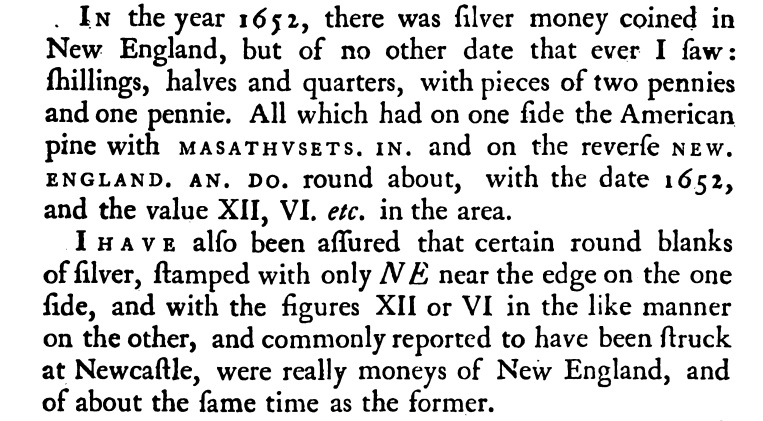 which mentions them thought to have been struck at Newcastle, not Norwiche. It sounds very similar to what you quoted, but not the same, and not from 1653. (Note that Folkes references non-existent twopence and penny coins; more on that in the linked article) |
|
Pillar of the Community
Russian Federation
5186 Posts |
Quote:
Ralph Thorsby's Ducatus Leodiensis, published in London in 1715 I looked it up on Internet Archive, and on page 592, in the Appendix, it says the following... 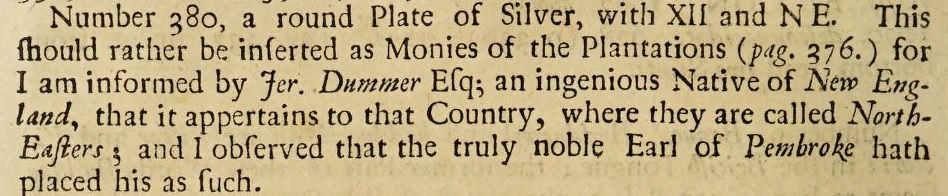 So it looks like the attribution to New England was already attested even that far back. [Page 376 features several coins of later issues, on which "New England" is given in full.] On the face of it I can see how it got attributed to Newark - those crude issues sure do look like siege money! I don't recall offhand whether there were any siege issues from Norwich or Newcastle. [EDIT: the intriguing name "Jer. Dummer Esq" matches Jeremiah Dummer, a major figure in early 18th century Connecticut, though if so then calling him a "Native" (sic) must have had very different connotation from today!] Edited by january1may
12/20/2022 07:46 am
|
|
Pillar of the Community
United States
4233 Posts |
@january1may, thank you for digging that up. I have seen the Norwich reference somewhere, but getting "Norwich" out of "NE" always seemed like a stretch. I wonder where that came from.
|
|
Pillar of the Community
Russian Federation
5186 Posts |
Quote:
@january1may, thank you for digging that up. I should have included the original context of entry number 380... 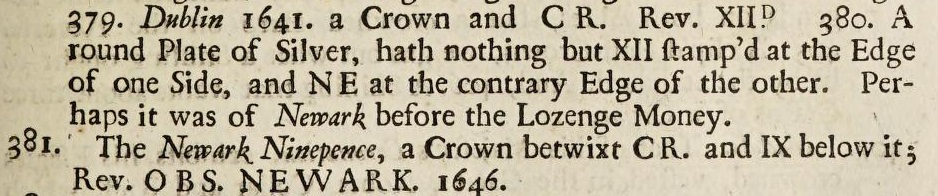 In other words, it was listed in the English Civil War section, next to several other siege issues. As I mentioned, if you don't happen to know, it's easy to make a guess that those very simple and crude pieces must be siege money of some kind, and Newark immediately comes to mind as a plausible candidate... I'm not sure why Norwich either. AFAICT there are no siege issues from Norwich (though there's a lot of local tokens), and where would the E come from? Newcastle makes a little more sense, though I'm not aware of any actual reports attributing it to there. Perhaps someone misremembered Newark. |
|
Page 3 of 3
|
Replies: 35 / Views: 4,121 |
Page 3 of 3
|







 First Page
 Previous Page


 Posted 12/14/2022 1:06 pm





